All-in-one SEO tools combine multiple features like keyword research, site audits, and backlink analysis into one platform, making them convenient for teams managing diverse SEO tasks. In contrast, specialized tools focus deeply on one area, such as technical audits or rank tracking, offering more precise insights. The choice between these depends on your goals, budget, and team size.
Key Takeaways:
- All-in-One Tools: Broad functionality, centralized data, better for large teams managing multiple tasks.
- Specialized Tools: Deep focus on specific tasks, often better for niche needs or advanced strategies.
- Cost: All-in-one tools start around $119/month, while specialized tools range from $11–$299/month, depending on features.
- Workflow: All-in-one platforms streamline collaboration; specialized tools excel in precision for specific challenges.
Quick Comparison:
| Feature | All-in-One Tools | Specialized Tools |
|---|---|---|
| Functionality | Covers multiple SEO needs | Focuses on specific tasks |
| Ease of Use | Centralized dashboard | Varies by tool complexity |
| Cost | $119–$1,499/month | $11–$299/month |
| Scalability | Suitable for large teams | May require multiple tools |
| Precision | General insights | Detailed, task-specific data |
| Update Frequency | May refresh less often | Often provides real-time updates |
Pro Tip: Consider a hybrid approach - use an all-in-one tool for general SEO tasks and add specialized tools for advanced needs like technical audits or rank tracking.
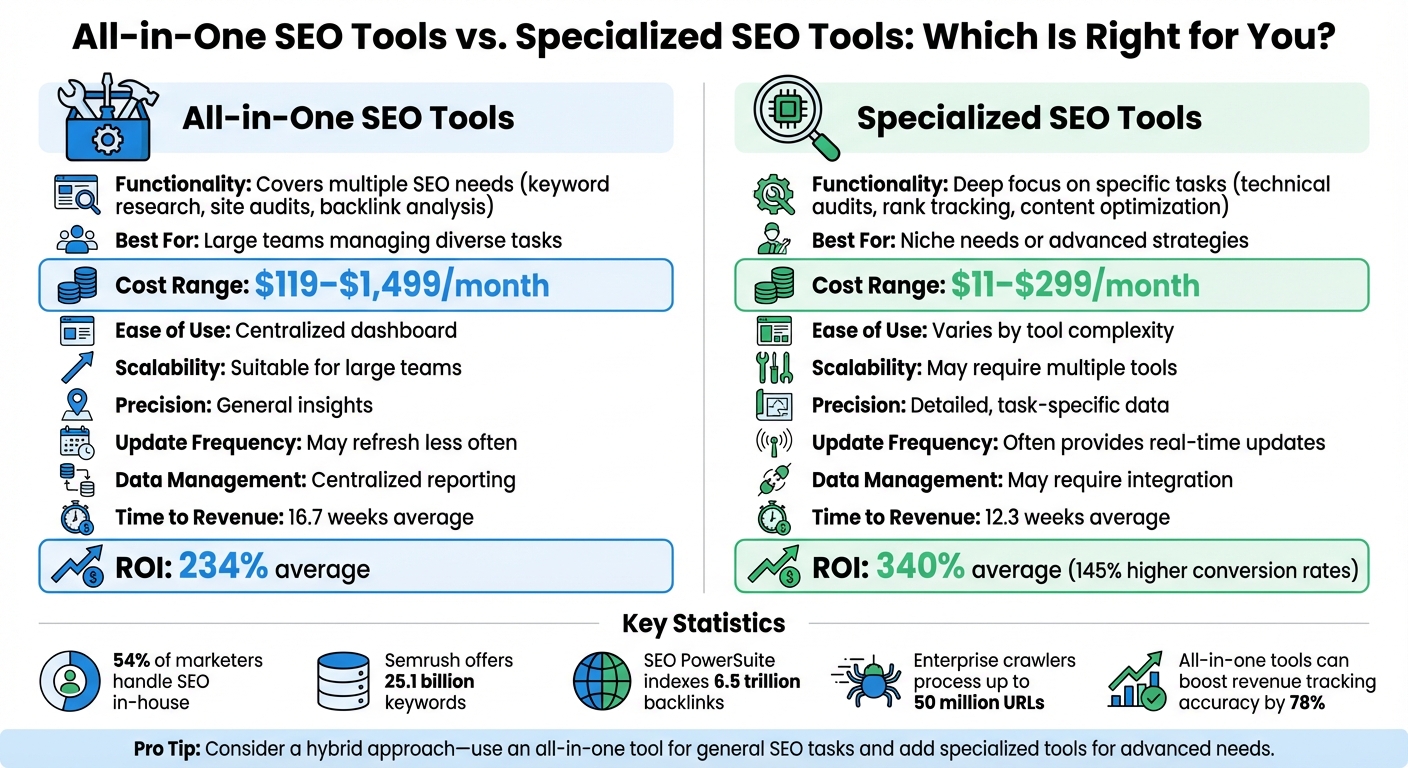
All-in-One vs Specialized SEO Tools: Feature and Cost Comparison
13 Best SEO Tools (My 2026 Stack)
What All-in-One SEO Tools Offer
All-in-one SEO tools bring together essential features like keyword research, rank tracking, competitor analysis, technical audits, content scoring, backlink profiling, and reporting - all within a single dashboard. This setup saves B2B marketers from the hassle of switching between multiple apps, streamlining processes and improving team collaboration.
This unified approach is especially helpful for B2B companies managing large, complex websites. Shelly Fagin, Director of SEO at DigitalOcean, shared that using Semrush Enterprise cut her analysis time from 20–30 hours per month to almost instant results. Major companies like Salesforce, SAP, and Samsung also rely on these tools to manage SEO across millions of pages. Features like automated internal link recommendations and AI-driven workflows make handling such massive operations more manageable.
These platforms are built to handle enormous datasets. For instance, Semrush offers access to a staggering 25.1 billion keywords, while SEO PowerSuite’s index includes 6.5 trillion backlinks. Enterprise-level crawlers can process up to 50 million URLs in one crawl and collect over 1,000 unique data points per URL. For B2B businesses, this means they can oversee multi-language websites from one central platform.
Centralized Data and Reporting
One of the biggest advantages of all-in-one SEO tools is their ability to centralize data. Instead of exporting information from multiple sources and compiling spreadsheets manually, these tools consolidate everything - keyword rankings, backlink profiles, technical audits, and content performance - into a single dashboard. This makes it easier for marketers to identify problems, like a ranking drop caused by a technical issue, and share clear, visual SEO metrics with non-technical stakeholders. As one SEO Specialist put it:
I love that Semrush offers a pretty complete package for an SEO campaign. It offers in-depth insight into anything from backlink metrics to keyword performance.
For businesses with long sales cycles and several decision-makers, centralized reporting is a game-changer. Integration with platforms like Google Analytics or Adobe Analytics allows teams to assign monetary value to organic traffic and demonstrate ROI to senior leadership. This creates a comprehensive view that merges first-party and third-party data, making it easier to showcase performance.
Team Management Features
Beyond organizing data, these tools also improve team collaboration. They support multi-user access, organize multiple projects, and provide white-label reporting options. Teams can easily delegate tasks, such as assigning technical fixes (e.g., 301 redirects) or content updates (e.g., meta descriptions), ensuring nothing slips through the cracks. Workflow automation features, like scheduled tasks and alerts for issues like domain expirations or ranking drops, further enhance productivity. Georgia James from Siteimprove highlights how these tools are essential for keeping stakeholders aligned and automating processes. Jon Henshaw, Founder of Coywolf, adds:
It's beneficial for sites that multiple developers manage because they have a habit of overwriting code and pushing changes that break search visibility.
What Specialized SEO Tools Offer
While all-in-one platforms provide a broad overview, specialized SEO tools focus on specific areas like technical audits, content optimization, rank tracking, or backlink analysis. These tools are perfect for teams that need detailed insights and precise control over a particular aspect of SEO rather than a general approach.
This level of detail is especially useful for B2B companies managing large, complex websites. A great example is Botify's SiteCrawler, which processes massive amounts of URLs and unique data points. Jenn Mathews, an SEO Strategist, shared how this tool made a difference:
We identified a 404 issue that an outside agency had created with an entire subdomain redesign before it went live using Botify.
Another key advantage of specialized tools is real-time monitoring. Platforms like AccuRanker, designed for rank tracking, offer on-demand ranking updates. This is especially helpful during critical periods like site migrations or product launches when immediate visibility changes need to be assessed. In contrast, all-in-one tools often refresh data less frequently, making them less effective in such scenarios.
Let’s dive deeper into how these specialized capabilities translate into actionable insights for specific SEO tasks.
Deep Functionality in Specific Areas
Specialized tools excel when advanced features are required. Take Screaming Frog, for example - a desktop-based technical crawler that allows custom data extraction using XPath. This enables SEOs to pinpoint specific code elements, such as post meta tags or publish dates. Sergei Bezdorozhev, International Blogs Lead at Semrush, highlights its value:
Screaming Frog quickly turns technical data into clear actions. The crawl comparison feature highlights changes between site versions, which is ideal for catching redirect loops or broken links after a redesign.
For content optimization, tools like ClearScope are designed to help writers align their work with search intent. ClearScope provides related term suggestions and "Priority" scores, making it easier to create content that ranks without relying on guesswork. It also helps maintain content quality over time by monitoring up to 50 pages and tracking three keywords per page.
Backlink management is another area where specialized tools stand out. URL Profiler, for instance, can pull authority metrics from platforms like Majestic, Ahrefs, and Moz through APIs, enabling users to evaluate thousands of potential link opportunities in bulk.
These tools also offer customizable solutions tailored to specific SEO challenges, as discussed below.
Customization Options
Specialized tools prioritize tailored analyses, allowing businesses to focus on their most critical SEO needs. For instance, if a B2B site faces technical issues like crawl budget inefficiencies or JavaScript rendering problems, Botify can integrate web server log files to reveal how search engine bots interact with the site. This can uncover "orphan pages" - pages not linked internally but still consuming crawl budget.
For local SEO, platforms like Birdeye streamline digital presence management across numerous directories, ensuring consistent business information and tracking reviews in specific locations. According to Birdeye, their local listing management can boost website traffic by up to 50% and increase calls by 240%.
On the other hand, tools like Yext specialize in managing multi-location businesses but lack features like keyword research or site audits. This narrow focus means businesses often need to combine multiple specialized tools - or pair them with an all-in-one platform - to address all their SEO requirements. Weighing these trade-offs helps B2B companies decide whether to prioritize specialized depth or broader coverage for their SEO goals.
All-in-One vs. Specialized SEO Tools: Direct Comparison
When deciding between all-in-one and specialized SEO tools, the choice often comes down to workflow preferences, budget constraints, data accuracy, and scalability. It’s not just about the features these tools offer - it’s about how well they align with your business goals and resources.
Platforms like Semrush and Ahrefs bundle numerous SEO functions into a single subscription, making it easier to avoid fragmented data and improve team collaboration. On the other hand, specialized tools often outperform in specific areas, delivering an average ROI of 340% compared to 234% for all-in-one platforms. This is because they are designed with specific conversion goals in mind.
Cost Considerations
The pricing structures of these tools vary significantly. All-in-one platforms typically start at $119.95–$129 per month, while specialized tools like Surfer SEO focus on one area - such as content optimization - for about $99 per month. What’s notable is that businesses using specialized tools tend to reach revenue milestones faster, averaging 12.3 weeks compared to 16.7 weeks for all-in-one solutions.
Comparison Table
| Feature | All-in-One Tools | Specialized Tools |
|---|---|---|
| Ease of Use | Centralized dashboard for all tasks, though learning curves may exist | Varies greatly; some are user-friendly, others highly technical |
| Cost Efficiency | Higher upfront costs ($119.95–$1,499/month) for bundled features | Lower starting costs ($11–$299/month), but expenses can add up |
| Precision | Broad functionality but less depth in specific metrics | Focused on targeted tasks, with ~145% higher conversion rates |
| Scalability | Ideal for large teams with centralized permissions and reporting | Can be harder to scale due to per-user pricing (e.g., extra fees with Ahrefs) |
| Data Management | Centralized data management to avoid silos | May require integration to prevent fragmented data |
| Update Frequency | Premium features like daily rank updates may cost extra (e.g., $100/month) | Frequent updates often included at lower prices (e.g., $11/month) |
Key Insights for B2B Companies
For businesses managing extensive websites with hundreds of thousands of URLs, integrated CRM attribution becomes essential. All-in-one platforms, when configured correctly, can boost revenue tracking accuracy by up to 78%. However, specialized tools often deliver 2.8 times better ROI when applied to specific strategies like programmatic SEO or alternative pages.
Each option has its strengths, so understanding your specific needs will help you make the right choice.
sbb-itb-5be333f
How to Choose Between All-in-One and Specialized SEO Tools
Picking the right SEO tool isn’t about finding the “perfect” one - it’s about identifying what fits your business needs. Did you know that over half of marketers (54%) now handle their SEO efforts entirely in-house?
Start by outlining your primary goals. Are you looking for a comprehensive platform to handle everything from keyword research to site audits and link building? Or do you need a tool tailored to a specific challenge, like technical audits or content optimization? Your answer will help you decide whether you need a tool that offers broad functionality or one that dives deep into a particular area.
Budget and team size also play a huge role. Smaller teams with limited resources might prioritize ease of use and quick deployment. On the other hand, larger enterprise teams often need tools with multi-user access, API integrations, and custom dashboards to streamline complex workflows. The cost difference is notable: all-in-one platforms typically start at $139.95 per month, while specialized tools often have lower starting prices.
For B2B companies, integration is another key factor. Does the tool work with your existing tech stack? Think CRMs like Salesforce or HubSpot, analytics platforms like GA4, or your CMS. Seamless integration helps tie your SEO efforts directly to lead generation and revenue, rather than just tracking technical metrics. This consideration often dictates whether an all-in-one or specialized tool is the better choice.
When All-in-One Tools Make Sense
All-in-one platforms shine in larger organizations managing multiple clients or websites. They’re ideal for teams that need centralized data and cross-departmental collaboration. If your team includes IT specialists, content creators, and brand managers, a unified platform simplifies access to SEO data and reporting.
These platforms eliminate the hassle of juggling multiple logins, subscriptions, and manual data exports. This is especially useful for teams managing user permissions or task assignments across various locations. For B2B companies with complex sales funnels, having everything in one place - from keyword research to competitor analysis - makes decision-making much easier. While these platforms have a higher upfront cost (ranging from $139.95 to $1,499 per month for tools like Semrush or Ahrefs), the bundled pricing can be more cost-effective than maintaining multiple specialized subscriptions.
All-in-one tools are also great for teams that prefer simplicity over specialization. If you need solid functionality across many areas rather than top-tier performance in one, these platforms provide a reliable starting point. This is especially true for businesses just beginning to build their SEO strategies or those without dedicated technical experts.
When Specialized Tools Make Sense
If your challenges are highly specific, specialized tools are the way to go. These tools are designed for targeted issues and deliver detailed analysis where it’s needed most. For example, if your B2B website struggles with technical issues like schema markup errors or H1 tag optimization, a tool like Alli AI (starting at $299 per month) can automate fixes that might otherwise take hours.
For content-heavy strategies, tools like Surfer SEO ($79–$99 per month) or LowFruits ($21 per month) offer focused features that general platforms might lack. These tools use advanced analysis techniques to optimize content for specific search intent, which is crucial when even a low-volume keyword could bring in high-value customers.
Specialized tools often deliver a better return on investment for specific tasks. Businesses using these tools typically hit revenue milestones in 12.3 weeks on average, compared to 16.7 weeks for all-in-one platforms. Additionally, they see about 145% higher conversion rates for targeted strategies.
If you already use an all-in-one platform, consider supplementing it with specialized tools to cover any gaps. Many businesses successfully combine the two - using a general platform for overall strategy and specialized tools for critical tasks like technical crawling or rank tracking. This hybrid approach offers both breadth and depth without paying for unnecessary features.
Lastly, specialized tools are particularly useful for agencies or teams managing multiple clients. For example, some all-in-one platforms charge an extra $100 per month to upgrade from weekly to daily rank tracking. Meanwhile, specialized tools like ProRankTracker include daily updates in their base price of just $11 per month. This makes them a cost-effective choice for frequent reporting and data updates.
Top SEO Marketing Directory: Find the Right SEO Tools
Picking an SEO tool from the sea of options can feel overwhelming. That’s where the Top SEO Marketing Directory steps in, organizing tools into two main groups: all-in-one platforms that handle everything from keyword research to site audits and backlink analysis, and specialized tools that focus on tasks like technical crawling or local SEO. By highlighting each tool’s strengths, the directory helps you find the right match for your specific SEO needs, simplifying what can otherwise be a daunting selection process.
To make decisions even easier, the directory provides side-by-side comparisons across six core SEO functions: keyword research, rank tracking, competitor analysis, backlink tracking, visitor behavior, and automated reporting. Each tool listing calls out its standout feature, such as "Best for technical SEO" or "Best for content optimization", making it easier to align with your goals. For example, Ahrefs Lite starts at $129 per month, scaling up to $1,499 for its Enterprise plan, while Mangools offers a more budget-friendly option at $19.90 per month when billed annually.
The directory also highlights tools with bundled pricing, a cost-effective alternative to subscribing to multiple specialized tools. Some tools, like Screaming Frog, even offer free versions with limited functionality, while full licenses cost approximately $279 per year.
To help you test tools before committing, the directory emphasizes making the most of free trials, which typically range from 7 to 14 days. Tools like Moz Pro stand out with a generous 30-day free trial, giving you more time to evaluate its features.
For those looking to balance cost and functionality, the directory suggests a hybrid approach: pairing a specialized tool like Screaming Frog for technical audits with an affordable all-in-one suite such as Mangools. This strategy helps cover all your SEO needs without breaking the bank. To get the most out of an all-in-one tool, focus on consistently using at least three key features, such as keyword research, link analysis, and site auditing.
Conclusion
Deciding between all-in-one SEO tools and specialized tools comes down to your team's size, budget, and primary SEO challenges. All-in-one platforms bring everything under one roof - keyword research, site audits, backlink analysis - offering convenience and centralized management. These are great for teams juggling multiple SEO tasks, with starting costs often in the low hundreds per month or less for some specialized tools. On the other hand, specialized tools dive deeper into specific needs, like technical site audits or uncovering niche keywords that broader platforms might overlook.
This boils down to a key trade-off: all-in-one tools provide wide-ranging functionality, while specialized tools hone in on advanced, targeted capabilities. Each serves different goals, depending on your operational demands and strategic focus.
For B2B companies, these distinctions are particularly relevant. Managing high-intent, low-volume keywords and complex buyer journeys often calls for specialized tools to pinpoint those crucial conversion-driving terms. Meanwhile, all-in-one suites excel at mapping content to buyer journeys and showcasing ROI to stakeholders. Smaller teams can start with an affordable, versatile platform like Mangools and bring in specialized tools later to address specific challenges.
To make your decision easier, check out the Top SEO Marketing Directory, which can help you quickly find tools tailored to your needs.
"The real risk isn't choosing the wrong tool. It's losing time and momentum by never putting one to work." - Sergei Bezdorozhev, International Blogs Lead, Semrush
Ultimately, the right tool for your team will depend on your priorities, budget, and the SEO hurdles you aim to overcome. Choose wisely to maximize your results.
FAQs
Should I choose an all-in-one SEO tool or a specialized tool for my business?
Choosing the right SEO tool depends on your business objectives, budget, and team structure. All-in-one SEO platforms bring together features like keyword research, site audits, backlink analysis, and rank tracking in a single dashboard. This setup can save time, simplify training, and create smoother workflows - making it a great fit for larger B2B companies that rely on cross-team collaboration and a unified strategy. That said, these platforms might not offer the in-depth functionality that some specialized tools provide.
On the other hand, if you’re targeting a specific SEO task - like advanced rank tracking or detailed technical site analysis - specialized tools often deliver more precise features. They can also be a cost-effective choice if you only need select capabilities. However, juggling multiple subscriptions and integrating data from various tools might take extra effort. To make the best decision, start by identifying your primary SEO priorities and then explore options using a resource like the Top SEO Marketing Directory, which lists both all-in-one and specialized tools.
What are the cost differences between all-in-one SEO tools and specialized tools?
All-in-one SEO tools bundle essential features like keyword research, rank tracking, backlink analysis, and site audits into a single subscription. These packages typically range from $100 to $500 per month, though premium plans can push the cost even higher. The big advantage? They streamline your workflow and simplify budgeting by providing everything you need in one place. However, this convenience often comes with a steeper upfront cost compared to using individual tools.
On the other hand, specialized tools are designed for specific tasks, such as tracking rankings or analyzing backlinks, and they usually come with lower starting prices. The catch? If you rely on multiple specialized tools to meet all your SEO needs, the total cost can quickly add up - sometimes matching or even surpassing the price of an all-in-one suite. Ultimately, the decision boils down to your priorities: do you prefer the ease and integration of an all-in-one tool, or would you rather build a custom toolkit with more affordable, single-purpose options?
Is it effective to use both all-in-one and specialized SEO tools together?
Combining all-in-one SEO platforms with specialized tools can be a smart move. All-in-one platforms give you a broad solution to manage your entire SEO strategy, covering everything from keyword research to performance tracking. On the other hand, specialized tools dive deeper into specific areas, like advanced keyword tracking or detailed technical audits.
By using both, you can tap into the strengths of each: the convenience and versatility of all-in-one platforms, paired with the precision and depth of specialized tools. This way, you can address every corner of your SEO strategy while tailoring solutions to your specific needs.