Localization compliance is about making sure your content, products, and interfaces meet the legal, language, and formatting standards of each market you target. It's not just about translation - it involves aligning with local laws, privacy rules, and user expectations to avoid fines and build trust.
Key Takeaways:
- Legal Compliance: Laws like GDPR (EU), CCPA (California), and PIPL (China) have strict rules on privacy, consent, and data handling. Non-compliance can lead to fines of up to 4% of global turnover.
- Content Validation: Legal documents (privacy policies, terms of service) must follow local laws. A translated U.S. privacy policy won’t meet EU standards.
- Formatting Standards: Ensure proper date, currency, and measurement formats. For example, U.S. uses MM/DD/YYYY, "$1,234.50" for currency, and imperial units.
- Audit Readiness: Keep detailed records of translations, approvals, and updates to prove compliance in case of audits.
- UI Testing: Test interfaces for text expansion and proper function of consent banners in local markets.
With global e-commerce projected to exceed $8 trillion by 2026, ignoring localization compliance isn't an option. Following this checklist ensures your business is ready to operate in diverse markets without legal or operational risks.
Regulatory Review for Target Markets
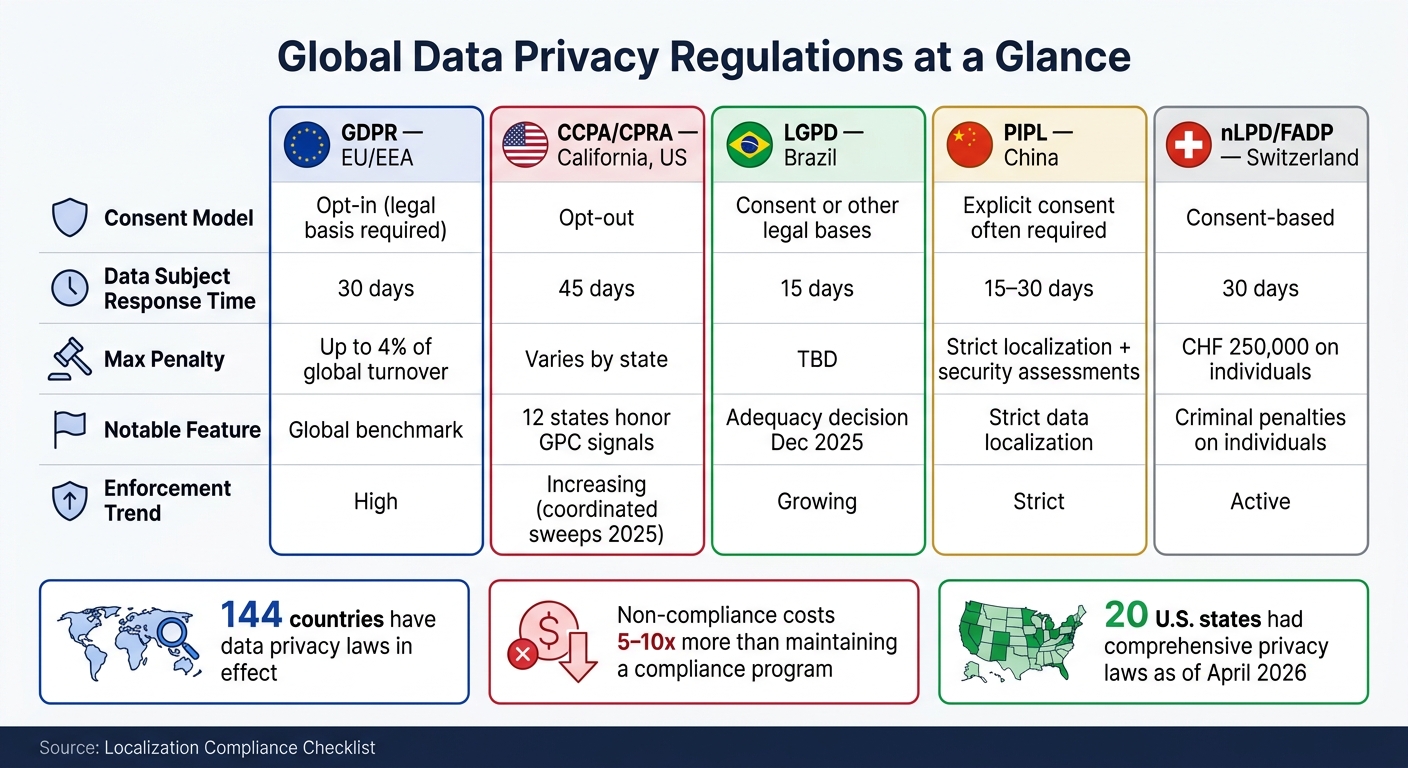
Global Data Privacy Laws Compared: GDPR, CCPA, LGPD, PIPL & More
Understanding and adhering to regulations in your target markets is a crucial starting point in the Localization Compliance Checklist.
Before diving into translations, it’s essential to grasp the legal framework of each market. Missing this step can lead to hefty penalties. With data privacy laws in place across 144 countries, the cost of non-compliance can be 5–10 times higher than maintaining a compliance program.
Mapping Local Legal Requirements
A good starting point is the EU's GDPR. It sets a high standard, and adjustments can be made for local variations.
"The smart approach is to build the highest standard once and apply local relaxations, rather than running parallel compliance programs." - Dr. Thiébaut Devergranne, Founder, Legiscope
However, compliance isn’t one-size-fits-all. For instance, 20 U.S. states had comprehensive privacy laws in effect as of April 2026. Some laws, like Florida's FDBR, apply only to billion-dollar companies, whereas Texas's TDPSA has no such thresholds, making it relevant to almost any business operating in Texas. Internationally, frameworks like China's PIPL, Brazil's LGPD, Japan's APPI, and South Africa's POPIA each come with their own consent models, data transfer rules, and response timelines.
Here’s a quick comparison of major regulatory frameworks:
| Framework | Region | Consent Model | Data Subject Response Time | Notable Feature |
|---|---|---|---|---|
| GDPR | EU/EEA | Opt-in (legal basis required) | 30 days | Global benchmark; fines up to 4% of global turnover |
| CCPA/CPRA | California, US | Opt-out | 45 days | 12 states now require honoring GPC signals |
| LGPD | Brazil | Consent or other legal bases | 15 days | Adequacy decision adopted December 2025 |
| PIPL | China | Explicit consent often required | 15–30 days | Strict data localization; security assessments required |
| nLPD/FADP | Switzerland | Consent-based | 30 days | Criminal penalties up to CHF 250,000 on individuals |
Beyond privacy laws, local content and labeling rules add another layer of complexity. For example, the European Accessibility Act (EAA), enforceable since June 28, 2025, mandates that digital products meet WCAG 2.1 Level AA standards and that accessibility statements are available in the local language of each EU member state. In Brazil, the Digital ECA (effective March 17, 2026) bans loot boxes in games accessible to minors and requires age-range data ingestion. Meanwhile, Japan’s Specified Commercial Transactions Act requires businesses to display their name, address, and phone number for any paid app or in-app purchase.
Jurisdiction-Specific Compliance Considerations
Each market comes with its own set of rules that can’t simply be transferred across regions. For example, in February 2026, the California Attorney General settled with the Walt Disney Company for $2.75 million over non-compliance with CCPA opt-out requirements. Similarly, in 2025, Connecticut fined TicketNetwork, Inc. $85,000 for failing to provide a compliant privacy notice under the Connecticut Data Privacy Act. These cases highlight a growing trend of stricter enforcement in both the U.S. and the EU.
Geolocation tagging is a practical way to address these challenges. By identifying a user’s location through their IP address or self-declaration, businesses can trigger the appropriate consent banners, privacy notices, and legal documents for that jurisdiction. This is especially critical as 12 U.S. states now mandate honoring Global Privacy Control (GPC) signals as a universal opt-out mechanism. Ignoring this isn’t just a user experience issue - it creates a compliance gap that regulators are actively monitoring. In September 2025, California, Colorado, and Connecticut conducted a coordinated investigative sweep targeting businesses that failed to honor opt-out preference signals.
The next step is to validate your legal documents and assess potential translation risks to ensure comprehensive compliance. Utilizing top SEO marketing tools can help streamline this process and ensure your content remains visible across all target regions.
sbb-itb-5be333f
Content and Legal Text Validation
After aligning with local regulations, it's important to ensure your legal documents meet all compliance requirements.
"A translated US privacy policy is not a GDPR-compliant EU privacy policy. These are different documents with different content requirements."
Validating Legal Documents and Notices
Each localized legal document should be treated as specific to its jurisdiction, rather than simply adapting a single source file. For example, clauses in US documents that conflict with local consumer protection laws in countries like Germany, France, or Brazil may be unenforceable and require careful review.
Here are some key steps to validate legal documents:
- Verify local legal entity details: Make sure localized pages clearly display the correct legal entity, address, and registration identifiers for that region.
- Test consent mechanisms: Check that cookie banner actions align with actual Tag Manager behavior in each locale.
- Ensure functional links: Confirm that localized privacy notices link to active, locale-specific contact channels, such as a French-language data subject access request (DSAR) form.
- Check regional rights language: For example, California pages should include "Do Not Sell or Share My Personal Information" links, while Japanese forms must use appropriate scripts.
In France, the Toubon Law requires that all commercial content aimed at the public - including contracts and software interfaces - be in French, making the French version legally binding. Similarly, under the EU Consumer Rights Directive, the 14-day right of withdrawal must be communicated in the customer’s language to be enforceable. Engaging a local legal expert is essential, as they can identify unenforceable clauses that translators might miss. While legal translation typically costs $100–$200+ per 1,000 words, this is a small investment compared to the potential fines for non-compliance.
Once document integrity is confirmed, the next step is to evaluate content-specific risks.
Risk Assessment for Translated Content
Translation risks can jeopardize compliance if not properly addressed. Different types of content come with unique compliance risks, requiring review by the right experts. The table below outlines who should review each content type and the risks of skipping validation.
| Content Type | Review Owner | Compliance Risks |
|---|---|---|
| Privacy Policy | DPO / Legal Team | GDPR/LGPD fines, invalid data processing, regulatory audits |
| Terms of Service | Local Legal Counsel | Unenforceable clauses, consumer protection lawsuits, voided contracts |
| Cookie Consent Banners | Product / Compliance | Invalid consent, "dark pattern" penalties, unauthorized tracking |
| Return/Refund Policy | Operations / Legal | Chargebacks, consumer disputes, violation of EU withdrawal rights |
| Ad Claims / Disclaimers | Marketing / Legal | Misleading advertising penalties, violation of local ad standards |
| Accessibility (WCAG) | Engineering / QA | EAA non-compliance, lawsuits, broken ARIA labels in translation |
Keep in mind that translations, such as English to German, often expand by 20–35%, which can result in truncated legal elements and potential compliance issues.
"Consistency in terminology is not a stylistic choice. In legal localization, it is a compliance requirement." - Glocco
To streamline this process, create a Legal Localization Kit for translators. This kit should include a data processing inventory, a glossary of approved legal terms (e.g., "controller" vs. "processor"), and a list of trusted vendors. Pair this with strict update SLAs to ensure localized versions stay current, lagging no more than a few days behind the source document. This kit will standardize legal language across all locales while supporting broader compliance efforts.
Format and Localization Standards
Once legal documents are validated, the next step in compliance is ensuring proper formatting. Even the most accurate translations can fail to meet requirements if they don't align with local standards for dates, currency, or measurements.
"A currency sign or the order of a date speak about the care you've put into the cultural adaptation of your product." - Simona Rahmanova
Locale-Sensitive Formatting Checks
U.S. formatting standards are precise and must be followed for compliance. The table below highlights key formatting requirements for localized content in the U.S.:
| Category | U.S. Standard (en-US) | Example |
|---|---|---|
| Date | MM/DD/YYYY | 06/02/2026 |
| Time | 12-hour clock with AM/PM | 2:30 PM |
| Currency | Symbol prefix, 2 decimal places | $1,234.50 |
| Numbers | Comma (thousands), period (decimal) | 1,000,000.00 |
| Measurements | Imperial system | 5 feet 10 inches, 75°F |
| Percentages | Sign after number, no space | 75% |
| Negative Currency | Parentheses notation | ($500.00) |
It's important to note that date formats, such as 03/04/2026, are interpreted as March 4th in the U.S., but other regions may interpret this differently. For international financial content, include the ISO code "USD" alongside the "$" symbol for clarity.
When dealing with timestamps, store all values in UTC within your database and convert them to the user's local time zone upon display. Use IANA time zones like America/New_York to account for Daylight Saving Time automatically. Dynamic formatting APIs, such as Intl.NumberFormat('en-US') and Intl.DateTimeFormat('en-US'), should be configured with two decimal places to ensure consistent currency formatting (e.g., "$10.00" instead of "$10").
Adapting Content and UI for the Target Market
Proper formatting is just the beginning - your interface must also adapt to different text lengths and local input standards. Compliance involves more than numbers; it requires a localized user experience. For example, translations into languages like German can expand text by 30–40%, potentially causing truncated labels, misaligned buttons, or cut-off legal disclaimers. A useful development practice is pseudo-localization, where UI strings are replaced with expanded, accented versions to test layout flexibility.
"A localized website feels like it was built for that market. A translated website feels like it was built elsewhere and sent through a converter." - Eray Gündoğmuş
Form fields should enforce U.S.-specific input patterns, such as requiring 5-digit ZIP codes, 10-digit phone numbers, and MM/DD/YYYY date formats. Tools like Playwright, Cypress, or Percy can perform visual regression testing, comparing localized UI screenshots to U.S. baselines, or perform a website audit to identify broader performance issues. These tools help catch errors, like a misplaced currency symbol, before they reach users.
Maintaining consistent formatting and adapting the UI to local expectations are critical steps in achieving effective localization compliance.
Approval, Documentation, and Audit Readiness
After navigating through rigorous regulatory reviews and content validations, the final phase focuses on securing formal approvals and maintaining thorough audit documentation. While this step is often rushed, neglecting it can lead to serious legal risks.
Final Compliance Sign-Off
The final approval process requires collaboration from linguists, developers, designers, and legal reviewers, as each group identifies unique issues. Skipping any of these perspectives can leave compliance gaps.
This review should take place in a staging environment, where a native speaker evaluates the user experience across multiple devices, mirroring how actual users would interact with it.
Documents like privacy notices, terms of service, and cookie consent texts need to go through legal experts - not just translators. For U.S. audiences, ensure opt-out consent mechanisms are functioning correctly according to state-specific privacy laws, such as the CPRA.
Here’s a breakdown of the five key sign-off categories and the responsibilities for each team:
| QA Category | Key Sign-Off Check | Responsible Team |
|---|---|---|
| Linguistic | Native review on live UI | Localization/Linguists |
| Legal | Enforceability of terms in target jurisdiction | Legal/Compliance |
| Functional | Form inputs & consent flows | Engineering/QA |
| Technical | Hreflang tags and UTF-8 encoding | SEO/Marketing |
| Visual | Layout integrity for text expansion or RTL mirroring | Design/Front-end |
Once sign-offs are completed, it’s crucial to document every step to ensure audit readiness.
Audit-Ready Documentation
Proper documentation acts as the final safeguard, proving that all localization standards have been met. As Acolad highlights:
"Audit readiness in translation is a process question, not a quality question. Inspectors verify traceability, not fluency."
Your records should address four critical questions: Who translated the content? Which source version was used? What changes were made? Who approved the final version?. Every localized file should include a complete audit trail with timestamps, version histories, and QA logs.
For recurring legal clauses like "How to contact us" or data retention policies, use reusable content blocks within your CMS. This ensures that updates to the source text automatically apply to all localized versions. Combine this with clearly defined Service Level Agreements (SLAs) to establish how quickly localized legal documents must be updated after a source text change. Without SLAs, outdated translations can lead to expensive compliance risks.
Key Takeaways
Localization compliance isn't just about translating content - it’s about ensuring your materials meet legal requirements, align with cultural norms, and function correctly in every market you enter. This approach not only protects your business but also enhances its performance in global markets. As the Transcy Team explains:
"Translation is not the same as compliance. True international compliance requires a dual approach: flawless storefront localization on the front end and rock-solid data privacy on the back end."
The link between proper localization and consumer behavior is clear. Well-localized websites can significantly boost e-commerce revenue, proving that treating localization as an afterthought can come at a high cost.
The checklist mentioned earlier addresses key areas like regulatory review, content validation, UI standards, and audit documentation. Skipping any of these steps increases compliance risks and exposes your business to potential legal and financial consequences.
Technical internationalization, such as using UTF-8 encoding and implementing hreflang tags, should be integrated early in the process. Making these changes later can cost 3–5 times more. Additionally, consent flows must be tested in the target markets since compliance requirements differ - what works for the CCPA in the U.S. won’t align with GDPR standards in the EU.
Partnering with compliance specialists can help reduce errors during the QA phase by up to 35%. This reduction is crucial because a single overlooked clause or malfunctioning consent mechanism can lead to hefty fines or even invalidate user consent. This highlights why following a thorough localization and compliance checklist is critical for any business aiming to succeed globally.
FAQs
Which localization tasks require local legal review (not just translation)?
Localization efforts often require legal scrutiny, especially for materials like privacy notices, terms of service, cookie consent banners, and consumer-facing contracts. Regional laws - such as GDPR in Europe, LGPD in Brazil, and various accessibility standards - differ widely, meaning translation alone won’t ensure compliance. Legal professionals play a critical role in verifying these documents to ensure they meet local regulations.
Additionally, safety warnings, hazard labels, and ingredient information demand expert review to align with regional labeling and documentation requirements. This step is essential for both consumer safety and regulatory adherence.
How do I handle consent banners and opt-outs across GDPR and U.S. state laws?
To manage consent banners effectively, implement a dynamic Consent Management Platform (CMP) that adjusts based on the user's location.
- For GDPR and Quebec: Use an opt-in approach, ensuring non-essential scripts are blocked until the user explicitly consents.
- For U.S. states: Follow an opt-out model. Include a clear link for users to opt out, such as 'Do Not Sell or Share My Personal Information', and respect universal opt-out signals like the Global Privacy Control (GPC).
What audit records should I keep to prove localization compliance?
To stay compliant with localization standards, it's crucial to keep a thorough, time-stamped audit trail for every translated asset. This should include the original source document with its version metadata, the completed translation, and a comprehensive version history that tracks all drafts and revisions.
Make sure to log details about everyone involved - such as the translator, reviewer, and approver - along with their credentials and the exact timestamps of their sign-offs. Additionally, store quality assurance reports, validation records, glossaries, and communication logs in a secure system with controlled access to protect sensitive information.