Manual keyword grouping is the process of organizing keywords into clusters based on search intent, topic relevance, and business goals. Unlike automated tools, this method relies on human judgment to ensure accuracy and avoid issues like keyword cannibalization. Here's a quick breakdown of the process:
- Prepare Your Keyword List: Start with seed keywords, expand using tools like Google Keyword Planner, and clean the list by removing duplicates and irrelevant terms.
- Set Up a Spreadsheet: Organize keywords into columns for search volume, difficulty, intent, and target URL. Use filters and formatting for clarity.
- Group Keywords: Identify themes, assign search intent, and cluster similar terms based on SERP overlap and semantic similarity.
- Refine Groups: Split broad groups into smaller clusters and prioritize keywords based on volume, difficulty, and business value.
- Validate Groups: Use SERP analysis to confirm intent alignment and adjust as needed.
- Apply Groups to Content: Map clusters to pages, optimize internal linking, and update existing content to align with keyword groups.
This approach ensures your SEO strategy targets both primary and long-tail keywords effectively, helping your content rank for multiple related terms while avoiding competition between your own pages.
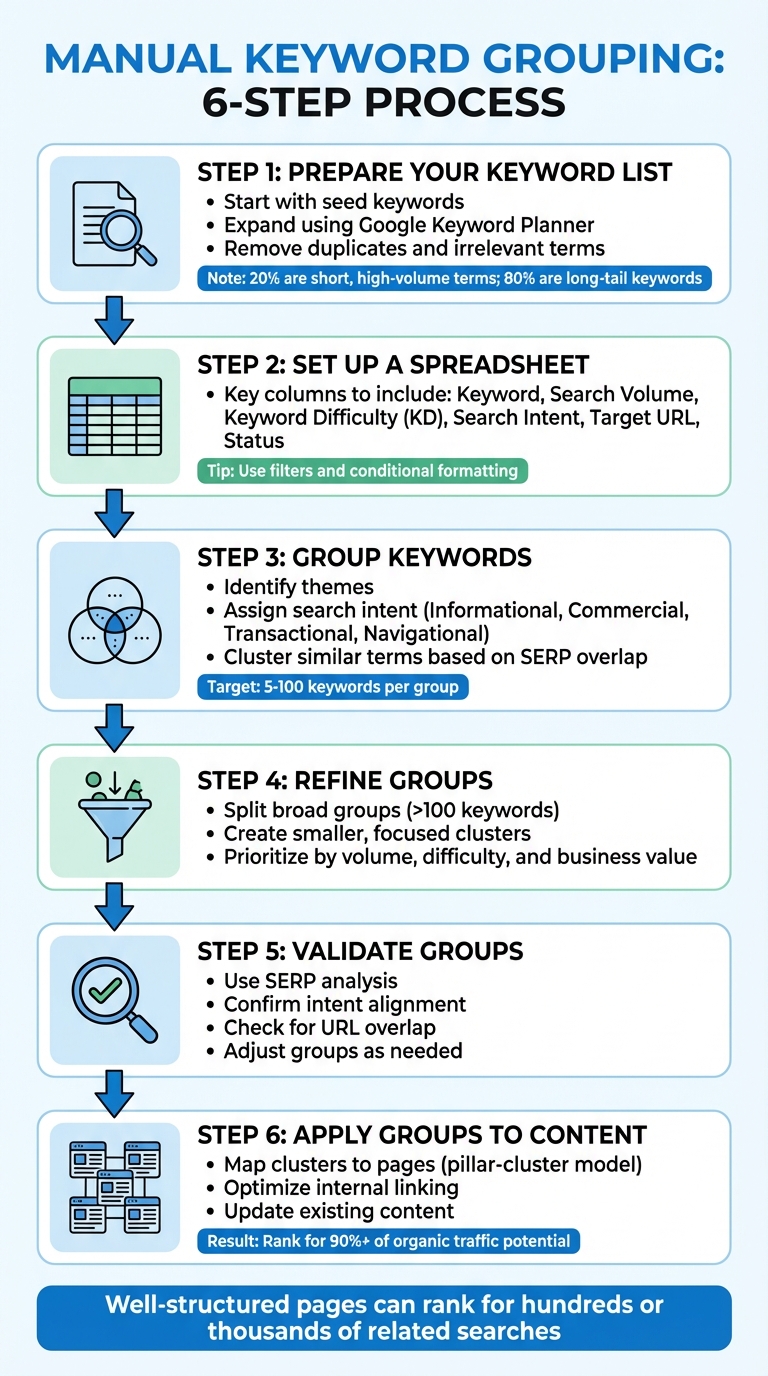
Manual Keyword Grouping Process: 6-Step SEO Workflow
Master Keyword Clustering in 13 Minutes: Step-by-Step Guide for SEO
Preparing Your Keyword List
Before diving into keyword grouping, it's essential to start with a well-organized and clean list. The success of your manual grouping process depends on how carefully you've prepared your keywords. A messy list leads to ineffective groups, which wastes time and can result in missed opportunities.
Building Your Master Keyword List
Begin by identifying seed keywords - these are the core terms that reflect what you want to rank for, what you're already ranking for (check Google Search Console), and what your competitors are targeting. Think of each seed keyword as a parent topic. Use tools like Google Keyword Planner, Moz, or Semrush to expand these seeds into related terms. This process helps uncover specific long-tail keywords that automated tools might miss.
To expand your list further, analyze competitor URLs and related queries. Don’t overlook "People also ask" questions and related searches at the bottom of Google search results. These question-based keywords can provide valuable insights into informational search intent. As Lily Ray, SEO Director at Path Interactive, explains:
"Question keywords are crucial, especially given how many different Google search features pull in questions directly into the search results".
To create variations of your seed keywords, add intent-based modifiers like "best", "cheap", "online", or location-specific terms. Keep in mind that about 20% of search queries are short, high-volume terms (fat head keywords), while 80% are long-tail keywords. Covering both types ensures you're not missing out on potential traffic.
Once you've built your list, the next step is refining and organizing it.
Cleaning and Normalizing Keywords
After gathering keywords from various sources, start by deduplicating your list. Remove duplicates, special characters, unnecessary numbers, and irrelevant modifiers like prepositions ("in", "for") or articles ("the", "a") that don’t affect the keyword’s intent.
Group plurals and related variations together to keep your list focused. Avoid creating separate groups for common misspellings - modern search engines handle these automatically. Filter out keywords with low search volume that don’t justify creating individual pages, and eliminate terms unrelated to your business offerings.
Use a word frequency counter or n-gram viewer to identify recurring patterns and modifiers in your list. For example, if words like "cheap", "best", and "leather" appear frequently, you’ll know these are important for structuring your keyword groups.
Once your list is cleaned, organize it into a structured spreadsheet.
Setting Up Your Spreadsheet
To streamline the grouping process, set up a spreadsheet with columns for essential data points. At a minimum, include: Keyword, Search Volume, Keyword Difficulty (KD), Search Intent, Target URL, and Status. You might also add columns for Priority Score (a combination of volume, difficulty, and CTR), Keyword Variations, and SERP Notes to track observations about ranking content.
Use separate tabs for different themes to keep things clear. Instead of deleting irrelevant terms, mark them with an "x" in a "No Good" column and filter them out. This way, you can keep the data for future reference.
Apply header filters and conditional formatting to organize your data and quickly spot priorities. Here’s an example of how your spreadsheet might look:
| Column Name | Purpose | Why It Matters |
|---|---|---|
| Keyword | The main search term | Forms the foundation for all analysis |
| Search Volume | Monthly search frequency | Indicates potential traffic |
| Difficulty (KD) | How challenging it is to rank for the term | Helps prioritize realistic targets |
| Intent | Informational, Commercial, Transactional, or Navigational | Guides content type and grouping |
| Target URL | The page assigned to this keyword group | Prevents keyword cannibalization |
| Priority | Ranking of importance (e.g., 1-5 or High/Low) | Focuses effort on high-value terms |
As Andy Crestodina, Cofounder of Orbit Media, points out:
"If you're not checking key phrase difficulty, you're not doing key phrase research. You simply don't have a chance of ranking for phrases that are way outside your website's authority".
Step-by-Step Manual Keyword Grouping Process
Once your spreadsheet is ready and your keywords are cleaned up, it's time to start grouping them manually. This process involves several steps: identifying overarching themes, tagging keywords by search intent, clustering related terms, refining your groups, and prioritizing the ones that matter most. Each step builds on the previous one, aligning your keywords with how users search online.
Identifying Primary Themes and Topics
Begin by pinpointing top-level themes based on your business's main offerings. For instance, a company specializing in heating and cooling might have themes like "HVAC repair" or "air conditioning installation." These broad categories act as the backbone of your keyword strategy, similar to how "cake" might serve as a primary category for a bakery.
To streamline this step, use a word frequency counter to analyze your keyword list and identify recurring terms. Narrow your focus to 50–75 key "hot words" that are most relevant to your business, and use them as the foundation for your clusters. You can test whether these themes are distinct by checking for URL overlap on Google.
Review data from tools like Google Search Console or Google Analytics to identify keywords already driving traffic and conversions. Competitor websites, especially their service pages and navigation menus, can also provide inspiration for additional categories. Keep in mind, though, that keyword groups larger than 100 terms often lose their focus, so aim to keep your themes tightly defined.
As Tom Casano, Founder of Sure Oak, puts it:
"To grow your organic traffic, you need your content to mirror the reality of what users are actually searching for. Your content planning and creation, keyword mapping, and optimization should all align with the market".
Tagging Keywords by Search Intent
Once your themes are set, assign a search intent to each keyword. Search intent generally falls into four categories:
- Informational: People are looking to learn something (e.g., "how to fix a leaky faucet").
- Navigational: People are searching for a specific website or page.
- Commercial: People are exploring options or researching products.
- Transactional: People are ready to make a purchase.
You can identify intent by looking for certain modifiers. For example, phrases like "how to" signal informational intent, while words like "buy" point to transactional intent. To double-check, perform a manual SERP search. If the top results for a keyword are product pages, it's likely transactional. If they're guides or tutorials, the intent is informational.
| Intent Category | Common Modifier Patterns | Example Keywords |
|---|---|---|
| Informational | how to, what is, guide, tutorial | "how to fix a leaky faucet" |
| Commercial | best, top, review, comparison | "best shipping software for small business" |
| Transactional | buy, price, coupon, order | "buy leather motorcycle jacket" |
| Navigational | [Brand Name], login, [Product Name] | "Stripe login", "Delta faucet store locations" |
Longer, more specific queries often indicate a stronger intent to purchase, making them easier to classify. Exclude navigational keywords that include competitor brand names to keep your focus on your own offerings.
With intent assigned, you can move on to grouping keywords that are semantically similar.
Grouping Keywords by Semantic Similarity
Within each theme and intent category, cluster keywords based on their semantic similarity. This means grouping together terms that are close variants, synonyms, or related phrases targeting the same topic. For example, "leather motorcycle jacket", "motorcycle jacket leather", and "leather jacket for motorcycles" all describe the same concept.
Use n-gram analysis to spot recurring word sequences and modifiers, such as "cheap", "best", or "armored". For instance, in a study of motorcycle jacket keywords, the modifier "armor/armored" appeared 33 times, while "body" and "best" each appeared 6 times. Keywords sharing these critical modifiers should be grouped together.
Check for SERP overlap at this stage. If two keywords return the same set of URLs on Google, they likely share the same search intent and should be grouped together. This step ensures you don't accidentally create separate pages that compete against each other for the same rankings. Targeting a cluster of related terms, rather than focusing on just one keyword, can help you capture over 90% of potential organic traffic.
After forming your clusters, review them carefully to ensure they're precise and relevant.
Refining and Splitting Broad Groups
Once your initial clusters are set, evaluate each group to see if it's too broad or too narrow. Groups with more than 100 keywords often need to be broken down into smaller, more specific subgroups.
To refine your groups, consider factors like subtopics, target audiences, or geographic locations. For example, a broad "motorcycle jackets" group might be divided into "leather motorcycle jackets", "waterproof motorcycle jackets", and "armored motorcycle jackets." Each subgroup should have a distinct focus that justifies its own dedicated content.
Look for patterns in your keywords to guide these splits. For instance, if certain terms consistently include location modifiers like "near me" or specific city names, you might create a separate local SEO group. This refinement helps ensure each group remains tightly focused and actionable.
Prioritizing Keywords Within Groups
After organizing your keywords, it's time to prioritize them based on your business goals. Choose one high-value focus keyword for each group and select secondary keywords that complement it. Relevance is key - if a keyword doesn't align with your business or audience, it shouldn't make the cut, no matter how attractive its metrics.
To prioritize, consider factors like search volume, keyword difficulty, click-through rate (CTR), and business value. For example, "motorcycle jackets with armor" boasts a monthly search volume of 21,670 and an organic CTR of 84%, making it an excellent focus keyword. On the other hand, keywords dominated by Google features, like "movies with robin williams", might have high search volumes but lower organic CTRs, often around 41%.
Focus on "striking distance" keywords - those where your site already ranks within the top 1–3 positions for related terms. For small-to-medium businesses, targeting keywords with difficulty ratings between 15 and 49 can yield strong results.
As Andy Crestodina, Co-founder of Orbit Media, advises:
"If you're not checking key phrase difficulty, you're not doing key phrase research. You simply don't have a chance of ranking for phrases that are way outside your website's authority".
Additionally, long-tail keywords - phrases with three or more terms - often have lower search volumes but higher conversion rates. These can be particularly cost-effective due to reduced competition.
sbb-itb-5be333f
Organizing and Validating Keyword Groups
Structuring Keyword Groups in Spreadsheets
Once you’ve grouped your keywords manually, the next step is to organize them into a well-structured spreadsheet. Think of this as creating a logical hierarchy, starting with broad themes and narrowing down to more specific subcategories. For instance, a main category like "motorcycle jackets" could break down into smaller groups such as "leather motorcycle jackets", "waterproof motorcycle jackets", and "armored motorcycle jackets."
To keep things tidy, use separate tabs for each main theme. This approach prevents clutter and makes it easier to navigate your workbook. Tools like conditional formatting can help highlight priority keywords or flag duplicates. Don’t forget to freeze header rows for easy scrolling and include a sequence column so you can restore the original order of your data if needed.
Keep each group manageable - aim for 5 to 100 closely related keywords per group. If a group exceeds 100 terms, break it into smaller, more focused subgroups. For teams collaborating in Google Sheets, you can use the "@" symbol to assign specific tasks.
Once your groups are organized, the next step is to validate them using targeted SERP analysis.
Validating Groups Through SERP Analysis
After structuring your keyword groups, it’s time to validate them by analyzing Google’s search results. Start by manually searching for your keywords. If two keywords bring up the same set of top-ranking URLs, they probably share the same user intent and should stay in the same group.
Pay close attention to the type of content ranking for each keyword. For example, if one keyword brings up product pages but another surfaces how-to guides, these keywords likely serve different intents and should be separated. The meta descriptions in the search results can also provide clues - Google often bolds terms it deems relevant, which can help you identify additional modifiers to refine your groups.
Don’t overlook the "People Also Ask" section. This feature can reveal related questions that might serve as subheadings for your content. As Lily Ray, SEO Director at Path Interactive, points out:
"Question keywords are crucial, especially given how many different Google search features pull in questions directly into the search results. Top-performing informational pages are often structured using a question and answer format."
After publishing your content, use Google Search Console to confirm that your target URL is ranking for the entire keyword cluster. If a different page ranks instead, it may signal keyword cannibalization, which you’ll need to address.
Maintaining and Updating Keyword Groups
Keyword groups aren’t static - they need regular updates to keep up with shifting search trends and competitor strategies. Add a "Last Updated" column to your spreadsheet to track when each group was last reviewed.
Google Search Console’s Performance report can help you identify which queries are driving impressions to specific pages. If a page ranks for keywords outside its assigned cluster, you may need to re-optimize that page or create a new one to target those terms directly. This process can also uncover content gaps where valuable keywords don’t yet have a dedicated page.
Assign clear actions for each keyword group. For example, mark new topics as Create, flag underperforming pages for Optimize, or note when no changes are needed. Using SEO tools to track your target URLs can also help you monitor traffic trends across your keyword clusters.
As Leigh McKenzie, Head of SEO at Backlinko, explains:
"Since the SEO industry is constantly changing with new techniques, tactics, and terminology, we first evaluate our existing content library to ensure everything is still relevant and accurate."
Just as you did during the initial grouping process, periodic reviews of your clusters are essential. This helps you avoid keyword cannibalization and ensures your strategy stays aligned with emerging search patterns. Regular updates also provide an opportunity to refine your internal linking structure, which can boost the performance of underperforming content.
Applying Keyword Groups to Your Website
Now that you've organized your keyword groups, it's time to put them to work by enhancing your website's structure and content.
Mapping Keyword Groups to Content
The next step is to map your validated keyword groups to specific pages using the pillar–cluster model. In this approach, broad, high-traffic keywords are assigned to "pillar pages." These pages act as in-depth guides on a topic. Meanwhile, more specific, long-tail keywords are used for "cluster pages", which dive into subtopics that support the pillar content.
Search intent should guide this mapping process. For instance:
- Informational queries like "how to fix a leaky faucet" are best suited for blog posts or how-to guides.
- Transactional searches such as "buy affordable faucets online" align better with product or category pages.
To ensure your content strategy is on point, use site:yourwebsite.com [topic] to audit your existing content. This helps identify duplicate content and highlight gaps where keyword groups lack dedicated pages.
Leigh McKenzie, Head of SEO at Backlinko, explains:
"We start the keyword mapping process with a content strategy that targets our ideal customer profiles (ICPs) and covers our main content pillars."
For example, Backlinko restructured their content library in March 2021 around four main pillars - SEO, Content Marketing, Link Building, and Digital Marketing. This focused approach helped them achieve over 500,000 organic sessions per month.
To stay organized, categorize your pages into three groups:
- "To Create": New content needed to target specific keyword groups.
- "To Optimize": Existing pages that need keyword integration or updates.
- "Updated": Pages that are already fully optimized.
Once your content mapping is complete, shift your focus to refining the site structure to enhance keyword relevance.
Optimizing URL Structure and Internal Linking
Your keyword groups should inform your URL structure, creating a clear hierarchy that reflects the pillar–cluster relationship. For example, use a format like website.com/topic/sub-topic. This structure not only improves user navigation but also signals to search engines how your content is interconnected.
Internal linking is another key part of this process. Ensure that every cluster page links back to its pillar page and use keyword-rich anchor text for these links. For instance, if "air conditioner repair" is the main keyword for a page, use that exact phrase in anchor text when linking from related pages.
Rachel Handley, Senior Content Writer at Semrush, emphasizes:
"Keyword-rich anchor text can establish relevance for target keywords to improve rankings."
Additionally, connect related subtopics within the same keyword group. This strengthens semantic connections, making it easier for search engines to understand your site's structure while enhancing user experience.
With a solid linking strategy in place, you can move on to updating and optimizing your existing content.
Updating Existing Content Using Keyword Groups
Keyword groups often highlight opportunities to improve underperforming content or consolidate pages with overlapping themes. Start by analyzing search results for each keyword in a group. If two keywords produce very different results, they likely address separate search intents and should be assigned to different pages. On the other hand, if multiple pages compete for the same keyword group, consider merging them into one authoritative page to avoid keyword cannibalization.
When a single page ranks for keywords with conflicting intents - like "internet providers by zip" versus "satellite internet" - it’s best to focus on the higher-value keyword. Then, create a new, interlinked page for the other term.
Carson Ward offers this advice:
"As a general rule, anything that would augment an existing page's core purpose can be added, but anything that would detract or confuse the core purpose should be placed elsewhere."
For pages marked as "To Optimize", follow these steps:
- Add the primary keyword to the title tag, meta description, H1 tag, and within the first 100 words.
- Naturally integrate secondary keywords into subheadings and body text to capture long-tail traffic.
- Update internal links, ensuring anchor text aligns with your keyword map. Make sure every cluster page links back to its pillar page to maintain a cohesive structure.
Conclusion
Manual keyword grouping turns scattered search terms into a clear, actionable plan for your SEO efforts. By organizing keywords based on search intent and semantic connections, you can create targeted content that avoids competing with itself. A well-structured page has the potential to rank for hundreds - or even thousands - of related searches. This process not only strengthens your content but also reinforces your website's authority on specific topics.
As Tom Casano, Founder of Sure Oak, explains:
"To grow your organic traffic, you need your content to mirror the reality of what users are actually searching for".
When done correctly, keyword grouping is more than just tidying up data - it’s about building topical authority. This authority signals to search engines that your site is a trusted, comprehensive resource, leading to improved visibility across entire topic clusters rather than just individual keywords. The result? Higher rankings and a stronger foundation for your ongoing content strategy.
Focusing on a single primary keyword might mean missing out on 90% of the organic traffic potential for a topic. Manual grouping helps capture those long-tail variations and related searches that often drive the bulk of conversions. Through a structured approach - like creating pillar pages and supporting cluster content - you lay the groundwork for growth that compounds with every update.
Keeping keyword groups updated is crucial to staying aligned with ever-changing search trends. As WordStream highlights:
"If you only complete the above steps once, your results will certainly stagnate; most likely, they'll degrade".
Search behavior shifts over time, new modifiers (like changing years from "2024" to "2025") emerge, and your site evolves. Regular maintenance prevents keyword cannibalization as you add new pages and ensures your content stays relevant to current search patterns.
FAQs
How does manual keyword grouping help avoid keyword cannibalization?
Manual keyword grouping is all about assigning each keyword - or a closely related set of keywords - to a single, specific page. Why does this matter? It helps avoid keyword cannibalization, where multiple pages on your site end up competing against each other for the same search query. By thoughtfully organizing your keywords, you create a clear structure that makes it easier for search engines to understand your content and rank it more accurately. Plus, it ensures your pages stay focused and on target.
What are the advantages of using a pillar-cluster model for organizing keywords?
The pillar-cluster model is a game-changer for organizing keywords into a structured content strategy. Instead of dealing with a flat, unstructured list of keywords, this method groups related terms around a central "pillar" page. These pillar pages serve as comprehensive overviews of broad topics, while the linked "cluster" pages dive into more specific subtopics. This setup not only aligns with user intent but also strengthens internal linking and signals topical relevance to search engines. The result? Better rankings for overarching topics and a chance to capture those valuable long-tail keywords.
On top of that, the pillar-cluster model makes content planning much easier. It helps pinpoint content gaps and prioritize what new pages to create. For readers, it’s a win too - they can seamlessly move between general overviews and in-depth details, which keeps them engaged longer and reduces bounce rates. If you're looking for tools to simplify this process, the Top SEO Marketing Directory offers a curated selection of platforms designed to help with keyword mapping and content organization.
How do I prioritize keywords effectively within a group?
To effectively prioritize keywords, start by collecting essential metrics like search volume, competition level, relevance, commercial intent, and estimated click-through rate (CTR). Then, assign a weight to each metric depending on your specific goals. For instance, if you're aiming to increase traffic, give more importance to search volume. If conversions are your focus, emphasize commercial intent. Combine these metrics into a priority score by multiplying each by its assigned weight and summing them up.
Next, filter out keywords that don’t meet your criteria, such as those with low search volume (e.g., fewer than 100 monthly searches) or high difficulty (e.g., a score above 45). Concentrate on high-scoring keywords for your primary content and use supporting terms to strengthen your strategy. To ensure your selections align with user intent, review search results and identify areas where you can differentiate yourself.
To save time and improve accuracy, leverage SEO tools from the Top SEO Marketing Directory. These tools can simplify data collection and scoring, allowing you to focus on creating impactful content.