Schema markup is now essential for staying visible in AI-driven search results. With AI systems like ChatGPT and Google's AI Overviews relying heavily on structured data, businesses must rethink their approach to schema. Here’s what you need to know:
- AI prioritizes entities, not just keywords: Schema helps clarify meanings, like distinguishing "Apple" as a fruit or tech company.
- Higher visibility with schema: Pages using schema markup see 40% higher click-through rates, and 36% are more likely to appear in AI-generated summaries.
- Voice and conversational search: FAQ and HowTo schema make your content accessible to voice assistants and chatbots.
- E-E-A-T signals matter: Use schema to highlight expertise, authoritativeness, and accuracy to build trust with AI systems.
- Regular updates are crucial: Outdated schema can hurt your visibility; tools like Google Search Console and Schema Markup Validator can help.
To succeed in 2025’s AI-powered search landscape, focus on entity-based schema, optimize for voice and multimodal search, and audit your schema regularly. This ensures your content is understood and surfaced by AI tools, driving both visibility and engagement.
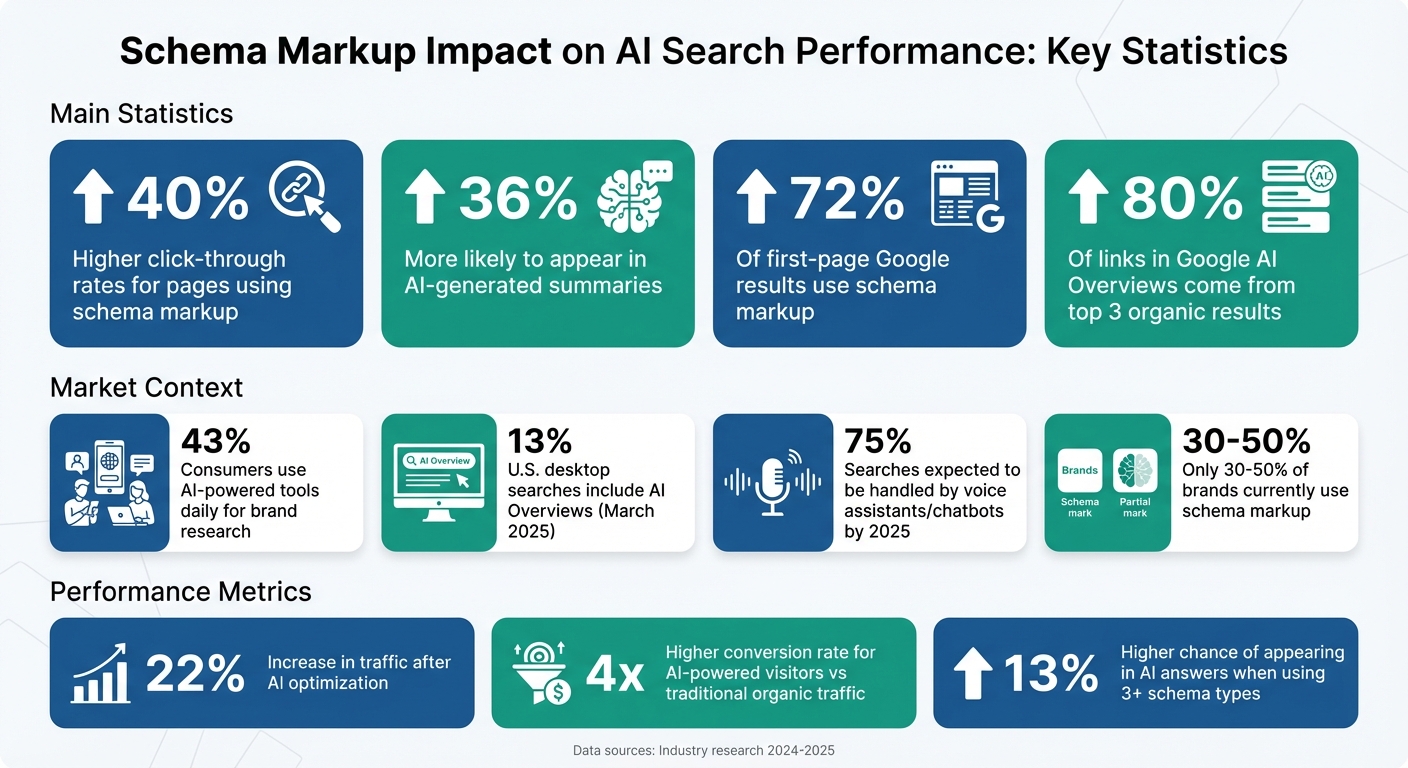
Schema Markup Impact on AI Search Performance: Key Statistics
Schema Markup and AI Search: From Entities to Results
How Schema Markup is Changing for AI Search
Schema markup is evolving to meet the demands of AI-enhanced search, requiring more precise strategies to help search engines understand and present your content effectively.
Entity-Based Schema for Better Context
AI search engines now focus on understanding entities rather than just matching keywords. Tools like ChatGPT and Google's AI Overviews rely on entity-based schema to grasp the true meaning of your content.
Entities are essentially the building blocks of meaning - things like people, places, products, or concepts. For example, if your page mentions "Bronco", entity-based schema can use unique identifiers like Wikidata Q-IDs to clarify whether you’re talking about the Ford SUV or the horse. This clarity is crucial for AI systems, which integrate your content into the broader Knowledge Graph.
To make your content AI-friendly, leverage schema properties like sameAs, about, and mentions. For instance, if you run an outdoor gear store, your Product schema should connect to your Brand entity, which should then link to your Organization schema. These connections should point to credible external sources like Wikipedia, LinkedIn, or official brand pages. This not only boosts your legitimacy but also helps AI systems process your content more effectively. In fact, pages optimized in this way saw a 22% increase in traffic after recent AI updates, with AI-powered visitors converting at four times the rate of traditional organic traffic.
"For AI systems like ChatGPT or Gemini, structured data is primarily a tool to understand the meaning and context of your content faster and better." - Ralf van Veen, SEO Specialist
Each page should focus on one main entity, ensuring alignment through elements like your title, H1, and the mainEntityOfPage property. Beyond clarifying entities, schema must now also address the growing trend of conversational queries.
Schema for Voice and Conversational Search
By 2025, voice assistants and chatbots are expected to handle 75% of all searches. To prepare, your schema strategy should accommodate natural language queries.
Using FAQPage schema is a great way to provide clear question-and-answer pairs that large language models can easily use in their responses. Write FAQs in conversational language, such as "What’s the best way to..." instead of "Best methods for...". According to Microsoft’s Fabrice Canel, "Bing's AI does use your structured data when generating answers". Even though Google has reduced visual FAQ snippets in traditional search results, they still recommend using this schema.
HowTo schema is another powerful tool, breaking down instructions into step-by-step formats that voice assistants can read aloud. Similarly, LocalBusiness schema supports "near me" searches by structuring essential details like addresses, hours, and service areas. For audio-focused content, implement Speakable schema with SpeakableSpecification to highlight key sections suitable for playback, such as summaries or takeaways.
Notably, 80% of the links cited in Google's AI Overviews come from the top three organic results. These schema adaptations not only improve your visibility but also enhance your presence in AI and voice search results.
Using Schema to Support E-E-A-T Signals
Schema markup plays a critical role in demonstrating Experience, Expertise, Authoritativeness, and Trustworthiness (E-E-A-T) to AI systems.
To highlight expertise, use Person schema for authors and key team members. Include details like jobTitle, alumniOf, hasOccupation, and award to showcase professional credentials. For certifications like "Google Analytics Certified" or "SOC 2 Type II Certified", use the EducationalOccupationalCredential type.
Authoritativeness can be strengthened by linking your Organization schema to recognized entities using sameAs and showing memberships with memberOf. Adding historical details like your foundingDate can also help.
Trustworthiness comes from clear, verifiable information. Use LocalBusiness schema to include accurate contact details and enhance credibility with Review or AggregateRating schema. Incorporate datePublished and dateModified in your Article schema to signal that your content is current and well-maintained.
"Structured data helps AI systems parse, validate, trust, and surface your content. By prioritizing structured data for AI citations, you make it easier for models to resolve entities, verify authorship, and attribute summaries back to your brand." - Emily Carter, Senior Content Team Lead, WebFX
Pages with detailed schema markup are 36% more likely to appear in AI-generated summaries and citations. Even if users don’t click through, being cited as a trusted source can significantly boost your brand’s visibility and credibility.
How to Audit and Update Your Schema Markup
Keeping your schema markup up-to-date is essential in a search environment increasingly shaped by AI. Outdated or incorrect schema can hurt your visibility, so regular audits are crucial. A thorough review helps you identify the best schema types to align with your evolving strategy.
Running a Schema Audit
Start by checking the "Enhancements" tab in Google Search Console to spot structured data errors or unsupported schema types. Google retired several schema types in 2025, including CourseInfo, ClaimReview, EstimatedSalary, LearningVideo, SpecialAnnouncement, VehicleListing, and PracticeProblem. If you're still using any of these, it's time to remove them to simplify your code.
Next, use Google's Rich Results Test to see which rich features your schema supports. For a broader review beyond Google's features, validate your pages with the Schema Markup Validator at Schema.org.
Look out for schema-content drift, which happens when your JSON-LD schema data doesn't match on-page details - like when an updated price in HTML isn't reflected in the schema. This mismatch can cause Google to flag your page and potentially remove rich result eligibility. Also, note that FAQ rich results are now mostly limited to government and health websites.
| Retired/Limited Schema Type | Current Status (Dec 2025) | Recommended Action |
|---|---|---|
| FAQPage | Limited to Gov/Health sites | Retain for AI understanding, but don't expect rich snippets |
| CourseInfo / LearningVideo | Retired | Remove or deprioritize maintenance |
| PracticeProblem | Retired | Eliminate from your workflow |
| VehicleListing / EstimatedSalary | Retired | Remove to clean up your code |
| How-To (Mobile) | Restricted | Focus efforts on desktop or plain-text formats |
"Structured data is like the nutrition label on your content. It helps every platform - from Google to ChatGPT - to understand what you're serving."
– Sarah B., Lead SEO Consultant, WebFX
Choosing the Right Schema Types
Once your audit is complete, shift your focus to schema types that effectively communicate your content to AI systems.
For your homepage, prioritize Organization schema to establish your brand identity. Include sameAs links to your official LinkedIn, Wikipedia, or Wikidata pages. If you have physical locations, use LocalBusiness schema with consistent name, address, and phone (NAP) details. For businesses without a physical storefront, highlight the areaServed property instead of creating a fake address.
E-commerce sites should use detailed Product schema, including product variants like size and color, as well as shipping and return policies. This helps clarify information for AI systems. The newer ProductGroup type is particularly useful for managing product families. Be cautious with reviews - don’t mark up third-party reviews (like those from Trustpilot) as your own, as Google may penalize such practices.
Building Modular Schema Templates
Using JSON-LD format is the most efficient way to create reusable schema blocks that can scale across your site. Google recommends JSON-LD because it simplifies implementation and reduces the risk of schema drifting from on-page content.
Develop templates for each content type that can dynamically pull data from your CMS. If you're using WordPress, plugins like Rank Math, Yoast SEO, and Schema Pro can automate much of this process. The key is ensuring that every product and location links to a stable URL and unique ID, which helps AI systems accurately identify your brand across the web.
To stay organized, create an "entity map" in a spreadsheet. This map should link every important URL to its canonical entity, Wikidata Q-ID, and its relationship to other pages on your site.
sbb-itb-5be333f
Monitoring and Updating Schema Over Time
Schema markup isn't a "set it and forget it" task - it needs regular updates to keep pace with evolving AI technologies. Recent data indicates a sharp rise in AI-driven traffic, which means your schema must stay effective across multiple platforms.
On top of that, testing your structured data is essential to catch errors early and avoid performance issues.
Testing Your Structured Data for Errors
Regular validation is key to maintaining visibility. Tools like Google's Rich Results Test can help ensure your pages qualify for specific search features. Additionally, the Schema Markup Validator can confirm compliance with Schema.org standards. Make it a habit to check Google Search Console's Enhancements tab every month for errors, indexing issues, and rich result eligibility.
One common problem to watch for is schema-content drift - this happens when your structured data no longer matches the content on your page. For example, if your schema lists outdated pricing, it could lead to penalties or loss of rich result eligibility. Always ensure that values in your schema, such as pricing or availability, align perfectly with your on-page content.
Measuring Schema Performance
To understand how your schema is performing, track AI referral traffic in GA4. Custom regex filters can help you isolate traffic from sources like Perplexity.ai, Gemini, and Bing. Pay close attention to quality metrics such as engagement time, pages per session, scroll depth, and conversion rates.
Pages with schema markup tend to perform better - data shows they achieve a 40% higher click-through rate, and 72% of pages on Google's first page use some form of schema. However, as AI generates more impressions but fewer clicks, engagement metrics become increasingly important.
"Structured data helps AI systems parse, validate, trust, and surface your content. By prioritizing structured data for AI citations, you make it easier for models to resolve entities, verify authorship, and attribute summaries back to your brand."
– Emily Carter, Senior Content Team Lead, WebFX
You should also monitor how often your brand is cited in generative AI responses from tools like ChatGPT, Perplexity, and Gemini. Each month, test these platforms with branded and non-branded queries to see if your brand appears and whether the information provided is accurate. Interestingly, about 80% of cited links in Google AI Overviews come from the top three organic search results. This makes it crucial to ensure your schema supports ranking for the right queries.
Once you've analyzed your performance, update your schema to align with new trends, particularly in multimodal search.
Getting Ready for Multimodal Search
AI is increasingly processing images, videos, and voice alongside text, so your schema needs to adapt. For example, adding VideoObject schema to embedded tutorials and explainers can improve your chances of appearing in AI-generated answer previews. Similarly, using Speakable markup can highlight sections of your content that are ideal for audio playback on voice assistants like Alexa or Google Assistant.
Don't forget about images in your Product and Article schema - they should be crawlable, in supported formats, and meet minimum size requirements. With 43% of consumers using AI-powered tools daily to research brands online, it's clear that optimizing your schema for multiple formats is no longer optional - it’s essential for staying competitive.
Using the Top SEO Marketing Directory for Schema Tools
Once you've fine-tuned your schema, the next step is to streamline its implementation and validation. This is where the Top SEO Marketing Directory comes in, offering a curated selection of tools and expertise designed to optimize your schema for AI-driven strategies.
Finding Schema Implementation Tools
The directory organizes schema resources into three main categories: automated implementation platforms, validation and testing tools, and CMS-specific plugins. If you're managing a large-scale site with thousands of pages, no-code solutions like Schema App Highlighter (rated 4.75/5 on G2 based on 18 reviews) can help you deploy schema dynamically - no developer needed. For WordPress users, plugins like Yoast SEO, Rank Math, and Schema Pro take care of schema markup automatically, making the process much easier.
For validation, tools like Google's Rich Results Test and SEOptimer's Structured Data Tester are essential for catching issues that could prevent your pages from being eligible for rich snippets. The directory also highlights platforms like AirOps, which integrate structured data directly into your publishing workflow. Interestingly, pages that use three or more schema types have about a 13% higher chance of being featured in AI-generated answers. This makes the right tools not just helpful but essential for measurable success.
Connecting with SEO Agencies
If implementing schema or building AI-ready strategies feels too technical for your team, the directory connects you with agencies that specialize in these areas. Agencies like TheeDigital, Zero Gravity Marketing, and Siege Media focus on optimizing content for AI models such as ChatGPT and Gemini. For example, in late 2024 and early 2025, Zero Gravity Marketing implemented Organization, Product, and FAQPage schema across its service pages. Within just 90 days, the company reported a 24% increase in organic impressions for high-value keywords and a 17% boost in click-through rates. Their content also started appearing in Google's "People Also Ask" and AI Overview sections.
These results align with earlier findings, which show that detailed schema markup increases the likelihood of appearing in AI-generated summaries by 36%. Whether you choose to work with expert agencies or use tools from the directory, the right resources can significantly enhance your schema strategy.
Getting Better Results with Curated Resources
The directory simplifies the overwhelming task of choosing from countless SEO tools by spotlighting solutions tailored for AI-optimized schema strategies. With only 30% to 50% of brands currently using schema markup, adopting these curated resources can give you a real edge. Tools like Screaming Frog and SEOptimer are included to help you identify and fix schema errors quickly. By relying on these vetted options, you can ensure your schema is accurate, error-free, and optimized for the growing share of U.S. desktop searches - 13% - that now include AI Overviews.
Conclusion
Schema markup has become a cornerstone for maintaining visibility in today’s AI-driven search landscape. With 43% of consumers relying on AI-powered tools daily for brand research and AI Overviews now appearing in 13% of all U.S. desktop searches as of March 2025, the shift from traditional SEO to Generative Engine Optimization is no longer just a possibility - it’s happening right now.
"Structured data helps AI systems parse, validate, trust, and surface your content. By prioritizing structured data for AI citations, you make it easier for models to resolve entities, verify authorship, and attribute summaries back to your brand." – Emily Carter, Senior Content Team Lead, WebFX
To stay competitive, businesses must treat schema as an evolving tool rather than a one-time task. Entity-based markup, such as Organization and Person schema, plays a critical role in helping AI systems recognize your brand and validate your authority. Pages with robust schema implementation are 36% more likely to appear in AI-generated summaries and experience a 40% higher click-through rate. This makes schema a vital part of the shift toward AI-optimized content strategies.
Regularly auditing and updating your schema ensures it stays aligned with the latest AI models. Whether you manage schema internally or collaborate with specialized agencies, maintaining accuracy and consistency is essential. Outdated or incorrect schema can quickly undermine trust with AI crawlers, impacting your visibility.
For those looking to get started, the Top SEO Marketing Directory provides access to vetted tools, validation platforms, and experienced agencies specializing in AI-optimized strategies. These resources can help you build a solid foundation for your schema strategy and give you a measurable edge in an ever-changing search environment.
FAQs
How does schema markup improve visibility in AI-powered search results?
Schema markup is all about giving search engines a clearer picture of your content. By providing structured data in a format that's easy for machines to understand, it ensures that your page's details are accurately interpreted and displayed in search results powered by AI.
This added clarity can boost your chances of showing up in relevant searches and even landing coveted spots like rich snippets or other eye-catching formats. In a world where AI-driven search is becoming the norm, using schema markup is a smart move to keep your content competitive.
How can I effectively update and audit schema markup for AI-driven search engines?
To make your schema markup work effectively, think of it as a living, breathing part of your website. Stick to the latest schema.org vocabulary and use JSON-LD - Google's recommended format - to make it easier for AI crawlers to understand your data. Keep fields like prices, availability, event dates, and business hours up-to-date so your information stays accurate and relevant. Also, clear out any outdated or unsupported schema types to prevent confusion.
Auditing your schema isn’t a one-and-done task - it should be a regular habit. Tools like Google Search Console’s enhancement reports can help you spot errors, missing properties, or mismatched content. Make sure your schema matches the actual on-page data and steer clear of duplicates, which can confuse AI crawlers. Keep an eye on performance metrics, like impressions for rich results, to catch potential issues early. Maintaining a log of schema updates can also make it easier to track changes and troubleshoot problems quickly.
How does schema markup enhance voice and conversational search results?
Schema markup leverages structured data (like JSON-LD) to help search engines better interpret and categorize your content. This plays a crucial role in tools like Google Assistant or Alexa, which depend on structured data to deliver precise, relevant answers instead of pulling vague information from plain text.
By incorporating schemas such as FAQPage, Q&A, Product, or LocalBusiness, you can make your content more suitable for AI-powered voice responses. For instance, these schemas allow AI to provide specific details, like product prices displayed as $100.00 or event dates formatted as MM/DD/YYYY - aligning with U.S. user expectations. When implemented correctly, schema markup can also boost the chances of your content being referenced in AI-generated responses, increasing both visibility and engagement.
To begin, prioritize schemas that address common customer questions and validate them using Google’s Rich Results Test. If you need professional guidance, the Top SEO Marketing Directory offers a list of experts who can help fine-tune your structured data for improved AI-driven search results.