Want better SEO results? Turn your podcasts into videos. Here’s why:
- Search engines can’t “listen” to audio. Adding video unlocks text-based elements like titles, descriptions, and transcripts that help your content rank.
- Video boosts engagement. Pages with videos see session durations increase by up to 5.2x and bounce rates drop by 40%.
- Higher rankings and traffic. Websites with video are 53x more likely to appear on Google’s first page, with organic traffic increasing by 157%.
- Revenue growth. Businesses embedding videos saw revenue jump by 162% and conversion rates rise by 27%.
From adding transcripts to leveraging YouTube, this guide explains how video podcasts improve rankings, drive traffic, and boost business results.
SEO Benefits of Video Podcasts: Key Statistics and Impact Data
How Video Podcasts Affect Search Rankings
How Search Engines Rank Video Content
Search engines rely on text to understand content since they can't "listen" to audio files. This reliance on text puts audio-only podcasts at a disadvantage in terms of search visibility. Here's where video podcasts shine - they offer multiple text-based elements like titles, descriptions, and metadata, making it easier for search engines to index them.
With video podcasts, you can tap into several layers of data that boost rankings. Features like YouTube metadata, transcripts, chapter timestamps, and video descriptions provide search engines with the context they need. Embedding a video podcast on your website creates what’s called a "multi-format relevance" signal, which essentially tells search engines that your content thoroughly covers the topic. This is something they actively reward.
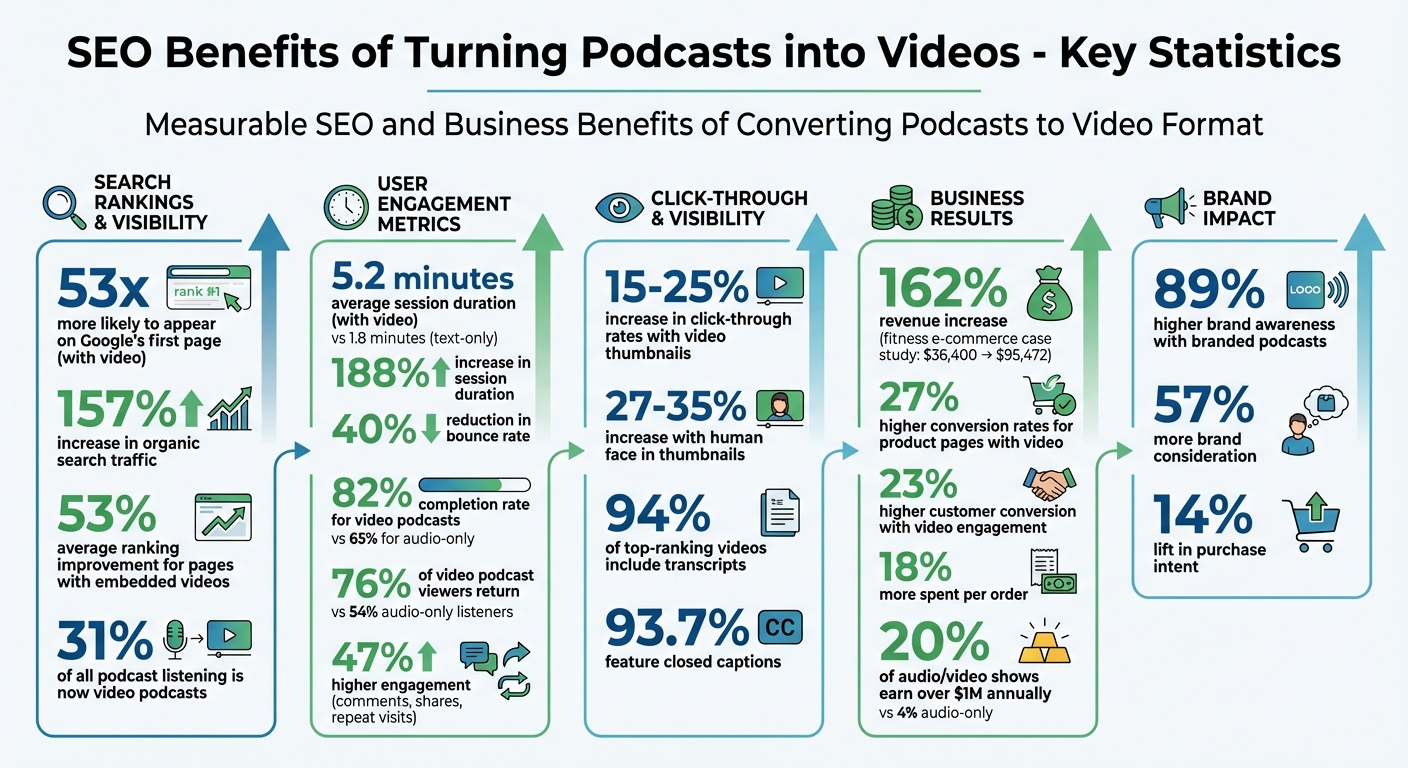
The numbers speak for themselves. Websites with video are 53 times more likely to appear on Google’s first page. Pages with embedded videos see an average ranking improvement of 53%, and video content can drive a 157% increase in organic search traffic.
"Video isn't just a content format anymore. It's become a ranking factor that can push your pages from position three to position one." - Felix Rose-Collins, CEO/CMO, Ranktracker
Engagement metrics also play a big role. Search engines track watch time and dwell time, and video content excels in both areas. Articles with embedded videos keep users on the page for an average of 5.2 minutes, compared to just 1.8 minutes for text-only articles. This longer engagement signals high content value, which search engines reward with better rankings. Video podcasts are especially effective here, as their format naturally holds viewers' attention. By turning your podcasts into videos, you not only sidestep the limitations of audio but also unlock measurable boosts in search rankings.
Companies That Improved Rankings with Video Podcasts
The advantages of video podcasts aren't just theoretical - they’ve driven real, measurable results for businesses across industries.
Take, for example, a fitness equipment e-commerce brand. Over six months, they created 12 videos, including product demos and workout tutorials. These were embedded on their site and uploaded to YouTube with optimized metadata. The results? Monthly organic traffic jumped by 86% - from 12,400 to 23,100 visits - and monthly organic revenue skyrocketed by 162%, increasing from $36,400 to $95,472. Product pages with embedded videos saw an average ranking improvement of 3.2 positions.
Another success story comes from a marketing blog targeting the keyword "AI marketing tools." Initially ranking in positions two and three, they embedded a YouTube video in their article. This single change propelled the page to the coveted position one, where it has stayed.
Then there’s Liveclicker, a provider specializing in interactive video commerce. They analyzed 37 web pages to assess the impact of adding video transcriptions. After including transcripts, the pages saw an average SEO ranking boost of 16% and a notable increase in inbound traffic. This highlights how even the text elements around video content contribute to better rankings.
These examples underline a broader trend: video engagement is becoming a key driver of search performance. The rise of video podcasts - now accounting for 31% of all podcast listening - reflects this shift.
User Engagement Metrics and SEO Performance
Session Duration and Bounce Rate Data
Search engines care about two key factors: how long visitors stay on your site and whether they leave right away. Video podcasts shine in both areas. For example, articles with embedded videos boast an average session duration of 5.2 minutes, compared to just 1.8 minutes for articles without videos. That’s a 188% jump - a clear signal to search engines that the content holds value.
Adding video doesn’t just keep people on your page longer; it also slashes bounce rates by 40% when compared to pages with only text or audio. Why? Because viewers tend to watch at least part of the video, naturally extending their time on the page. This prolonged engagement tells search engines your content is not only relevant but also worth ranking higher.
Here’s another compelling stat: 93.3% of SEO professionals noticed better dwell time after incorporating video content. And longer sessions often translate to a boost of 2 to 4 positions in search rankings . For podcasters, turning audio content into video can entirely transform how search engines perceive and rank your work.
By encouraging longer visits and reducing bounce rates, video content lays the groundwork for stronger click-through rates and better retention, multiplying its SEO impact.
Click-Through and Retention Rates
Video podcasts don’t just keep visitors engaged - they also attract them in the first place. Search results featuring video thumbnails can increase click-through rates by 15% to 25% . And if those thumbnails include a human face, clicks jump even higher - by 27% to 35%. These visuals grab attention and make your content pop in a sea of search results.
Once visitors arrive, video podcasts hold their attention better than audio-only formats. Completion rates for video podcasts hit 82%, compared to just 65% for audio-only content. Adding dynamic elements like B-roll every 30–45 seconds can further boost completion rates by 41%.
Retention doesn’t stop there. 76% of video podcast viewers come back for more, compared to 54% of audio-only listeners. This loyalty often stems from the visual connection viewers feel with hosts. Seeing someone’s facial expressions and reactions builds a sense of familiarity - a "parasocial relationship" that audio simply can’t replicate . The result? Video podcasts drive 47% higher engagement, including more comments, shares, and repeat visits.
"Video not only enriches user experience but also signals deeper engagement. Search engines see how watchers stay longer, exploring more pages."
- Ciaran Connolly, Director, ProfileTree
These metrics - longer watch times, higher click-through rates, and stronger retention - feed directly into SEO performance. Search engines reward content that captivates viewers, using those engagement signals to rank your content higher. By leveraging video podcasts, you’re not just improving user experience - you’re reinforcing your entire SEO strategy.
Using Transcripts and Captions to Improve SEO
How Transcripts Increase Organic Traffic
Search engines can’t watch or listen to your video podcasts - they rely on text to figure out what your content is about. This is where transcripts shine. A 10-minute video alone can provide a substantial amount of text for search engines to index.
Take this example: a tech tutorial channel added transcripts to 50 of its videos. The result? Monthly views skyrocketed from 10,000 to 45,000 - a 350% increase. Ranked search terms jumped from 12 to 67 (a 458% boost), and average video rankings improved from pages 3–4 to pages 1–2. Similarly, when the radio show This American Life transcribed its entire archive, 6.26% of unique search visitors landed directly on transcript pages, significantly increasing organic traffic.
Transcripts also help capture long-tail keywords and natural phrases that your audience is searching for, broadening the range of queries your content can rank for. On top of that, they supply text that search engines can use for featured snippets and "how-to" results.
"Transcripts and captions allow Google to crawl everything that is said in your video, increasing not only your keyword density, but also your keyword diversity."
- Elisa Lewis, Senior Marketing Manager, 3Play Media
To make the most of this, host both your video and its transcript on your own website to ensure proper indexing. Be sure to clearly state your main topic and keywords within the first 30 seconds of the video, as search engines give more weight to the beginning of transcripts. While AI-generated transcripts are over 90% accurate, manually reviewing them for proper nouns, technical terms, and brand names ensures search engines pick up the right keywords.
These strategies not only improve keyword capture but also enhance your overall SEO performance. And while transcripts are key, captions and detailed video descriptions are just as important for boosting visibility.
Captions and Video Descriptions for Search Visibility
Captions, like transcripts, make every spoken word in your video indexable. Saved as text files (e.g., SRT), captions allow search engine bots to process the dialogue. The numbers back this up: 94% of top-ranking videos include transcripts, and 93.7% feature closed captions.
The benefits extend beyond search engines. Captioned videos on YouTube, for instance, saw an average of 7.32% more views in experiments. In one case, a phrase found only in the captions helped a video rank fourth in search results. On Facebook, captions boosted video views by 12%, according to their research.
Descriptions also play a big role. The first 100 characters are particularly important, as search engines use this section to gauge relevance. Including timestamps in your descriptions creates searchable chapters, which Google can index and display as "Key Moments" in search results.
For best results, always upload a clean SRT file since auto-generated captions often contain mistakes that could hurt your SEO. When embedding your video podcast on your website, include the transcript below the player to ensure Google associates the text with your domain. Together, transcripts and captions create a solid foundation for improving your video podcast's SEO and driving organic traffic.
Business Results from Video Podcast SEO
Revenue Growth from Video Podcast SEO
Using video podcast SEO can lead to impressive revenue growth. Take the example of a U.S. fitness equipment brand that, in early 2025, adopted a video-first SEO strategy. By producing 12 videos and three weekly workout tutorials, they saw their monthly organic revenue soar from $36,400 to $95,472 - a 162% increase - in just six months. The key? Embedding videos on product pages and optimizing for YouTube SEO, which also drove a 135% boost in monthly orders and earned them 14 AI citations. With an initial investment of $18,200, their annualized ROI hit an astonishing 3,881%.
But this isn’t limited to e-commerce. A career coach, for instance, repurposed a single podcast episode, "Career Change After Motherhood," into an SEO-optimized blog post. The result? Over 1,000 visitors and five consultation bookings, generating more than $7,000 in revenue. Similarly, a wellness brand specializing in natural supplements worked with a video marketing agency to create a comprehensive campaign featuring brand documentaries and user testimonials. Within six months, their revenue grew 5x, website conversion rates jumped from 1.2% to 4.9%, and customer acquisition costs dropped by 32%.
The data paints a clear picture: product pages with videos placed above the fold convert 27% higher than those without. Additionally, customers who engage with video content convert 23% higher and tend to spend 18% more per order. Video-enhanced podcasts also outperform audio-only formats in revenue potential. In fact, 20% of audio/video shows earn over $1 million annually, compared to just 4% of audio-only podcasts. These revenue gains naturally contribute to broader brand visibility.
Building Brand Reach Through Video Podcasts
Video podcasts don’t just drive revenue - they significantly expand brand reach. With 31% of users discovering new podcasts on YouTube, brands benefit from increased top-of-funnel awareness without needing to spend extra on ads. This matters because branded podcasts deliver 89% higher awareness, 57% more brand consideration, and a 14% lift in purchase intent.
Video content also finds its way into AI-powered search platforms like Perplexity and ChatGPT, offering brands another avenue for visibility and traffic. This creates a ripple effect: video podcasts continue to generate exposure and bring in traffic long after they’re published. Industry experts often refer to this as building a "relationship and ROI engine", where the content does more than just exist - it actively works for the brand.
sbb-itb-5be333f
Why you should transcribe podcasts: A powerful tool for podcast SEO, growth, and discovery | The...
Using Top SEO Marketing Directory for Video Podcast Optimization
Leveraging the SEO potential of video podcasts gets even better when you incorporate specialized tools and expert agencies into your strategy.
Finding Video SEO Tools and Services
The Top SEO Marketing Directory connects marketers with tools tailored to turn podcast audio into search-friendly video content. For transcription needs, platforms like Sonix (priced at $10 per audio hour) and Speechpad (starting at $1.30 per minute) convert audio into text that search engines can index. As Speechpad highlights:
"Search engines are unable to accurately recognize the content within a video... A critical element to video SEO marketing is the ability to transcribe that video content into words that can be crawled."
For repurposing content, the directory features AI clipping tools such as quso.ai (from $29/month), Opus Clip ($19/month), and Descript ($15/month). These tools help create short, engaging video clips optimized for search. Additionally, technical SEO monitoring tools like Google Search Console and GA4 are included to track performance.
Video hosting platforms like Wistia, Vimeo, and YouTube also play a key role. Their advanced SEO features, such as metadata and schema support, improve video discoverability. Together, these tools form a strong foundation for maximizing SEO efforts, streamlining the process from content creation to measurable results.
Working with SEO Agencies for Better Results
While tools are invaluable, partnering with experienced SEO agencies can take your efforts to the next level. The directory helps businesses find services like technical audits, link building, and dynamic rendering. For example, in 2024, Direct Online Marketing (DOM) assisted a premium podcast studio that had lost 73% of its page 1 Google rankings after a site redesign. Within five months, DOM's strategy led to a 621% increase in page 1 rankings, a 125% jump in search sessions, and 1.6 million additional impressions.
These agencies also excel at repurposing podcasts into SEO-optimized formats like blog posts, articles, and short clips. Their workflows can transform a single podcast interview into over 30 strategic assets across search engines, LinkedIn, and sales channels. As John H. Corcoran, Co-Founder of Rise25, puts it:
"A strategic B2B podcast supported by Podcast Production Services becomes an SEO engine, a LinkedIn authority platform, a referral machine, and a sales acceleration tool."
Conclusion
Research shows that turning podcasts into video content offers clear SEO benefits compared to audio-only formats. Studies reveal that websites featuring video are 53 times more likely to rank on Google's first page, and video content can increase session durations by up to 5.2 times compared to text-only pages. Additionally, video podcasting now makes up 31% of all podcast listening. This shift toward prioritizing video isn't just a passing trend - it’s quickly becoming essential for staying competitive as we approach 2026.
These SEO improvements also deliver real business results. For example, a fitness e-commerce brand implemented a six-month video strategy and saw its monthly organic revenue jump from $36,400 to $95,472, a 162% increase. The combination of better search rankings, longer engagement, and multi-platform reach allows a single podcast episode to evolve into a content ecosystem that attracts traffic, builds credibility, and earns backlinks naturally.
What’s more, achieving these gains doesn’t have to break the bank. By using transcripts, metadata, and schema markup, businesses can see a 16% ranking boost while unlocking rich search features. As AI-powered search engines increasingly prioritize video content, the long-term SEO value of video podcasts goes beyond just traditional Google rankings.
Starting small is entirely feasible. Affordable tools like transcription services (starting at $1.30 per minute) and AI-powered clipping tools (as low as $15 per month) make video podcasting accessible. The Top SEO Marketing Directory is another great resource, connecting you with agencies and tools that specialize in podcast-to-video optimization. Whether you need help with technical audits, repurposing workflows, or distribution strategies, this directory offers everything you need to maximize your podcast’s potential.
With the right approach, each podcast episode can become a powerful tool for improving rankings, increasing visibility, and driving measurable business growth.
FAQs
Do I need to film myself, or can I turn audio into a video?
You don’t have to be on camera to transform a podcast into a video. Tools like AI-based platforms or repurposing software can take your audio-only podcast and pair it with engaging visuals to create a compelling video. That said, adding on-camera visuals or speaking directly to the camera can take things up a notch. Videos featuring faces often draw more attention and can even improve SEO performance. Both methods work well - it just depends on what you’re aiming to achieve.
Where should I publish video podcasts for the best SEO impact?
Publishing video podcasts on platforms like YouTube can do wonders for your online presence. As the second largest search engine in the world, YouTube provides unmatched visibility and engagement opportunities. By hosting your video podcasts there, you not only tap into a massive audience but also boost your chances of improving search rankings. It’s a smart way to expand your reach and make your content more discoverable.
How do I add transcripts and captions without hurting SEO?
To include transcripts and captions without affecting SEO, make sure they are accurate, well-structured, and naturally incorporate relevant keywords. This approach helps search engines index your video content effectively, boosting its visibility. Avoid practices like hiding transcripts or using formats that are difficult for search engines to access, as these can hinder indexing. Optimized transcripts and captions add keyword-rich text to your page, working alongside your video to improve search rankings without causing any harm.