Attribution reporting helps marketers understand which touchpoints - ads, emails, social media, or organic search - drive conversions. However, most businesses struggle to turn this data into actionable strategies, leading to wasted budgets and misallocated resources. Common mistakes include over-relying on last-click attribution, inconsistent models across platforms, and failing to track multi-device journeys. Privacy regulations and platform biases further complicate accurate reporting.
Key Takeaways:
- Last-Click Attribution: Overvalues final touchpoints while ignoring discovery channels like SEO and social media.
- Inconsistent Models: Platforms often double-count conversions, inflating results and skewing budget decisions.
- Cross-Device Tracking: Data fragmentation makes it hard to track users across devices, distorting performance insights.
- Platform Bias: Self-reported metrics from platforms like Google and Meta often overstate their role in conversions.
To improve attribution:
- Use multi-touch models to capture the full customer journey.
- Standardize UTM parameters for consistent tracking.
- Implement cross-device tracking and first-party data solutions.
- Test incrementality to measure the true impact of marketing efforts.
Marketing Attribution Mistakes Costing You Sales (And How to Fix Them) feat. Scott Desgrosseilliers
sbb-itb-5be333f
Common Attribution Reporting Mistakes
Attribution reporting often falters in predictable ways. Recognizing these pitfalls can help you avoid wasting resources or misinterpreting your marketing data.
Relying Only on Last-Click Attribution
Last-click attribution assigns all the credit for a sale to the final touchpoint before purchase. While simple, this approach fails to capture the full customer journey.
On average, consumers engage with 5–10+ touchpoints - across devices and channels - before making a purchase. By focusing only on the last click, businesses undervalue the channels that spark initial interest, like social media, influencer campaigns, and SEO tools. These channels often require multiple interactions to influence a sale. As a result, they frequently lose funding because they rarely drive the final click.
Meanwhile, branded search and retargeting campaigns get over-credited. These channels primarily capture existing demand rather than generating new interest. In fact, 60–80% of branded search clicks would likely convert through direct traffic anyway. As Sushil Goel from LayerFive explains:
Last-click attribution doesn't measure performance. It measures who had the good fortune to be last in line.
Brands that cut spending on top-of-funnel channels based on last-click data may see a short-term boost in return on ad spend (ROAS). However, over time, their pipeline of new customers dries up because they’ve stopped creating demand. For example, 53% of shoppers discover products via social media, yet these discovery moments receive zero credit in last-click models.
Privacy changes have made this problem worse. Safari cookies often expire within 24 hours, causing returning visitors to appear as new "last-click" converters. With 76% of brands now investing in multi-touch attribution to address these flaws, it’s clear that last-click attribution no longer suffices.
Next, let’s explore the challenges of using inconsistent attribution models across platforms.
Using Different Attribution Models Across Platforms
Every major platform - Meta, Google, TikTok - uses its own tracking system, attribution windows, and logic. This creates a "walled garden" effect, where 66% of digital marketers identify attribution modeling as their biggest challenge when managing multi-channel campaigns.
A common issue is double-counting. If a user interacts with a Facebook ad, a Google ad, and an email before purchasing, each platform might claim full credit for the sale. This inflates reported revenue across dashboards, often exceeding the company’s actual earnings.
For example, in 2025, Billy Footwear addressed this issue by adopting LayerFive’s identity-resolved attribution system. By relying on first-party data to track customer journeys instead of platform-reported metrics, the company increased ad revenue by 72% year-over-year while raising ad spend by just 7%. This success came from reallocating budgets away from over-credited channels to those driving true growth.
Platforms have a vested interest in over-reporting their role in conversions to justify ad spend. Using different models across platforms fragments the customer journey into isolated events. This leads to poor budget decisions, often cutting funding for top-of-funnel channels that build awareness.
Now, let’s look at how cross-device tracking complicates attribution further.
Cross-Device Tracking and Data Fragmentation
The average U.S. household now has 21 connected devices, and over 60% of online purchases involve multiple devices. However, devices don’t share data seamlessly, leaving gaps in user behavior tracking.
This fragmentation creates "data islands", where a single user appears as multiple anonymous visitors. Without robust cross-device tracking, channels like social media or mobile ads often seem ineffective because they generate awareness on one device while conversions happen on another.
Privacy measures add another layer of complexity. Apple’s App Tracking Transparency framework has opt-in rates of just 25%, while Safari cookies often expire after 24 hours. With third-party cookies largely blocked by Safari and Firefox, marketers lose visibility into the full customer journey.
Adding to the challenge, enterprises typically use 23 tools in their Go-To-Market tech stacks. Each tool uses proprietary tracking methods, leading to conflicting reports where multiple channels claim credit for the same conversion. However, businesses that implement cross-device tracking report 20–30% better insights into customer behavior, making it a worthwhile investment.
Data fragmentation undermines accurate performance analysis and distorts budget allocation.
Platform Self-Attribution Bias
Marketing platforms have a built-in incentive to overstate their role in conversions. This bias often results in conflicting reports, where the sum of platform-reported conversions far exceeds actual revenue. Unsurprisingly, 51% of CTOs say they don’t trust data from marketing platforms due to these inaccuracies.
Platforms like Google and Meta restrict access to raw data, forcing marketers to rely on self-reported metrics. These metrics are often inflated to justify ad spend.
The financial impact is staggering. Brands waste an estimated 47% of their marketing budgets - over $66 billion annually in e-commerce - due to inaccurate metrics and data gaps. This bias skews credit toward certain touchpoints, leading teams to over-invest in seemingly high-performing channels while neglecting those that actually generate demand.
To address this, businesses need a centralized analytics platform that serves as a single source of truth. This approach ensures accurate reporting and better decision-making.
Challenges in Setting Up Attribution Reporting
Extracting useful insights from attribution reporting isn't as simple as it sounds. Businesses often underestimate the technical and organizational challenges involved. Success requires integrating complex systems, maintaining high-quality data, and aligning teams across the organization.
Underestimating Setup Complexity
Setting up attribution reporting can feel like piecing together a massive puzzle. It involves linking multiple data sources, cleaning up inconsistencies, and figuring out how to track users across devices. With 10–20 platforms in a typical marketing tools and services - each with its own tracking methods - this task can get overwhelming fast.
One of the biggest hurdles is resolving user identities across devices. Without this, a single customer’s journey can split into several anonymous records, making it nearly impossible to get a clear picture. On top of that, privacy laws like GDPR and CCPA, combined with changes like iOS 14.5 and the decline of third-party cookies, have made cross-device tracking even harder.
Then there’s the issue of data quality. Messy data can create problems like mismatched UTM parameters, missing tracking information, duplicate customer profiles, and bot traffic distorting your numbers. To tackle these problems, businesses are turning to solutions like server-side tracking and standardizing UTM parameters across all marketing channels.
Given these challenges, selecting the right attribution model becomes critical to fully capture the customer journey.
Using Only One Attribution Model
Relying on a single attribution model can give you a skewed view of your data. Single-touch models, like first-click or last-click, only credit one interaction, ignoring the other steps in the customer journey. This is a big problem since most customer journeys involve 8 to 12 touchpoints before a purchase.
Switching to a multi-touch model can reveal a lot. For example, moving from last-click to position-based attribution has been shown to increase attributed SEO revenue by 200–300%. It also highlights organic search’s role in 45% of conversion paths, compared to just 15% under last-click attribution. Without this broader view, you risk missing key insights about which touchpoints are driving conversions.
Many companies use multiple models at the same time. For instance, they might rely on last-click for short-term campaign decisions while using position-based or data-driven models to guide long-term budget planning. Matching the model to your sales cycle is also important. Time-decay models work well for short sales cycles, while position-based or W-shaped models are better for longer B2B cycles. To validate these models, marketers often use incrementality testing, like geo-holdout tests, to measure a channel’s true impact rather than just correlations.
A well-thought-out attribution plan is essential to make sense of these models and align them with your business goals.
Missing a Clear Attribution Plan
Even the most advanced tools can’t fix a broken system. As Charlie Saunders, Founder of CS2, puts it:
Adding an attribution tool to this mess [unprocessed data and broken sales handoffs] is a terrible idea... They can't magically fix all the gaps in data and process for you.
Without a clear plan, you’ll struggle to create reliable reports. A solid attribution plan ensures that marketing, sales, and finance teams are all on the same page, agreeing on a "single source of truth." This prevents internal debates over which department gets credit for revenue. For large enterprise deals, which can take an average of 417 touchpoints to close, tracking and categorizing every interaction is essential.
Before rolling out any new tool, it’s crucial to align stakeholders. Agree on definitions for terms like MQLs, SQLs, and "conversions." Document a taxonomy of touchpoints - such as campaigns, events, and sales outreach - and map them to specific stages of the funnel. Consistent UTM governance is also key to keeping campaign names and URL parameters in order over time. Instead of looking for one "perfect" attribution model, use different models for different purposes. For example, first-touch attribution might be ideal for awareness campaigns, while a W-shaped model works better for analyzing pipeline performance.
How to Prevent Attribution Reporting Mistakes
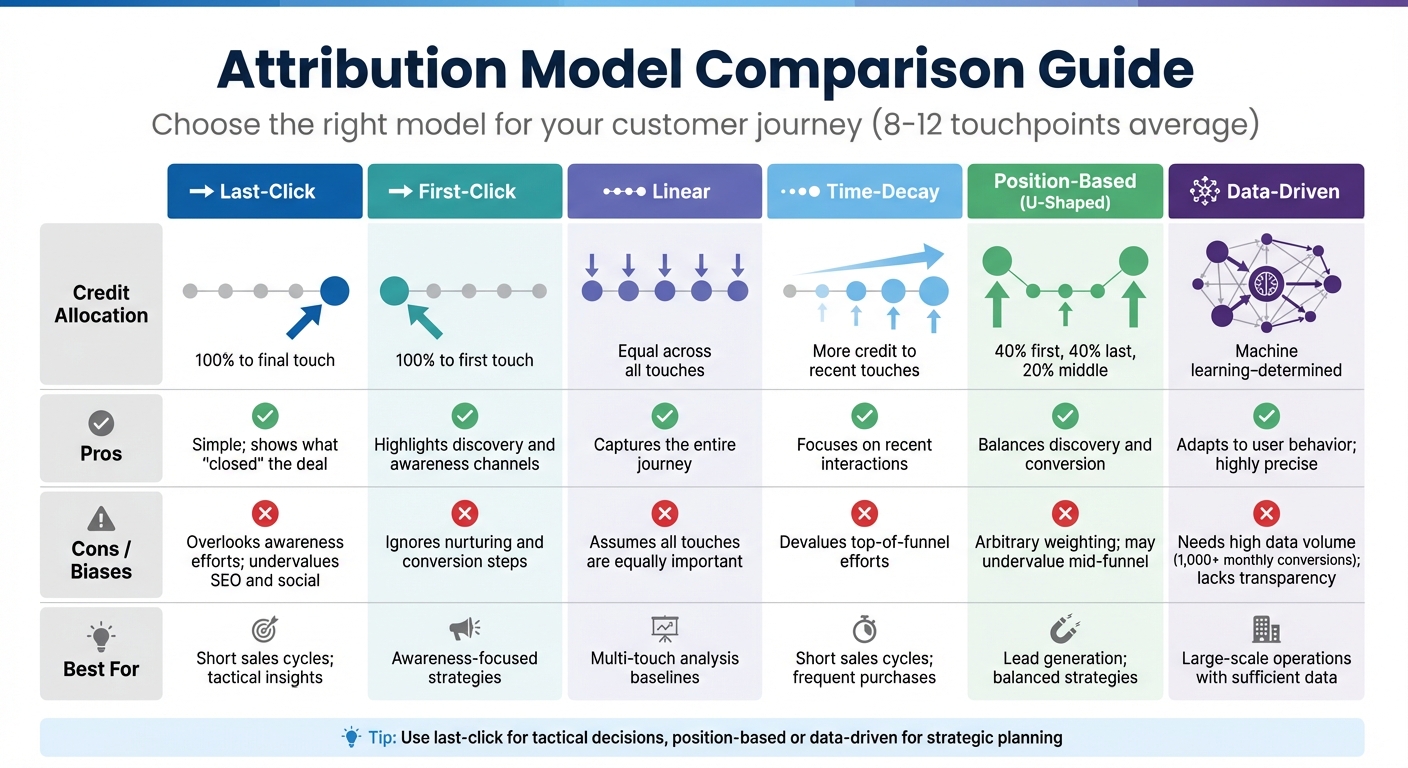
Attribution Model Comparison: Credit Allocation and Best Use Cases
Once you've identified common attribution pitfalls and setup challenges, it's time to focus on strategies to prevent these errors. A systematic approach - using clear models, clean data, and the right tools - can make a big difference. As Michael Torres, Head of Analytics at PxlPeak, puts it:
"The goal isn't perfect attribution. The goal is making better marketing decisions with imperfect information."
Attribution Model Comparison
To avoid mistakes, choose an attribution model that reflects your customer's typical journey of 8–12 touchpoints before making a purchase. Here's a breakdown of popular models and how they can help:
| Model | Credit Allocation | Pros | Cons/Biases | Best For |
|---|---|---|---|---|
| Last-Click | 100% to final touch | Simple; shows what "closed" the deal | Overlooks awareness efforts; undervalues SEO and social | Short sales cycles; tactical insights |
| First-Click | 100% to first touch | Highlights discovery and awareness channels | Ignores nurturing and conversion steps | Awareness-focused strategies |
| Linear | Equal across all touches | Captures the entire journey | Assumes all touches are equally important | Multi-touch analysis baselines |
| Time-Decay | More credit to recent touches | Focuses on recent interactions | Devalues top-of-funnel efforts | Short sales cycles; frequent purchases |
| Position-Based (U-Shaped) | 40% first, 40% last, 20% middle | Balances discovery and conversion | Arbitrary weighting; may undervalue mid-funnel | Lead generation; balanced strategies |
| Data-Driven | Machine learning–determined | Adapts to user behavior; highly precise | Needs high data volume (1,000+ monthly conversions); lacks transparency | Large-scale operations with sufficient data |
For tactical, day-to-day decisions, last-click models can be helpful. For broader, strategic planning - like quarterly budget allocations - position-based or data-driven models are better suited.
Best Practices for Accurate Attribution
To ensure accuracy, start by establishing a single source of truth. Use an independent analytics platform to reconcile data across channels. Relying on platform-specific dashboards, like those from Meta or Google, can lead to inflated conversion reports. For example, if a customer interacts with a Facebook ad, a Google ad, and an email before converting, each platform might claim full credit - resulting in a combined 300% of the actual revenue.
Here are some steps to refine your attribution process:
- Standardize UTM Parameters: Use a documented taxonomy for
utm_source,utm_medium,utm_campaign,utm_content, andutm_term. This avoids "dark traffic" being misclassified as direct or organic. - Audit Campaign Links: Regularly check your links to ensure proper tracking.
- Adjust Lookback Windows: Depending on your sales cycle, set a 30-, 60-, or 90-day window to capture the full customer journey. Research shows that B2B buyers interact with 7 to 13 pieces of content before purchasing.
- Test Incrementality: Use geo-holdout tests or lift studies to determine how much of your conversions are directly driven by marketing versus those that would have happened organically.
Additionally, adopt first-party data and server-side tracking. Advanced first-party identity resolution can improve identification rates by 2 to 5 times compared to cookie-based tools. This is especially important since over 60% of online transactions involve multiple devices.
Using Top SEO Marketing Directory for Attribution Tools

To enhance your attribution strategy, consider leveraging tools from the Top SEO Marketing Directory. This resource simplifies the process of finding analytics, tracking, and SEO tools that support accurate attribution.
The directory organizes tools by category, helping you find solutions for cross-platform data integration, identity resolution, and UTM management. It also offers flexible pricing plans:
- Basic Plan (Free): Compare SEO tools and services side-by-side.
- Premium Plan ($49/month): Access advanced analytics tools and agency listings.
- Enterprise Plan: Tailored for businesses managing complex, multi-platform attribution.
Conclusion
Attribution reporting has redefined marketing, turning it from a cost center into a driver of profit. As Sushil Goel from LayerFive explains:
Marketing attribution has evolved from a nice-to-have reporting feature into mission-critical growth infrastructure.
By addressing common pitfalls, you can clearly demonstrate how every marketing dollar contributes to measurable outcomes.
Single-touch attribution models often mislead teams, potentially wasting millions of dollars on misallocated budgets. On the flip side, multi-touch attribution offers immense potential - boosting ROI by up to 20% by reallocating resources to underappreciated channels. For example, SEO, which typically involves around 10 touchpoints per sale, benefits greatly from more advanced attribution models, uncovering value that simpler methods overlook entirely.
To move forward effectively, focus on three key actions: standardize data collection with Google Analytics with consistent UTM tagging, extend attribution windows to align with your sales cycle, and test multiple models simultaneously to uncover undervalued channels. These steps lay the groundwork for accurate insights and better collaboration across teams. As tracking evolves toward privacy-focused and AI-driven methods, these practices are becoming even more essential.
High-quality, identity-resolved attribution data is no longer optional. It’s the backbone of automated optimization and personalized marketing at scale. When your data is unified, budgeting becomes more precise, and strategic planning improves.
John Wanamaker’s timeless observation still resonates:
Half the money I spend on advertising is wasted; the trouble is I don't know which half.
Now, you have the tools to solve that puzzle. Use them to turn insights into measurable growth.
FAQs
How do I choose the right attribution model for my business?
To choose the best attribution model, start by examining your customer journey and how your audience engages with your marketing channels. Depending on your sales process and objectives, you might explore options like last-click, multi-touch, or data-driven models.
For instance, multi-touch models can provide deeper insights by crediting multiple touchpoints in the journey, but they often demand more sophisticated data analysis. The real challenge is finding the right balance between accuracy, complexity, and what works best for your business. This balance will help you make smarter, more informed marketing decisions.
What’s the simplest way to fix messy or inconsistent UTM tracking?
To keep things straightforward, stick to consistent tagging practices. For example, use lowercase for all source, medium, and campaign names across your campaigns. Before launching, always validate your UTM links to catch any typos or missing parameters. These simple steps can lead to cleaner, more reliable data and better attribution accuracy.
How can I measure incrementality without risking revenue?
To understand the real impact of your marketing efforts without jeopardizing revenue, rely on controlled testing methods such as experiments or randomized trials. These methods allow you to compare a group exposed to your campaign with a control group that isn’t. By doing this, you can pinpoint which conversions are directly tied to your campaign. This not only gives you a clearer picture of incremental revenue but also helps you make smarter decisions about optimizing your marketing budget.