Automated keyword clustering tools save hours of manual effort by grouping related keywords based on search intent and SERP data. These tools are essential for SEO strategies in 2025, helping prevent keyword cannibalization, create content clusters, and align with Google’s focus on topical authority. Here’s a quick look at the top tools:
- Answer Socrates: Affordable and beginner-friendly with semantic clustering and question discovery. Free plan available; paid plans start at $9/month.
- Search Atlas: AI-driven topical mapping, ideal for large-scale content strategies. Starts at $99/month, no free trial.
- Semrush Keyword Strategy Builder: SERP-based clustering integrated with Semrush’s ecosystem. Handles up to 10,000 keywords/project. Starts at $119.95/month with a 14-day free trial.
- Keyword Insights: Offers 100% clustering accuracy using live SERP data. $1 trial available; full plan at $58/month.
- SE Ranking Keyword Grouper: Flexible SERP clustering with integration into SE Ranking tools. Starts at $55/month with a free trial.
- Cluster AI: Credit-based pricing for large-scale clustering. Pay-per-batch system starting around $10.
- KeyClusters: Pay-per-use SERP overlap clustering. Costs $9 per 1,000 keywords with no subscription required.
- Writesonic Keyword Clustering: Combines clustering with AI content creation. Starts at $19/month with a 7-day free trial.
These tools cater to different needs, from startups to agencies managing thousands of keywords. For a quick visual comparison, see the table below.

2025 Automated Keyword Clustering Tools Comparison: Features, Pricing & Trials
Best Free & Paid Keyword Clustering Tools for SEO (2025 Review)
Quick Comparison
| Tool | Clustering Method | Max Keywords Per Process | Starting Price (USD) | Trial Option |
|---|---|---|---|---|
| Answer Socrates | Semantic/ML | ~1,500 (free), 3,000+ (paid) | $9/month | Free plan available |
| Search Atlas | SERP-informed/Topical mapping | Tens of thousands | $99/month | No free trial |
| Semrush Keyword Strategy Builder | SERP-based/Hybrid | Up to 10,000/project | $119.95/month | 14-day free trial |
| Keyword Insights | SERP-based (live data) | Several thousand | $58/month | $1 trial |
| SE Ranking Keyword Grouper | SERP similarity/overlap | Thousands | $55/month | Free trial available |
| Cluster AI | SERP similarity | Thousands per upload | ~$10+ (credit-based) | Varies by plan |
| KeyClusters | SERP overlap | Pay-per-use | $9 per 1,000 keywords | No subscription required |
| Writesonic Keyword Clustering | Semantic/NLP + SERP signals | Several thousand | $19/month | 7-day free trial |
Choose a tool based on your budget, project size, and workflow needs. Whether you’re managing a small blog or a large-scale agency, there’s a tool to streamline your keyword clustering process.
1. Answer Socrates

Answer Socrates takes a fresh approach to keyword research by leveraging AI-powered semantic clustering rather than relying on traditional SERP overlap. Its machine learning algorithms group related keywords based on semantic similarity and common question patterns. One of its standout features is the recursive question search, which digs deeper into your seed keywords to surface related questions - perfect for creating FAQ sections or brainstorming content ideas.
Using the tool is straightforward. Just upload a CSV file, and Answer Socrates quickly organizes your keywords into clusters. During testing, it processed a keyword list into 44 clusters with 66.51% coverage in only 3 minutes. The free plan includes 1,500 monthly credits (1 credit per keyword), 3 daily searches, and 1 recursive search. Paid plans start at $9/month for 3,000 credits, making it an affordable choice for many users.
Integration is seamless, thanks to CSV export functionality. You can upload keyword lists from tools like Ahrefs or SEMrush, cluster them instantly, and download the results for use in Google Sheets or any content planning software. This workflow makes it easy to compare strategies across different tools.
In comparative testing, Answer Socrates earned a score of 42/100. While it excels in pattern analysis and question discovery, it lacks the precision needed for advanced SEO tasks. This makes it a better fit for smaller projects or startups looking to enhance their content strategies without breaking the bank.
2. Search Atlas

Search Atlas takes a topic-first approach to content planning, leveraging advanced clustering techniques. Using AI-driven topical mapping, the tool starts with a seed keyword, automatically identifies related queries, and organizes them into topic clusters. By analyzing SERP data and semantic relationships, it helps create content hierarchies that align with search intent - making it a strong choice for enterprise-level content strategies.
In independent testing, Search Atlas produced an impressive 345 clusters in just 2 minutes, earning a score of 50/100 for its ideation capabilities. However, one drawback is its inability to upload CSV files, which means it doesn't support importing pre-researched data from tools like Ahrefs or SEMrush. This makes it more suitable for workflows that begin with fresh seed keywords rather than those that rely on existing datasets.
The platform integrates topical maps directly into editorial calendars and content briefs, streamlining the planning process. Agencies, in particular, benefit from its multi-project setup, which keeps clusters and reports well-organized.
Pricing starts at $99 per month, with no free plan or trial available. This positions Search Atlas as a premium tool designed for agencies and in-house teams with larger budgets, offering a comprehensive SEO suite tailored to their needs.
3. Semrush Keyword Strategy Builder

The Semrush Keyword Strategy Builder uses SERP-based clustering to group keywords by their topical similarity and competitive overlap. This approach ensures the clusters reflect actual user intent, rather than just semantic relationships. The tool simplifies the process by automatically organizing keyword lists into structured groups, creating a clear framework for pillar pages and subtopics in one step.
The automation can handle up to 10,000 keywords in a single run, typically finishing in about 15 minutes. You can start with up to five seed keywords per project, and the tool organizes related terms pulled from the Keyword Magic Tool or uploaded via CSV. In independent tests, the tool created 25 clusters with 83% coverage from a standard keyword set and achieved an efficiency score of 52/100. While this score trails behind specialized clustering tools, the real advantage lies in its seamless integration with Semrush’s ecosystem of over 50 SEO tools. This integration allows clusters to flow directly into tools like Position Tracking, the Content Marketing Toolkit, and the On-Page SEO Checker - eliminating the need for manual exports and saving time.
The platform also visualizes clusters as interactive mind maps and tables, making it easier for teams to grasp site structure and the relationships between pillar and supporting content. It’s highly workflow-friendly, allowing you to import keywords via CSV or pull them directly from Semrush’s database. Refined clusters can then be exported to planning tools like Google Sheets for further use.
Semrush pricing starts at $119.99 per month for the Pro plan, with the Guru plan at $229.99 per month and the Business plan at $449.99 per month. While there isn’t a standalone free tier, Semrush offers a 14-day free trial of its full suite, giving users a chance to explore its capabilities. This makes it a premium solution, particularly suited for agencies and in-house teams already using - or planning to use - Semrush as their primary SEO platform.
4. Keyword Insights
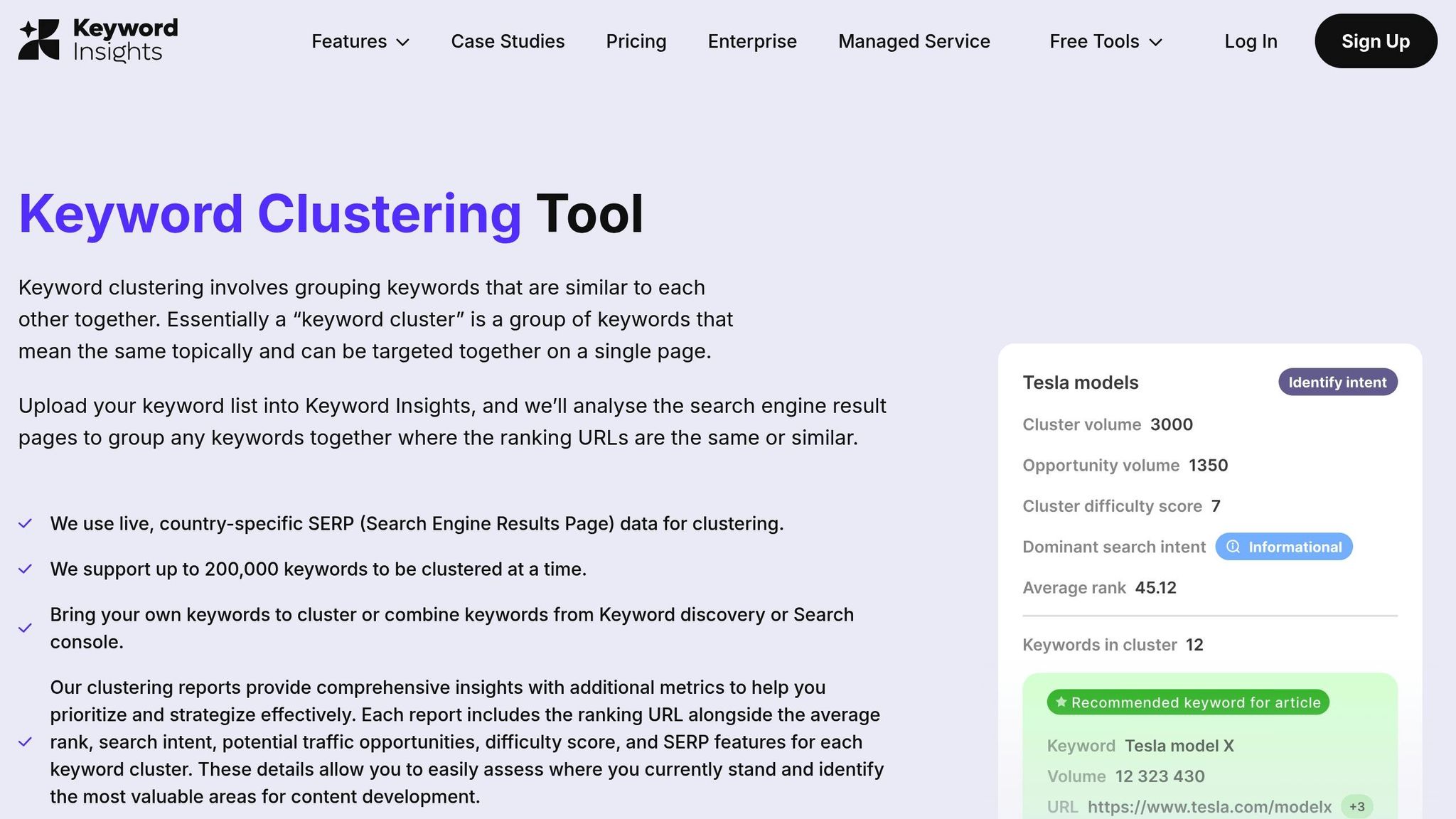
Keyword Insights uses a SERP-based clustering approach to analyze live Google search results. It groups keywords by ranking overlap and user intent, identifying which keywords share the same top-ranking URLs. This helps determine whether certain keywords can rank on a single page or require separate content. During testing, the tool demonstrated impressive efficiency, achieving 100% coverage and generating 141 clusters in just 17 minutes. It earned a score of 95/100 for its accuracy and smooth workflow integration.
The tool simplifies keyword management by offering flexible input and export options. You can upload keywords via CSV or enter them manually, and the tool instantly organizes them based on search intent and ranking patterns. This SERP-driven clustering method helps avoid keyword cannibalization by clearly showing which terms should be grouped on one URL and which need separate pages. Once clustered, the data can be exported to CSV or Google Sheets, making it easy to share with content teams or integrate into project management systems.
What sets Keyword Insights apart is its ability to cover the entire SEO workflow. Beyond clustering, it supports the creation of optimized content briefs and tracks performance. This makes it a great choice for agencies or in-house teams managing large content sites or SaaS projects, where organizing thousands of keywords into actionable clusters is crucial. The platform also integrates with other keyword research tools, allowing for deeper clustering and content planning.
The pricing is straightforward and accessible. It starts with a $1 trial, which scored 89/100 during testing, offering a low-risk way to explore the tool’s capabilities. The Pro plan costs $58 per month, providing unlimited advanced features like higher keyword limits and full workflow access. All prices are listed in USD. While there’s no permanent free tier, the trial offers enough functionality to help you decide if the tool meets your needs.
For those evaluating multiple SEO tools, resources like the Top SEO Marketing Directory can help you compare clustering platforms alongside other keyword research and content optimization solutions.
sbb-itb-5be333f
5. SE Ranking Keyword Grouper
The SE Ranking Keyword Grouper uses SERP analysis to cluster keywords by analyzing URL overlaps in Google’s top results. When keywords share 3–5 top-10 URLs, they’re grouped together, signaling they could be targeted on a single page. You can fine-tune the clustering level - stricter settings result in smaller, more focused groups, while looser settings create broader topic clusters. This approach mirrors how Google understands search intent, minimizing the risk of over-separating synonyms or closely related terms. The tool’s interface is designed to make this process smooth and efficient.
With its SERP-based foundation, the Keyword Grouper offers an automated workflow from start to finish. You can import keywords via CSV, copy-paste, or pull them directly from SE Ranking’s research or rank tracking tools. From there, select your target region (e.g., Google United States), device type, and clustering settings before running the process. The tool automatically retrieves SERPs, calculates URL overlaps, and organizes your keywords into clusters in just minutes - perfect for small to medium-sized lists. Once the clusters are ready, you can refine them in the interface by merging or splitting groups, renaming them to align with page topics, and marking primary keywords based on search volume and difficulty. When finished, export your clusters as a CSV or integrate them directly into SE Ranking’s content planning tools.
The tool’s integration with the broader SE Ranking platform makes it especially convenient. After creating clusters, you can seamlessly use them in SE Ranking’s content marketing and on-page SEO tools for optimization and SERP tracking. This end-to-end workflow - covering keyword discovery, clustering, and performance monitoring - all within one platform is particularly useful for agencies already relying on SE Ranking for audits and reporting.
Each cluster includes key metrics like search volume, keyword difficulty, and CPC, which are critical for prioritizing efforts in the U.S. market. You can filter or sort clusters by these metrics to identify high-traffic opportunities or focus on long-tail keywords that are easier to rank for. The platform also supports tagging and labeling, allowing teams to organize clusters by funnel stage, content type, or client, making collaboration more streamlined.
Pricing starts at $40–$60 per month (USD) for monthly billing, with discounts for annual plans. The Keyword Grouper operates on a credit-based system, where limits depend on the number of keywords or projects processed monthly. Higher-tier plans are ideal for agencies or larger teams managing extensive projects. SE Ranking also offers a 14-day free trial, which includes access to the Keyword Grouper with limited functionality - enough to test a few hundred keywords and assess how well the tool aligns with your content strategy.
6. Cluster AI
Cluster AI is a keyword clustering tool built for SEO teams, designed to handle large keyword lists by analyzing live SERP data. Instead of just looking at text similarity, it focuses on which URLs rank for each query. If two keywords, like "best running shoes" and "top running shoes", share 2–3 identical URLs in the top search results, they’re grouped together. This allows a single page to target both keywords effectively, minimizing the risk of keyword cannibalization. By simplifying the clustering process, Cluster AI helps create a more efficient SEO workflow.
The tool automates the entire process - from uploading a CSV file to exporting the final clusters. It scrapes Google SERPs, calculates URL overlap, and determines primary and supporting keywords for each cluster based on search volume or SERP dominance. Once the clustering is done, users can download the results in a CSV or Excel format, complete with cluster names, main keywords, and supporting terms. This data can then be easily integrated into content briefs, editorial calendars, or tools like Asana and Trello.
Cluster AI fits naturally into existing SEO workflows. For instance, teams can gather keyword lists from platforms like Semrush or Ahrefs, export them, and upload them directly to Cluster AI. Each cluster is then mapped to a single page or article, with the highest-volume keyword serving as the primary focus and related terms included as subheadings or FAQs. This ensures that every page targets a specific search intent, avoiding internal competition and aligning with the growing trend of automated, SERP-driven strategies.
The tool is especially useful for large-scale content projects where manually grouping keywords would be overwhelming. For example, a U.S.-based ecommerce site launching a home gym equipment category might process over 20,000 keywords through Cluster AI. The resulting clusters could define category pages, subcategories, and long-form guides. Similarly, agencies conducting content audits can use Cluster AI to identify overlapping posts - like multiple articles on "email marketing tips" - and decide which URLs to merge or redirect, reducing cannibalization.
Cluster AI’s pricing model adds to its appeal. Instead of a flat monthly subscription, it typically operates on a credit-based or pay-per-batch system. This makes it a cost-effective choice for U.S. agencies and freelancers who need enterprise-level clustering without committing to high recurring fees. Pricing is listed in USD, and while there’s no permanent free plan, limited free trials or small test runs are often available, allowing users to evaluate the tool before committing to larger projects.
For marketers looking to expand their SEO toolkit, resources like the Top SEO Marketing Directory can help discover additional tools and agencies that integrate well into workflows alongside Cluster AI.
7. KeyClusters

KeyClusters takes a unique approach to keyword clustering by focusing on SERP-overlap methodology. Instead of relying on semantic similarity, it analyzes real-time Google search results to group keywords based on significant URL overlap. This method provides a clear picture of search intent and helps identify potential keyword cannibalization by showing which pages consistently rank together.
The tool is straightforward to use. You can upload a CSV keyword list from platforms like Semrush or Ahrefs, and KeyClusters will process it to deliver clusters. These clusters include essential details like group names, member keywords, search volumes, and primary keyword suggestions. The output is designed to integrate smoothly with spreadsheets, content briefs, or project management tools like Asana. While its interface is simple, the tool delivers fast and efficient results.
For instance, an ecommerce team in the U.S. might export a list of around 1,200 mid-volume keywords related to "SEO tools" from Semrush. At a cost of roughly $9 per 1,000 keywords, KeyClusters processes these into SERP-based clusters. Each cluster can then be assigned to a single content page, reducing the risk of internal competition. The results, available in CSV format, can be easily synced with editorial calendars or other SEO platforms.
One standout feature of KeyClusters is its pay-per-use pricing model. Unlike subscription-based tools, you only pay when processing keywords, offering flexibility for agencies and freelancers who need clustering on demand. While the tool doesn’t offer a free plan or permanent trial, its low entry cost makes it an affordable option for testing smaller projects before committing to larger ones. This pricing structure is especially appealing for quick, one-off tasks.
KeyClusters is best viewed as a specialized tool for clustering and checking keyword cannibalization. Its SERP-focused approach ensures accurate, intent-driven keyword groups, making it an excellent choice for content planning and audits. For those seeking more SEO tools, the Top SEO Marketing Directory provides a curated list of resources for keyword research, technical SEO, and content optimization.
8. Writesonic Keyword Clustering
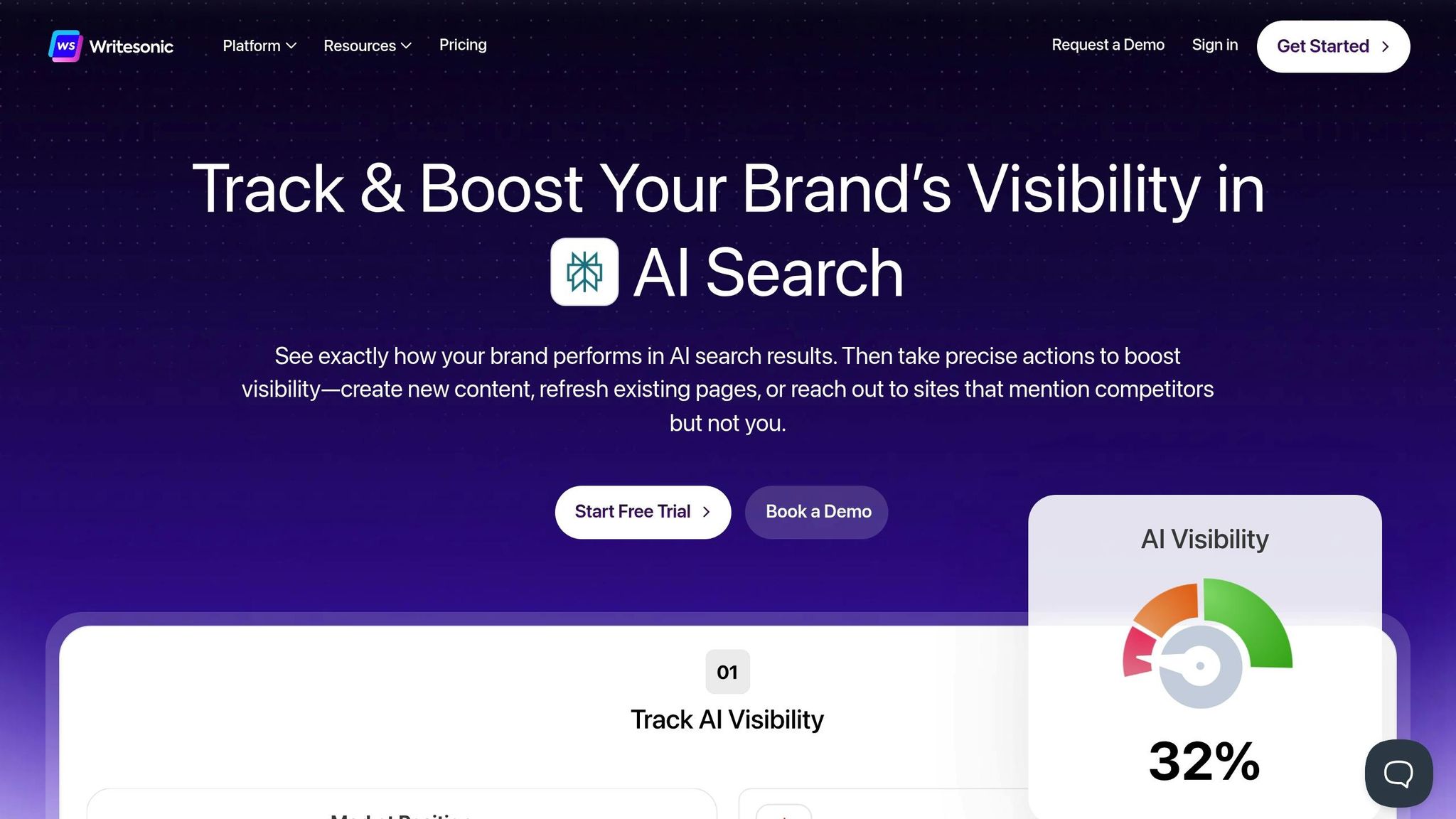
Writesonic Keyword Clustering leverages AI to organize keywords based on search intent, topical relevance, and SERP similarities. What sets it apart from standalone clustering tools is its integration with AI-driven content creation. This means keyword clusters can be transformed into outlines and articles almost instantly, making it a practical choice for content teams looking for an all-in-one solution.
The platform’s automation features are designed to streamline workflows and cut down on manual effort. For example, uploading a single CSV file prompts the AI to analyze SERPs and group keywords according to search intent. Once the clusters are ready, they’re automatically fed into Writesonic’s content creation system, producing content briefs and outlines in seconds. According to tests, this automation reduces keyword grouping time by 80%. Additionally, users can export clusters in CSV format for easy integration with other tools.
When it comes to performance, Writesonic processed 16 keywords in about 2 minutes during comparative testing, scoring 61 out of 100 for clustering accuracy. While its speed is impressive, its accuracy falls short of specialized tools like Keyword Insights. Specific metrics for similarity match rates weren’t available, but experts emphasize Writesonic’s strength lies in its ability to handle complete content workflows. This makes it an excellent choice for teams that value integrated content creation over pinpoint clustering precision.
Pricing for Writesonic is straightforward. The basic plan starts at $19 per month, offering limited clustering credits, while premium plans begin at $99 per month and include unlimited clustering along with advanced AI features. Although there’s no standalone free plan, a 7-day free trial allows users to test clustering for up to 500 keywords. All prices are listed in USD, with no hidden fees. This pricing structure is ideal for teams with ongoing content needs but may not be as cost-effective for agencies or freelancers with less frequent requirements.
For teams focused on creating content immediately after grouping keywords, Writesonic’s seamless transition from clusters to outlines can be a significant time-saver. To explore more SEO tools, check out the Top SEO Marketing Directory.
Comparison Table
Here’s a quick look at eight automated keyword clustering tools, comparing their methods, automation features, keyword limits, pricing, and trial availability. This table is designed to help you find the right fit for your SEO needs.
SERP-driven tools excel at grouping keywords for precise single-page targeting. On the other hand, semantic and hybrid methods prioritize speed but might group keywords with different search intents. For context, small businesses typically handle 1,500–3,000 keywords monthly, while agencies often process over 10,000. Automation levels range from fully hands-off workflows to tools that assist with content planning.
Check out the table below to see which solution aligns with your workflow and budget:
| Tool | Clustering Method | Automation Features | Max Keywords Per Process | Starting Price (USD) | Trial Option |
|---|---|---|---|---|---|
| Answer Socrates | Semantic/ML | Auto CSV upload, SERP scraping, cluster export | ~1,500 keywords/month (free); 3,000+ (paid) | Free / $9/month | Free plan available |
| Search Atlas | SERP-informed/Topical mapping | Auto topical maps, keyword discovery, content briefs | Tens of thousands/month | $99/month | No free trial |
| Semrush Keyword Strategy Builder | SERP-based/Hybrid | Auto grouping, intent tagging, content templates | Up to 10,000 keywords/project | $119.95/month | 14-day free trial |
| Keyword Insights | SERP-based (live data) | Full auto: SERP fetch, clustering, intent labels, briefs | Several thousand/month | $58/month | $1 trial |
| SE Ranking Keyword Grouper | SERP similarity/overlap | Auto SERP collection, user-defined thresholds, export | Thousands per campaign | From $55/month | Free trial available |
| Cluster AI | SERP similarity | Auto SERP data, main/supporting keyword mapping | Thousands per upload (credit-based) | ~$10+ (credit tiers) | Varies by plan |
| KeyClusters | Pure SERP overlap | Auto clustering via CSV with a minimal interface | Pay-per-use (large batches supported) | $9 per 1,000 keywords | No subscription required |
| Writesonic Keyword Clustering | Semantic/NLP + SERP signals | Auto clustering → AI content generation, outlines | Several thousand/month | $19/month | 7-day free trial (up to 500 keywords) |
Conclusion
In 2025, automated keyword clustering tools have become a cornerstone of effective SEO strategies. These tools replace the tedious process of manually sorting through spreadsheets, delivering well-organized keyword clusters in just minutes. This efficiency speeds up content planning and execution, paving the way for more targeted and streamlined content strategies.
SERP-based tools like Search Atlas and Semrush Keyword Strategy Builder excel in grouping keywords with shared ranking potential. Premium options boast an impressive 95–100% coverage during testing. This level of precision helps prevent keyword cannibalization while establishing topical authority - two key factors as Google's algorithms increasingly favor comprehensive content that aligns with user intent.
Getting started is simple and affordable. Free options like Answer Socrates (offering 1,500 monthly credits) or low-cost trials like the $1 plan from Keyword Insights allow you to test results against manual grouping. For larger-scale projects, pay-per-use plans such as KeyClusters ($9 per 1,000 keywords) provide professional-grade SERP overlap analysis without requiring long-term commitments.
Choosing between semantic clustering and SERP-based methods depends on your specific needs. Semantic tools are ideal for quick, intent-based grouping, while SERP-driven platforms offer the accuracy required for competitive niches where ranking overlap is critical. For professionals managing more than 10,000 keywords monthly, investing in SERP-based automation often proves worthwhile.
For more tools and services to elevate your SEO game in 2025, check out the Top SEO Marketing Directory.
FAQs
What should I look for in a keyword clustering tool to enhance my SEO strategy?
When selecting a keyword clustering tool, prioritize how effectively it groups keywords and whether it suits the specific needs of your niche or industry. The tool should be easy to navigate and work well with the SEO tools you already use. Features like automation, customization options, and in-depth analytics can significantly simplify your workflow.
It's also important to think about the cost - does it fit your budget? Don’t overlook the level of support and resources available, as these can help you get the most out of the tool. Ultimately, a great tool should save you time and make your keyword strategy more efficient.
How do SERP-based clustering tools help avoid keyword cannibalization?
SERP-based clustering tools are a game-changer when it comes to avoiding keyword cannibalization. They group keywords with similar search intent into clusters, ensuring your content zeroes in on one cluster instead of multiple pieces competing for the same terms in search results.
This approach streamlines the process of creating focused, optimized content. By consolidating related keywords, you can craft targeted pieces that have a better chance of ranking well, ultimately boosting your overall performance in search engines.
What are some affordable keyword clustering tools for startups?
Startups aiming to manage their keyword clustering on a tight budget can check out the "Best Automated Keyword Clustering Tools 2025" guide. This resource showcases tools that balance affordability with essential features, making them a great fit for businesses in their early stages.
These tools are built to deliver dependable clustering functionality, helping startups fine-tune their SEO strategies without overspending. Whether you're after free options or affordable subscription plans, there's a range of tools designed to meet your requirements.