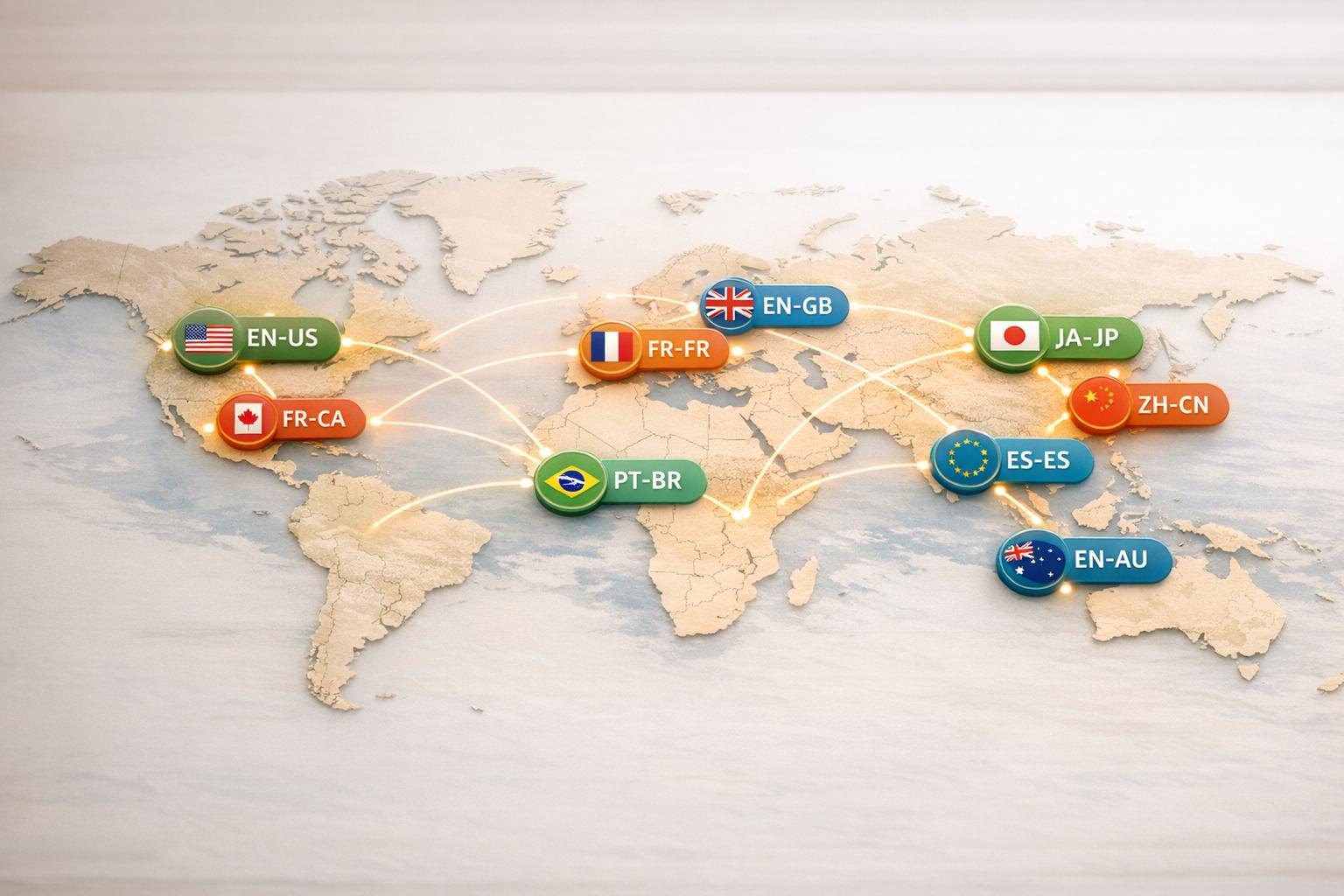
If you use one translated keyword list for every market, you will miss traffic. Search behavior changes by country - even when people want the same product or service.
Here’s the short version:
- 56% of Google traffic comes from non-English searches
- Fewer than 20% of brands optimize for more than one country or language
- The same keyword can mean different things in different places
- The same query can show different SERP features by market
- You need to research each country-language pair on its own
What I’d do:
- Check GA4, Google Search Console, and CRM data to pick target markets
- Build a local keyword list instead of translating one master list
- Review country-level search volume, CPC, and difficulty
- Check the live SERP in each market for intent and page type
- Group terms into clusters and map them to localized URLs
- Use one working sheet with keywords, intent, SERP notes, and page mappings
A few simple examples show why this matters:
- “Sneakers” in the U.S. becomes “trainers” in the UK
- “Apartment” becomes “flat”
- “Football drills” means one thing in the U.S. and another in the UK
- “International SEO” can be informational in one country and transactional in another
The point is simple: country keyword research is not translation work. It’s a page-planning process based on how people search in each market.
If you want pages that match local demand, this is the workflow to use.
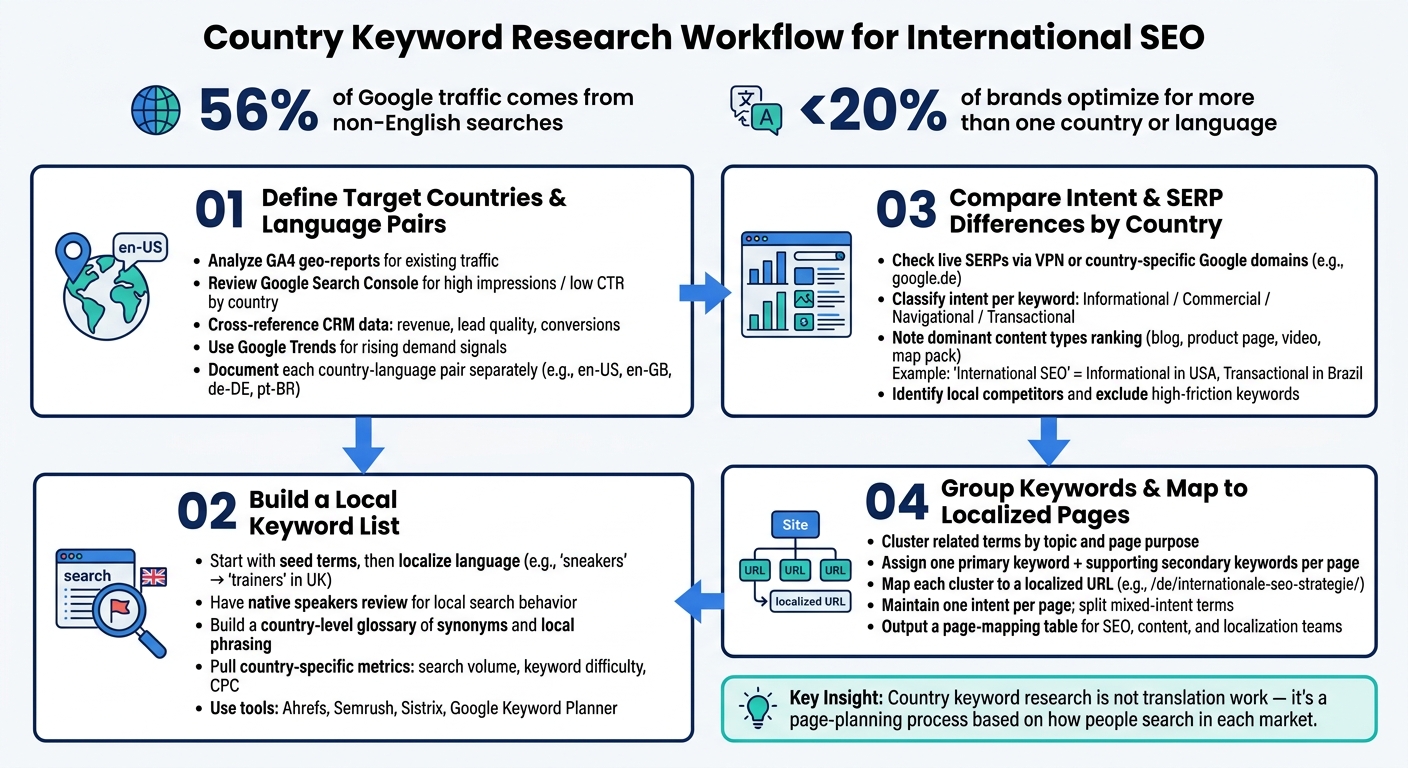
Country Keyword Research Workflow for International SEO
Keyword Research Across Languages: Localizing for International SEO
sbb-itb-5be333f
1. Define target countries and country-language pairs
Before you dig into keywords, decide which countries are most likely to pay off. Choosing markets on gut feel is a good way to burn time. Start with the data you already have and look for places where demand is already showing up.
Use existing data to prioritize markets
First, check your GA4 geo-reports to see which countries already send traffic to your site. Then compare that with Google Search Console, filtered by country. If one region has high impressions but a low click-through rate, that often means people are seeing your pages, but the content isn't lining up with local search behavior. That's often a better place to dig in than jumping into a brand-new market from scratch.
Next, pull in CRM data. Traffic matters, but it shouldn't make the decision on its own. Put more weight on revenue, lead quality, and conversion rate. Before you put SEO time into any market, lay out the numbers side by side: current traffic, lead volume, conversion quality, and revenue signals.
| Data Source | What to Look For |
|---|---|
| GA4 Geo-Reports | Countries with existing sessions and conversion behavior |
| Google Search Console | High impressions, low CTR by country |
| CRM / Revenue Data | Lead quality, average deal value, and pipeline by region |
| Google Trends | Rising or seasonal demand for your product in a new market |
Document each country-language combination separately
Once you have a shortlist, don't lump markets together just because they share a language. English is not one market. A buyer in the UK searching for "holiday insurance" and a buyer in the US searching for "vacation insurance" want the same thing, but they use different terms.
For each market you plan to target, write down the country, language, local dialect if it matters, and any early notes on how search intent may shift. Track which competitor domains own the local SERPs. Also note search engine differences. Google leads in most places, but Baidu is the main player in China, Naver in South Korea, and Yandex in Russia. Each one calls for its own research path.
From there, treat each country-language pair as its own unit. Build a separate local keyword list for each one.
2. Build a local keyword list for each country
Start with seed terms, then localize the language
Start with the product, problem, and category terms. Then rewrite them for each country-language pair. For example, "sneakers" in the US becomes "trainers" in the UK. That isn't a minor wording tweak. It's the exact language people type into Google.
Don't rely on direct translation alone. Have a native speaker review the list - ideally someone who understands search behavior, not just language. Build a country-level glossary that includes synonyms, abbreviations, and the way local buyers talk about the problem.
That glossary becomes your input for country-level search volume checks and SERP review.
Pull country-specific metrics from keyword tools
Once you have a working list of local terms, run each one through a keyword tool set to the exact country and language. Do not use global data or "all countries" views. That kind of data can blur demand at the country level.
For each country-language pair, collect:
- Monthly search volume
- Keyword difficulty
- CPC
| Tool | Best For |
|---|---|
| Ahrefs | Multi-country keyword data |
| Semrush | Competitive analysis by country |
| Sistrix | European/DACH markets |
| Google Keyword Planner | Free baseline data (with Ads account) |
Use this data to trim the list before you look at live local search results.
Check Google results in the target country
Keyword metrics don't tell the whole story. To see if a term is worth going after, check Google results from the target country. You can use a VPN or a country-specific Google domain like google.de or google.com.mx. Treat what you find as a gut check - either the term fits, or it doesn't.
Look closely at the formats ranking on page one. If the query shows a local map pack, shopping results, or videos, that's a plain signal of what Google thinks the searcher wants. Review the title tags and H1s on top local pages too. They often show the exact phrasing local competitors use.
Also check Google Autocomplete and People Also Ask for the query. Those features reflect live local search behavior and often turn up long-tail terms that keyword tools skip.
Use all of that to decide which terms belong on each localized page. Cut terms when the SERP doesn't line up with what you can offer - especially if page one is dominated by a local pack and you don't have a local presence.
With the local list checked, compare intent and SERPs by country.
3. Compare intent and SERP differences by country
After you build local keyword lists using top keyword research tools, use the SERP in the target country to figure out which terms deserve their own page.
Classify intent for each priority keyword
The same keyword can point to different intent depending on the country. So don't rely on the wording alone. Look at the ranking pages in that market.
Check the top three results in the target country and tag each keyword by page type - blog post, product page, comparison guide, or video. Then assign intent based on what is actually ranking: informational, commercial, navigational, or transactional. Base that call on the SERP, not on how the keyword sounds.
For example, "international SEO" in the US brings up long-form guides and industry definitions - informational. In Brazil, the same term brings up agency service pages and pricing tables - transactional.
Once you've pinned down intent, look at which local domains are winning those spots.
Spot local competitors and exclusion keywords
As you review the local SERP, note which local domains rank. If marketplaces or regional publishers control page one, treat that keyword as high-friction or cut it.
Also cut terms when the local SERP shows a meaning that doesn't fit your offer. If the results don't line up with what you sell, drop the keyword.
Build a country comparison table for priority terms
Pull the findings into a comparison table.
| Keyword | Country | Language | Dominant Intent | Typical Ranking Content Type |
|---|---|---|---|---|
| "Football drills" | USA | English | Informational | Video tutorials, coaching guides (American football) |
| "Football drills" | UK | English | Informational | Tactical blogs, academy training plans (soccer) |
| "International SEO" | USA | English | Informational | Long-form guides, industry definitions |
| "International SEO" | Brazil | Portuguese | Transactional | Agency service pages, pricing tables |
| "Super 8 digitalisieren" | Germany | German | Commercial | Service provider landing pages |
Use this table to decide which terms belong on each localized URL. Then use it in the next step to group keywords by page purpose.
4. Group keywords and map them to country pages
Use the Step 3 comparison table to turn your approved terms into a site architecture plan - one country at a time.
Cluster keywords by topic and page purpose
Don’t go after single keywords one by one. Group related terms into topic clusters. One primary keyword should lead the page, and secondary terms should support it.
For example, a page built around "electric bikes" in the US could also include "eco-friendly commuter bike" and "best bikes for city travel" so the page covers the topic more fully.
Use the intent and SERP data from Step 3 to decide where each cluster should live.
Keep one intent per page. If a term mixes intents, split it into separate pages.
Assign each cluster to a localized URL
Map each cluster to a localized URL for one country-language pair per page. For many sites, subdirectories like example.com/us/ or example.com/de/ are a good fit because they keep country targeting clear and consolidate authority.
Use a localized URL slug instead of adding a language folder to an English slug. For example, use /de/internationale-seo-strategie/ instead of /de/international-seo-strategy/.
Build a page-mapping table teams can execute
Turn the research into a handoff document that content, SEO, and localization teams can use right away.
| Column | What to Include |
|---|---|
| Country/Market | Target region, such as US, Germany, or Brazil |
| Language Code | ISO code, such as en-US, de, or pt-BR |
| Primary Keyword | Main localized term for on-page focus |
| Secondary Keywords | Long-tail variants and related queries |
| Search Intent | Informational, Navigational, Commercial, or Transactional |
| Localized URL | Specific path, such as /fr/a-propos/ |
| Content Format | Blog post, pillar page, comparison page, or solution page |
| Priority Level | High, Medium, or Low |
Use this table as a hreflang checklist. Each page should reference every country-language variant, including itself.
Conclusion: A simple workflow for country-level keyword research
Country-level keyword research works when you use actual market data, research each country-language pair on its own, check terms in local SERPs, and map keyword clusters to dedicated pages. That turns broad demand into clear page-level decisions.
Localized pages beat generic translation because they match how people search in each market and what they want from the results.
Once you’ve mapped the clusters, the table becomes the execution brief. Use the page-mapping table as the handoff document for SEO, content, and localization teams.
Then repeat the same process for each market. Go back to it as rankings, intent, and local SERPs shift over time.
FAQs
How do I choose which countries to target first?
Use existing data - not gut instinct. Check Google Analytics 4 and Google Search Console to see where your organic traffic, impressions, and clicks already come from.
Then focus on countries where you already operate, can ship, or have clear demand. After that, compare search volume with competition.
Localization takes work. Each region needs its own keyword research and content. So it makes sense to start with the markets most likely to bring in the most revenue.
Why isn’t direct keyword translation enough?
Direct keyword translation often falls flat because search behavior comes from local habits, market context, and the way people actually talk. Even when two countries share the same language, people may use different words, phrasing, and idioms for the exact same product or need.
The result is simple: you can end up targeting terms with little search volume while missing the phrases local audiences use every day. And because search engines lean hard on intent, not just literal meaning, that mismatch can hurt rankings and make your content feel off to local readers.
When should one keyword get separate pages by country?
Create separate country pages when local search behavior, intent, or phrasing differs in a meaningful way.
Even when two countries use the same language, people don't always search the same way. They may use different words for the same product, and they may want different things from the search result.
If a direct translation - or even a shared term - doesn't match how local users talk about your service or category, separate pages make sense.