Negative reviews can harm your local SEO rankings by lowering your average star rating, reducing user engagement, and affecting customer trust. Google prioritizes businesses with high ratings (above 4.0), frequent reviews, and active responses. Falling below this threshold can lead to decreased visibility in local search results. Here's what you need to know:
- Star Ratings Matter: Businesses with ratings below 4.0 often lose visibility in local search.
- User Behavior Impacts SEO: Negative reviews can reduce clicks, increase bounce rates, and lower engagement - signals that hurt rankings.
- Timely Responses Help: Responding to over 75% of reviews and addressing complaints within 24 hours can improve rankings.
- Review Volume and Recency: A steady flow of new reviews boosts visibility. Businesses with more reviews often rank higher.
- Content of Reviews: Google analyzes review content. Frequent mentions of poor service or issues can harm your profile.
Focus on generating positive reviews, responding promptly to feedback, and maintaining a strong average rating to protect your local SEO performance.
How to Remove Bad Google Reviews in 2026 (Step-by-Step Playbook That Actually Works)
sbb-itb-5be333f
How Negative Reviews Directly Affect Local SEO Rankings
Negative reviews can take a toll on local SEO rankings by influencing Google's evaluation of review metrics and top SEO tools and reducing user engagement. Let’s break down how star ratings impact visibility in the local pack and what Google says about the role of negative feedback.
Star Ratings and Local Pack Visibility
Google places a lot of weight on reviews as part of its "Prominence" factor for local rankings. Businesses with a higher number of reviews and better ratings are often perceived as more trustworthy, which helps them rank higher in search results. While a single one-star review won’t tank your ranking, a consistent drop in your overall rating can hurt. Staying above a 4.0-star average is particularly important - businesses that fall below this threshold risk being filtered out by users who prefer higher-rated options, leading to decreased visibility.
Google's algorithms also analyze the content of reviews, not just the star ratings. Repeated mentions of negative experiences, like "poor customer service" or "slow delivery", can create a lasting association of negativity with your business profile.
Google's Position on Negative Reviews
Google explicitly states that reviews influence local search rankings. Their documentation on Google Business Profile emphasizes:
High-quality, positive reviews can improve your business's visibility.
Review signals are a big deal - they account for about 17% of local pack rankings, while Google Business Profile signals make up roughly 32%. Instead of punishing businesses for individual negative reviews, Google's system focuses on rewarding positive factors like high average ratings, frequent reviews, and active engagement. One way to counteract the impact of negative reviews is by responding promptly and thoughtfully. This not only shows users that you care but also signals to Google that your business is well-managed, which can help soften the blow of negative feedback.
Indirect Effects of Negative Reviews on SEO Performance
Negative reviews can have a ripple effect on your local SEO, beyond just affecting your star ratings. When potential customers spot a 2.5-star rating instead of a 4.5-star one, they’re far less likely to click on your listing. This dip in click-through rate sends a signal to Google that users aren’t finding your business appealing, which can gradually harm your visibility over time.
Click-Through Rates and User Engagement
It’s not just about fewer clicks - negative reviews can lead to quick exits from your page. When users leave immediately, it tells Google that your listing might not be relevant. On top of that, fewer conversion actions - like calls, direction requests, or form submissions - can weaken your local prominence.
The actual content of the reviews matters, too. For instance, if several reviews highlight poor service or cleanliness issues, Google’s AI might start associating your business with those negative traits. This could influence how your listing appears in related searches.
And it doesn’t stop there. Negative reviews don’t just affect engagement - they also chip away at trust.
Loss of Consumer Trust
When trust is lost, users are less likely to interact with your site. This leads to higher bounce rates and shorter dwell times. Without consumer confidence, potential customers are unlikely to explore your website or take meaningful actions - signals that suggest your site isn’t meeting their needs. As Ross Cohen explains:
A poor reputation means fewer calls, form submissions, or direction requests... Over time, these indirect effects can add up - slowly pushing your visibility and authority downward.
Research Data on Negative Reviews and Rankings
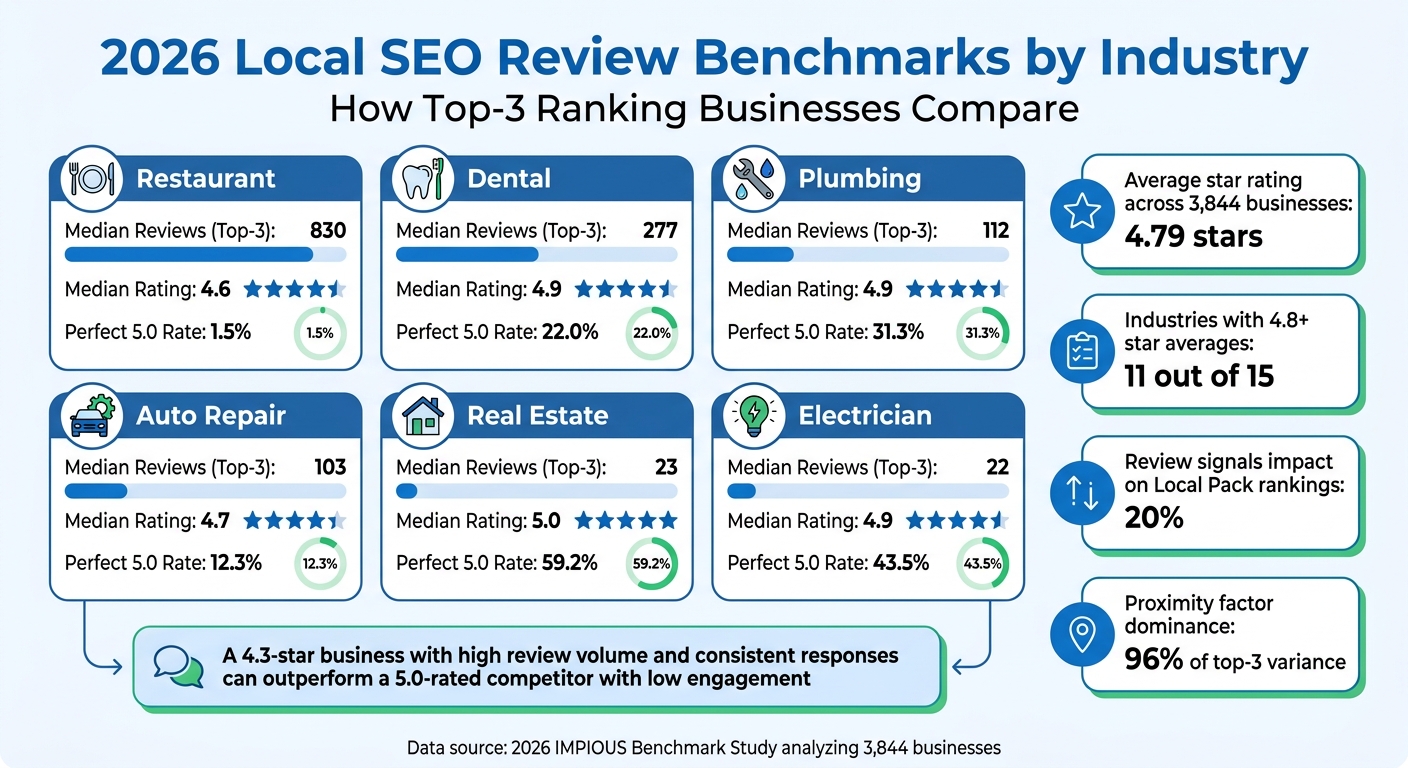
2026 Local SEO Review Benchmarks by Industry
Recent research sheds light on how businesses can mitigate the impact of negative reviews by adopting active response strategies. Studies from 2025-2026 reveal that star ratings alone no longer dictate local search rankings.
Star Ratings and Ranking Position Data
The bar for local reviews has risen sharply. An analysis of 3,844 businesses in 2026 found the average star rating climbing to 4.79 stars. In fact, 11 out of 15 major industries now boast averages above 4.8 stars. As ReplyProof aptly notes:
The star rating alone does not differentiate you. Ratings are table stakes.
The 2026 IMPIOUS Benchmark Study highlights just how competitive these metrics have become across industries:
| Industry | Median Reviews (Top-3) | Median Rating | Perfect 5.0 Rate |
|---|---|---|---|
| Restaurant | 830 | 4.6 | 1.5% |
| Dental | 277 | 4.9 | 22.0% |
| Plumbing | 112 | 4.9 | 31.3% |
| Auto Repair | 103 | 4.7 | 12.3% |
| Real Estate | 23 | 5.0 | 59.2% |
| Electrician | 22 | 4.9 | 43.5% |
Interestingly, a business with a 4.3-star rating, coupled with a high review volume and consistent responses, can outperform a 5.0-rated competitor with low engagement. Review signals now make up about 20% of Google's Local Pack ranking algorithm , based on updated 2026 findings. Still, proximity remains the dominant factor, accounting for 96% of top-3 variance. While star ratings set the stage, review volume and timely responses are key players in shaping rankings.
Review Volume and Response Rate Findings
Beyond star ratings, how businesses manage reviews significantly impacts their SEO tools and services can help manage how businesses handle reviews, which significantly impacts their local search visibility. A 2026 study by Flen AI revealed that businesses responding to more than 75% of their reviews ranked an average of 2.3 positions higher in the local pack, often determining whether they land on page one or page two.
Speed also plays a role. Businesses that respond to reviews within 24 hours achieve an average ranking position of 2.8, compared to 4.4 for those taking a week or longer. As Zee from Flen AI points out:
Businesses responding to 75%+ of reviews ranked 2.3 positions higher on average. That's the difference between page 1 and page 2.
This responsiveness influences consumer behavior as well. 88% of consumers are willing to engage with a business that replies to all reviews, compared to 47% for those that don’t. Moreover, businesses actively addressing negative reviews saw a 12% improvement in their overall ratings over 12 months, compared to just 4% for those that ignored them.
Interestingly, while the sheer number of reviews shows a weak correlation with rankings (Spearman ρ = -0.092), review velocity - the steady inflow of new reviews - proves more impactful, particularly in industries like Real Estate (ρ = -0.166) and Insurance (ρ = -0.146).
How to Reduce the Impact of Negative Reviews
Studies reveal that 73% of dissatisfied customers are willing to give a business another chance if their complaint is handled well. Furthermore, 54% of customers may revise their initial negative review following a successful resolution. These insights highlight the importance of handling negative feedback effectively to protect your reputation and improve local SEO.
How to Respond to Negative Reviews
Quick responses matter more than crafting the perfect reply. In fact, 53% of customers expect a response within a week. When replying, avoid reacting emotionally. Instead, try using the STAR Framework:
- Specific: Address the details of the complaint directly.
- Thankful: Show gratitude for the feedback.
- Actionable: Provide clear steps for resolution, like sharing a contact number or email.
- Reinforcing: Emphasize a positive aspect of your brand.
Before responding, confirm the reviewer is a genuine customer. If the review seems fake or includes offensive language, report it using Google's "Report Review" tool. Never offer incentives, such as discounts or gifts, to have reviews removed - this violates Google's policies and can lead to penalties. Thoughtful, sincere replies can rebuild trust and address concerns that might otherwise damage your credibility. As Local SEO expert Mike Blumenthal explains:
People treat reviews like decoration. They're not. They are the content. They're your brand.
Also, remember that 60% of users distrust automated responses. Ensure replies are human-written or at least customized to avoid appearing impersonal.
How to Generate More Positive Reviews
A steady flow of positive reviews not only boosts your reputation but also enhances your local search rankings. The key is to encourage genuine feedback while strictly adhering to platform rules - no incentivizing, fake reviews, or hiding negative feedback ("review-gating").
Simplify the review process by sharing direct links or using QR codes. Timing matters, too: some businesses have success with same-day SMS requests, while others find waiting 24 hours more effective. Train your team to resolve issues during the customer interaction, so complaints don’t escalate. When customers leave positive reviews, respond to each one - 88% of consumers are more likely to choose a business that acknowledges all reviews.
By balancing proactive strategies with thoughtful responses, you can build a strong online reputation that withstands occasional negative feedback.
Using Tools from Top SEO Marketing Directory
For businesses with multiple locations, managing reviews across platforms can become a daunting task. The Top SEO Marketing Directory offers tools to simplify this process. Services like Moz Local provide automated notifications for new reviews and a centralized dashboard to manage responses on platforms like Google, Yelp, and niche-specific sites. Similarly, GatherUp uses AI to analyze review sentiment, categorizing feedback by themes such as staff behavior or service quality.
These tools complement the strategies discussed earlier, helping businesses respond promptly and stay on top of their reputation. The directory's Premium plan, priced at $49/month, includes advanced SEO tools and access to agency listings. For larger companies, Enterprise-level solutions are available. Additionally, resources like Moz Academy's "Local SEO Tactics" course can help teams refine their approach to handling reviews and building a strong online presence.
Conclusion
Ignoring negative reviews can slowly chip away at your local SEO, leading to reduced visibility, fewer clicks, and a drop in revenue.
Review signals play a major role in determining local pack rankings, heavily influenced by Google Business Profile factors. Interestingly, slightly imperfect ratings can make a business appear more genuine and trustworthy.
Keeping a steady flow of 4–8 new reviews each month and responding to reviews within 24 hours not only provides fresh content for Google but also shows active engagement. This approach signals to both search engines and customers that your business is attentive and responsive.
Since removing legitimate negative reviews is almost impossible, focusing on generating authentic positive feedback is a smarter move. This helps push down the impact of older negative reviews. Research shows that businesses with 112 or more reviews tend to perform better in local search rankings. Additionally, responding to at least 25% of reviews can boost conversion rates by 4.1%.
To make these strategies easier to implement, the Top SEO Marketing Directory offers tools designed to handle negative reviews effectively. These tools can automate review monitoring, analyze sentiment trends, and streamline responses for businesses with multiple locations. Whether you opt for the free Basic plan or an advanced Enterprise-level solution, these resources can turn reputation management into a proactive strategy that drives growth. Ultimately, your reviews impact not just search rankings but also how customers perceive your business.
FAQs
How many negative reviews does it take to hurt local rankings?
Negative reviews don’t have a set number that will automatically lower your local rankings. However, they can still hurt your local SEO in other ways. They might harm your business's reputation, discourage potential customers, and even affect how much Google trusts your brand. To avoid these issues, it’s important to focus on building and maintaining a strong, positive online presence.
What’s the fastest way to recover after a bad review?
To bounce back from a bad review, it's crucial to act swiftly and professionally. Here's how you can handle it effectively:
- Acknowledge their experience: Start by genuinely recognizing the customer's concerns. A simple, heartfelt acknowledgment can go a long way in showing you care.
- Offer a resolution: Invite them to discuss the issue offline or directly. This not only shows your willingness to help but also keeps the conversation constructive.
- Take action: If there's a legitimate issue, address it promptly. Once resolved, you can kindly encourage the customer to consider updating their review.
Handling negative feedback this way not only helps rebuild trust but can also positively influence your local SEO performance.
Can replying to reviews improve my Google local pack position?
Responding to reviews can boost your position in Google's local pack. Engaging with reviews signals to both customers and search engines that your business is active and values feedback. This not only builds trust but also strengthens your local SEO. Regularly replying to reviews helps enhance your online reputation, making your business more visible in local search results.