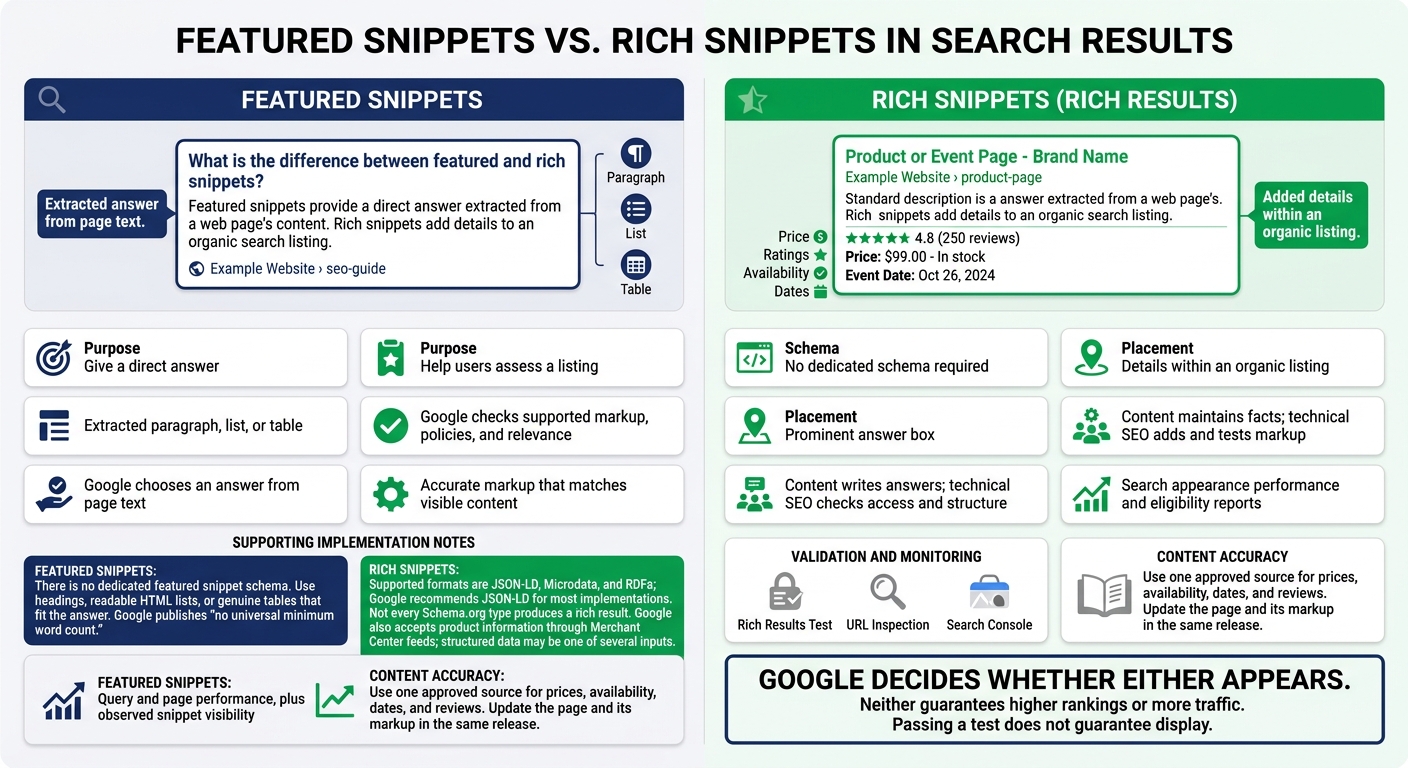
Featured snippets answer a question. Rich snippets add details to a search listing. I start with 2 different tasks: write clear answers for featured snippets, and add supported structured data for rich snippets.
Featured snippets can show paragraphs, lists, or tables. Rich snippets, also called rich results, can show prices, ratings, availability, or dates. <u>Google decides whether either appears.</u> Neither guarantees higher rankings or more traffic.
Quick Comparison
| Criterion | Featured snippets | Rich snippets |
|---|---|---|
| Purpose | Give a direct answer | Help users assess a listing |
| Format | Extracted paragraph, list, or table | Added prices, ratings, availability, or dates |
| Selection | Google chooses an answer from page text | Google checks supported markup, policies, and relevance |
| Page setup | Clear, visible, indexable answers | Accurate markup that matches visible content |
| Schema | No dedicated schema required | Usually requires supported structured data |
| Placement | Prominent answer box | Details within an organic listing |
| Team roles | Content writes answers; technical SEO performs a technical SEO audit to check access and structure | Content maintains facts; technical SEO adds and tests markup |
| Measurement | Query and page performance, plus observed snippet visibility | Search appearance performance and eligibility reports |
My approach: match the answer format to the question, keep page facts and markup in sync, and use Google’s Rich Results Test and Search Console to check implementation and track results. Passing a test does not guarantee display.
Featured Snippets vs Rich Snippets: Key Differences
What Are Featured Snippets & Rich Snippets (& How To Get Them In 2020)
sbb-itb-5be333f
Featured Snippets: Formats and Selection
Google selects passages that best answer the query. Publishers cannot submit a passage or control the wording Google extracts. Featured snippets extract answers, rather than add details to listings, so answer structure matters more than page position.
Paragraph, List, and Table Formats
Use paragraphs for definitions and direct explanations. Ordered lists work for sequential steps; unordered lists work for collections that don't need a set order. Tables work for comparisons with consistent fields. Choose the format that makes the answer clearest.
Page Content Without Dedicated Schema
On service pages, support answer extraction with a concise definition beneath a descriptive heading. Explain processes with clear inputs, steps, and outputs. Keep pricing, turnaround times, and included services in separate sections. Use readable HTML lists or genuine tables - not screenshots.
There is no dedicated featured snippet schema. Semantic HTML helps Google interpret content, but it doesn't reserve placement. No format or word count guarantees selection. Cut filler and keep the details that answer the query, including any necessary conditions.
The next distinction is markup: rich snippets use structured data to add listing details rather than extract answer copy.
Rich Snippets: Markup and Listing Details
Unlike featured snippets, rich snippets use structured data to add details to an organic listing. Google decides whether to display those details based on result type, eligibility, country, and device. Follow Google’s documentation for supported rich results and required properties. Not every Schema.org type produces a rich result.
Prices, Availability, Ratings, and Dates
Product results can show price, availability, ratings, and reviews in the listing. Recipes can show cook time, nutrition, and ratings; events can show dates, times, and locations; breadcrumbs can show site hierarchy.
Google also accepts product information through Merchant Center feeds. Structured data may be one of several inputs.
Schema Requirements and Content Accuracy
Google supports JSON-LD, Microdata, and RDFa and recommends JSON-LD for most implementations. Choose a supported type and include its required properties.
For Product, include
review,aggregateRating, oroffers, plus the other required fields.
Teams control markup accuracy and whether it matches visible page content. Prices, currency, stock status, and ratings must reflect what’s on the page. Don’t apply a brand-wide rating to an individual product or label unavailable inventory as “In Stock.” Keep changing fields in sync with visible content and follow the feature’s policies.
Validate pages with Google’s Rich Results Test, fix errors, and monitor rich result reports in Search Console. Passing the test confirms implementation, not display. Featured snippets emphasize answer-ready content; rich snippets put the work into markup, validation, and reporting.
Key Differences and Eligibility Limits
With formats and markup covered, the next issue is control: what teams can change and what Google decides.
| Comparison criterion | Featured snippets | Rich snippets |
|---|---|---|
| Purpose | Answer the searcher’s question directly. | Add listing details that help users evaluate a result. |
| Trigger | Google identifies a passage that best answers the query. | Supported structured data, feature requirements, and Google’s relevance assessment determine eligibility. |
| What teams cannot guarantee | Selection, extracted wording, lasting visibility, rankings, or traffic gains; placement varies across searches. | Display, frequency, rankings, or traffic gains; placement varies across searches. |
| Measurement focus | Query and page performance, plus observed featured-snippet visibility. | Search appearance performance and eligibility reports. |
The difference goes beyond appearance. Each format gives teams different ways to influence eligibility and presentation.
What Teams Can Control
| Work area | Featured snippets | Rich snippets |
|---|---|---|
| Content clarity | Place a direct answer near the relevant heading. Make sure it makes sense without the surrounding text. | Keep feature-specific facts clear and consistent. |
| Structure | Use headings, lists, or labeled tables that fit the answer. | Make marked-up entities and attributes easy to identify. |
Google publishes no universal minimum word count for featured snippets. Write enough to answer accurately, rather than forcing the answer into a fixed length.
Valid markup does not override content policies or guarantee display. Misleading schema can make a page ineligible for rich results or lead to a structured-data manual action. Structured data is not a generic ranking factor.
How to Measure Results
Before making changes, record target queries, URLs, release dates, country, and device. Compare first-party performance using top SEO tools and marketing resources over several weeks or months, using a comparison group when possible.
Keep third-party SERP observations separate. They show what appeared during a check, not what every searcher saw.
Conclusion: Main Differences and Team Roles
Featured snippets come from page copy; rich snippets come from structured data. Content teams shape snippet-ready answers. Technical SEO teams handle rich-result eligibility and validation.
Assign Content, Schema, and Reporting Tasks
Give each team clear responsibilities for content, markup, and measurement.
| Team | Featured-snippet responsibilities | Rich-snippet responsibilities |
|---|---|---|
| Content | Write direct answers near relevant headings; update answers and structure as search intent changes. | Keep visible product details, ratings, prices, dates, and availability current. |
| Technical SEO | Maintain crawlability, page structure, and appropriate snippet controls. | Implement and validate supported schema; update markup alongside page content. |
| Editorial and subject-matter review | Check answers for accuracy and clarity. | Verify that marked-up facts match the visible page. |
| Analytics | Track target queries, impressions, clicks, CTR, and conversions. | Use Search Console rich-result reports to monitor eligibility and errors; track performance and business outcomes over time. |
Use one approved source for prices, availability, dates, and reviews. Update the page and its markup in the same release.
Choose Audit, Validation, and Reporting Tools
Use Rich Results Test, URL Inspection, and Search Console to validate markup and monitor performance across content, schema, and reporting tasks.
FAQs
Can my page earn both snippet types?
Your page can earn both featured snippets and rich snippets at the same time. Rich snippets use structured data markup to show extra details, such as star ratings or prices. Featured snippets usually draw from clear, concise answers to informational queries in your page content.
The two rely on different mechanisms, so a single page can qualify for both. This can give your page more visibility in search results and improve click-through rates.
Which snippet type should I prioritize?
You don’t have to choose between rich snippets and featured snippets. They serve different purposes and appear under different conditions.
For rich snippets, add structured data (schema markup) to help search listings display star ratings, prices, and FAQs, where eligible. These details can improve click-through rates.
For featured snippets, write concise, high-quality content that directly answers informational searches, such as how-to and definition questions.
Why did my snippet disappear?
Your snippet may have disappeared because of structured data errors, differences between markup and visible content, or policy violations. Common problems include missing required schema properties, syntax errors, hidden content, duplicate or conflicting schema, and schema types that don’t fit the content.
Use the Google Rich Results Test and Google Search Console Enhancements report to find errors. Fix them, then request a recrawl.