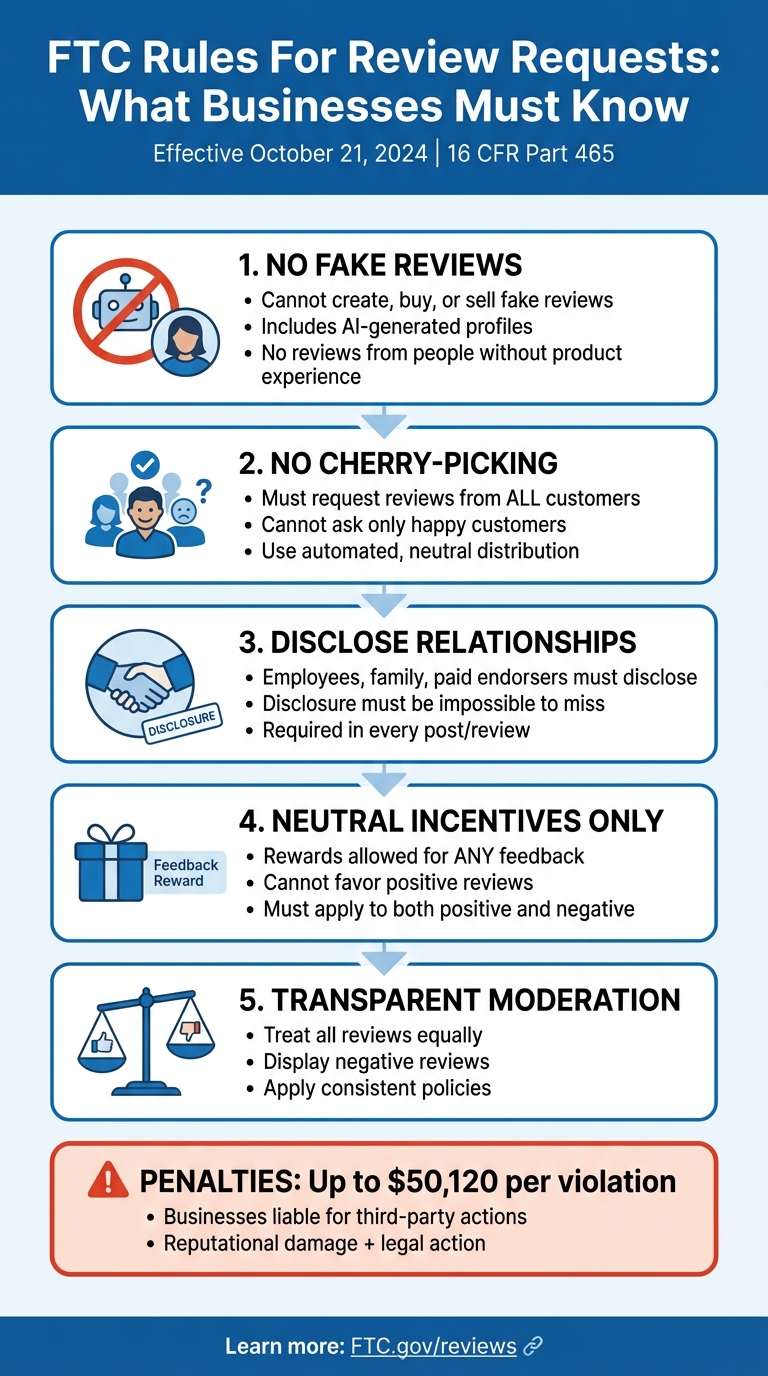
The FTC's "Rule on the Use of Consumer Reviews and Testimonials" (16 CFR Part 465), effective October 21, 2024, aims to eliminate deceptive practices in online reviews. Here’s a quick breakdown of what you need to know:
- Fake Reviews Are Banned: Businesses cannot create, buy, or sell fake reviews, including those written by individuals without real product experience or AI-generated profiles.
- No Cherry-Picking: Asking only happy customers for reviews is prohibited. Requests must go to all customers.
- Disclose Relationships: If a reviewer has ties to your business (e.g., employees, family, or paid endorsers), it must be clearly disclosed.
- Incentives Are Allowed, But Neutral: Rewards for reviews must apply to all feedback (positive or negative) and cannot imply favoritism.
- Transparent Moderation: Websites must treat all reviews equally, display genuine feedback (including negative), and apply consistent moderation policies.
Violations can result in fines of up to $50,120 per infraction, reputational damage, and potential legal action. Businesses are also liable for third-party actions, such as fake reviews posted by hired agencies. The key is transparency, fairness, and neutrality in handling reviews.
For more details on compliance and best practices, read on.
FTC Review Rules: 5 Key Requirements for Businesses in 2024
Main Requirements of the FTC Consumer Reviews and Testimonials Rule
Ban on Fake or Misleading Reviews
The FTC's latest rule, approved unanimously (5-0), takes a hard stance against fake or deceptive reviews. This includes reviews attributed to people who don't exist, those written by individuals with no actual experience with the product, or even AI-generated profiles. Essentially, businesses are forbidden from creating or purchasing fake reviews, regardless of the source.
"Fake reviews not only waste people's time and money, but also pollute the marketplace and divert business away from honest competitors." - Lina M. Khan, Chair, Federal Trade Commission
Importantly, companies are also responsible for fraudulent reviews created by third parties, such as advertising agencies or reputation management services, even if they claim they were unaware of the activity. The FTC applies a "should have known" standard, meaning businesses can't ignore red flags like an unusual surge in reviews, a mismatch between reviews and the product, or other suspicious patterns.
Rules for Offering Review Incentives
The FTC also clarifies rules regarding incentives for customer reviews. While businesses can offer incentives like discounts, gift cards, or free products to encourage feedback, they cannot require reviewers to leave a specific type of review - positive or otherwise. Requests must remain neutral, and incentives must apply to all honest feedback, regardless of whether it’s glowing praise or critical.
This means businesses need to avoid any language or actions that might imply customers must leave favorable reviews to qualify for the reward. Transparency and neutrality are key.
When to Disclose Relationships in Reviews
To ensure reviews remain credible, the FTC requires clear disclosures of any relationships that might influence a review. If a reviewer has a connection to your business - whether they’re an employee, a relative, or someone receiving free products or payments - it must be disclosed if it’s something consumers wouldn’t naturally expect and if it could affect how they view the review. This applies to employees, officers, friends, or anyone benefiting from perks like commissions or free items. Officers and managers are specifically prohibited from posting reviews without disclosure.
These disclosures must be impossible to miss. Consumers shouldn’t need to click, hover, or scroll to find them. Use plain, straightforward language like "Company Employee" or "I received this product for free" at the start of the review. For video testimonials, disclosures should appear within the video itself, not just in the description. And for social media posts, each post must include its own disclosure, as viewers may not see earlier posts.
"If there's a connection between an endorser and the marketer that a significant minority of consumers wouldn't expect and it would affect how they evaluate the endorsement, that connection should be disclosed clearly and conspicuously." - Federal Trade Commission
sbb-itb-5be333f
How to Request Reviews the Right Way
Requesting Reviews Without Breaking FTC Rules
The best way to stay compliant with FTC rules is to send review requests to all your customers. Picking and choosing who to ask for feedback can land you in trouble. Instead, use automated SEO marketing tools to distribute review requests evenly to everyone who has purchased your product or service.
When crafting your request, keep the language neutral. For example, avoid saying something like, "Tell us how much you loved your visit to get a $5 coupon", as it implies the incentive is tied to positive feedback. A better option would be: "Share your honest feedback about your recent purchase and receive a 10% discount on your next order." The critical difference here is that the incentive applies to any review - positive or negative.
"If you offer an incentive for a review, don't condition it, explicitly or implicitly, on the review being positive." – Federal Trade Commission
By using neutral, inclusive approaches like this, you ensure fairness and transparency in gathering customer feedback.
Adhering to FTC guidelines for both requesting and responding to reviews helps maintain consumer trust and safeguards your business's reputation.
How to Handle Negative Reviews
Neutrality doesn't stop at requesting reviews - it also applies to how you handle negative feedback. When faced with criticism, respond publicly and professionally rather than trying to suppress it. The FTC explicitly prohibits intimidating tactics, baseless legal threats, or personal attacks aimed at silencing dissatisfied customers. These actions, often referred to as "character assassination", are not only unethical but also illegal.
Treat all reviews - positive or negative - with the same moderation standards. Don't make negative reviews jump through extra hoops for verification or apply stricter scrutiny to them. If you organize reviews by factors like "most helpful" or star ratings, ensure that negative feedback isn't buried or hidden from view. Equal treatment of all reviews isn't just the right thing to do; it's also required under the FTC rules that took effect on October 21, 2024. By following these principles, you can handle feedback ethically while staying compliant with the law.
FTC Rules for Reviews on Your Own Website
How to Moderate Reviews Transparently
If your website hosts customer reviews, the FTC requires you to clearly explain how reviews are collected, processed, displayed, and how overall ratings are calculated. This rule takes effect on October 21, 2024.
Moderation policies must be applied equally to all reviews, whether positive or negative. For instance, if you prohibit mentions of competitors' products, that rule must apply across the board. The Federal Trade Commission emphasizes:
"Treat positive and negative reviews equally. Don't subject negative reviews to greater scrutiny."
Importantly, reviews cannot be edited to change their meaning - such as softening harsh language in a negative comment.
You can remove reviews that are clearly false, obscene, or violate a neutrally applied policy (like referencing the wrong business). However, these rules must be enforced consistently. Applying stricter standards to negative reviews than to positive ones would breach FTC guidelines.
This approach to moderation also extends to how negative reviews are displayed.
Don't Hide Negative Reviews
In line with transparent moderation, the FTC requires all genuine feedback to be displayed on your website. Selectively showcasing only positive reviews is not allowed. While you can organize reviews by factors like "most helpful" or star rating, making negative reviews harder to find violates FTC rules.
The FTC advises:
"Publish all genuine reviews and don't exclude negative ones."
A key example is Fashion Nova, LLC, which settled with the FTC for $4.2 million in January 2022. The company was accused of using a third-party review tool to automatically post four- and five-star reviews while suppressing lower-starred ones between 2015 and 2019. This practice deprived consumers of an accurate view of product quality.
Additionally, any review written by an employee or relative must include a clear and unavoidable disclosure of their connection to your business. These disclosures must be obvious - customers shouldn’t have to click a link or hover over an icon to see them.
These website-specific rules align with the FTC's broader focus on honest consumer reviews. Following these guidelines not only protects your customers but also shields your business from potential penalties.
Penalties for Breaking FTC Rules
Fines and Legal Consequences
Understanding the penalties for violating FTC rules is just as important as knowing how to comply. The stakes are high - civil penalties can reach up to $50,120 per violation, with annual adjustments for inflation.
The FTC takes violations seriously. If your business receives a "Notice of Penalty Offense", it’s a formal warning that future violations could lead to maximum fines. In 2021, the FTC issued these notices to more than 700 companies, including major retailers and advertising agencies, to remind them of their obligations under the FTC Act. Once a notice is issued, any subsequent violation could result in fines of $50,120 per offense. The FTC has made its stance clear:
"because they can exceed what a wrongdoer earned through their misconduct, penalties send a clear message that preying on consumers will not be profitable".
Recent enforcement actions highlight the financial risks. For instance, Fashion Nova, LLC and Hubble have faced multimillion-dollar settlements for violating FTC rules. In May 2022, Hubble agreed to a $3.5 million settlement after failing to disclose incentives for reviews.
It’s also worth noting that businesses are responsible for the actions of third parties, including PR or SEO firms they hire. If a third-party agency posts fake reviews on your behalf, your business will bear the legal and financial consequences.
Beyond the fines, the damage to a brand’s reputation can be just as severe.
Damage to Your Brand's Reputation
Fines are only part of the picture. Deceptive review practices can seriously harm your brand’s reputation, which is built on trust. When consumers learn that a business has manipulated reviews or used fake testimonials, it creates a breach of trust that can have lasting consequences. The FTC has noted:
"fake, false, or otherwise deceptive reviews and testimonials harm consumers who rely on genuine feedback and disadvantage competitors who comply with the law".
This loss of trust doesn’t just affect customers - it can also lead to account suspensions on review platforms, making your business less visible to potential clients. Even if review incentives are disclosed properly, they may still reduce the perceived credibility of your reviews.
The fallout doesn’t stop with customers. Public FTC enforcement actions can tarnish your reputation with partners, investors, and even employees. These actions often generate news coverage, leaving a permanent digital trail that can haunt a company for years. The FTC warns:
"businesses that are tempted to use fake reviews or manipulated rankings should also consider the serious damage to their brand image if the public learns of that breach of trust".
In short, the financial and reputational risks of breaking FTC rules far outweigh any short-term gains from deceptive practices.
Conclusion and Next Steps
What Businesses Should Remember
The FTC's Rule on the Use of Consumer Reviews and Testimonials, effective October 21, 2024, requires businesses to ensure that all reviews are genuine. This means avoiding fake reviews, steering clear of conditional incentives, and making sure any material connections are disclosed clearly and immediately.
"People should be able to trust that reviews reflect the honest opinions of customers or experts who actually used a product or service."
It's important to avoid practices like selectively requesting reviews or suppressing negative feedback. Also, if you hire third-party SEO or reputation management firms, you are still responsible for their actions. If they post fake reviews on your behalf, your business could face severe penalties. Treat all reviews equally during moderation, respond to negative feedback in a professional manner, and ensure employees disclose their affiliation with your business when leaving reviews. Following these practices not only helps you stay compliant but also strengthens your online reputation and search engine rankings.
Using Resources for SEO and Compliance
Compliance doesn't just keep you out of trouble - it also builds trust and boosts visibility. The FTC provides free resources at FTC.gov/reviews, including easy-to-understand guides tailored for marketers and small businesses. You can also subscribe to FTC Consumer Alerts for updates on regulatory changes and review the FTC Legal Library regularly to ensure your policies stay up-to-date.
If you're working with SEO or reputation management partners, make sure they follow ethical, FTC-compliant strategies. A helpful starting point is the Top SEO Marketing Directory (https://marketingseodirectory.com), which lists vetted agencies and tools that focus on legitimate optimization practices. By choosing partners who are transparent and ethical, you can build genuine customer reviews, improve your search engine performance, and avoid the risks associated with shady tactics like fake reviews or undisclosed pay-to-play schemes.
The FTC Cracks Down on Fake Reviews - These companies should take notice!
FAQs
What counts as “cherry-picking” review requests?
"Cherry-picking" review requests refers to the practice of selectively asking only satisfied customers to leave reviews, rather than seeking feedback from all customers or a representative group. This approach can mislead potential buyers by presenting a skewed and overly positive view of a product or service, rather than an accurate reflection of its overall quality or reputation.
How should I disclose employee or free-product reviews?
Always make it clear if a review is written by an employee or if the reviewer received free products. This kind of disclosure not only complies with FTC rules but also shows honesty by revealing any incentives or relationships that could influence the review. Being upfront builds trust with your audience and helps you steer clear of any legal troubles.
What do I need to do to avoid liability for agency-posted fake reviews?
To steer clear of liability, make sure all reviews are genuine, free from incentives or manipulation, and in line with FTC guidelines. The Consumer Reviews and Testimonials Rule strictly forbids knowingly false or misleading reviews. It's crucial to keep an eye on your agency's practices and provide proper education on compliance to prevent any breaches.