Scaling a content team for SEO success requires more than just hiring more writers. It’s about building systems that boost efficiency, maintain quality, and align content efforts with business goals. Here’s a quick breakdown:
- SEO Goals and Metrics: Set specific, measurable objectives tied to business outcomes. Track key metrics like organic traffic, keyword rankings, and conversion rates to evaluate success.
- Team Structure: Start with a strategic generalist (e.g., a Content Manager) before expanding. Use a clear RACI model to define roles and responsibilities.
- Workflows: Standardize processes like content briefs, SEO reviews, and publishing to save time and reduce errors. Automate repetitive tasks using SEO marketing tools where possible.
- Content Creation and Distribution: Develop a repeatable workflow that incorporates SEO best practices from the start. Repurpose content for multiple platforms to maximize reach.
- Performance Tracking: Monitor leading and lagging indicators regularly. Allocate resources to update older content and run audits to spot gaps or opportunities.
The key takeaway? Success in scaling content teams lies in structured systems, measurable goals, and consistent evaluation - not just producing more content.
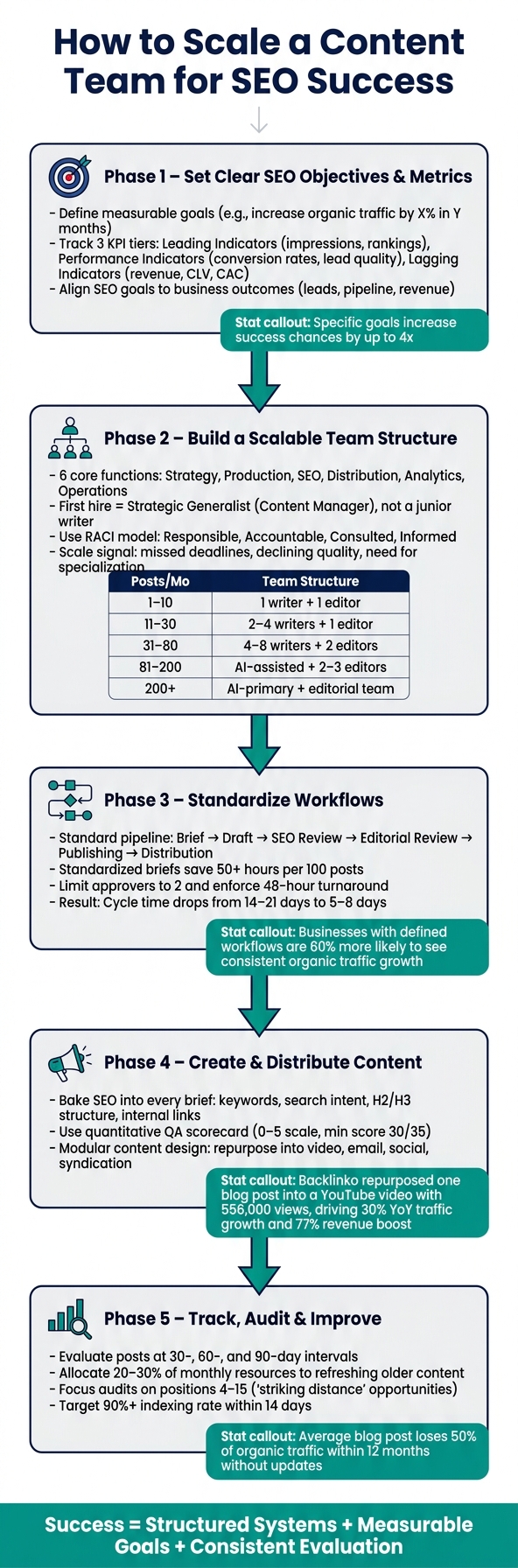
How to Scale a Content Team for SEO Success: Step-by-Step Framework
Scaling SEO and Content Without Sacrificing Quality With Brad Smith
sbb-itb-5be333f
Set Clear SEO Objectives and Metrics
Before diving into hiring or investing in top SEO tools, it's essential to define clear SEO objectives. Goals like "get more traffic" are too vague to drive real progress. On the other hand, specific and measurable objectives can increase your chances of success by up to four times.
Set Measurable SEO Goals
For SEO strategies to work, goals need to tie directly to your business results. Think in terms of clear targets, like increasing organic traffic by a certain percentage within a set timeframe or improving engagement at the bottom of the funnel to boost conversions.
Traffic alone doesn’t mean much if it doesn’t lead to tangible results like leads or sales. A great example is Tomorrow Sleep, which identified topic gaps and optimized content for search intent. The result? Their organic traffic skyrocketed from 4,000 to 400,000 monthly visits in just one year.
Once you've set your goals, it’s time to identify the right KPIs to track progress.
Choose the Right KPIs
Focusing on the right metrics ensures your team prioritizes what truly matters. KPIs can be grouped into three main categories:
| Metric Category | Key KPIs | Purpose |
|---|---|---|
| Leading Indicators | Organic impressions, keyword ranking movement, scroll depth | Tracks whether your strategy is heading in the right direction |
| Performance Indicators | Conversion rates by content type, lead quality scores, featured snippet rates | Evaluates how well your content supports business goals |
| Lagging Indicators | Revenue attribution, Customer Lifetime Value (CLV), Customer Acquisition Cost (CAC) | Measures the overall ROI of your SEO investment |
You can also include operational metrics, like how long it takes to publish content, to pinpoint workflow inefficiencies.
Connect SEO Goals to Business Outcomes
To maximize support and resources for your SEO efforts, align your goals with broader business objectives. Isolated SEO goals often fail to gain traction, but when you frame them in terms of business impact - like lead generation, pipeline growth, or revenue contribution - it’s much easier to secure buy-in.
"The most effective and meaningful goals for SEO teams come from thoroughly understanding and utilizing data... share as much business data as possible with your SEO team." - Corey Morris, President/CEO, Voltage
One practical way to do this is by working backward. Start with a specific business target, such as generating a set number of qualified leads each month. Then, reverse-engineer the organic traffic, keyword rankings, and content production needed to achieve that goal. This ensures every piece of content directly supports a business outcome that matters.
Build a Scalable Team Structure
Once your SEO goals and KPIs are set, the next challenge is assembling a team that can consistently deliver. The way you structure the team matters far more than how many people you have. A small, well-organized team can easily outperform a larger, uncoordinated one.
Define Roles and Responsibilities
To execute your SEO strategies effectively, you need a clear team structure. A scalable content team typically covers six key functions: content strategy and editorial direction, production (writers and designers), SEO and optimization, distribution, analytics, and content operations (managing workflows and tools). For smaller teams, individuals may handle multiple roles, but as the team grows, these responsibilities naturally split into four main areas: Strategy, Creation, Quality Assurance, and Optimization.
Your first hire is crucial. Rather than starting with a junior writer, focus on bringing in a strategic generalist, such as a Content Manager, who can oversee the bigger picture and manage the editorial calendar. As Trae Halkitis, Co-Founder of Penmo, explains:
"Hiring a junior writer first, without this strategic oversight, often leads to misaligned and ineffective content."
To avoid confusion as the team expands, implement a RACI model (Responsible, Accountable, Consulted, Informed). This ensures everyone knows who approves content and who simply needs to be informed. Without this clarity, tasks and responsibilities can easily fall through the cracks.
Grow Team Resources at the Right Pace
Scaling your team too quickly can be just as problematic as moving too slowly. Signs that it’s time to expand include missed deadlines, declining content quality due to high workloads, or the need for specialized skills like technical SEO or video production.
A hybrid approach works best: keep core strategy in-house while outsourcing high-volume or specialized tasks to freelancers or agencies. For example, outsourcing a 1,500-word post to skilled freelancers typically costs between $150 and $400. Using AI-assisted drafts with human oversight can lower this cost to around $25–$75 per post. If you’re looking for vetted SEO service providers, the Top SEO Marketing Directory is a great resource. It offers a curated list of tools and services, from content optimization to technical SEO.
Here’s how team size and system requirements typically scale with content volume:
| Monthly Volume | Typical Team Size | System Requirements |
|---|---|---|
| 1–10 posts | 1 writer + 1 editor | Basic editorial calendar |
| 11–30 posts | 2–4 writers + 1 editor | Standardized briefs, style guide |
| 31–80 posts | 4–8 writers + 2 editors | Automated scoring, topic clusters, workflow tools |
| 81–200 posts | AI-assisted + 2–3 editors | Full pipeline automation, quality gates |
| 200+ posts | AI-primary + editorial team | End-to-end automation with human oversight |
As your team grows, having clear roles and standardized systems becomes even more important to maintain quality and efficiency.
Standardize Workflows for Better Collaboration
Inconsistent workflows can lead to inefficiencies and miscommunication. The solution? Standardization. Create a system that everyone on the team can follow.
Every piece of content should move through the same process: Brief → Draft → SEO Review → Editorial Review → Publishing → Distribution. Standardized briefs are particularly impactful. Each brief should outline the target keyword, search intent, required H2/H3 structure, evidence or data needs, and internal link targets. This approach can save over 50 hours of manual work for every 100 posts and ensures consistency across all contributors.
"The teams that scale content successfully don't produce more content per person - they build systems that remove decisions from the production process." - The SEO Engine Editorial Team
Build a Content Creation and Distribution Process
Once you've established a streamlined team workflow, the next step is creating a repeatable content process that aligns with your SEO goals. This ensures your content not only gets created but also reaches the right audience effectively.
Create a Step-by-Step Content Workflow
A clear, step-by-step workflow is essential for any scalable content strategy. Research shows that businesses with a defined content workflow are 60% more likely to see consistent growth in organic traffic. Despite this, an estimated 60–70% of B2B content goes unused, often because of a lack of structure.
Standardizing the workflow eliminates confusion and inefficiencies. A typical content workflow might include the following steps: topic selection, brief creation, drafting, editorial review, approval, and publishing. Automating parts of this process can significantly reduce time and failure rates, as shown below:
| Workflow Stage | Avg. Time (Manual) | Avg. Time (Automated) | Failure Rate |
|---|---|---|---|
| Keyword & Topic Selection | 2–4 hours | 15–30 min | 12% |
| Brief Creation | 1–3 hours | 10–20 min | 31% |
| First Draft | 4–8 hours | 30–90 min | 15% |
| Editorial Review | 1–2 hours | 45–60 min | 22% |
| Approval & Compliance | 1–4 hours | 30–60 min | 35% |
| Publishing & Distribution | 30–60 min | 5–10 min | 6% |
(Source: The SEO Engine)
One of the biggest bottlenecks in this process is the approval stage, which has a 35% failure rate. Content often gets stalled or sent back for revisions, delaying publication. A simple fix is to limit the number of approvers to two and enforce a 48-hour turnaround time. Teams that adopt this approach typically reduce their cycle time from 14–21 days to just 5–8 days from brief to publication.
"An effective SEO content workflow connects strategy, execution, and optimization into a single content operations workflow rather than isolated tasks." - Keywordly.ai
Once your workflow is established, integrating on-page SEO best practices ensures your content meets quality standards and performs well.
Apply On-Page SEO Best Practices
A strong workflow is only effective if SEO is baked into the process from the start. Each content brief should include primary and secondary keywords, search intent, H2/H3 structure, internal links, and competitor gap analysis.
To maintain quality, replace subjective editorial feedback with a quantitative QA scorecard. Score each piece on a 0–5 scale across criteria like intent alignment, depth of coverage, and technical readiness. Set a minimum passing score - such as 30 out of 35 - before content moves to publication. This approach removes ambiguity and ensures consistency as your team grows.
On the technical side, implement a pre-publish checklist that covers meta tags, URL slugs, alt text, schema markup, and internal links. A good rule of thumb: every new page should link to at least two related cluster pages and one conversion-focused destination. As Backlinko's lead editor noted:
"Our style guide isn't a static document. I review every new article we publish, which helps me see trends that need addressing."
Use Multiple Channels to Distribute Content
Creating great content is only half the battle - distribution is just as important. The key is modular content design, where you break content into smaller, reusable components (such as insights, data points, or quotes) that can be adapted for various platforms.
For example, in 2024, Backlinko repurposed its "Complete SEO Checklist" blog post into a YouTube video, which garnered over 556,000 views. This multi-channel strategy contributed to a 30% year-over-year increase in organic traffic and a 77% boost in revenue. The takeaway? Repurposing content for new formats can help you tap into entirely new audience segments.
In addition to social media and video, email newsletters are an effective way to drive direct traffic back to your content. Partnerships and syndication can also expand your reach beyond your own platforms. As AI-powered tools like ChatGPT, Perplexity, and Google SGE gain prominence, structuring your content with natural language FAQs and entity-rich data will become increasingly important for visibility in AI-generated results.
Track Results and Improve Over Time
Once you've set up solid content creation and distribution systems, the next step is tracking your performance and making adjustments to refine your strategy.
Monitor Key Metrics on a Regular Schedule
Divide your tracking efforts into two categories: operational KPIs and performance KPIs. Operational KPIs include metrics like time-to-publish and revision cycles, while performance KPIs focus on organic traffic, lead quality, and conversion rates. Keep an eye on leading indicators - such as organic impressions, ranking changes, and technical health. These can serve as early warning signs before lagging indicators, like revenue, reflect the results. For instance, spotting a drop in impressions early on is far easier to address than trying to recover lost revenue later.
A good practice is to evaluate individual posts at 30-, 60-, and 90-day intervals after they go live. Automating reporting dashboards will save time by cutting out manual data entry, allowing your team to focus on interpreting the numbers and making decisions.
"You can't manage what you can't see. High visibility means having a clear view of all content projects, including who is doing what and the status of each task." - Rankai.ai
Run Content Audits and A/B Tests
Did you know that the average blog post loses half of its organic traffic within 12 months if it isn’t updated?. That’s why having a refresh strategy is non-negotiable. Allocate 20–30% of your monthly content resources to updating older posts instead of only producing new material.
When performing audits, focus on posts ranking in positions 4–15 on search results pages. These are your "striking distance" opportunities - content that’s already close to ranking higher but needs a little extra effort. During the audit, look for issues like keyword cannibalization (multiple pages competing for the same keyword), orphan pages (those with no internal links), and any content that hasn’t been indexed within 14 days. Ideally, your site should achieve a 90%+ indexing rate within this timeframe.
For A/B testing, prioritize high-impact areas like high-traffic blog posts, product pages, and key conversion pages. Tools like Microsoft Clarity can help you analyze heatmaps and scroll depth, so you can identify where readers lose interest and adjust accordingly. A great example comes from Tomorrow Sleep, which used a content audit approach between 2024 and 2025 to identify topic gaps and optimize for search intent. The result? Their organic traffic skyrocketed from 4,000 to 400,000 monthly visitors in just one year.
By comparing tracked data over time, you can uncover patterns and pinpoint areas that need further improvement.
Use Tables to Compare Performance Data
A simple table can help you evaluate performance metrics against your targets. Here’s an example:
| Metric | Target Value | Actual Value | Tool Used |
|---|---|---|---|
| Organic Traffic | 50,000/mo | 45,000/mo | Google Analytics |
| Bounce Rate | <50% | 47% | Semrush |
| Keyword Rankings | Top 10 | Top 15 | Ahrefs |
| Indexing Rate | 90%+ in 14 days | 85% | Google Search Console |
| Time-to-Publish | 5 days | 7 days | Project Management Tool |
Spending just 30 minutes each month reviewing tables like this can reveal systemic problems. For example, if your revenue per post is dropping even as you publish more, it’s a sign that quality standards need attention - not that you should increase output. Regular analysis ensures your content strategy stays aligned with your goals, helping your team consistently deliver measurable SEO results.
Conclusion
To achieve SEO success, scaling your content team requires clear goals, a structured team, repeatable processes, and consistent performance tracking. These elements form the backbone of an effective strategy. A well-defined RACI matrix ensures projects stay on track, standardized workflows uphold quality as your workload increases, and regular audits keep your content aligned with its purpose.
Specialization is now the key to staying competitive. As the SEO Webster Team aptly stated, "The one-person SEO department died years ago. Companies still trying to make it work are competing with organizations that have dedicated teams optimizing every facet of the search ecosystem." This shift toward specialization should influence how you allocate resources and structure your team. The right setup beats simply adding more people, whether you're operating with a modest $5,000–$15,000/month content budget or managing a mature SaaS budget of $75,000–$150,000+ per month.
If your team has gaps in areas like technical SEO, content optimization, keyword research, or link building, consider turning to the Top SEO Marketing Directory. This resource connects businesses to vetted SEO tools and agencies, helping you find the expertise you need without the trial-and-error. Plans start free, with premium access available at $49/month for teams seeking advanced listings. It’s a practical way to support the systems-based approach required for long-term success.
"Success comes from building systems that maximize content impact rather than merely increasing volume." - Insight Engine
The best teams focus on building smart systems, measuring what matters, and refining their strategies. Start by assessing your current setup, address any weaknesses, and scale up what’s already working.
FAQs
When should I hire my first content manager vs. more writers?
When your team grows to include 2-3 writers, it’s time to consider hiring your first content manager. Why? Because this is the point where strategic oversight, process management, and quality control become essential. A content manager helps streamline workflows, maintain consistency, and provide leadership to ensure everything runs smoothly.
Once your processes are solid and you’re ready to ramp up production to meet demand, that’s when you bring in more writers. While additional writers boost your output, a content manager ensures the quality doesn’t take a hit as your team scales.
What does a simple RACI look like for an SEO content team?
A straightforward RACI framework for an SEO content team identifies four key roles:
- Responsible: Content creators tasked with producing the content.
- Accountable: The team lead or SEO manager who ensures the content aligns with quality standards and strategic goals.
- Consulted: SEO specialists or editors who provide feedback and guidance during the content creation process.
- Informed: Stakeholders, such as marketing managers, who are kept updated on the project's progress.
This setup helps define clear responsibilities, reduces redundancy, and streamlines workflows.
How do I prove SEO content is driving leads or revenue?
To show that SEO content generates leads or revenue, focus on tracking critical metrics such as organic search traffic and conversions. Tools like Google Analytics are invaluable for monitoring performance, spotting weaknesses, and calculating ROI. Make sure to set up conversion tracking for essential actions like form submissions, phone calls, or online transactions. This allows you to directly link leads and sales to your SEO efforts. Regular audits and structured optimization processes further highlight the value and effectiveness of your content.