Your SEO competitors are often not your sales competitors. If I want a list that helps me win more search traffic in 2026, I need to track the domains that show up across my buyers’ searches - including publishers, directories, review sites, AI Overview sources, and direct rivals.
Here’s the short version:
- I start with 50-200 buyer-search keywords
- I sort them by intent - informational, commercial, transactional, and branded
- I check 15-20 high-value SERPs by hand across Google, ChatGPT, and Perplexity
- I flag domains that appear in 5+ queries
- I confirm them with keyword overlap, using 30%+ overlap as a strong signal
- I review topic clusters, not just single pages
- I check backlink patterns to see which rivals have search support
- I split competitors into local, national, and global
- I keep an active map of only 5-7 domains
The main point is simple: if a domain keeps showing up where your buyers search, it matters, even if it does not sell what you sell.
What I like about this process is that it cuts out noise. Instead of dumping every market rival into one list, I can build a smaller SEO map tied to rankings, traffic, and pipeline. In 2026, that also means watching AI search visibility, not just blue links.
If I had to boil the article down to one rule, it would be this: track the domains that win buyer-intent SERPs again and again - then judge them by overlap, cluster depth, links, and search role.
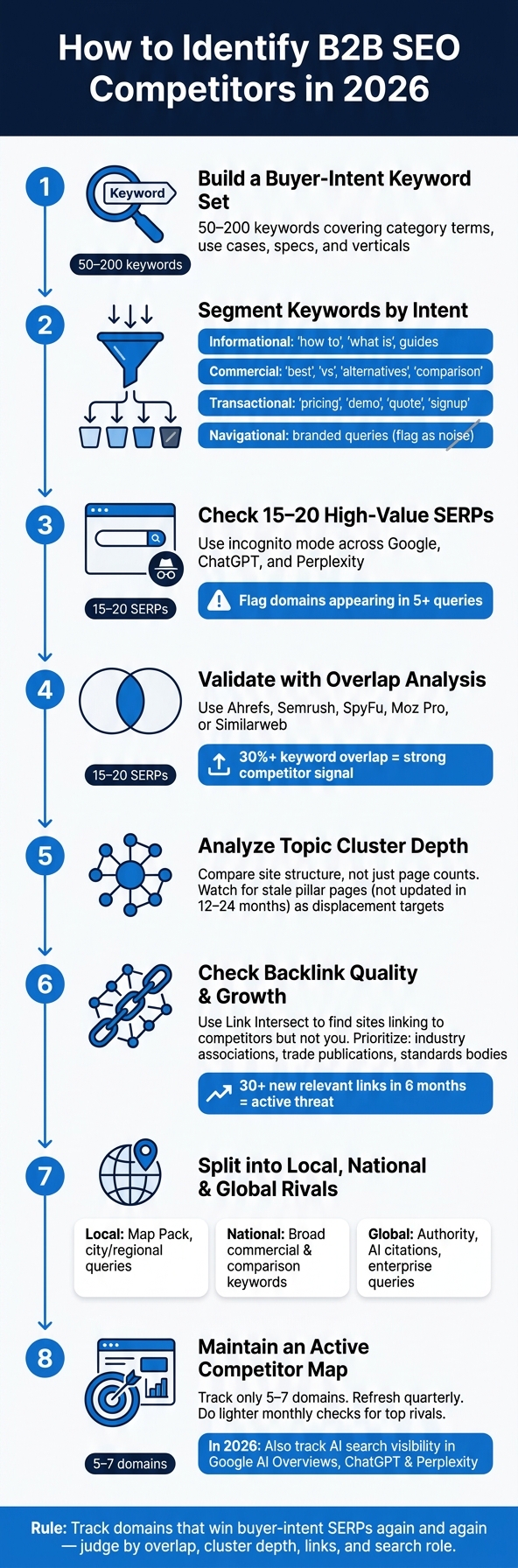
How to Identify B2B SEO Competitors in 2026: Step-by-Step Process
Find competitors by search intent and keyword sets
Build a B2B keyword set that reflects real buying journeys
Start with the terms buyers use in search - not your internal product labels. Build a set of 50 to 200 terms that covers category terms, use cases, specs, and vertical phrases such as "metallurgy consultancy" or "specialty fastener distributor".
Before you compare domains, group those terms by intent. That step matters more than many teams think. A search like "how to" or "what is" usually shows early-stage research. Queries built around definitions, methods, and guides fit there too. Commercial terms like "best", "comparison", "alternatives", and "vs" tend to signal evaluation. Transactional terms such as "pricing", "demo", "signup", "quote", and "contact" point to decision-stage interest. Navigational queries are mostly branded noise unless you want to track a competitor's brand on purpose.
Why does this matter? Because informational and transactional SERPs often bring up different sets of domains. If your list starts to grow, group it by product category or application instead of looking at each keyword one by one.
Once the terms are sorted by intent, you can test which domains keep showing up for those searches.
Run live SERP checks to spot recurring domains
Use your grouped keywords to check live SERPs and find the domains that repeat.
Run manual checks on your 15 to 20 highest-value keywords. Use incognito mode or a rank tracker to cut down personalization. Then log the domains that repeat in organic results and AI search surfaces.
A simple rule helps here: treat domains that appear in five or more queries as primary competitors. As you count frequency, split true SERP rivals from indirect ones. In most cases, you'll see three buckets:
- authority-heavy domains
- content-led domains
- intent-mismatch domains
Then use overlap tools to test that pattern across the full set.
Use top SEO tools to confirm who competes most often
Run your core keyword set through Ahrefs, Semrush, SpyFu, Moz Pro, or Similarweb to find domains with heavy keyword overlap. Focus on competitors with 30%+ keyword overlap. Those domains are usually competing with you most often for the same search visibility.
Each tool calculates overlap a bit differently.
| Tool | Overlap Metric | Best Use | Strengths | Limits |
|---|---|---|---|---|
| Ahrefs | Shared Keywords / Content Gap | Backlink-heavy analysis | Largest backlink index; precise page-level data | Higher cost and a steeper learning curve |
| Semrush | Organic Competitors Report / Overlap % | Traffic estimates and keyword gap discovery | Strong competitor traffic estimates | Can surface irrelevant domains without filtering |
| SpyFu | Shared Keywords & Ad History | Budget-friendly keyword and PPC research | Tracks organic and paid history | Backlink data less comprehensive than Ahrefs |
| Moz Pro | Domain Authority / Keyword Overlap | Strategic monitoring and SERP feature tracking | Reliable DA metric | Smaller keyword database than Semrush or Ahrefs |
| Similarweb | Traffic Share & Audience Overlap | High-level market benchmarking | Reveals traffic mix across channels | Less granular for specific B2B long-tail keywords |
sbb-itb-5be333f
Validate competitors with content clusters and backlink signals
Map topic clusters instead of comparing single pages
Once overlap shows which domains appear again and again, the next step is to see why. Are they ranking because they have deep topic coverage, or because a few pages happen to be doing well?
A domain can rank for a large set of keywords with one strong cluster. So don't compare raw page counts. Compare site structure. Start with the recurring domains from your overlap review, then map how far each one goes around a topic cluster.
One pattern is worth watching closely: a stale pillar page. If a page ranks in positions 1-5, hasn't been updated in 12-24 months, and has weak internal links, that's often a good displacement target rather than a locked-down position.
If a competitor ranks for far more keywords in a category than you do, the issue is usually structural - not that they simply published more articles. Pull keyword-gap exports and group terms into clusters based on search intent. That gives you a cleaner view of how their coverage is built.
After that, look at links. Structure explains part of the story. Backlinks show whether that visibility has support behind it.
Check backlink patterns that reinforce rankings
Backlink strength helps you tell the difference between rankings that are likely to hold and rankings that could slip. Use link patterns to verify which recurring domains are hard to outrank at a structural level.
In B2B, link quality usually matters more than raw volume. One link from an industry association, trade publication, or standards body can matter more than dozens of generic directory links.
Use Link Intersect to find sites that link to multiple competitors but not to you. Those sites are your warmest outreach targets. They also help confirm that a competitor has structural strength in the niche.
Then sort those links by why they exist, not just where they came from:
| Link Motivation | Description |
|---|---|
| Structural | Directories, tool roundups, industry listings |
| Asset-based | Links to original data, tools, or research |
| Editorial | Earned mentions in trade press or news |
| Relationship | Links from partners, integrations, or associations |
Also check whether the competitor's referring domains are still growing and whether the anchor text mix looks natural.
Segment local, national, and global rivals and build a competitor map
Separate local and global competitors by market and SERP type
Use keyword overlap and backlink signals to sort competitors by market footprint and SERP role.
After you confirm overlap, group competitors by geography and how they show up in search. Local rivals tend to win map-pack terms through Google Business Profiles and location pages. National rivals usually take broad commercial and comparison keywords. Global leaders often win through authority, deep topic coverage, and AI citations. Each group calls for a different playbook.
| Competitor Type | Geography | Local Pack Presence | Primary Queries | Authority Tier |
|---|---|---|---|---|
| Local Service Rival | City/Regional | High (Map Pack) | Maintenance, Repair | Tier 3 (Niche) |
| National Organic Rival | U.S. National | Low | Product Sales, Software | Tier 1 (Direct) |
| Global Category Leader | International | None | Enterprise Solutions | Tier 2 (Authority) |
| Niche Tech Blog | Global | No | Technical Guides | Tier 3 (Low) |
That split tells you which 5 to 7 domains should stay on the active map.
Build a working competitor map for quarterly use
Keep the active map tight - just 5 to 7 domains. Pick them based on keyword overlap, intent match, content-cluster strength, backlink quality, and SERP role, not just name recognition. If a domain keeps showing up across your highest-value keywords and topic clusters, it belongs on the map. If it doesn't, leave it off.
"A competitive analysis without prioritization is just data. The map turns it into a marketing strategy you can resource, schedule, and measure." - LATT SEO
Refresh the full map every quarter. Then do lighter monthly checks for ranking swings and new content from top-priority rivals.
| Competitor | Overlap % | Top Clusters | Backlink Strength | Geography | SERP Role | Priority |
|---|---|---|---|---|---|---|
| National Rival | 45% | CRM, Sales Ops | Growing | National | Snippet Owner | High |
| Global Leader | 12% | Industry News | Flat | Global | AI Citation | Low |
| Content Rival | 32% | Product Reviews | Strong | National | PAA Dominant | Medium |
| Local Rival | 55% | Local Services | Moderate | Local | Local Pack | High |
If a competitor picks up 30+ relevant industry links in six months, mark it as an active threat.
Use curated tool and agency directories when the team needs outside support
If your team needs outside help to move faster, use a vetted directory. When you're missing keyword-gap, backlink, or technical SEO tools, use Top SEO Marketing Directory to find vetted SEO tools and agencies.
How to perform a B2B Competitor Analysis
To streamline this process, you can leverage various B2B SEO tools designed to identify competitors and track keyword overlap.
Conclusion: A practical process for identifying B2B SEO competitors
Once you’ve built the competitor map, the next job is simple: keep it tied to what’s happening in search right now.
To identify B2B SEO competitors, combine high-intent keywords, live SERP checks, keyword overlap, topic-cluster coverage, backlink quality, and geography. Then use backlink strength and market scope to split competitors into local, national, and global rivals. If another domain owns a cluster you barely touch, that’s not just a gap - it’s a structural threat.
In 2026, there’s one more filter to add: AI search visibility. Competitors that keep showing up in Google AI Overviews, ChatGPT, or Perplexity may be pulling in attention that rank trackers don’t show.
Review the map every quarter, and check top rivals each month so it stays tied to rankings, qualified traffic, and pipeline. Track ONLY the domains that affect rankings, qualified traffic, and pipeline.
FAQs
How do I tell SEO competitors from sales competitors?
SEO competitors are the sites that rank in the top 10 for your target keywords - not just the companies your sales team watches. Sales competitors are the companies you lose deals to. SEO competitors can be those companies too, but they can also be media sites, publishers, and blogs.
To tell them apart, start with your core keywords. Then check SERP overlap in Ahrefs or Semrush, and group the domains that show up again and again by authority, content, or search intent.
What if my site competes with publishers instead of direct rivals?
If your site is up against publishers, aggregators, or review sites - not just direct business rivals - treat them as SERP competitors. They might not sell what you sell, but they can still take the search visibility you're after.
Don't brush them aside. Look closely at what Google is rewarding for those queries: content structure, depth, formatting, and search intent. Then match the patterns users seem to want, whether that's a guide, a comparison, or a definition.
How often should I update my B2B SEO competitor map?
For most B2B websites, a full competitor analysis each quarter is enough. If you're in a crowded market, add monthly signal tracking so you can spot shifts early.
Review your map every month to watch ranking changes after search engine updates or when competitors publish new pages. That keeps it current, accurate, and useful.