Long-tail keywords account for 70% of search traffic and convert 2.5x better than broad terms. If you're in a niche market, these keywords can help you rank faster and attract high-intent users. Here's a quick breakdown of the 7 strategies to master long-tail SEO:
- Use Specialized SEO Tools: Tools like Ahrefs, LowFruits, and Keyword Keg help identify low-competition, high-intent keywords.
- Understand Search Intent: Align keywords with user goals - whether informational, commercial, or transactional.
- Leverage Forums & Q&A Sites: Platforms like Reddit and Quora reveal real-world search terms.
- Add Location-Based Keywords: Include geographic modifiers to target local audiences effectively.
- Build Keyword Clusters: Group related keywords to create in-depth, intent-driven content.
- Update Existing Content: Refresh pages with new long-tail variations for improved rankings.
- Track & Adjust: Use tools like Google Search Console to monitor performance and refine your approach.
These strategies are designed to help niche websites rank faster, connect with specific audiences, and achieve higher conversions. Start by implementing one or two tactics, then expand as you see results.
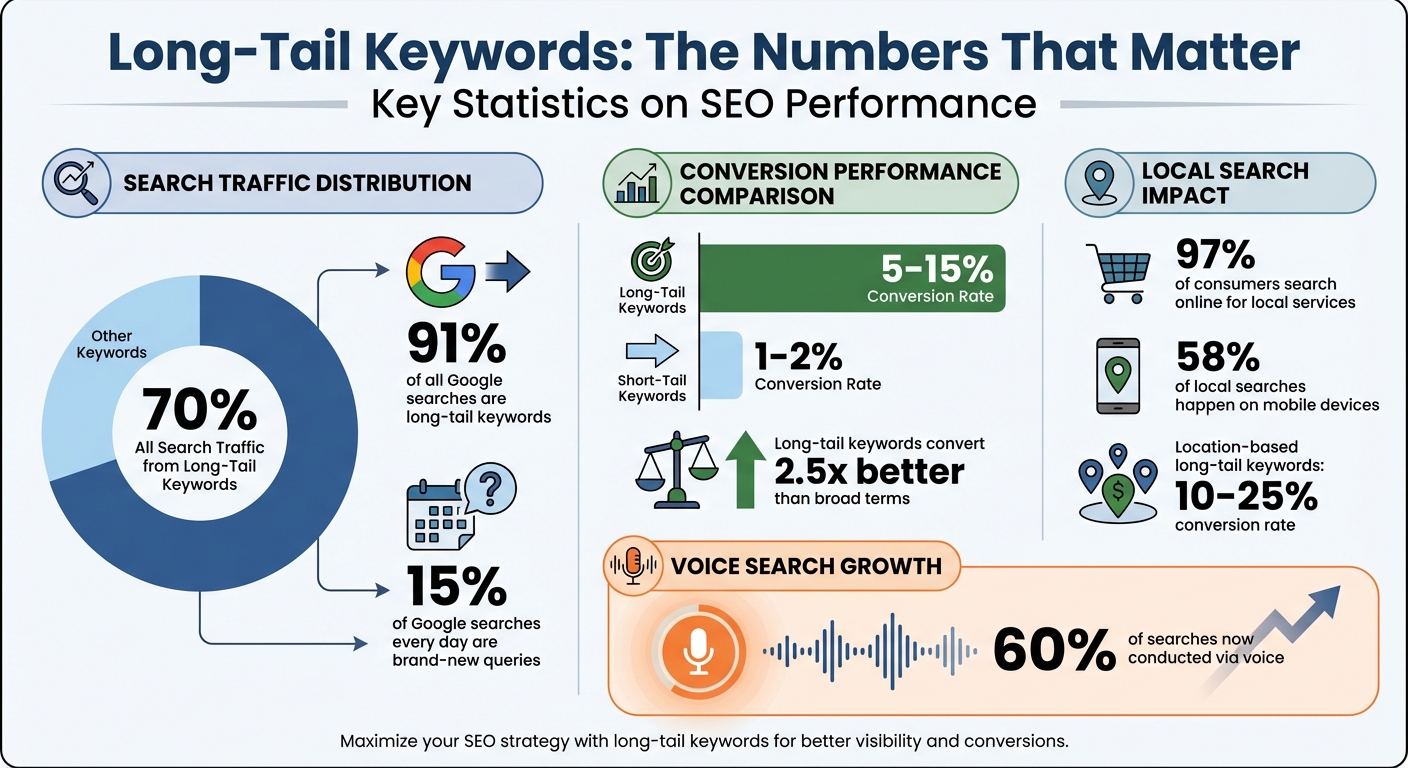
Long-Tail Keyword SEO Statistics and Performance Metrics
How to Drive Targeted Traffic with Long Tail Keywords
sbb-itb-5be333f
1. Use Specialized Tools for Detailed Keyword Research
Finding the right tools can make all the difference when it comes to uncovering those hidden, long-tail keywords that your competitors might overlook. While platforms like Google Keyword Planner are great for basic search volume data, they often miss out on low-volume keywords that could be goldmines for niche markets. To dig deeper, you’ll need tools that go beyond the basics and reveal opportunities others miss.
Take Ahrefs Keywords Explorer, for example. Its "Traffic Potential" (TP) metric doesn’t just show you keyword data - it highlights the total organic traffic the top-ranking page receives from all related keywords. This saves you from wasting time on keywords that might seem easy to rank for but are fiercely competitive. Then there’s LowFruits, which pinpoints "Weak Spots" in search results - perfect for newer sites trying to break into a niche. And don’t forget Keyword Keg, which pulls data from 11 sources, including Amazon, eBay, and YouTube. Its "Buyer Intent" filter helps you focus on keywords that are more likely to lead to sales.
"Keyword Keg is my go-to source for rich keyword data on the fly. The simple UI, fast results, and stability of the tool have cemented its place in my SEO toolbox for life." - Nick Eubanks, Founder, I'm From The Future
Search Intent Alignment
Once you’ve chosen your tools, the next step is aligning your keyword research with user intent. Keywords can be categorized by intent - whether users are looking for information, navigating to a specific site, or ready to make a purchase. Tools like SEMrush Keyword Magic Tool and Ahrefs make this process easier by offering intent tags and question filters. These features are especially useful for targeting voice search queries or snagging featured snippets. To refine your focus, set filters for keywords with low KD (Keyword Difficulty) scores. This approach helps you zero in on long-tail keywords that are both achievable and relevant.
Potential for Conversions
Finally, consider the conversion potential of the keywords you’re targeting. Tools like Keywordme are designed to help you find high-intent niche phrases by applying filters for longer phrases and low KD scores. Another method to identify quick wins is the Keyword Golden Ratio (KGR). Simply divide the number of "allintitle" Google results by the monthly search volume. If the ratio is 0.25 or less, you’ve likely found a keyword that can rank quickly.
For those looking to compare keyword research tools, the Top SEO Marketing Directory (https://marketingseodirectory.com) is a handy resource. It provides side-by-side comparisons of features and pricing, with options ranging from free versions to premium plans starting at $49/month.
2. Understand User Search Intent and Buyer Journey Stages
Knowing why people search is just as important as knowing what they search for. Long-tail keywords often provide clues about user intent - whether they’re exploring a topic, weighing their options, or ready to buy. This insight shapes your content strategy for every stage of the buyer's journey.
Search Intent Alignment
Google now prioritizes context and meaning over word-for-word matches. Instead of creating thin, separate pages for every keyword variation, focus on grouping semantically similar long-tail keywords into one comprehensive piece of content that addresses a single core intent. For example, phrases like "how to fix a leaking dishwasher", "dishwasher leaking from bottom", and "stop dishwasher water leak" all reflect the same problem-solving intent. A single in-depth guide can effectively cover all these queries.
Search intent generally falls into four categories:
- Informational: The user wants to learn or solve a problem.
- Commercial: The user is comparing options or evaluating products.
- Transactional: The user is ready to make a purchase.
- Navigational: The user is looking for a specific brand or website.
Each intent requires tailored content. A "how-to" search works best with a step-by-step guide, while a "vs" query benefits from a detailed comparison table highlighting pros and cons.
"You no longer need a separate page for every variation. You need strong, comprehensive content that satisfies the full intent behind a group of similar queries."
– Brett Helling, Founder, Trendline SEO
By aligning your content with these intents, you guide users seamlessly through discovery, consideration, and conversion.
Potential for Conversions
Consider this example: a search for "best stability running shoes for flat feet women" signals a user who’s close to purchasing - they’ve already identified their specific needs.
To map keywords to the buyer’s journey effectively:
- Discovery Stage: Create content like "how to choose running shoes for flat feet."
- Consideration Stage: Offer comparisons such as "Brooks vs ASICS for flat feet."
- Conversion Stage: Provide transactional pages like "buy women's stability running shoes under $100".
This structured approach ensures you capture users at every step of their decision-making process.
Ease of Implementation
Long-tail keywords often face less competition, giving niche websites the chance to rank faster - sometimes in weeks instead of years. Look at the current search results for your target keywords. If the top-ranking pages are broad or lack depth, you have an opportunity to create a focused, high-intent guide.
Expand your seed keywords with intent-focused modifiers like "best for beginners", "how to fix", "under $50", or "near me." These additions allow you to address specific needs across the buyer journey.
3. Find Keywords in Niche Forums and Q&A Sites
To build on your keyword research and better understand user intent, dive into niche forums and Q&A sites. Platforms like Reddit and Quora are treasure troves of user-generated content, offering a natural way to uncover long-tail keywords that reflect how people actually search online.
Relevance to Niche Audience
Forums give you a peek into the exact language your audience uses - language that often differs from polished marketing jargon. Here's a compelling stat: over 91% of all Google searches are long-tail keywords. Many of these come directly from questions users post when they can't find what they need in traditional search results.
"People often go to online communities like Reddit and Quora when they can't find an answer to their question elsewhere." - Rachel Handley, Senior Content Writer at Semrush
This makes forums a goldmine for identifying unmet needs and aligning your content with the way your audience naturally speaks and searches.
Search Intent Alignment
Every forum question is an opportunity to tap into the "why" behind a search. For instance, if someone asks on Quora, "What are the most common weight loss myths?" you can turn that into a content piece titled "7 Common Weight Loss Myths to Avoid". And don't stop there - check out the "Related Questions" sidebar on Quora for even more long-tail keyword ideas.
Ease of Implementation
Just like using specialized keyword tools, search operators can simplify your hunt for low-competition keywords in forums. While forum pages often lack SEO optimization - missing descriptive headings, structured URLs, or detailed answers - they still manage to rank. This creates an opportunity for your optimized content to outperform them.
To uncover these opportunities, try Google search operators like:
inurl:forum + [Keyword]intitle:forum + [Niche]
Once you've found a forum URL, analyze it with tools like Ahrefs or Semrush. Use their "Organic Keywords" report to filter for terms with a Keyword Difficulty (KD) of 0–10. If a forum ranks in the top three positions for these terms, you've found low-hanging fruit - keywords that require minimal backlinks to rank well.
Here’s a quick guide to using search operators for forum research:
| Search Operator | Purpose | Example Query |
|---|---|---|
[Keyword] + forum |
Finds general forums on a topic | dog training forum |
inurl:forum + [Keyword] |
Finds URLs with "forum" and your keyword | inurl:forum camping gear |
intitle:forum + [Niche] |
Finds forums with your niche in the title | intitle:forum home theater |
[Keyword] + community |
Finds niche communities and groups | SaaS marketing community |
4. Add Location-Based Long-Tail Keywords for Local Search
Taking your keyword strategy to a more focused level, targeting local markets can give your SEO efforts a sharper, more precise edge.
Relevance to a Specific Audience
Incorporating geographic modifiers into your long-tail keywords allows you to connect with a local audience that broader terms often miss. For example, instead of just targeting "bakery", you could use a phrase like "gluten-free birthday cakes for kids in Denver". This kind of specificity ensures you're reaching people actively searching for exactly what you offer in their area.
It’s worth noting that over 97% of consumers search online for local services, and 58% of these searches happen on mobile devices. This highlights how critical it is to optimize for local search.
Aligning with Search Intent
Local searches often reflect immediate needs. A query like "same-day AC repair commercial buildings Bangalore" clearly shows urgency and a specific problem that needs solving. These aren’t casual browsers - they’re potential customers ready to act. Adding location modifiers to your keywords helps capture this urgency, something generic terms simply can’t do.
"Long-tail keywords are the secret weapon for smart marketers in 2026. While enterprise giants battle over generic terms, agile businesses are capturing high-intent traffic - and sales - by targeting the specific, multi-word phrases that real buyers use." - Nishant Raghav, Founder, GoIT360
With over 60% of searches now conducted via voice, optimizing for conversational, location-based queries is more important than ever. People tend to use full sentences when speaking, such as "Where can I find same-day AC repair near me?" Your content should reflect this natural language style.
Higher Conversion Potential
Location-based long-tail keywords significantly outperform short-tail terms in terms of conversions, boasting rates between 10% and 25%, compared to just 1% to 3% for broader keywords. For instance, someone searching for "affordable wedding photographer candid shots Mumbai" is much closer to making a booking than someone simply searching "photographer."
These keywords also face less competition. While large brands might dominate broad terms like "coffee", smaller businesses can more easily rank for phrases like "organic coffee shops NYC". By focusing on local markets, you can attract high-intent traffic and achieve better conversion rates.
Simple to Implement
Adding location and qualifier modifiers to your core keywords is straightforward. For example, you can use phrases like "personal trainer for seniors home visits San Diego" or "startup incorporation lawyer technology companies Austin". Using top SEO marketing tools like Semrush's Keyword Magic Tool (starting at Tools like Semrush's Keyword Magic Tool (starting at $139.95/month) or KWFinder ($49/month) are excellent39.95/month) or KWFinder ($49/month) is excellent for identifying location-specific search volumes and competition levels. Additionally, optimizing your Google Business Profile with these keywords and incorporating local business schema markup can help search engines better understand your geographic relevance.
5. Build Keyword Clusters Based on Search Intent
Building keyword clusters is a smart way to refine your SEO strategy, especially when focusing on niche topics. By grouping keywords based on search intent, you can create content that aligns with what users are actively searching for, boosting your site's authority and relevance.
Search Intent Alignment
Organizing long-tail keywords by search intent is a proven way to strengthen your site's authority. Why? Because Google often ranks pages for not just one keyword but for hundreds - or even thousands - of related terms.
A great model to follow here is the "Hub and Spoke" structure. In this setup, you have a pillar page that covers a broad topic, like "budget smartphones", while cluster pages dig into more specific queries, such as "best budget Android phones under $300 in 2025". This method helps establish topical authority while avoiding internal competition. The key rule to follow: one search intent = one keyword cluster = one page.
This strategy not only helps with search rankings but also lays the groundwork for better internal linking and conversion-focused content.
Potential for Conversions
Keyword clusters aligned with different stages of user intent are a game-changer for conversions. Long-tail keywords already outperform short-tail terms, converting 2.5 times better. When you organize these into a three-stage funnel, the results can be even more impressive:
- Discovery Stage: Informational content like how-to guides attracts users who are just starting their research.
- Consideration Stage: Comparison posts and reviews help users weigh their options.
- Conversion Stage: Product pages with clear calls-to-action target users ready to make a purchase.
Here’s a quick breakdown of content formats by intent stage:
| Intent Type | User Goal | Content Format Example |
|---|---|---|
| Informational | Learning or solving a problem | How-to guides, checklists, primers |
| Commercial | Comparing options/brands | Comparison tables, "Best of" reviews |
| Transactional | Ready to purchase or sign up | Product pages, landing pages with CTAs |
This approach is especially crucial now, as AI-generated overviews dominate broad queries. Long-tail clusters allow you to capture specific user intent that AI tools often miss, drawing more organic clicks to your site.
"Target and focus more on answering the long tail queries of your users… We are going to see a much bigger and more important impact from those as a consequence of the AI overviews." – Aleyda Solis
Ease of Implementation
You don’t need expensive tools to start building keyword clusters. Begin by exporting your keyword list and applying the Keyword Golden Ratio (KGR). Keywords with a KGR of 0.25 or lower are easier to rank for. For larger lists, tools like Ahrefs can help you identify "Parent Topics" that naturally group related terms.
Once you’ve built your clusters, link them back to your pillar pages using keyword-rich anchor text. This helps distribute authority and makes your site structure clearer to search engines. Additionally, Google Search Console can be a goldmine for finding long-tail keywords already generating impressions. Use a regex pattern like .{25,} to spot these queries and group them into clusters.
6. Update Existing Content with Long-Tail Keyword Variations
Building on the idea of keyword clustering, refreshing your existing content with long-tail keyword variations can give your SEO strategy a noticeable boost.
Relevance to Niche Audience
Incorporating long-tail keywords into your content helps you connect with your niche audience more effectively. These phrases often mirror the exact language and concerns of your readers, making your content feel more tailored and relevant. For example, instead of sticking to a generic guide on "budget smartphones", you could refine it with variations like "best budget Android phones for seniors" or "affordable smartphones for small business owners." These tweaks let you address specific audience segments directly.
Long-tail keywords are a powerhouse for driving search traffic. They’re especially useful in niche markets because they usually face less competition from big brands. By weaving these targeted phrases into your existing pages, you not only improve rankings but also create content that resonates deeply with your audience.
Search Intent Alignment
Before diving in, it’s crucial to check if the new keyword variations align with your current content or if they require a standalone page. A simple way to do this is through a SERP overlap analysis. Compare the top results for your main keyword with those for the variation. If the results are similar, the variation can be added to your existing page. If they’re different, it might indicate a unique intent that deserves its own dedicated content.
Tools like Google Search Console can help you pinpoint quick wins. Look for keywords ranking in positions 5–20 - these are terms already generating impressions but just need a little push. Incorporate these variations naturally into headers (H2s and H3s), meta descriptions, and opening paragraphs to signal relevance to search engines. Adding question-based long-tail keywords from "People Also Ask" sections can also help you secure featured snippets.
Potential for Conversions
Long-tail keywords are not just about traffic - they’re also conversion magnets, performing 2.5 times better than broader terms. Take the example of Wave, a SaaS company that launched a landing page targeting "free accounting software for nonprofits" in July 2025. That single page ranked among the top three results for 25 different keywords, driving organic traffic worth $2,600 per month.
To replicate this success, fine-tune your content with audience-specific modifiers like "for seniors", "for Shopify", or "for small apartments." These tweaks allow you to capture users at every stage of their journey, from initial research to making a purchase.
Ease of Implementation
Updating existing content is often quicker and easier than creating new pages from scratch. Since your page already has a foundation in search indexes, you’re building on something that’s already working. As part of your SEO plan, aim to update your top-performing pages quarterly with 3–5 long-tail variations.
For identifying low-competition keywords, try using the Keyword Golden Ratio (KGR) - a ratio of 0.25 or less indicates a term that can rank quickly. Using top SEO tools and services like Google Search Console (free), Ahrefs (starting at $99/month), and Semrush (starting at Tools like Google Search Console (free), Ahrefs (starting at $99/month), and Semrush (starting at $139.95/month) can help you spot gaps in competitor content39.95/month) can help you spot gaps in competitor content and find "page 2" opportunities. Alternatively, dig into customer support tickets, reviews, or niche forums to uncover the natural language your audience is already using.
7. Track Performance and Adjust Your Long-Tail Strategy
Keeping an eye on how your long-tail keywords perform is essential for maintaining effective niche SEO. The good news? Free tools like Google Search Console make it easy to start tracking your progress.
Relevance to Niche Audience
The first step is to pinpoint the sub-topics that resonate most with your audience. A great way to do this is by filtering Google Search Console for keywords ranking in positions 5–20. Look for those with high impressions but low click-through rates - these are often "quick wins" waiting to be optimized. For example, in June 2025, Choose Chicago used this method to target local long-tail FAQs. The result? A single guide ranked in the top three results for 482 keywords, half of which were four words or longer. This shows how focusing on niche-specific queries can pay off.
To stay organized, tag your tracked keywords by intent - whether informational, navigational, commercial, or transactional. This helps you align your goals with performance metrics. If you're targeting local markets, keep an eye on keywords with city or region-specific modifiers. These often bring in high-intent traffic that converts at much higher rates. Finally, compare engagement metrics to ensure your content matches what your audience is searching for.
Search Intent Alignment
Metrics like click-through rate (CTR) and bounce rate can reveal whether your content is hitting the mark. A high CTR suggests your title and meta description are doing their job, while low bounce rates and longer time-on-page show that your content is delivering value. By comparing these metrics for long-tail versus head terms, you can see how well your strategy aligns with search intent. Using regex patterns in Google Search Console can also help uncover additional long-tail opportunities.
To avoid internal competition, consolidate similar keyword targets. These insights not only help refine your strategy but also improve conversion performance.
Potential for Conversions
Long-tail keywords often outperform head terms when it comes to conversions. While head keywords typically convert at 1%–2%, long-tail keywords can achieve conversion rates of 5%–15%. Don't just track direct conversions - look at assisted conversions too. Informational long-tail content often plays a critical role in starting the customer journey, even if it doesn’t lead to the final sale.
A real-world example? In July 2025, Wave's landing page for "free accounting software for nonprofits" ranked in the top three for 25 keywords. This page generated organic traffic worth $2,600 per month, highlighting the value of monitoring keyword clusters rather than focusing solely on individual rankings.
Ease of Implementation
Tools like the WordPress plugin Analytify simplify performance tracking without requiring complex data exports. Set a quarterly schedule to review your top-performing pages. Refresh them with updated data, new insights, and additional long-tail variations based on what's working. At the same time, consider removing underperforming pages that may dilute your site’s authority.
As conversational search continues to grow, it’s also worth tracking how often AI-generated responses appear for conversational long-tail queries. Rachel Handley, Senior Content Writer at Semrush, emphasizes this point:
"If you use long-tail keywords appropriately, your content is more likely to align with users' language and influence the AI response".
Conclusion
Achieving success with long-tail SEO means weaving together all seven strategies into a continuous, evolving process. Tools provide the data, while forums and Q&A platforms reveal the language your audience actually uses. By understanding search intent, you can align keywords with the right stages of the buyer journey. Keyword clusters, in turn, establish the topical depth that search engines reward. Adding location-specific modifiers further fine-tunes your strategy, helping you attract high-intent local traffic that’s more likely to convert. This method doesn’t just refine your approach - it delivers results you can measure.
The numbers back this up. Long-tail keywords account for 70% of all search traffic and boast conversion rates between 5% and 15%, far outpacing the 1% to 2% seen with broader terms. Plus, with 15% of Google searches every day being brand-new queries, standing still isn’t an option. Regular tracking, paired with quarterly content updates, helps you capture emerging trends and stay visible in today’s AI-driven search environment.
Real-world examples prove this point. Nishant Raghav, Founder of GoIT360, explains:
"Long-tail keywords are the secret weapon for smart marketers in 2026. While enterprise giants battle over generic terms, agile businesses are capturing high-intent traffic".
This strategy works across industries, whether you’re running a local service, a SaaS platform, or an e-commerce business. The secret? Treat SEO as an ongoing process, not a one-off task.
Start small - implement one or two strategies this quarter. Then, as you gain traction, gradually integrate the others. Keep an eye on your results, refine what works, and drop what doesn’t. The businesses that dominate niche markets in 2026 won’t be the ones with the deepest pockets - they’ll be the ones that adapt, evolve, and optimize their long-tail SEO approach consistently.
FAQs
How do I find long-tail keywords with real buying intent?
To uncover long-tail keywords that signal buying intent, focus on specific, user-focused phrases that mirror real search queries in your niche. A great starting point is brainstorming questions or needs your audience might have. What problems are they trying to solve? What products or services are they actively seeking?
Next, use tools like Google Autocomplete to dig deeper. Type in a broad term related to your niche and see what detailed suggestions pop up - these often reflect what people are actually searching for.
Don't stop there. Explore forums, social media platforms, and review sites to understand how your audience talks about their needs. Pay attention to the actual words and phrases they use. This approach helps you identify keywords that not only match user intent but also attract visitors who are more likely to take action.
When should a long-tail keyword get its own page vs an existing page?
When deciding whether a long-tail keyword needs its own page, consider its purpose and uniqueness. If the keyword addresses a specific user intent or focuses on a distinct niche, it likely warrants a dedicated page. However, if it overlaps heavily with the content of an existing page or has low search volume without a clear, separate intent, it’s more effective to incorporate it into an already existing page.
What SEO metrics best show if long-tail keywords are working?
When it comes to measuring the success of long-tail keywords, focus on three key metrics: search rankings, organic traffic, and conversion rates. These metrics provide a clear picture of how well your strategy is working.
- Search Rankings: Tracking where your content appears on search engine results pages (SERPs) shows how effectively your long-tail keywords are boosting visibility.
- Organic Traffic: Analyzing the volume of visitors coming to your site through these keywords helps determine if they’re attracting the right audience.
- Conversion Rates: Ultimately, the goal is action - whether that’s a purchase, sign-up, or another desired result. High conversion rates signal that your keywords are resonating with users and driving meaningful engagement.
Together, these metrics reveal how well your long-tail keyword strategy is improving visibility and connecting with your target audience.