Monitoring search rankings internationally is critical for understanding how your content performs in different regions. Search engines like Google, Baidu, Yandex, and Naver prioritize unique algorithms and local preferences, making it essential to track rankings by country, language, and device. Here's a quick overview of what you need to know:
- Why It Matters: Search results vary by location, and 90% of users prefer browsing in their native language. Ignoring this can lead to missed opportunities and irrelevant content delivery.
- Top Tools: Platforms like Ahrefs, Semrush, and SISTRIX help track rankings across multiple countries, search engines, and devices. They also monitor AI-driven search visibility.
- Setup Tips: Use Google Search Console and professional tools to identify target regions and keywords. Configure campaigns for precise tracking at global, country, and city levels.
- Automation: Automate rank tracking and alerts for critical keywords to save time and catch ranking drops early. Generate localized reports to provide actionable insights for stakeholders.
- Avoid Common Mistakes: Personalization, device differences, and regional competitors can skew results. Use tools to reduce bias and track local SERP features.
This guide outlines tools, strategies, and best practices for effectively managing international SEO and ensuring your content reaches the right audience across the globe.
International SEO Tracking And Reporting With AWR
Tools for Tracking Search Rankings Across Countries
International SEO Rank Tracking Tools Comparison: Features and Coverage
Popular Rank Tracking Tools
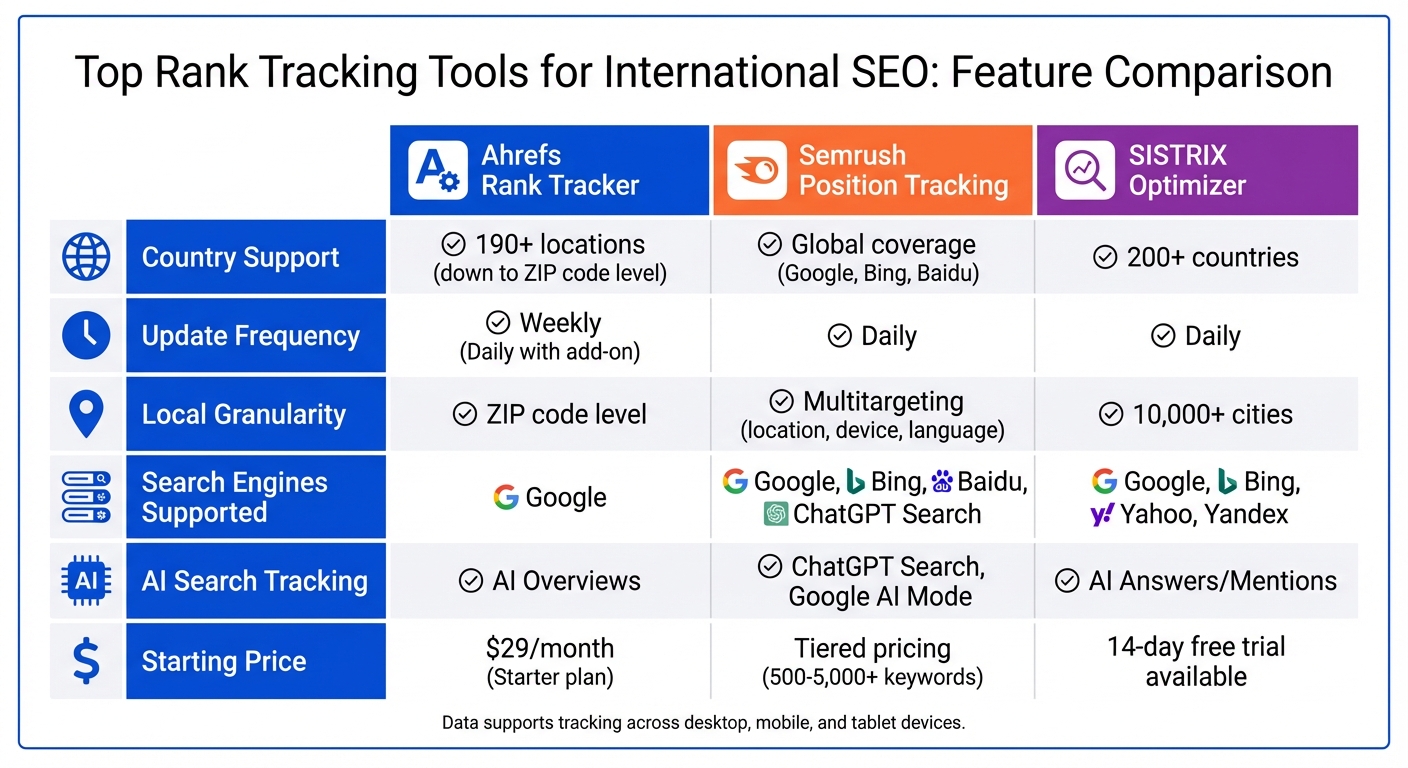
Finding the right tool to monitor SEO rankings across various countries is essential. Ahrefs Rank Tracker lets you track keyword rankings in over 190 locations, down to ZIP code level, and monitors 19 SERP features, including AI Overviews and local packs. Semrush Position Tracking provides daily updates for Google, Bing, Baidu, and even AI-powered search engines like ChatGPT Search. Its "Multitargeting" feature allows you to track variations by location, device, and language within a single campaign. Meanwhile, SISTRIX Optimizer supports tracking in more than 200 countries and offers detailed monitoring across 10,000+ cities.
"Position Tracking tracks any keyword and domain, even those not in the main Semrush database." - Semrush
Although Google is the primary focus for most tools, both SISTRIX and Semrush also support Bing and Baidu. SISTRIX goes further by including Yahoo and Yandex. Additionally, all major tools offer separate tracking for desktop, mobile, and tablet rankings. A growing trend in the industry is the inclusion of AI search monitoring, with leading tools now tracking visibility on AI-driven platforms like ChatGPT Search and Google AI Mode.
Tool Comparison by Features and Coverage
Here's a breakdown of the top rank tracking tools by their features and regional coverage:
| Feature | Ahrefs Rank Tracker | Semrush Position Tracking | SISTRIX Optimizer |
|---|---|---|---|
| Country Support | 190+ locations | Global (Google, Bing, Baidu) | 200+ countries |
| Update Frequency | Weekly (Daily with add-on) | Daily | Daily |
| Local Granularity | ZIP code level | Multitargeting | 10,000+ cities |
| Search Engines | Google, Bing, Baidu, ChatGPT | Google, Bing, Yahoo, Yandex | |
| AI Search Tracking | AI Overviews | ChatGPT Search, Google AI Mode | AI Answers/Mentions |
When it comes to pricing, options vary based on your requirements. Ahrefs starts at $29/month for its Starter plan. Semrush offers tiered pricing, with keyword limits ranging from 500 to over 5,000, depending on the plan. SISTRIX provides a 14-day free trial, allowing users to explore its Optimizer and rank tracking capabilities. For agencies or large-scale campaigns, Semrush's Business plan supports up to 5,000 keywords and multitargeting options for 5,000 targets per campaign.
These tools are indispensable for country-specific tracking, as discussed earlier. To simplify your decision-making process, the Top SEO Marketing Directory offers an efficient way to find the perfect tool for your needs.
Using the Top SEO Marketing Directory
The Top SEO Marketing Directory (https://marketingseodirectory.com) is a valuable resource for businesses focused on international SEO. It allows you to filter and compare rank tracking tools based on regional strengths and specific features. Instead of testing multiple platforms individually, the directory provides curated listings to help you identify tools that excel in areas like local tracking, support for search engines such as Baidu or Yandex, and white-label reporting for agencies. By organizing tools based on capabilities like multi-language support, AI visibility tracking, and advanced reporting features, the directory saves time and ensures you find the right match for your global SEO strategy.
Setting Up Country-Specific Tracking Campaigns
Selecting Target Countries and Keywords
Start by diving into your Google Search Console data. Use the "Country" filter to identify regions where your site is generating organic impressions - even if you haven’t actively targeted those areas. For instance, if you notice impressions from Germany but low click-through rates, that’s a potential opportunity to explore.
When picking target countries, consider practical factors like your business logistics. Focus on markets where you have physical offices, shipping capabilities, or where your products or services vary due to seasonal demands or legal requirements. Once you’ve narrowed down your list, use SEO tools to compare search volumes and competition levels across these regions. This helps you prioritize markets with the best growth potential.
For keyword research, rely on native speakers to ensure you’re capturing local search behavior accurately. Regional phrases, local naming conventions, and unique search habits can differ significantly from one market to another. A great example is ActiveCampaign, which localized its SEO strategy for Spanish-speaking users in 2025. The result? A 73% year-over-year boost in traffic to its Spanish blog and a 111% increase in usage of its Spanish Help Center. Similarly, UNIQLO revamped its international SEO approach and saw a 109% rise in organic traffic and a 141% jump in revenue.
Keep in mind that Google isn’t the top search engine everywhere. In China, Baidu dominates; in Russia, it’s Yandex; and in South Korea, Naver leads the pack. Each platform has its own tracking requirements. Also, search intent can vary by region - some audiences may prioritize technical details, while others lean toward reviews or social proof. Fun fact: 90% of internet users prefer browsing in their native language when given the choice.
Once you’ve nailed down your target markets and keywords, you’re ready to set up campaigns for precise local tracking.
Configuration Best Practices
After identifying promising markets and keywords, it’s time to configure campaigns for accurate, location-specific tracking. Create separate campaigns for each target country to ensure clean and precise data. Many tools let you localize tracking at four levels: global, country, region, and city.
For keywords with local intent - like “restaurants near me” - city-level tracking is essential. Google determines user location at least at the city level using IP addresses, so this approach ensures your data reflects what users actually see. In multilingual regions like Canada or Belgium, set up campaigns to track specific language-market combinations, such as Google Canada in French versus English.
Don’t forget to track rankings separately for desktop and mobile devices. Most professional SEO tools update rankings daily, ensuring you always have up-to-date insights. Import keywords from Google Search Console to monitor terms you’re already ranking for in each country. Keep in mind that tracking costs can add up - tracking 10 keywords in two cities counts as 20 keywords because each location and device is billed separately.
For hreflang tags, make sure they are reciprocal and include a self-reference. This helps search engines identify the correct language version of your content. For larger websites, managing hreflang tags through XML sitemaps can simplify updates and reduce page load times compared to embedding them directly in the code.
Avoid forcing IP-based redirects to localized versions of your site. Instead, use banners or pop-ups to suggest localized content. Googlebot often crawls from a U.S. IP address, so forced redirects can block international content from being indexed. To track performance by market tier or content language, set up custom dimensions in Google Analytics 4. Lastly, test page load speeds and Core Web Vitals in each target market using tools like VPNs or GTmetrix to ensure a smooth user experience.
sbb-itb-5be333f
Automating Rank Monitoring and Reporting
Automation Strategies for Multi-Country Tracking
Set up automated systems to monitor rankings daily for high-revenue keywords and weekly for informational content. This blend of daily and weekly checks keeps costs under control while ensuring critical terms are closely watched. By tracking your most valuable keywords daily, you can catch ranking drops up to six days earlier than weekly scans, potentially preventing significant revenue losses.
Leverage automated alerts to notify you when rankings for high-value keywords drop by three or more positions or when a Featured Snippet is lost. Modern tools can also track SERP features like Local Packs, "People Also Ask" boxes, and AI Overviews, which now appear in 78% of top-performing keywords. Since competitive keywords often fluctuate by 3–5 positions daily, automation helps you focus on meaningful changes rather than reacting to normal variations.
"The businesses winning in 2026 are those treating rank tracking as a diagnostic intelligence system, not a vanity metric dashboard." - SEO Webster Team
Don’t forget to monitor mobile and desktop rankings separately. Mobile results often differ due to factors like page speed and location-specific weighting. With mobile devices generating 58.67% of global web traffic in 2024 - and over 76% for local searches - this distinction is crucial. For hyper-local insights, grid tracking can pinpoint rankings based on specific GPS coordinates.
Companies like Marriott and Glassdoor have seen impressive results by automating technical SEO processes. For instance, Marriott used Botify's automation to achieve a 30% increase in unique pages visited, while Glassdoor estimated an additional $10 million in SEO-driven revenue.
Once monitoring is automated, the focus shifts to effectively sharing these insights with stakeholders.
Generating Reports for Stakeholders
Instead of relying on a single global average, create white-label, country-specific reports. A global figure can mask localized issues - like a competitor gaining traction in France or a ranking drop in Japan - that require immediate action.
"A single 'global' number is like grading the whole class on the smartest kid's test. It hides the slackers and leaves you guessing where the real work needs to happen." - Kali Armstrong
Organize your reports in tiers. Start with revenue data for each country, then layer in organic traffic and ranking metrics. Tools like SE Ranking (starting at $119/month) or AgencyAnalytics (starting at $12/client) can help agencies create branded client portals - such as reports.youragency.com - to enhance their professional image. Automate the delivery of weekly or monthly PDF reports to save time and keep stakeholders informed. To add extra clarity, include programmatic screenshots of target SERPs, offering a visual representation of how your site appears across different regions.
Common Mistakes in Cross-Country Rank Tracking
Personalization and Device Variations
Search results are shaped by a range of factors, including IP addresses, GPS data, Wi-Fi signals, language preferences, search history, and even the type of device being used. For example, users generally favor content in their native language, which can significantly influence how search results are displayed across different regions.
If you're only tracking rankings from a single location, like New York, you might overlook how search results vary in other areas. Mobile and desktop search engine results pages (SERPs) also differ: mobile users often see features like "call" buttons and local packs prioritized, while desktop users encounter a different layout. Even shared office networks can skew results due to collective browsing behavior tied to the same IP address.
"The reality is that search results are dynamic, personalized, and context-dependent. Meanwhile, SEO reporting tools are designed to strip away that variability and provide a consistent, unbiased picture of performance." – Marcel Digital
To get a clearer picture of rankings, utilize tools like Chrome Developer Tools to simulate searches from specific locations by inputting longitude and latitude coordinates. You can also add URL parameters (e.g., &near=cityname) to mimic local search behavior. Professional rank tracking tools can help reduce personalization effects, but it's still essential to check rankings separately for mobile and desktop. Grasping these nuances is a necessary first step before tackling external factors that affect rankings.
Ignoring Competitors and Algorithm Updates
Personalization isn't the only challenge. External factors, like competitors and algorithm updates, can also cause major ranking shifts. For example, regional competitors often outperform global brands by aligning more closely with local search intent. These competitors may dominate in their specific markets but remain invisible during global audits.
Take the case of ActiveCampaign: in August 2025, the company applied SEO transcreation and localization to its Spanish-language content. The results? A 73% year-over-year increase in traffic to its Spanish blog and a 111% rise in Help Center usage.
"Keyword shifts spark client questions... Maybe three new competitors launched similar content last week. Without the right data, it's guesswork." – Kali Armstrong, AgencyAnalytics
Set up automated alerts to track not just personalization issues but also competitor activity and algorithm updates. Dive into local competitor research for each target region and monitor region-specific SERP features like "People Also Ask" boxes or map packs. Add notes to your reports about recent algorithm changes or competitor actions to provide context for performance fluctuations.
Conclusion
Tracking search rankings across different countries is about more than just numbers - it’s about understanding localized performance. As discussed earlier, successful international SEO relies on precise tracking and tailored strategies. Take UNIQLO and Saxo Bank, for example; both saw noticeable increases in organic traffic and revenue after refining their international SEO approaches.
"International SEO is a coordination game. Technical setup, targeting logic, and cultural relevance must move in sync for global performance".
To thrive in global markets, aligning technical configurations, targeting methods, and regional relevance is key - especially when navigating search engines like Baidu, Yandex, or Naver. This guide has emphasized the importance of accurate, country-specific tracking to ensure your strategy adapts to the nuances of each market.
Standard analytics tools often fall short by averaging global data, which can obscure critical insights. For example, a 50% traffic drop in one country could be hidden behind gains in another. Without localized tracking, you might miss vital keyword variations, overlook regional competitors, or fail to address technical issues that differ across markets.
FAQs
What’s the best way to track search rankings in different countries?
To keep tabs on search rankings across different countries, start by selecting a tool that offers extensive international coverage and delivers accurate insights tailored to specific regions. Ideally, the platform should allow you to track rankings by country, language, or even specific local search engines, ensuring precise and relevant data.
Automation plays a crucial role here. Tools that automatically refresh rankings and present clear, actionable insights can save you time and help avoid manual mistakes. Also, consider tools with localization capabilities - features like language-specific tracking and region-based reporting are essential for fine-tuning your international SEO efforts.
When you combine these elements - global scope, automation, and localization - you’ll have a streamlined way to monitor and improve search rankings across various countries effectively.
What should I focus on when creating SEO campaigns for specific countries?
When you're crafting SEO campaigns for different countries, focusing on a few essential elements can make all the difference. Start with choosing the right site structure. Options like country-code top-level domains (ccTLDs), subdomains, or subdirectories each have their own advantages. Pair this with hreflang tags to guide search engines on language and regional targeting. This not only helps users land on the correct version of your site but also avoids duplicate content headaches.
Localization is another big piece of the puzzle. Don’t stop at simple translations - adapt your content to reflect local preferences, behaviors, and even specific terminology. This makes your site more relatable, improving user engagement and increasing the likelihood of conversions. On top of that, enabling geotargeting ensures your campaigns are hitting the right audience. Tracking performance across different markets is also key to making well-informed tweaks.
Lastly, keep an eye on local regulations and how search engines operate in each country. Ranking factors can vary significantly, so tailoring your strategy to these nuances can improve visibility and deliver better results in international markets.
How can I automate tracking search rankings across different countries?
Automating search rank tracking across different countries is a game-changer for saving time and improving precision. With advanced SEO tools, you can monitor rankings daily, pinpoint results for specific locations, and even distinguish between devices like iOS and Android. These tools also offer detailed insights, such as hyper-local data, and generate reports that are ready to share with clients.
By embracing automation, you can simplify global and local SEO tracking. This ensures your rank monitoring is not only consistent but also accurate - without the need for manual input. It turns rank tracking from a routine task into a powerful way to analyze performance and fine-tune strategies.