Predictive analytics is transforming B2B SEO by enabling teams to forecast traffic, leads, and revenue instead of relying on past data. These tools use historical trends, machine learning, and CRM data to predict outcomes like traffic changes, keyword growth, and content performance. This approach helps SEO teams:
- Spot declining page visibility early and estimate traffic impacts.
- Prioritize high-value keyword clusters for qualified leads.
- Model the ROI of SEO investments compared to paid channels.
For enterprise B2B organizations, predictive tools simplify complex sales cycles by connecting SEO efforts to pipeline and revenue forecasts. Platforms like BrightEdge, Conductor, and seoClarity offer features like traffic forecasting, keyword opportunity scoring, and integration with analytics tools. These tools help teams justify budgets, align SEO with business goals, and stay ahead of competitors.
Quick Overview of Top Tools:
- BrightEdge: Focuses on ROI measurement and keyword forecasting.
- Conductor: Specializes in content strategy and performance projections.
- seoClarity: Scales for large, global B2B sites with advanced forecasting.
Predictive analytics shifts SEO from a reactive to a proactive strategy, making it easier to plan, prioritize, and deliver measurable business outcomes.
The Rise of Predictive Analytics in Marketing Strategy
Key Features to Look for in Predictive Analytics Tools
For enterprise teams managing intricate sales cycles and multi-domain tracking, predictive analytics tools must connect organic search efforts directly to revenue. The following features are essential for B2B SEO teams aiming to turn predictive insights into actionable strategies that drive results.
SEO-Specific Data Modeling
General analytics tools often fall short when it comes to SEO forecasting. Tools designed specifically for SEO leverage a mix of historical rankings, click-through rates, search volume trends, and seasonality, paired with on-site engagement and conversion data. This combination helps estimate future traffic and pipeline outcomes under various scenarios. For B2B companies, this is especially important when dealing with low-volume, high-value keywords - those that may only generate a handful of searches each month but can lead to significant deals.
These tools also differentiate between branded and non-branded queries and support custom conversion events like marketing-qualified leads (MQLs), sales-qualified leads (SQLs), or opportunities. This allows predictions to focus on meaningful outcomes rather than generic metrics like form fills. Effective keyword-level forecasting should go beyond traffic projections to estimate conversions and revenue impact.
Additionally, tools should allow for cohort and segment analysis - breaking down data by industry, account tier, or intent level. This helps teams pinpoint which topics or search engine results page (SERP) positions drive the most pipeline and closed deals. For instance, pushing a product comparison page into the top three SERP rankings could significantly boost pipeline based on historical data.
Beyond individual keywords, advanced data modeling identifies emerging topics, shifts in search intent (e.g., from informational to commercial), and rising SERP features. These insights help prioritize content clusters and landing pages that align with future buyer behavior. Ranking prediction features can estimate the impact of moving key pages up SERP bands in terms of incremental clicks, leads, and pipeline value, enabling teams to focus on high-return opportunities.
Integration with Existing SEO Platforms
Predictive analytics tools must integrate seamlessly with existing SEO and analytics platforms like Google Analytics, Google Search Console, SEMrush, and Ahrefs. Strong integrations allow automated data pulls - daily or even hourly - and consistent mapping of URLs, properties, and dimensions. This ensures keyword and ranking data is enriched with confirmed conversion and revenue metrics. Incorporating competitor visibility or backlink data further refines forecasts.
Bi-directional integration takes this a step further by enabling teams to push prioritized recommendations, content briefs, or tasks directly into project management systems or SEO tools. For enterprise B2B organizations, where SEO, content, and demand generation teams often overlap, this level of integration ensures consistent tagging, unified campaign performance views, and streamlined reporting.
Customizable Dashboards and Reporting
Enterprise SEO teams cater to varied audiences, from specialists optimizing individual pages to executives focused on quarterly pipeline contributions. Customizable dashboards and reporting make it easier to provide each stakeholder with the right level of detail.
Dashboards can be tailored by role. For example:
- Tactical dashboards might focus on keyword clusters, technical SEO issues, and page-level opportunities.
- Executive dashboards could highlight forecasted pipeline, revenue impact, and cost efficiency metrics.
Dashboards should also allow for filtering by market, product line, or account segment. Forecasts should be presented in business-friendly terms, such as projected opportunity value in USD or expected time-to-impact on quarterly goals.
Predictive reports should map organic sessions and conversions to downstream CRM stages, showing how specific pages or topics influence opportunity creation and closed deals. These insights can then be used to project future performance. Including elements like confidence intervals, scenario analyses (e.g., conservative, expected, and aggressive outcomes), and cost assumptions makes predictions more actionable and helps compare ROI across channels.
For example, a B2B SaaS company might use predictive tools to identify high-intent keyword clusters, align content strategies, and drive pipeline growth. Similarly, a global B2B brand could integrate predictive analytics with CRM and web analytics data to create dashboards showing SEO’s contribution to quarterly pipeline targets by region and product line. These insights support better budget allocation and campaign planning across teams.
Experts recommend starting small - focusing on a limited set of high-intent keywords - and validating the model’s projections against observed performance. As data quality improves and stakeholders gain confidence, the scope can be expanded. Involving data, analytics, and sales operations teams early ensures accurate conversion definitions, attribution rules, and revenue mappings, which are critical for reliable insights and adoption.
Tools that automate reporting and consolidate data into customizable dashboards not only save time but also enable enterprise SEO teams to make smarter, data-driven decisions.
Top Predictive Analytics Tools for B2B SEO
Enterprise B2B SEO teams rely on tools that can forecast traffic, rankings, and revenue impact. These tools are designed to transform SEO into a proactive planning function by leveraging historical data and machine learning. Below, we explore some of the leading platforms that cater to the intricate needs of B2B organizations, especially those managing complex, multi-domain websites and long sales cycles.
Here’s a breakdown of tools that help turn predictive insights into actionable SEO strategies for enterprise teams.
1. Top SEO Marketing Directory
The Top SEO Marketing Directory acts as a comprehensive resource for enterprise SEO professionals to shortlist predictive analytics platforms, specialized agencies, and complementary tools. It allows B2B teams to compare offerings side-by-side, filter by enterprise features, and find providers experienced in industries like SaaS, manufacturing, or professional services.
For procurement teams, this directory simplifies vendor evaluation by consolidating feature lists, pricing tiers (in USD), and integration details in one place. It’s especially useful for identifying platforms that support advanced forecasting - an essential feature for large-scale B2B SEO efforts.
Beyond core platforms, the directory also highlights specialized services such as link-building providers, technical SEO consultants, and content optimization agencies. For example, a global B2B brand might use the directory to find both a forecasting platform and a technical SEO agency to resolve crawl issues flagged by predictive models.
Pricing structure:
- Free basic tier for standard listings
- Premium tier at $49/month for advanced listings
- Custom enterprise pricing for tailored solutions and full access
2. BrightEdge

BrightEdge is an enterprise-level SEO platform with AI-driven forecasting capabilities that connect keyword performance to business outcomes. By analyzing historical ranking data, search volume trends, and click-through rates, it estimates future traffic and conversion impacts. This is particularly valuable for B2B teams focusing on high-value, low-volume keywords where even a slight ranking improvement can significantly affect the pipeline.
Key features include keyword performance forecasting, content opportunity identification, and ROI measurement. These tools help prioritize content updates, estimate impacts on marketing-qualified leads (MQLs), and align campaigns with fiscal quarters or industry events. For instance, a team could model how moving a product comparison page from position five to position two might influence quarterly revenue.
BrightEdge integrates seamlessly with analytics platforms and CRMs, pulling real-time conversion data to enhance predictive accuracy. Customizable dashboards show predicted versus actual performance, enabling teams to refine strategies over time. The platform also supports multi-year trend analysis for both desktop and mobile, helping identify seasonal patterns and long-term growth opportunities.
Typical pricing: Custom enterprise pricing based on tracked keywords, domain count, and feature modules. Annual contracts in USD are standard, with costs varying by data scale and integration needs.
3. Conductor

Conductor is an enterprise SEO and content intelligence platform that uses search and audience data to guide content strategy and forecast outcomes. Its features include opportunity scoring, demand trend analysis, and performance projections, which help B2B teams determine the most impactful content formats and topics.
Conductor excels at linking SEO insights to revenue outcomes. Teams can project how improving rankings for specific keywords will affect the pipeline in USD terms, then use these insights to shape content roadmaps. The platform’s dashboards allow comparisons across product lines, regions, or buyer personas, ensuring investments align with different stages of the buyer journey.
For example, Conductor’s predictive models can identify whether comparison guides, case studies, or implementation checklists are likely to drive the highest conversions for account-based marketing campaigns. Its integrations with Salesforce and HubSpot automate attribution mapping, offering a clear view of how specific pages contribute to opportunity creation and closed deals.
Typical pricing: Subscription pricing is tiered, with custom enterprise packages available. Costs scale based on site size, feature access, and support requirements, with annual agreements in USD being the norm.
4. seoClarity
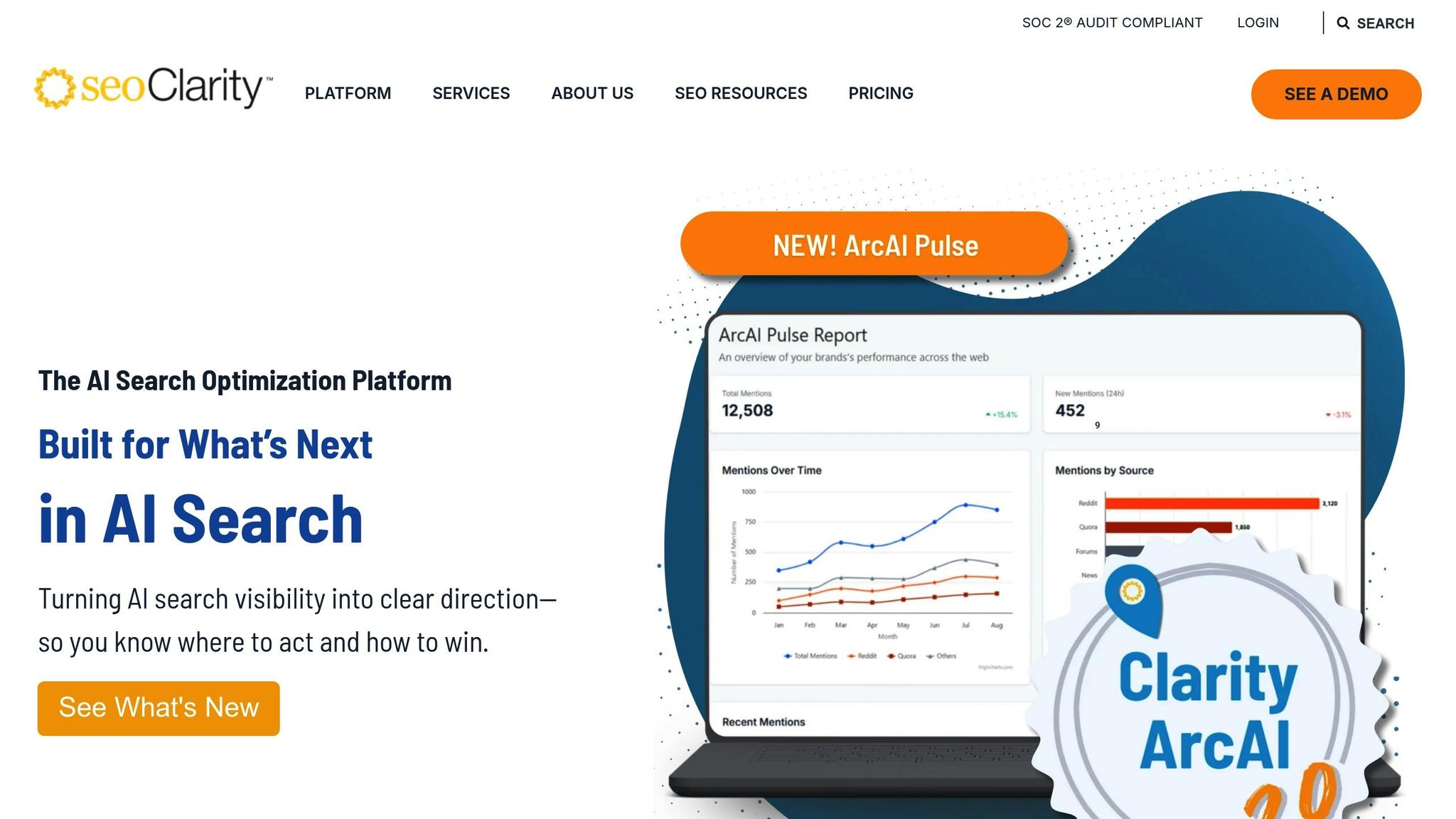
seoClarity is built for handling predictive analytics at scale, making it ideal for large B2B organizations with extensive keyword portfolios and millions of URLs. Its AI-driven features include rank volatility analysis, traffic impact forecasting, and global performance monitoring across multiple markets and product categories.
For enterprise teams, seoClarity offers segmentation by product line, persona, or region, allowing precise forecasting of traffic and conversions. For instance, a global B2B manufacturer might use seoClarity to predict the impact of fixing crawl issues across regional sites or consolidating duplicate product pages.
The platform’s historical data and AI-assisted forecasting enable scenario planning, such as estimating the lift in traffic and revenue from moving key pages to the first page of search results. These insights help build strong business cases for budget approvals by comparing forecasted revenue gains against subscription costs.
Integration with tools like Tableau and Power BI allows SEO forecasts to be incorporated into broader performance dashboards, offering a unified view of organic search, paid media, and sales data. The platform also supports frequent model updates and provides options for data residency, aligning with enterprise IT standards.
Typical pricing: Custom enterprise pricing based on data volume, user count, and feature modules. Entry plans start at a few hundred dollars per month, with full-scale implementations requiring annual contracts in USD.
Summary of Tools
Here’s a quick comparison of the platforms:
| Platform | Primary Predictive Strength | Best For | Integration Ecosystem |
|---|---|---|---|
| Top SEO Marketing Directory | Vendor discovery and comparison | Shortlisting tools and agencies | N/A (directory of vendors) |
| BrightEdge | AI-driven ROI measurement and keyword forecasting | Linking SEO forecasts to business outcomes | Google Analytics, major CRMs, marketing automation |
| Conductor | Content opportunity scoring and trend analysis | Content strategy and buyer journey optimization | Google Analytics, Adobe Analytics, Salesforce, HubSpot |
| seoClarity | Large-scale rank monitoring and forecasting | Managing global B2B sites and complex operations | Tableau, Power BI, CRMs, log file analysis |
When choosing a platform, enterprise teams should focus on tools that provide detailed forecasts at the URL, topic cluster, and account level, rather than just domain-level metrics. Running pilot projects on high-value pages can validate forecast accuracy before scaling efforts. Additionally, shared dashboards and regular reporting cycles across SEO, content, and sales teams ensure predictive insights drive meaningful business decisions.
sbb-itb-5be333f
Best Practices for Using Predictive Analytics in B2B SEO
After diving into predictive tools and their key features, it’s clear that turning insights into measurable outcomes requires more than just having the right software. Predictive analytics only delivers results when fully integrated into your SEO workflows. Many B2B teams invest in forecasting platforms but struggle to move beyond using them as reporting tools. The key to success lies in aligning insights with goals, ensuring model accuracy, and fostering collaboration across departments.
Align Predictive Insights with SEO Goals
Start by connecting high-level business objectives to actionable SEO metrics that predictive models can forecast. Don’t stop at surface-level metrics like rankings or traffic - tie forecasts to metrics that resonate in the boardroom, such as sales-qualified leads (SQLs), pipeline value in USD, customer acquisition cost (CAC), or organic-assisted conversions.
For example, if you have a $5M pipeline target, break it down into the number of demo requests or form submissions required to hit that goal. Configure your predictive models to forecast these conversion events by segment, whether it’s brand vs. non-brand traffic, specific product lines, or regional markets. This approach clarifies priorities by linking traffic and ranking predictions directly to revenue potential, helping teams focus on initiatives with the highest return on investment.
Many enterprise B2B teams integrate SEO platforms with tools like Salesforce or HubSpot to connect predicted traffic and ranking changes to opportunity creation and closed-won revenue. This means using attribution models to translate organic sessions into dollar amounts - like forecasting an additional $500,000 in pipeline instead of just reporting clicks or positions.
To make these predictions actionable, focus on high-intent keyword clusters and pages that have historically driven qualified leads. Predictive models should also segment forecasts by persona and buying stage (awareness, consideration, decision), so content teams can prioritize assets like comparison pages, product guides, or implementation checklists. This is especially valuable for the longer sales cycles typical in B2B.
Once revenue targets are mapped out, it’s crucial to continuously monitor and refine forecasts to keep them accurate.
Monitor and Adjust Regularly
Predictive models are only as good as the data and assumptions they’re built on. Factors like Google algorithm updates, competitor strategies, seasonal trends, and buyer behavior can quickly make static forecasts outdated. Regular monitoring and adjustments are essential to maintain reliable predictions.
Enterprise B2B teams often conduct monthly reviews to compare actual performance against forecasts for metrics like organic traffic, conversions, and pipeline. These reviews should cover both leading indicators (e.g., share of voice, ranking distribution, crawl coverage, and click-through rates) and lagging outcomes (e.g., organic opportunities and revenue). Tracking the gap between forecasted and actual results helps identify where models may need recalibration.
Significant changes - like a Google core update, product launch, site migration, or new competitor - should prompt immediate adjustments. This might involve updating baseline data, revisiting seasonality assumptions, or reassessing conversion rates for key queries.
Dashboards play a critical role in monitoring. Executive dashboards should highlight forecasted vs. actual pipeline and revenue, while tactical dashboards for SEO managers can break down rankings and traffic by keyword group. Weekly or biweekly updates ensure teams have the latest data, with any deviations from forecasts clearly flagged.
Feedback loops, such as quarterly reviews, are also valuable for fine-tuning models. When predictions don’t align with results, document the reasons - whether it’s lower-than-expected conversion rates or unexpected impacts from technical changes - and use those insights to improve future forecasts. Avoid common mistakes like overfitting models to short data windows, ignoring larger market shifts, or treating forecasts as guarantees. Instead, use multi-year data, test different scenarios, and incorporate human judgment to challenge overly optimistic projections.
Enable Cross-Team Collaboration
Predictive analytics becomes far more powerful when insights are shared across departments. SEO teams shouldn’t operate in isolation - forecasts must influence content, sales, and marketing strategies to drive meaningful results.
One effective method is creating shared "opportunity backlogs." These backlogs rank keyword clusters, topics, and technical fixes by their projected impact on traffic, conversions, and revenue. SEO strategists can then collaborate with content teams to turn these insights into production schedules, while analytics teams validate assumptions and ensure accurate tracking.
For instance, if a predictive model shows that comparison pages for a specific product category could generate significant pipeline, content teams can prioritize those pages in their editorial calendar. Sales teams can also weigh in, confirming whether these high-value topics align with the questions they hear from prospects. This ensures that SEO efforts are grounded in actual buyer behavior, not just search volume data.
Involving sales and product marketing is especially critical for long B2B sales cycles. Predictive models can group queries by persona and buying stage, helping teams focus on assets that push prospects toward demos or trials rather than just driving top-of-funnel traffic. Sales teams can validate whether these predictions align with real-world pain points and messaging.
Shared dashboards are essential for keeping everyone aligned. Create views that translate predictive SEO metrics - like pipeline and revenue - into business-friendly terms. When leadership, sales, and marketing teams all see the same data, it’s easier to coordinate priorities and adjust strategies when results deviate from expectations.
Encourage teams to log observations when actual performance doesn’t match predictions. For example, if a high-intent keyword drives traffic but doesn’t convert, it might indicate the need to tweak landing page messaging or calls-to-action. Feeding these insights back into the predictive models creates a continuous improvement loop, enhancing both accuracy and execution over time.
For teams new to predictive analytics, resources like the Top SEO Marketing Directory can help identify tools, agencies, and platforms that specialize in forecasting and ROI tracking. This is particularly helpful for industries like SaaS, manufacturing, or professional services, where predictive analytics needs to scale effectively.
When presenting predictive SEO insights to U.S.-based executives, frame them in terms of quarterly pipeline forecasts in USD, customer acquisition costs (CAC), and payback periods to ensure alignment with business priorities.
Conclusion
Predictive analytics is reshaping B2B SEO, turning it into a key driver for revenue planning, product strategy, and go-to-market decisions. Instead of waiting for post-campaign performance data, enterprise teams can now predict which keyword groups, content investments, and technical updates will deliver the most qualified leads and pipeline value in USD.
This shift is powered by predictive tools that not only forecast outcomes but also provide actionable insights. Tools like Top SEO Marketing Directory, BrightEdge, Conductor, and seoClarity equip teams with forecasting models, scenario planning features, and integrated dashboards. These platforms are built to scale predictive SEO efforts across vast numbers of URLs and complex buyer journeys. For instance, the Top SEO Marketing Directory simplifies the process of evaluating vendors and agencies that focus on analytics, forecasting, and enterprise-grade solutions. Meanwhile, specialized platforms link SEO performance directly to measurable outcomes, such as marketing-qualified leads, sales opportunities, and closed revenue.
The advantages of predictive analytics are supported by industry data. Surveys consistently show that marketers leveraging advanced analytics and predictive tools report much higher ROI and stronger revenue impacts compared to those relying solely on descriptive analytics. Additionally, case studies from predictive marketing providers often highlight organic traffic increases of 20–50% within 6–12 months when predictive insights are systematically applied to content strategies, technical SEO, and internal linking.
For maximum impact, successful B2B SEO programs integrate predictive analytics across all data channels. High-performing teams centralize data from analytics platforms, CRM systems, and SEO tools, aligning them with clear business objectives. They use forecasts to prioritize initiatives and manage leadership expectations. Treating predictive modeling as an ongoing process - by regularly updating data, refining assumptions, and monitoring accuracy - ensures these programs stay effective as search trends, competition, and business needs evolve. Collaboration across teams is also essential. When SEO, content, sales, RevOps, and leadership share the same forecasts and dashboards, they can align strategies, anticipate lead shifts, and incorporate projections into budgeting and planning.
FAQs
How do predictive analytics tools enhance the ROI of B2B SEO compared to traditional methods?
Predictive analytics tools empower businesses to fine-tune their B2B SEO strategies by using data to foresee trends, pinpoint effective keywords, and adjust content plans accordingly. Unlike older methods that depend heavily on past performance, these tools analyze patterns to predict future outcomes, allowing businesses to make smarter, forward-looking decisions.
With these insights, companies can allocate their resources more effectively, zero in on strategies that promise the best ROI, and maintain a competitive edge. This proactive approach not only enhances search rankings but also attracts more targeted traffic and boosts conversions, ultimately optimizing the return on investment.
What features should you prioritize when choosing a predictive analytics tool for enterprise-level B2B SEO?
When choosing a predictive analytics tool for enterprise-level B2B SEO, focus on features that align with your objectives and simplify your workflow. Opt for tools that provide advanced keyword forecasting, traffic trend analysis, and performance prediction to help you anticipate market shifts and stay competitive. It's also crucial to ensure the tool integrates smoothly with your existing platforms, like Google Analytics or CRM systems, for effortless data sharing and analysis.
Look for tools that offer customizable dashboards, automated reporting, and strong data visualization features to turn insights into actionable steps that are easy to interpret. Since scalability is a must for enterprise-level operations, confirm that the tool can manage large datasets and keep up with your expanding needs.
How can predictive analytics tools work with SEO and CRM platforms to improve forecasting and business results?
Predictive analytics tools work hand-in-hand with SEO and CRM platforms by diving into massive datasets to spot patterns, predict outcomes, and fine-tune strategies. These tools take historical SEO data and CRM insights to anticipate future search trends, customer behaviors, and potential ROI.
When data from SEO tools (like keyword rankings and traffic stats) is combined with CRM insights (such as customer interactions and sales figures), businesses can make smarter, data-driven decisions. This integration sharpens marketing campaigns, highlights high-value keywords, and ensures SEO efforts align with broader business objectives. The result? More effective strategies and streamlined operations that deliver stronger results.