For multilingual websites, SEO is the key to reaching the right audience. Without proper implementation and SEO marketing tools, you risk losing traffic and frustrating users - like a Spanish speaker landing on an English page. Here’s what you need to know:
- URL Structures: Subdirectories (
example.com/es/) are cost-effective and consolidate SEO authority. ccTLDs (example.es) send strong local signals but require higher maintenance. Subdomains (es.example.com) fall in between. - Hreflang Tags: These guide search engines to show the correct language version. Use HTML tags for small sites, XML sitemaps for large ones, and HTTP headers for non-HTML files. Errors here can hurt rankings and waste crawl budget.
- Content Localization: Go beyond translation. Tailor content to local search habits and preferences. For example, using "zapatillas" instead of "calzado" in Spain can boost visibility and engagement.
Investing in multilingual SEO services can increase traffic by up to 47% and improve ROI. Focus on technical precision and localized content to connect with global audiences effectively.
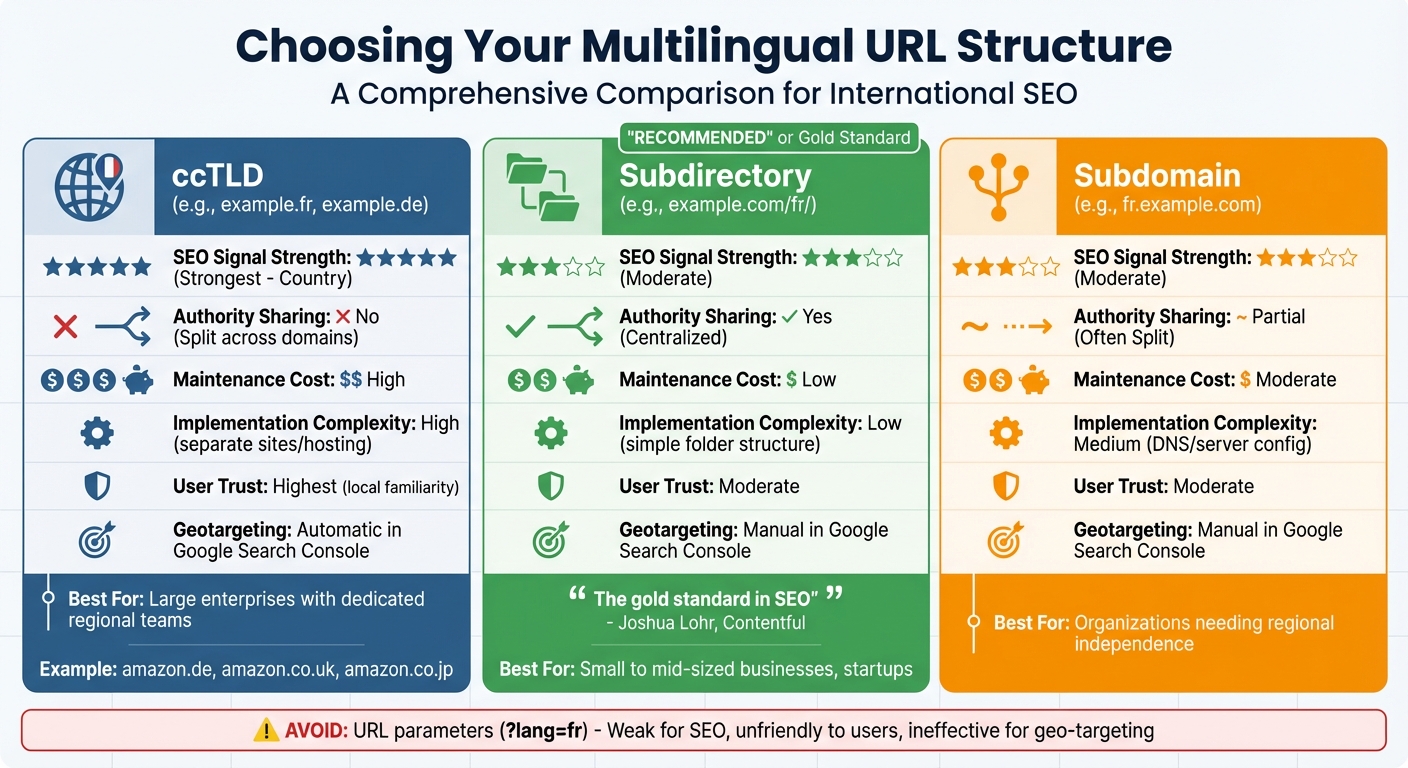
Multilingual SEO URL Structure Comparison: ccTLD vs Subdirectory vs Subdomain
Best SEO Practices for Multilingual Websites (Drive More Targeted Traffic)
sbb-itb-5be333f
1. URL Structures
The structure of your URLs plays a big role in how you target languages and manage your site. You have three main choices: subdirectories (e.g., example.com/es/), ccTLDs (e.g., example.es), and subdomains (e.g., es.example.com). Each comes with its own SEO benefits, technical challenges, and cost considerations.
SEO Impact
Using subdirectories helps consolidate your SEO authority. For example, if someone links to your Spanish page at example.com/es/, that link equity strengthens your entire domain, benefiting all language versions. Joshua Lohr, Senior SEO Manager at Contentful, describes subdirectories as "the gold standard in SEO" because they centralize authority and adapt well to different requirements. On the other hand, ccTLDs (country-code top-level domains) split domain authority - links to example.de won’t benefit example.fr. This means each ccTLD needs its own link-building strategy.
However, ccTLDs send the clearest geo-targeting signals to search engines. They’re automatically recognized in Google Search Console and build strong regional trust. For instance, Amazon uses ccTLDs (amazon.de, amazon.co.uk, amazon.co.jp) to create confidence among local users. Subdomains fall somewhere in the middle. They create clear content boundaries but are often treated as separate entities by search engines, which can dilute link equity.
While SEO impact is critical, you also need to weigh the technical challenges of each approach.
Implementation Complexity
If you’re looking for simplicity, subdirectories are the easiest to implement and maintain, especially if you’re using a single CMS. With subdirectories, you only need to manage one domain, one SSL certificate, and one hosting plan. On the flip side, ccTLDs are the most complex to manage. You’ll need to register multiple domains, maintain separate hosting environments, and duplicate your infrastructure for each market.
Nike’s EMEA team, for example, used subdirectories to implement hreflang across 26 ecommerce sites in nine languages. While the project took nine months, it avoided the headaches of managing separate domains. Subdomains, while less complicated than ccTLDs, still require extra DNS configurations and separate site management.
Finally, consider the financial impact of your decision.
Cost-Effectiveness
Subdirectories are the most cost-effective option. With only one domain, SSL certificate, and hosting plan to manage, they keep operational costs low. In contrast, ccTLDs are the most expensive, requiring multiple domains, certificates, and hosting environments. Subdomains fall in between, with moderate additional maintenance costs . For startups and mid-sized businesses, subdirectories often strike the best balance between SEO benefits and affordability.
| Structure | SEO Signal Strength | Authority Sharing | Maintenance Cost |
|---|---|---|---|
ccTLD (.fr, .de) |
Strongest (Country) | No (Split) | High |
Subdirectory (/fr/) |
Moderate | Yes (Centralized) | Low |
Subdomain (fr.) |
Moderate | Partial (Often Split) | Moderate |
Avoid URL parameters like ?lang=fr. They’re weak for SEO, unfriendly to users, and don’t allow for effective geo-targeting by Google. If you choose subdirectories or subdomains, make sure to set your target country manually in Google Search Console to improve geo-targeting signals.
2. Hreflang Implementation Methods
Once your URL structure is ready, the next step is implementing hreflang tags to guide search engines toward the right language version of your content. While URL structures lay the groundwork for regional targeting, hreflang tags fine-tune the process, ensuring international users see the most relevant version of your site. There are three primary methods for implementing hreflang: HTML <link> tags in the page head, XML sitemaps, and HTTP headers. Each comes with its own technical challenges, maintenance needs, and cost considerations.
SEO Impact
Hreflang tags act as signals to search engines, helping them determine which language or regional version of a page to display. When done correctly, these tags not only improve user experience but also prevent duplicate content issues by clarifying the intended audience for each version. Google's Gary Illyes highlights their importance:
"hreflang tags can have a direct impact on rankings because pages in a hreflang cluster share ranking signals"
.
The results can be transformative. For example, in early 2026, a global SaaS company managing over 50,000 pages in 12 languages faced a ranking accuracy rate of just 45% due to inconsistent hreflang setups. By switching to the XML sitemap method and using automated validation, they reduced their Google Search Console hreflang errors from 34,000 to just 12 in 90 days. This change boosted international organic traffic by 75% (from 1.2 million to 2.1 million visits per month) and cut bounce rates caused by language mismatches by 54%.
However, hreflang implementation is prone to errors. Studies show that 31% of websites have conflicting hreflang directives, and 16% miss self-referencing tags entirely. These mistakes not only confuse search engines but also waste valuable crawl budget, preventing a full understanding of your site’s structure.
Implementation Complexity
Each hreflang implementation method has its pros and cons, depending on the size and complexity of your site:
- HTML
<link>tags: Ideal for small sites, these are added directly to the<head>section of each page. They’re easy to debug and verify but can slightly increase page size (about 1.5 KB for 20 language variants). - XML sitemaps: A better option for large sites with over 10,000 pages, this method keeps hreflang data separate from your HTML, avoiding page weight issues. However, debugging becomes more challenging since the tags aren’t visible on the page itself.
- HTTP headers: Best for non-HTML files like PDFs, this method requires server-level access and is the most complex. It’s also prone to issues with CDNs stripping headers.
No matter the method, strict rules must be followed to ensure success. Each hreflang tag must reciprocate (if Page A points to Page B, Page B must point back to Page A), include a self-referencing tag, and use absolute URLs with the full protocol (e.g., https://). Additionally, proper ISO codes are essential - ISO 639-1 for languages (e.g., "en") and ISO 3166-1 Alpha-2 for regions (e.g., "gb" for the United Kingdom, not "uk"). As Yoast founder Joost de Valk explains:
"Hreflang tags are among the most complex specs we've ever seen from a search engine. Because doing it right is challenging and takes time"
.
This complexity can directly impact cost and efficiency.
| Method | Best For | Complexity | SEO Impact / Overhead |
|---|---|---|---|
| HTML Link Tags | Small sites (<100 pages) | Low | Slightly increases page weight (~1.5 KB per 20 languages) |
| XML Sitemaps | Large sites (10,000+ pages) | Medium | No page weight impact; harder to debug |
| HTTP Headers | Non-HTML files (e.g., PDFs) | High | No page body impact; difficult to audit |
Cost-Effectiveness
Manual hreflang updates often require frequent developer input, leading to high error rates (60–65%) and significant time spent troubleshooting. Automated tools like Weglot or MultiLipi, while subscription-based, claim 99.8% technical accuracy. These tools can handle bidirectional and self-referencing tags dynamically, reducing implementation time to under five minutes. For growing businesses, this approach often saves more time and money compared to repeatedly relying on developers for manual fixes.
Finally, don’t forget to include an x-default tag as a fallback for users whose language or region doesn’t match any specific version. This ensures they aren’t directed to irrelevant content and improves the overall user experience.
Once hreflang is properly implemented, the next step is to focus on making your content resonate with audiences through effective localization strategies.
3. Content Localization Approaches
Once the technical foundation is in place, adapting your content to resonate with local audiences becomes a key factor in achieving success. Translation focuses on converting words, but localization goes deeper - it tailors your message to align with local cultural nuances, search habits, and emotional triggers. This difference can determine whether users trust your brand enough to take action.
SEO Impact
Localization doesn’t just make your content relatable - it directly improves SEO performance by aligning with how people in specific regions actually search, rather than just how they speak. For example, in 2013, Nike’s EMEA SEO lead, Joshua Lohr, found that their Spanish site ranked for "calzado" (footwear). However, Spanish users were searching for "zapatillas" (sneakers) - a term with nine times the search volume. Adjusting their keywords to reflect this local search behavior led to noticeable gains in organic performance across Spain and Latin America.
Localized sites can achieve up to 327% more visibility in Google’s AI-generated overviews for non-English searches and experience a 47% increase in organic traffic overall.
It’s also worth noting that 75% of online shoppers prefer to buy in their native language, and 60% of non-English speakers rarely or never shop on English-only websites. By using localized keywords that match search intent, you avoid wasting effort on low-volume terms. Adriana Stein, CEO of AS Marketing, emphasizes this point:
"If you don't check out each keyword's local search volume and consider similar phrases, you'll lose out on valuable organic traffic due to minor linguistic or cultural nuances".
Implementation Complexity
While localization offers clear SEO benefits, it also comes with its own set of challenges. Beyond translating keywords, effective localization requires careful operational adjustments and website audit checks across multiple areas.
This includes market-specific keyword research, adapting metaphors and idioms to fit local contexts, creating localized metadata (titles, descriptions, alt text), and making technical adjustments such as updating currency formats, date styles, and measurement units. By 2026, most teams are expected to use AI-human hybrid workflows: AI tools handle initial drafts and keyword clustering, while native experts refine the content for cultural and emotional accuracy.
| Feature | SEO Translation | SEO Localization |
|---|---|---|
| Primary Goal | Linguistic accuracy | Cultural relevance and conversion |
| Keyword Strategy | Literal translation of terms | Research local search intent and volume |
| Content Type | Technical/legal/universal info | Marketing, blogs, and product pages |
| User Experience | Functional but "foreign" feel | Feels native, with relatable local examples |
| SEO Impact | Basic visibility; risk of "dead" keywords | High visibility and competitive edge |
To streamline the process, apply the 80/20 rule: focus on the 20% of pages that drive 80% of your traffic or revenue. Prioritize high-impact areas like homepages, top-performing product pages, and key blog posts. Don’t forget to localize URL slugs (e.g., /es/zapatos instead of /es/shoes) to boost click-through rates and signal stronger relevance to search engines.
Cost-Effectiveness
Localization doesn’t have to break the bank. Human translation costs around $0.15 per word, while AI translation with human post-editing (MTPE) costs closer to $0.03 per word. For instance, a SaaS company spent $15,000 on Spanish localization in 2025 and gained 25,000 new monthly visitors from Spain, Mexico, and Argentina, resulting in a 340% ROI within the first year. Similarly, an e-commerce brand that invested $30,000 in French and German localization generated $450,000 in additional revenue over 12 months - a 1,400% ROI.
Using a Translation Management System (TMS) can further cut costs by 20–30% through workflow optimization and content reuse. Companies like ActiveCampaign saw their Spanish blog traffic grow by 75% year-over-year after centralizing their localization processes, while Popsa reduced turnaround times by 75% and cut costs by about 20% by integrating their design and content tools into a unified localization platform.
Overall, localization can often deliver better returns than paid media for international growth. Focusing on high-value content first and leveraging modern tools ensures the process stays efficient while maximizing the impact of your international SEO strategy. This approach complements technical investments like URL structures and hreflang implementation, reinforcing your global reach.
Advantages and Disadvantages
Here's a quick breakdown of the pros and cons of different multilingual SEO strategies, focusing on cost, technical needs, and SEO effectiveness.
Subdirectories (e.g., example.com/fr/) are often the go-to choice for most businesses. They consolidate link equity into one domain, which makes them simpler to manage and more affordable. With just one SSL certificate and domain registration, they provide strong SEO benefits by sharing authority across all language versions.
Country-code top-level domains (ccTLDs) (e.g., .fr or .de) provide the strongest local signals, but they come with higher costs and complexity. Each ccTLD requires its own domain, hosting, and link-building efforts. Google’s John Mueller has pointed out:
"Local domain names tend to do better because Google Search promotes content local to the user".
Subdomains (e.g., fr.example.com) offer technical separation, which can be useful for teams needing regional independence. However, search engines often treat subdomains as semi-independent sites. This can split SEO authority, requiring more effort in link-building. Subdomains strike a middle ground in terms of complexity and cost, offering flexibility without the full demands of ccTLDs.
Here’s a side-by-side comparison of the key features of each approach:
| Feature | ccTLDs (.fr) | Subdirectories (/fr/) | Subdomains (fr.) |
|---|---|---|---|
| SEO Impact | Strongest local signal; split authority | Consolidated authority; shares link juice | Split/diluted authority |
| Implementation Complexity | High (separate sites/hosting) | Low (simple folder structure) | Medium (DNS/server config) |
| Cost-Effectiveness | Low (multiple domains/SSLs) | High (single domain/SSL) | Medium (shared root domain) |
| User Trust | Highest (local familiarity) | Moderate | Moderate |
| Geotargeting | Automatic in GSC | Manual in GSC/Bing | Manual in GSC/Bing |
This table highlights the trade-offs each URL structure brings to the table, showing how decisions can impact regional performance. For example, Nike’s EMEA strategy illustrates how these choices can directly shape success in specific markets.
When it comes to implementing hreflang tags, the choice of method depends on your site's size and structure. XML sitemaps are ideal for enterprise-level websites with thousands of pages, as they keep data separate from HTML. For smaller sites (under 100 pages), HTML link tags are more practical. HTTP headers, while useful for non-HTML files, are technically complex and prone to errors, especially when paired with CDNs.
Conclusion
When crafting a multilingual SEO strategy, it’s crucial to align your approach with your business’s size, budget, and goals. For many businesses, subdirectories (e.g., example.com/fr/) strike an excellent balance between technical ease and SEO effectiveness. As Joshua Lohr, Senior SEO Manager at Contentful, put it:
"Subfolders... is the gold standard in SEO by consolidating equity and offering flexibility".
This approach works particularly well for small to mid-sized B2B companies and e-commerce sites, delivering strong results without unnecessary complexity.
A strong technical foundation is key to success. Combining subdirectories with proper hreflang implementation ensures that different language versions don’t compete with each other in search results. At the same time, localized keyword research - going beyond literal translations - helps align your content with actual search intent. For instance, in Spain, the term "zapatillas" is searched 9 times more often than its literal counterpart, "calzado". This layered strategy is why websites leveraging SEO localization often see up to a 70% increase in organic traffic within a year.
Addressing technical issues like hreflang errors can also significantly impact performance, boosting international traffic and reducing bounce rates.
To streamline your efforts, tools like the Top SEO Marketing Directory provide access to resources for technical audits, hreflang validation, translation management, and localized keyword research. Whether you’re handling 3 languages or 30, having the right tools can transform scattered efforts into cohesive international growth.
Keep in mind that 72% of consumers prefer browsing websites in their native language, and 40% won’t make a purchase from a site in another language. By delivering content that’s both technically sound and tailored to their language preferences, you’ll foster trust and drive meaningful results.
FAQs
How do I choose between subdirectories, subdomains, and ccTLDs?
When deciding between subdirectories, subdomains, and ccTLDs, it all comes down to your priorities and resources:
- Subdirectories (e.g., example.com/fr/) are great for consolidating SEO efforts. They’re also easier on the budget, making them a cost-efficient choice.
- Subdomains (e.g., uk.example.com) require separate authority-building, but they’re useful if you need to keep content distinct or manage it independently.
- ccTLDs (e.g., example.co.uk) send strong regional signals to search engines, which is a big plus for targeting specific countries. However, they can be more expensive and demand extra work to maintain.
When making your choice, think about your budget, how much regional targeting you need, and whether your setup can grow with your goals.
What are the most common hreflang mistakes to avoid?
When it comes to hreflang implementation, there are a few common errors that can disrupt your multilingual SEO efforts. Here are some pitfalls to watch out for:
- Missing self-referential tags: Every page should include an hreflang tag pointing to itself. Skipping this can confuse search engines about the primary language version of the page.
- Incorrect language or region codes: Using the wrong codes, like "en-UK" instead of "en-GB", can lead to improper indexing. Always stick to ISO 639-1 for languages and ISO 3166-1 Alpha 2 for regions.
- Broken reciprocal links: If Page A points to Page B, Page B must also point back to Page A. Failing to establish this link can break the hreflang chain.
- Conflicting implementation methods: Mixing methods like HTML tags, HTTP headers, and sitemaps can create confusion. Stick to one consistent approach across your site.
- Referencing non-canonical URLs: Ensure hreflang tags always reference the canonical version of a page. Pointing to non-canonical URLs can dilute SEO signals and hurt rankings.
Avoiding these mistakes is essential for proper indexing and better search rankings for multilingual websites. Pay close attention to these details to ensure your hreflang setup works as intended.
How can I localize keywords without rewriting every page?
When localizing keywords without reworking every page, prioritize key elements such as metadata - this includes titles, descriptions, and alt texts. Incorporate localized keywords that align with regional search behaviors.
Using hreflang tags is another essential step. These tags help search engines display the right version of your content to users in specific regions.
Additionally, tweak content components like URLs, currency formats, and measurement units to reflect local preferences. These small adjustments can make your content more relevant without requiring a complete overhaul of your pages.