Finding the right social media platform for niche content is all about connecting with the right audience where they already spend time. Instead of trying to dominate every platform, focus on smaller, engaged communities that align with your goals. Here's a quick breakdown of seven platforms that excel at targeting niche audiences:
- Reddit: Ideal for community-driven discussions in specific subreddits. Great for market research and indirect monetization.
- Discord: Perfect for real-time engagement and loyalty within private servers but lacks discovery tools.
- LinkedIn: Best for professional networking and B2B content, with strong lead generation tools.
- TikTok: Effective for discovery and viral potential, especially for visually appealing niches.
- Threads: Focuses on meaningful conversations and integrates with Instagram, but lacks direct monetization.
- Noplace: Text-focused platform with a nostalgic design and precise interest targeting, but no monetization options.
- Substack: Direct-to-inbox content delivery for building trust and monetizing through paid subscriptions.
Quick Comparison
| Platform | Audience Targeting | Engagement Style | Monetization Options |
|---|---|---|---|
| Subreddits (specific) | Voting, discussions | Ads, traffic funneling | |
| Discord | Private servers (specific) | Real-time chat | Subscriptions, tips |
| Professional networking | Career-focused content | Ads, premium services | |
| TikTok | Interest-based | Short videos | Creator Fund, sponsorships |
| Threads | Instagram-linked | Text conversations | None (indirect monetization) |
| Noplace | Interest tags | Text-based discussions | None |
| Substack | Email subscribers | Long-form content | Paid subscriptions |
The key is to align your platform choice with your content format and audience preferences. For example, LinkedIn works well for B2B professionals, while Reddit and Discord are better for niche communities. Focus on fewer platforms and provide real value to build lasting connections.
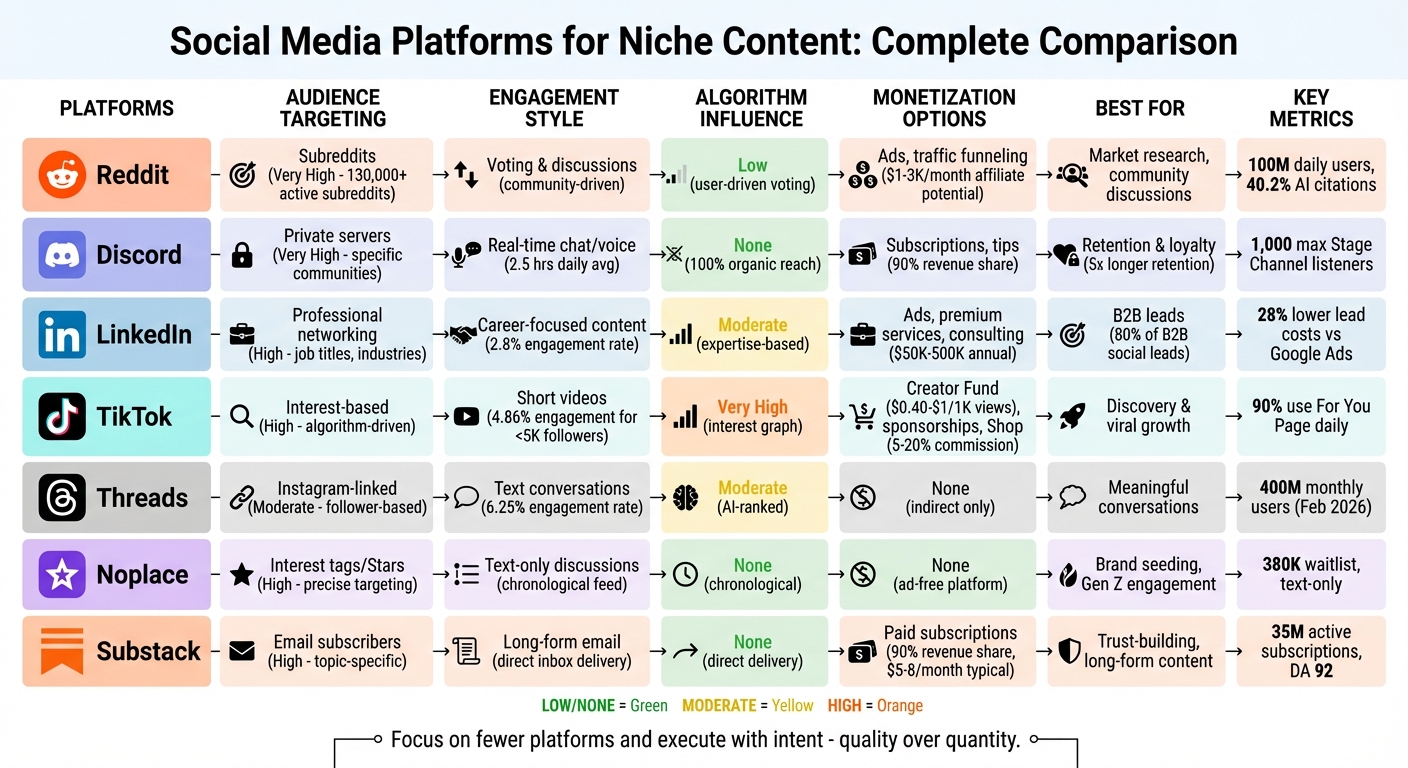
Social Media Platforms for Niche Content: Feature Comparison Chart
Connect on Niche Interests on Social
sbb-itb-5be333f
1. Reddit
Reddit's subreddit ecosystem is like a treasure trove for niche audiences. With over 130,000 active subreddits, users naturally gravitate toward highly specific communities. These range from broad groups like r/technology to ultra-focused ones like r/sourdough. This setup encourages community-driven content, where users themselves decide what thrives.
The platform's voting system is at the heart of how content gains visibility. Posts and comments rise or fall based on community upvotes, not follower counts or paid ads. For instance, a post that racks up 50 upvotes in its first hour can outrank another that earns 100 upvotes over six hours. On top of that, Reddit's algorithm applies a 12.5-hour half-life, meaning content loses visibility quickly, keeping the platform fresh and dynamic.
Authenticity is king on Reddit. As URX Media explains:
"Reddit's culture punishes blatant self-promotion and rewards those who contribute meaningfully first".
This is where the 90/10 rule comes in: 90% of your activity should focus on adding value, while only 10% can be promotional. Users with high "Karma" scores - earned through consistent, meaningful contributions - gain more trust and visibility. This system rewards genuine participation over spammy tactics.
When it comes to monetization, Reddit offers indirect opportunities. While the Contributor Program pays around $0.90 to $1.00 per gold award received, many creators use Reddit as a way to funnel traffic to external platforms. Affiliate marketers, for example, can earn between $1,000 and $3,000 monthly, especially in tech-savvy niches like SaaS and AI tools, where problem awareness is high. For advertisers, Reddit's bidding system offers CPM rates between $2.00 and $10.00, and CPC rates from $0.50 to $3.00. But beyond money, Reddit's anonymity makes it a goldmine for market research.
Anonymity fuels honest conversations, revealing real pain points and opportunities. Users often post frustrations or questions without worrying about personal branding. Posts starting with phrases like "How do I...?" or "I hate that..." can uncover genuine market needs. Additionally, Reddit’s influence extends far beyond its 100 million daily active users. It’s the most cited domain in large language models, accounting for 40.11% of citations, and its top posts often outrank traditional websites in Google search results. From its niche-focused communities to its emphasis on authenticity, Reddit showcases how tailored platforms can thrive by serving specific audiences exceptionally well.
2. Discord
Discord offers creators a direct line to their audience, delivering 100% organic reach without any algorithmic interference. Every message you send reaches your members directly, making it a fantastic platform for engaging with niche, highly dedicated communities.
The platform’s unique server structure encourages natural and interactive conversations. Discord supports text, voice, and video channels, along with Stage Channels that can host up to 1,000 live audio listeners. On average, users spend up to 2.5 hours daily in their servers, and niche-focused communities retain members five times longer than general-interest servers. This level of engagement makes Discord an excellent companion to platforms like YouTube or TikTok, which are better suited for growing an audience.
Monetization Opportunities on Discord
Discord doesn’t just shine in engagement - it also gives creators strong tools for monetization. Through native features and third-party integrations, creators can generate revenue directly from their servers. For example, Server Subscriptions let creators keep 90% of the revenue (after transaction fees), with prices ranging from $2.99 to $199.99 per month.
Take Bella Poarch’s approach in December 2022: she introduced three subscription tiers - offering exclusive videos for $2.99/month, poll voting rights for $4.99/month, and behind-the-scenes content for $9.99/month. Similarly, some trading signal servers charge between $50 and $200 monthly for premium access. These examples show how creators can tailor their offerings to match their audience’s interests and willingness to pay.
The Challenge of Discovery
While Discord excels at retention, it falls short when it comes to audience discovery. As Mark, Founder of MarksInsights, explains:
"Discord is powerful for retention, terrible for acquisition".
This means you’ll need to build your following on platforms like YouTube or TikTok first. Once you’ve established a loyal audience, you can invite your superfans to join your Discord for deeper engagement. For instance, Purple Mattress successfully converted a customer group into the "r/LifeOnPurple" server, which now boasts over 4,300 active members. They’ve even monetized the community through affiliate sales and paid sleep consultations.
Tips for Building a Successful Discord Server
To make the most of Discord, focus on creating a highly specific community. For example, a server called "iPhone Photography for Small Business Owners" will likely perform better than a broad "Photography" community. While the average Discord server has only 5 to 20 users, smaller, targeted groups often foster stronger engagement.
Use Forum Channels to keep discussions organized and searchable. Additionally, assign roles that reflect expertise levels - this not only rewards active members but also gives them access to exclusive channels, encouraging long-term participation.
3. LinkedIn
For creators focusing on niche audiences, LinkedIn offers a professional platform that complements spaces like Reddit and Discord by emphasizing expertise. Instead of chasing fleeting attention, LinkedIn prioritizes content that advances careers and builds professional credibility. Its algorithm is specifically designed to spotlight niche authority.
This makes LinkedIn a powerhouse for niche B2B content - 80% of all B2B social media leads come from LinkedIn. The platform uses Large Language Models to match posts with users based on job titles, industries, and interests. But achieving success here hinges on positioning yourself as an expert in 2–3 key areas. Nathanial Bibby, Founder of Bibby Media Group, explains:
"The algorithm is constantly asking: 'Do we know what this person is known for?' If the answer is yes... distribution becomes easier."
How LinkedIn's Algorithm Highlights Expertise
LinkedIn's algorithm evaluates posts in four stages: quality filtering, limited exposure to 2–5% of your network, broader relevance testing, and a re-evaluation period lasting 48–72 hours or more. A critical factor is dwell time - the amount of time users spend reading your post. Posts that perform well in the first 60–90 minutes (known as the "Golden Hour") are distributed more widely.
Personal profiles typically achieve 5–6× more organic reach than company pages, and PDF carousels generate nearly 3× more engagement than videos. Interestingly, native video posts now receive about 30% less reach compared to text-based updates. LinkedIn also resurfaces older posts (2–3 weeks old) if they remain relevant to users' professional needs. This fine-tuned targeting enhances visibility and supports monetization efforts.
Tools and Strategies for Niche Creators
LinkedIn provides advanced targeting tools like Boolean search operators, industry-specific groups, and Campaign Manager filters for paid campaigns. To increase organic reach, optimize your profile headline and summary with keywords specific to your niche. Tracking these optimizations requires the right SEO analytics tools to measure profile visibility and engagement growth. Compared to Google Ads, LinkedIn generates leads at 28% lower costs, and these leads are 40% more likely to convert.
Monetization options include ticketed webinars (Paid Events), Premium Newsletter Subscriptions priced between $29–$99 per month, and high-ticket consulting services ranging from $1,000 to over $10,000 per client. Top consultants on the platform report annual revenues of $50,000 to $500,000, driven by their content authority. Alice Xiong, Director of Product Management at LinkedIn, advises:
"Think about what kind of knowledge you have to offer to help people. That is the kind of thing that will likely get you to reach the right audience as well."
To succeed, focus on an 80/20 balance between educational content and promotional posts. Avoid tactics like "Comment YES if you agree", as LinkedIn now penalizes engagement baiting and generic AI-generated content as of March 2026.
4. TikTok
TikTok operates on an interest graph, which prioritizes distributing content based on users' interests rather than their social connections. This approach makes TikTok especially effective for niche creators. For instance, accounts with fewer than 5,000 followers enjoy 4.86% average engagement rates, more than double the 2.06% rate seen by accounts with over 100,000 followers. TikTok tests each video with an initial audience of 200–500 users who are likely to engage with it. If the video performs well, it gets promoted to larger, similar audiences.
How TikTok's Algorithm Matches Content to Audiences
TikTok's algorithm is a powerhouse. It evaluates visual elements, captions, hashtags, and audio to categorize videos into specific subcultures like #BookTok or #STEMTok, without depending solely on text. With 90% of users visiting the For You Page daily, discovery on TikTok comes from the algorithm rather than follower-based feeds.
One of the most critical factors is watch time. For videos between 15–30 seconds, a 70% completion rate is key to unlocking broader distribution. TikTok’s recommendation system is so effective that even videos from accounts with no followers can go viral, reaching millions of views in hours.
In 2026, TikTok introduced the Follower-First Testing Model, where new uploads are first shown to existing followers. Their engagement determines whether the video is pushed to non-followers. Other factors also play a role: videos with background music attract 98.31% more views, and high-quality uploads can generate 40× more follower growth than lower-quality content. These features, combined with TikTok's discovery-driven design, create immense opportunities for creators.
Monetization for Niche Creators
TikTok provides several ways for creators to monetize their content, though earnings vary widely depending on the niche. Through the Creator Rewards Program, TikTok pays $0.40–$1.00 per 1,000 qualified views for videos longer than one minute. Niches like Finance and Technology, which attract higher ad budgets, tend to earn more, while visually-driven niches like Beauty and Fitness thrive through brand sponsorships. TikTok Shop affiliate commissions range from 5% to 20%, and creators with 10,000–50,000 followers can earn $100–$500 per sponsored post.
Most monetization features require creators to have at least 10,000 followers and 100,000 views within 30 days. However, TikTok Shop and LIVE Gifts are accessible to those with as few as 1,000–5,000 followers. Many successful creators use TikTok as a way to grow their audience and direct traffic to higher-paying platforms like email lists or digital products:
"The riches are in niches. A creator with 50,000 loyal postpartum fitness followers will earn more from brand deals than a creator with 200,000 random fitness followers."
Next, we’ll dive into the pros and cons of using TikTok for distributing niche content.
5. Threads
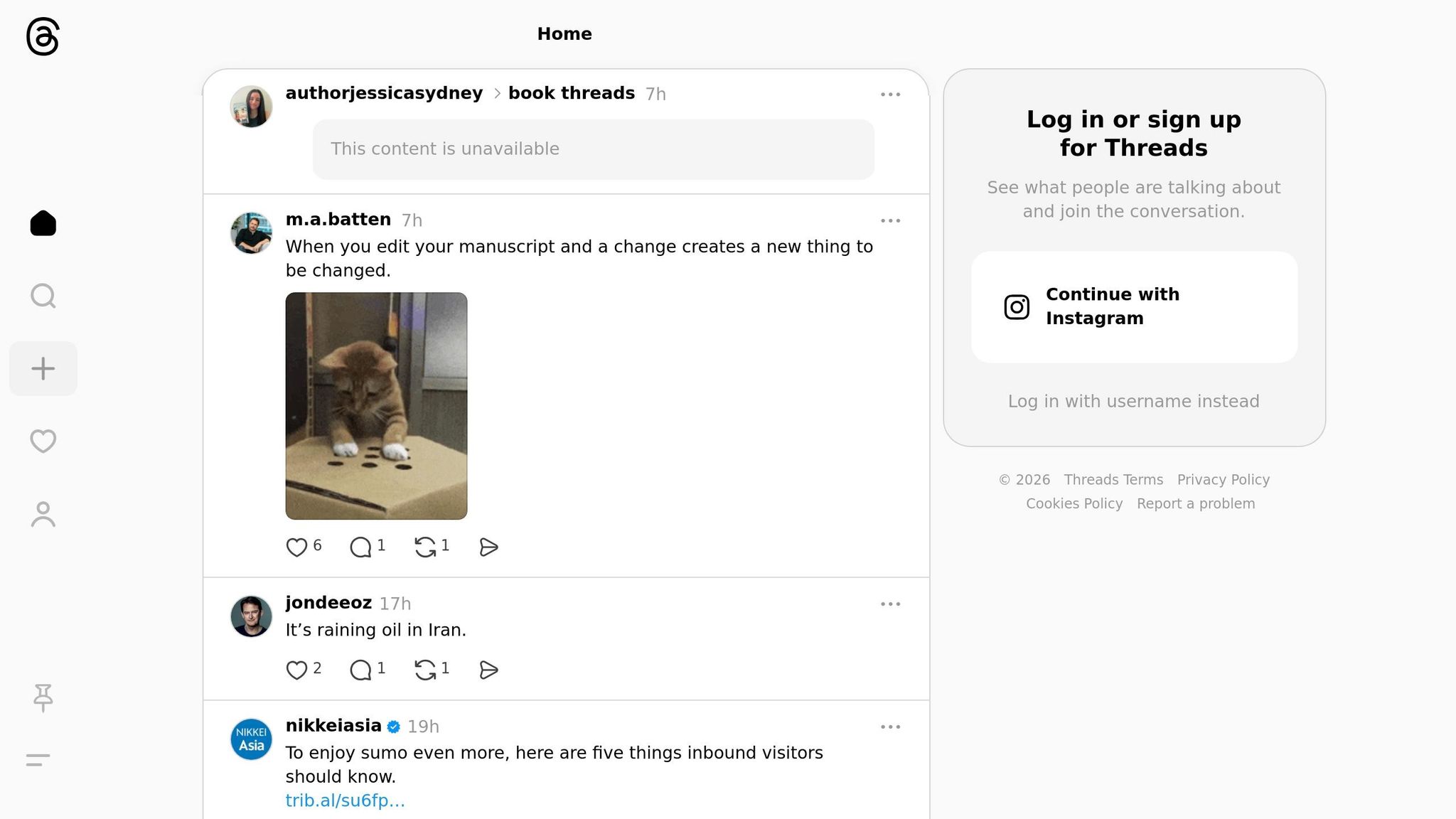
By February 2026, Threads had reached an impressive 400 million monthly active users, carving out a space as a conversation-first alternative to more traditional social platforms. Instead of prioritizing viral content, Threads focuses on fostering meaningful, multi-turn discussions rather than relying on passive interactions like likes. This approach has paid off, with Threads boasting an average engagement rate of 6.25%, nearly double the 3.6% seen on X/Twitter.
Threads uses AI to rank posts based on engagement signals. It also simplifies content discovery with "Topics", which are interest-based tags limited to one per post. This ensures precise categorization and makes it easier for users to find relevant conversations. The platform’s integration with the Instagram social graph is another standout feature. Actions like viewing a profile on Instagram directly influence the niche content that appears in your Threads feed, creating a seamless experience across both platforms [78,83].
This system has led to real-time success stories. For instance, in February 2026, Michael Eckstein, a Senior Product Marketer at Buffer, joined a trending "Quantum physics" discussion. Despite not being a physicist, his post on the topic garnered 54,000 views and over 90 reposts in just a few hours. This highlights how Threads rewards posts that are both authentic and topically relevant.
Engagement is further amplified when users actively reply to comments, which can boost interaction by 42%. With a 500-character limit for posts - expandable to 10,000 characters with attachments - Threads allows creators to share detailed, niche content. Features such as Threads Communities, customizable Flair for specific groups, and integration with the Fediverse via ActivityPub extend the platform's reach to decentralized networks like Mastodon [78,80]. These tools make Threads a powerful platform for building engagement.
However, Threads does not currently offer direct monetization options. Its Creator Bonus program ended in July 2025 [89,92]. Instead, creators use Threads as a top-of-funnel platform to drive brand partnerships, affiliate deals, or traffic to newsletters and websites [88,93]. As Elena Mazaheri, a content marketer at BlackTwist, explained:
"Threads is not a creator fund platform".
That said, Threads’ high engagement rates and integration with Meta’s ad ecosystem still make it a valuable tool for building trust and warming up audiences before directing them to monetized channels. By offering a niche-focused environment, Threads helps creators strengthen their community bonds before transitioning to revenue-generating platforms.
6. Noplace
Noplace made a splash in July 2024, launching with a staggering 380,000-user waitlist. It quickly climbed to the top of the Apple App Store's free category and secured $19 million in funding. The platform taps into Gen Z's love for early 2000s internet nostalgia, with its MySpace-inspired design featuring customizable profiles and a "Top 10 Friends" list. But what really sets Noplace apart is its "Stars" interest tag system.
The "Stars" system is at the heart of how users connect. By tagging interests like astrology, gaming, or poetry on their profiles, users essentially turn these tags into a social search engine, helping them find like-minded people. Unlike platforms that rely on algorithms to determine what you see, Noplace uses a chronological "Everyone" feed. Posts show up in real time, prioritizing timing over virality.
Posts on Noplace are text-only, which encourages focused discussions within niche communities. The platform spices things up with gamification: users can boost posts repeatedly and earn rewards through a "Level" system. It also features "Spaces", which are user-created communities built around specific values or causes, allowing creators to lead meaningful conversations.
CEO Tiffany Zhong described the platform's vision:
"The vision for what we're building is actually becoming a social search engine... we're building features where you can ask questions and get crowdsourced responses".
However, creators looking to make money directly on Noplace may face limitations. The platform is intentionally ad-free and avoids corporate involvement. There are no creator funds, ad-revenue sharing, or promotional tools. As RadianMarketing experts put it:
"Noplace is ideal for long-term brand seeding, not short-term sales".
This means creators can use Noplace as a way to build a loyal fanbase and foster genuine connections before guiding followers to monetized platforms.
That said, the text-only format and lack of promotional features can pose challenges for brands used to polished visuals. Metricool highlighted this issue:
"the lack of content formats and promotion options makes it difficult to build brand communities".
Despite these hurdles, Noplace offers a refreshing space for creators who are ready to embrace raw, text-based interactions. With its Stars system enabling precise niche targeting, the platform provides high organic visibility in an environment that's far less commercialized. Next, let’s dive into how Substack uses direct-to-inbox content to captivate niche audiences.
7. Substack
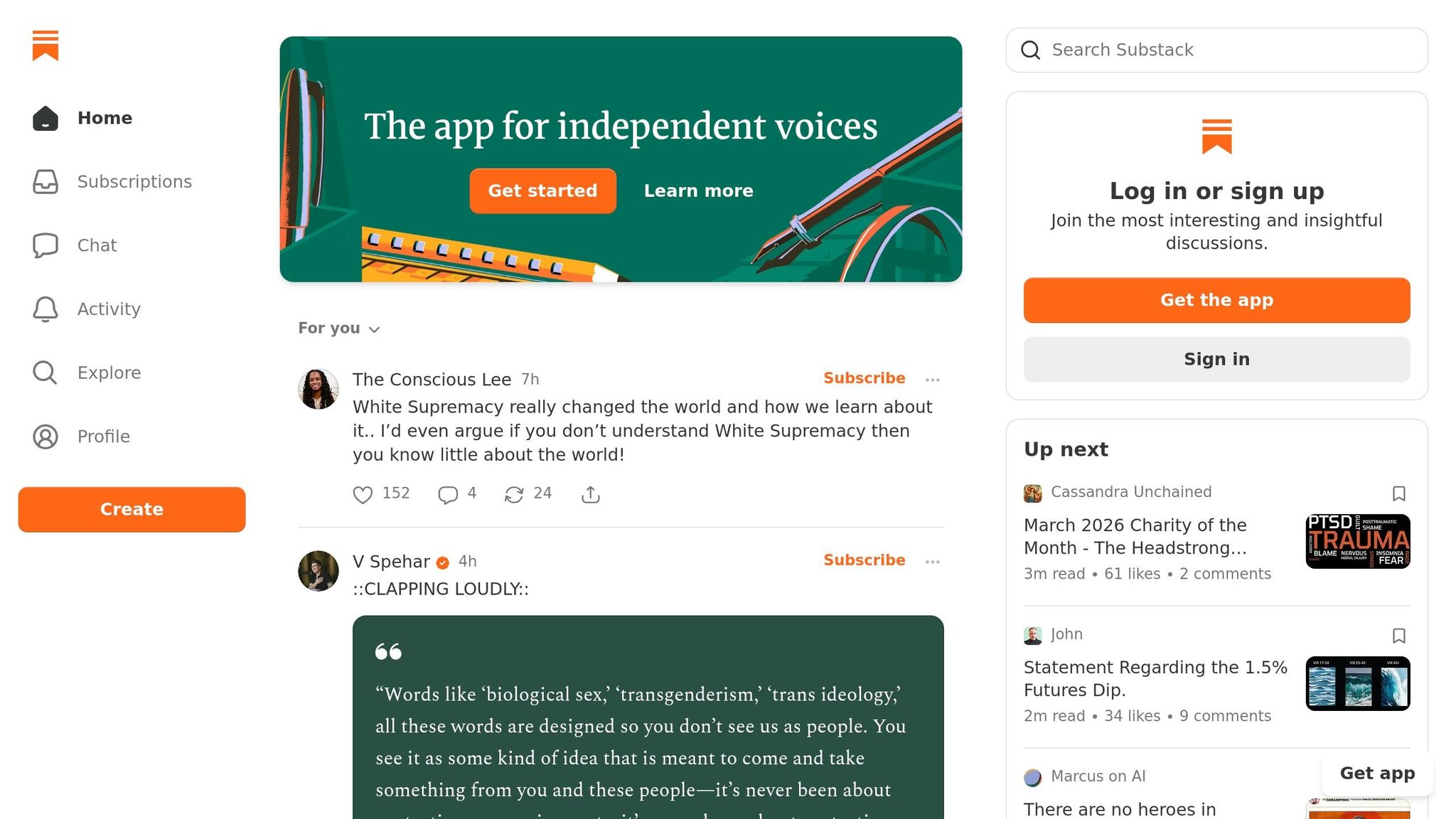
Substack takes a unique approach by delivering posts straight to subscribers' inboxes via email, giving creators direct access to their audience. Unlike platforms driven by algorithms, Substack ensures creators maintain control over their reach, making it a standout option for targeted content.
By 2025, Substack boasts over 35 million active subscriptions. Its impressive domain authority of 92 allows niche content to rank more quickly on search engines compared to independent blogs by leveraging top SEO tools and marketing resources.
Substack functions as a "human network" with five key features: long-form essays, Notes, Comments, Recommendations, and Chat. Among these, Notes has become the go-to tool for content discovery. For instance, Julie Fratantoni, PhD, used a Note on brain performance to gain 32,535 new subscribers and $4,546 in revenue. Similarly, Olivia Noceda's short cooking video brought in 437 subscribers and $480 in revenue.
Creators keep 90% of their subscription revenue, while Substack takes a 10% cut, alongside Stripe’s processing fees (about 2.9% + $0.30 per transaction). Subscription prices typically range from $5–$8 per month or $50–$80 annually, with "Founding Member" tiers priced between $80 and $200 for dedicated fans. Substack’s built-in network contributes to 25% of all paid subscriptions through cross-promotions and recommendations. Notably, readers with saved payment details are three times more likely to subscribe. A great example of Substack's potential is Emily Sundberg, who scaled her daily business newsletter, "Feed Me", to 50,000 subscribers, generating over $400,000 annually.
However, there are some trade-offs. Substack offers fewer customization options and charges a higher platform fee than some other newsletter tools. That said, the platform’s model ensures immediate engagement and visibility, which is crucial for niche audiences. Substack’s algorithm prioritizes posts that see high engagement within the first 30–90 minutes , though creators can further boost visibility using SurferSEO for content optimization. Additionally, app users are seven times more likely to share or restack content compared to web readers. Mike Cohen, Head of Machine Learning at Substack, summed up the platform’s focus:
"The goal is to get people to discover, subscribe, and ideally pay. That's how we built the feed".
For creators targeting niche markets, Substack works best when they define a clear focus, use Notes consistently to signal activity, and hold off on monetization for 6–12 months to build trust before introducing paid tiers. The platform thrives on consistent, in-depth content, making it ideal for those looking to cultivate a loyal and engaged audience without chasing a broad appeal.
Pros and Cons
This section breaks down the key advantages and drawbacks of various platforms, helping you tailor content strategies to fit specific niches.
Reddit stands out for its strong SEO capabilities, ranking for 47% of targeted keywords on Google and accounting for 40.2% of AI search citations. Posts often stay relevant for 6–24 months, with an average traffic value of $247 per post. However, Reddit’s strict anti-promotional rules mean content must prioritize value over self-promotion.
Discord fosters deep loyalty through real-time interactions within private servers. A great example is Chipotle’s 2023 virtual job fair, where the brand attracted nearly 24,000 job applicants in under a week. Despite its engagement power, Discord requires heavy moderation to maintain quality and lacks organic discovery features found on more open platforms [5, 8, 126].
LinkedIn shines in B2B lead generation, boasting a visitor-to-lead conversion rate of 2.74% - three times higher than platforms like X or Facebook. The average B2B lead value on LinkedIn is around $5,200. However, engagement rates hover at just 2.8%, and content rarely achieves virality beyond professional circles [125, 128].
TikTok offers massive viral potential thanks to its interest-driven algorithm. But its content lifespan is short, typically lasting only 24–72 hours. The platform’s audience is heavily skewed toward Gen Z (62%), and it tends to deliver lower-quality leads for B2B purposes, with a high bounce rate of 62%.
Threads benefits from its connection to Instagram’s network and Meta’s ad ecosystem, enabling conversational engagement. However, daily active user numbers have dropped since its initial launch [5, 9].
These insights underscore the importance of aligning your platform choices with the unique behaviors and preferences of your target audience.
Below is a table summarizing the comparative strengths and limitations of these platforms, offering a quick guide for crafting effective content distribution strategies.
| Platform | Targeting Strength | Engagement Type | Algorithm Influence | Monetization Options |
|---|---|---|---|---|
| Very High (Subreddits) | Discussion & Voting | Low (User-driven) | Ads, Community Points | |
| Discord | Very High (Private Servers) | Real-time Chat/Voice | None | Subscriptions, Tips |
| High (Professional) | Professional Dialogue | Moderate | Ads, Premium, Courses | |
| TikTok | High (Interest-based) | Passive/Viral Video | Very High | Creator Fund, Ads, Shop |
| Threads | Moderate (Follower-based) | Conversational Text | Moderate | Integrated with Meta Ads |
| Substack | High (Topic-specific) | Deep Reading/Email | None (Direct) | Paid Subscriptions |
Conclusion
Selecting the right platform hinges on aligning your content format with your SEO and business objectives. For businesses aiming to generate B2B leads or establish themselves as industry leaders, LinkedIn remains a top choice for professional networking and showcasing expertise. On the other hand, if your goal is to connect with tech-savvy Millennials and Gen Z through meaningful discussions, Reddit's focus on authentic, value-driven engagement makes it a strong contender.
"In 2026, winning on social isn't about being everywhere; it's about choosing fewer platforms and executing with intent."
- Talar Mazloumian, Content Marketing Manager, Later
This insight underscores the importance of tailoring your strategy to the strengths of each platform. A smart approach often involves adopting a home base strategy. For instance, you could build your authority on LinkedIn with in-depth articles while using TikTok to boost discovery. Alternatively, you might foster community loyalty on Discord and rely on Reddit for broader visibility.
Before diving into campaigns, take the time to genuinely engage with your chosen communities. Platforms like Reddit and Discord demand that brands offer real value and participate in conversations before attempting any promotion. Success comes from focusing your efforts on a few channels and committing to them fully, rather than spreading yourself too thin.
FAQs
Which platform is best for my niche?
The best platform to choose hinges on your audience's interests and demographics. For communities centered around specific topics, Reddit and Discord are excellent choices. If your focus is on visually-driven niches like fashion or crafts, Pinterest stands out. For establishing yourself as a thought leader, Quora is a great fit. Meanwhile, Bluesky is gaining traction as a platform for curated, community-focused engagement.
The key is understanding your audience and the type of content they prefer. While mainstream platforms have their appeal, niche platforms often provide more focused and genuine connections.
How do I get discovered on Discord?
To help more people find your Discord server, consider adding it to Discord server directories. These platforms are designed to connect niche communities with users who share similar interests.
Another way to spread the word is by promoting your server on social media, relevant Reddit threads, and forums where your audience might hang out. Don't forget the power of word-of-mouth - invite your friends and get involved in related communities to naturally attract members.
Additionally, many server listing sites allow you to regularly "bump" your server to keep it visible. If you're looking for an extra push, you might also explore paid advertising as a way to expand your reach even further.
What’s the fastest way to monetize niche content?
If you're looking to turn niche content into income in 2026, a few strategies stand out. Affiliate marketing remains a top choice, especially when promoting niche-specific products or tools that resonate with your audience. For creators with a dedicated following, paid subscriptions or memberships can generate consistent revenue by offering exclusive content or perks.
Another effective approach is selling digital products, such as e-books, templates, or online courses tailored to your niche. These products not only showcase your expertise but also provide a scalable income stream.
To maximize these efforts, focus on platforms that align with your audience. YouTube and TikTok are excellent for video content, while communities like Reddit can be leveraged for discussions and targeted promotions. These platforms open doors for ads, sponsorships, and even direct fan support.
For the best results, adopt a multi-channel strategy. By diversifying your presence across platforms and income streams, you can speed up the monetization process while reaching a broader audience.