Automated link building uses tools, software, and AI to simplify time-consuming tasks like finding link prospects, qualifying them, and managing outreach. It helps save time, cut costs, and scale link-building campaigns efficiently while maintaining quality. However, automation must be used responsibly to avoid penalties from search engines like Google.
Key Takeaways:
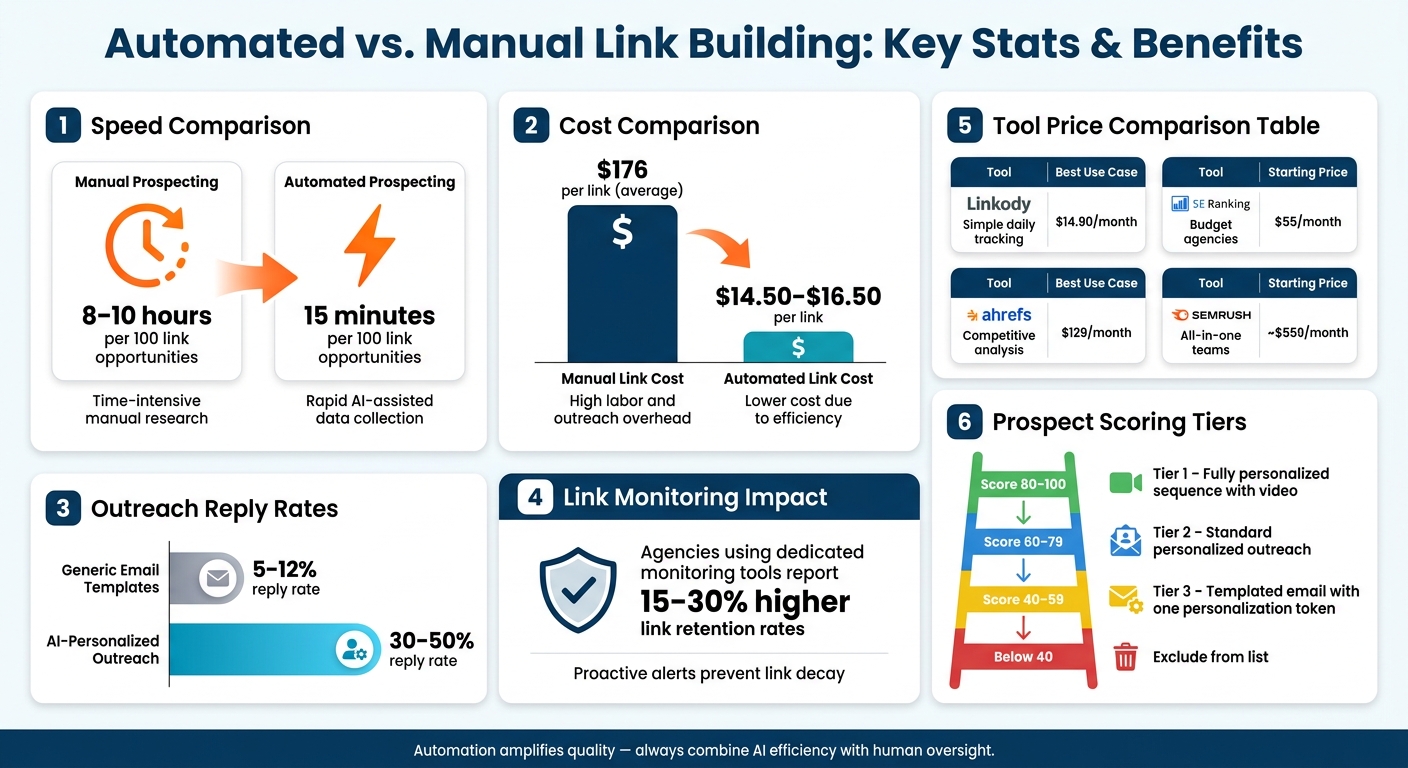
- Time Savings: Automation reduces tasks like prospecting from 8–10 hours to 15 minutes.
- Cost Efficiency: Manual link costs average $176, but automation can lower this to $14.50–$16.50 per link.
- Ethical Use: Focus on earning editorial links and avoid spammy tactics like bots or private blog networks (PBNs).
- Best Practices: Use AI for research, outreach personalization, and monitoring, but keep human oversight for strategy and quality control.
- Tools: Platforms like Ahrefs, Semrush, Pitchbox, and BuzzStream streamline prospecting, outreach, and monitoring.
Automation is a tool to enhance efficiency, not a shortcut for low-quality practices. Focus on high-value, compliant links and test strategies before scaling efforts.
Automated vs. Manual Link Building: Cost, Speed & Results
Core Concepts and Best Practices
Natural vs. Manipulative Links
Google draws a clear line between acceptable automation and manipulative practices. Automation is fine when it helps with legitimate outreach, but it’s a problem when it’s used to mass-produce links in unethical ways. For example, using automation to spam links across thousands of sites, build private blog networks (PBNs), or generate links that aren’t earned editorially is a surefire way to get penalized.
The difference is simple: white-hat automation supports ethical practices, while black-hat automation fuels manipulation. Automation should enhance human judgment, not replace it.
Once you’ve established the boundary between ethical and manipulative practices, the next step is to evaluate the quality of your link prospects.
Key Quality Factors for Links
Not all backlinks are created equal. Whether you’re assessing link opportunities manually or with top SEO tools, a few key factors consistently separate high-value links from low-quality ones.
- Domain authority and real traffic: A good starting point is a Domain Rating (DR) of 40 or higher, paired with meaningful organic traffic. Interestingly, about 86% of guest posting sites don’t meet these benchmarks.
- Topical relevance: It’s not just about keyword overlap anymore. Modern AI tools use Natural Language Processing (NLP) to determine if a site’s content truly aligns with your niche.
- Placement matters: Links embedded within the main content of an article carry more weight than those buried in footers, sidebars, or hidden behind paywalls.
- Healthy link profiles: A mix of dofollow and nofollow links, paired with diverse, non-spammy anchor text, signals a balanced and natural link profile.
Here’s a quick breakdown of these factors and how AI evaluates them:
| Quality Factor | Why It Matters | How AI Evaluates It |
|---|---|---|
| Content Relevance | Shows authority in your niche | NLP semantic similarity analysis |
| Traffic Quality | Reflects the trustworthiness of a site | Source and engagement analysis |
| Link Placement | In-content links have higher SEO value | DOM and visual analysis |
| Audience Overlap | Ensures links reach the right audience | Traffic pattern and demographic analysis |
Using these filters ensures that automation focuses only on high-quality links.
Compliance and Brand Safety
In the U.S., the FTC requires clear disclosure for paid or sponsored content. Ignoring this can lead to hefty penalties, so it’s crucial to stay compliant.
For brand safety, human oversight is key. Every AI-generated outreach email should go through a quick review to check for factual accuracy, appropriate tone, and to remove any generic phrasing that might make your message feel like a template. Additionally, automation tools should include exclusion lists to avoid contacting competitors, existing partners, or sensitive domains.
To maintain email deliverability, start small. Warm up new email domains by sending just 10 to 20 emails per day in the first week, then gradually increase to 100+ emails per day by the fourth week.
sbb-itb-5be333f
Automating link building with Claude
Types of Automated Link Building Tools
Automated link building works best when approached as a three-step process: prospecting, outreach, and monitoring. Each step builds on the previous one - first, you find potential link opportunities, then reach out to them, and finally, track the results using top SEO tools and services. While these tools can save a lot of time, they aren't a substitute for proper editorial judgment or ethical outreach practices.
Prospecting and Opportunity Discovery Tools
The first step is research - identifying the websites worth targeting before you send any emails. Tools like Ahrefs and Semrush are popular for this phase. For example, Ahrefs boasts an enormous backlink database with over 35 trillion external links. This makes it particularly useful for competitive gap analysis, helping you find websites that link to your competitors but not to you.
AI-powered prospecting tools take this up a notch. They can uncover competitor gaps, broken-link opportunities, and niche-specific targets. What’s impressive is the speed: AI can identify around 100 link opportunities in just 15 minutes. Compare that to the 8–10 hours it would take to do the same work manually. Once you’ve identified the best prospects, they’re ready for outreach.
Outreach and Email Automation Tools
Outreach tools help you manage email campaigns, from initial contact to follow-ups, on a large scale. Platforms like Pitchbox (around $550/month) and BuzzStream (starting at $24/month) are built for this. These tools automate tasks like sending emails and scheduling follow-ups while keeping the communication personalized.
The real magic lies in AI-driven personalization. These tools analyze each prospect’s content and craft tailored opening lines, making your outreach feel more genuine. This approach can deliver reply rates of 30–50%, compared to the 5–12% typical of generic email templates. Success often hinges on persistence, with 3–5 follow-up emails being the sweet spot. Tools like Pitchbox and Respona handle this entire process, ensuring your outreach stays efficient and effective. Once you secure those links, the next step is to monitor them.
Monitoring and Reporting Tools
After earning links, monitoring tools ensure they remain active and beneficial. These tools flag issues like link removals, changes in attributes (e.g., switching from "dofollow" to "nofollow"), or placements on harmful sites. Advanced monitoring tools go beyond basic checks. They offer features like AI-based toxicity scoring, anchor text analysis to maintain a natural profile, and integration with Google Search Console to confirm your links are on indexed pages.
Agencies that use dedicated link monitoring tools report 15–30% higher retention rates for earned links. Here’s a quick comparison of some popular tools:
| Tool | Best For | Starting Price |
|---|---|---|
| Linkody | Simple daily tracking | $14.90/month |
| SE Ranking | Budget-conscious agencies | $55/month |
| Ahrefs | In-depth competitive analysis | $129/month |
| Semrush | All-in-one teams | $129/month |
| Pitchbox | Enterprise-level outreach | ~$550/month |
Each tool serves a specific purpose, so choosing the right one depends on your goals and budget. Whether you're managing a small campaign or running a large-scale operation, these tools can streamline your efforts and improve your outcomes.
How to Build an Automated Link Building Strategy
Tools can make the process smoother, but a solid strategy is what truly drives results. Automation should be used to scale tasks like prospecting and outreach, but only within clearly defined boundaries.
Setting Goals and Constraints
Before diving into tools, take a step back and define your goals. What does success look like? Establish specific targets, like the number of backlinks you want to secure each month, your budget per link, minimum DR/DA requirements, and any geographic preferences. These parameters act as the “rules” your automation follows.
For instance, you could configure your outreach platform to automatically approve placements on domains with a DR of 70+ that cost $350 or less. Anything above those limits can be flagged for manual review.
Once you’ve set those constraints, focus on building a prospect list that aligns with your criteria.
Finding and Qualifying Link Prospects
To find the best link opportunities, combine multiple approaches: analyze competitor backlinks, conduct SERP research, and use AI tools to uncover relevant publications in your niche. This multi-pronged method ensures you’re not missing out on valuable prospects.
After compiling your initial list, refine it using a scoring system. Assign weights to factors like relevance, traffic quality, domain authority, and link placement value. This helps rank prospects into tiers for targeted outreach. Here’s how scoring might look:
| Total Score (out of 100) | Tier | Outreach Treatment |
|---|---|---|
| 80–100 | Tier 1 - High Priority | Fully personalized sequence with video |
| 60–79 | Tier 2 - Standard | Standard personalized outreach |
| 40–59 | Tier 3 - Light personalization | Templated email with one personalization token |
| Below 40 | Exclude | Remove from list entirely |
Don’t skip the verification step - tools like Hunter.io can confirm whether AI-generated domain suggestions are legitimate. AI can sometimes create URLs that sound real but don’t actually exist.
Once your list is ranked, focus on the highest-priority prospects to guide your content and outreach efforts.
Content Planning and Outreach Execution
AI can also help you analyze competitor link profiles to identify gaps in your own content. These gaps often reveal opportunities for creating high-value, link-worthy content.
When it comes to outreach, avoid sounding robotic. Create a banned phrases list to steer clear of overused openings like "I hope this email finds you well" or "I came across your article." Instead, instruct your AI tools to craft more engaging openings by referencing something specific from the prospect’s recent content. This personal touch can make a big difference.
Use a two-step approach in your outreach: first, ask for permission to share more details, rather than jumping straight to a link request. Test your outreach strategy with a small group of 20–30 prospects. If reply rates exceed your baseline, then you can confidently scale your efforts.
Before scaling, refine your approach by removing any weak angles from your initial test.
Using Directories and Curated Resources
Once you've set your link-building goals, curated directories can be a game-changer. They simplify the process of aligning tools with each stage of your workflow - whether it's prospecting, outreach, backlink analysis, or managed link building. This saves you time and effort, letting you move from planning to action much quicker.
How to Use the Top SEO Marketing Directory
The Top SEO Marketing Directory, created by DevriX, is a go-to resource for discovering SEO tools and services. It categorizes options by function, making it easy to find solutions for tasks like prospecting, outreach, backlink analysis, or managed link-building services.
The directory's structure helps you quickly match tools to specific stages of your workflow. Whether you're searching for a backlink management platform or a guest post placement service, you can also decide between self-service tools and managed services based on your team's needs.
Accessing the directory is straightforward. The Basic plan is free, while the Premium plan costs $49 per month and unlocks advanced listings. This can be particularly helpful if you're actively building or expanding your tool stack.
How to Evaluate Tools and Agencies
Finding a tool in a directory is just the beginning. To ensure you're making the right choice, focus on four key factors: fit, integration compatibility, deliverability, and cost.
| Tool Category | Key Evaluation Metric | Price Range |
|---|---|---|
| Backlink Intelligence | Index size and data freshness | $99+/month |
| Outreach CRMs | Deliverability and contact management | $24–$550+/month |
| AI Automation Tools | Personalization quality and negotiation logic | $39–$99/month |
| Managed Agencies | Publisher screening and link guarantees | $49–$500+ per placement |
Before committing, check if the tool integrates with your existing systems, such as CRMs like HubSpot or Pipedrive, and email providers like Gmail or Outlook. Lack of integration can lead to data silos and inefficiencies. Also, evaluate deliverability features like email warm-up, list verification, and whether bounce rates stay below 5%.
For tools, consider running a small pilot with 20–30 prospects. This allows you to test reply rates and bounce rates against the tool's claims in real-world campaigns.
If you're exploring agencies, prioritize those offering publisher pre-approval, replacement guarantees, and region-specific filters.
Conclusion and Key Takeaways
Summary of Key Points
Once you've selected your tools and set up a workflow, the main objective is clear: grow your link-building efforts without sacrificing quality. The most effective way to use automated link building is to let AI handle repetitive tasks while leaving strategy, relationship-building, and approvals in human hands.
AI-driven workflows can significantly reduce manual labor and improve reply rates - if outreach efforts are thoughtfully personalized.
Leverage automation for tasks like research and tailoring outreach, but avoid using it for spammy tactics or questionable link schemes.
Final Thoughts on Automation
One common misstep is jumping straight into scaling without proper testing. Always test new outreach strategies manually with a small group of 20–30 prospects first. If your reply rates don’t reach at least 15%, tweak your approach before automating. Once you’ve fine-tuned your pitch, automation can take over the repetitive tasks. However, strategy, negotiation, and campaign performance tracking should remain firmly in human hands. Remember, automation amplifies the quality of the system you’ve built - it’s this balance that ensures long-term success.
FAQs
How much automation is safe in link building?
Safe automation in link building is all about using tools to handle tasks like prospect research, managing outreach campaigns, and tracking follow-ups. However, it’s crucial to steer clear of shady practices like automating link placements, which can come across as manipulative.
The goal is to scale your legitimate efforts while ensuring that link placement remains a human-driven, editorial process. Overdoing automation or resorting to spammy tactics can backfire, leading to penalties or a drop in rankings. To stay on the right side of things, stick to Google's guidelines and focus on building authentic, earned links.
What links should I avoid automating?
Steer clear of automating links using shady or manipulative tactics like link farms, private blog networks (PBNs), directories without proper editorial oversight, or spammy websites. Google views the use of automated tools for link creation as a breach of its spam policies, which could lead to penalties. Instead, focus on automating tasks that support your efforts - such as research and outreach - but avoid automating link placement, especially on unreliable or low-quality sites.
How do I know if an automated campaign is working?
To gauge the success of an automated campaign, focus on tracking key performance metrics such as response rates, deliverability, and the quality of backlinks. Here’s what to look for:
- Response Rates: An increase in replies is a strong sign that your messaging resonates with your audience.
- Email Open Rates: Aim for a stable open rate above 20%. This indicates your subject lines and targeting are effective.
- Backlink Quality: High-quality links that follow natural patterns (without appearing spammy) are a clear indicator of campaign success.
Leverage tools to audit backlinks and monitor your outreach performance daily. By keeping an eye on these metrics and observing consistent improvements, you’ll know your campaign is heading in the right direction.