Attribution modeling helps e-commerce businesses understand which marketing channels drive customer purchases. This is vital because shoppers often interact with multiple touchpoints - like organic search, social media, or paid ads - before buying. Without proper tracking, businesses risk misallocating budgets and undervaluing key channels like SEO.
Here’s a breakdown of the top SEO tools for attribution modeling in e-commerce SEO:
- Google Analytics 4 (GA4): Offers free data-driven attribution using machine learning, integrates with platforms like Shopify, and includes advanced reporting features.
- Triple Whale: Tailored for e-commerce, it combines data from paid ads, SEO, and customer surveys for a complete view of performance.
- Adobe Marketo Measure: Tracks complex multi-touch journeys, supporting models like First Touch, U-Shaped, and Machine Learning-based attribution.
- Dreamdata: Unifies data across platforms, emphasizing SEO’s role in multi-decision-point journeys.
- Cometly: Tracks organic search alongside paid channels with real-time reporting and extended attribution windows.
- ThoughtMetric: Focuses on revenue-driven SEO insights, integrating with platforms like Shopify and Google Ads.
- AnyTrack: Provides server-side tracking for accurate data collection, even with browser restrictions.
- Ruler Analytics: Links organic search to offline conversions and supports nine attribution models.
- CaliberMind: Ideal for B2B and complex e-commerce setups, offering customizable and machine-learning models.
Key Takeaway: These tools help e-commerce SEO teams allocate budgets effectively, track multi-touch customer journeys, and measure SEO’s true impact. Choose based on your business size, sales cycle, and integration needs.
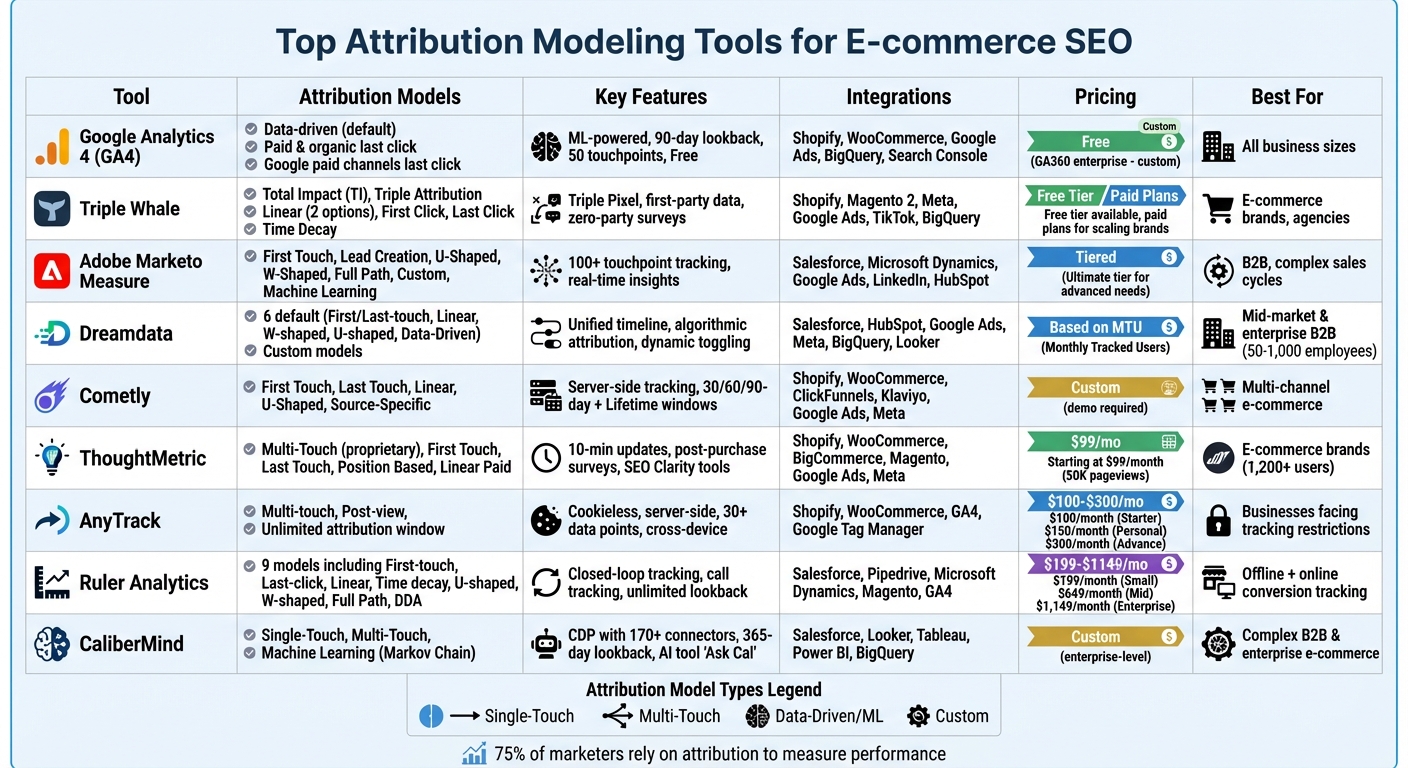
E-commerce Attribution Tools Comparison: Features, Models & Pricing
What Is Attribution Modelling | A Quick Explainer For Ecommerce Owners
sbb-itb-5be333f
1. Google Analytics 4 (GA4) Data-Driven Attribution

Google Analytics 4 (GA4) is a widely used, free tool for e-commerce attribution. As of November 2023, it supports three attribution models: Data-driven attribution (DDA), Paid and organic last click, and Google paid channels last click.
Attribution Model Types Supported
The Data-driven attribution model is GA4’s default and uses machine learning to distribute credit across up to 50 touchpoints within a 90-day period. By analyzing historical data, it identifies which interactions are most influential in driving conversions. For this model to perform effectively, Google suggests a minimum of 200 conversions and 2,000 touchpoints per month. If your site doesn’t meet these thresholds, the Paid and organic last click model might be a better fit. This model ignores direct traffic and assigns all credit to the last non-direct channel. Alternatively, the Google paid channels last click model focuses exclusively on Google Ads, giving full credit to any Google Ads click within the conversion path.
"Data-driven attribution is the default model in GA4. Rather than following a strict rule, it uses machine learning to fairly divide credit among every touchpoint on a customer's journey." – Varsha Bairagi, SEO Specialist, Conversios
These attribution models aim to provide a clearer view of the customer journey by accounting for multiple touchpoints. GA4’s Model Comparison report (located under Advertising > Attribution) further enhances this by letting users evaluate how switching from a last-click model to data-driven attribution impacts the perceived value of SEO and paid channels. This adaptability is further supported by GA4’s strong integration capabilities.
Integration Capabilities with E-commerce Platforms and SEO Tools
GA4 seamlessly integrates with popular platforms like Shopify and WooCommerce, both of which offer pre-built e-commerce events for automated data tracking. For more customized setups, you can use Google Tag Manager or gtag.js. Additionally, linking GA4 to Google Ads allows for streamlined ad performance tracking, while exporting data to BigQuery enables in-depth, large-scale user path analysis. GA4 also pulls data from Google Search Console, combining search performance metrics, Core Web Vitals, and conversion data into a single view. Once tagging is complete, e-commerce data typically appears in GA4 reports within 24 to 48 hours. These integrations make GA4 a flexible tool for businesses of varying complexities, often featured among top SEO tools and marketing resources for data analysis.
Pricing and Scalability for Businesses of Different Sizes
GA4 is available at no cost to all businesses. However, for high-volume e-commerce sites that require faster data processing or advanced reporting, Google Analytics 360 offers premium features like unsampled reports and data updates within four hours. Pricing for Analytics 360 is tailored to each business and requires contacting Google for details. If you decide to export data to BigQuery for advanced analysis, keep in mind that additional costs will apply based on storage and query usage.
2. Triple Whale
Getting attribution right is essential for boosting SEO efforts, and Triple Whale steps up with tailored models and seamless integrations. This platform is built specifically for e-commerce brands, helping them track performance across multiple channels. Unlike general analytics tools, it brings everything together - paid ads, organic search, and even customer surveys - into one place. Its unique Triple Pixel collects first-party data from all customer interactions, which helps offset data losses caused by privacy changes like iOS 14. These features make it a strong contender for accurate attribution modeling.
Attribution Model Types Supported
Triple Whale provides a variety of attribution models to meet different campaign needs. Its Total Impact (TI) model combines first-party and zero-party data with proprietary algorithms to offer a full view of the customer journey. The Triple Attribution model gives all the credit to the final ad interaction, while its two Linear Attribution options either spread credit equally across all touchpoints or focus solely on paid media. Other supported models include First Click, Last Click, and Time Decay, all of which come with flexible attribution windows.
"Brands that lean into accurate attribution can cut through the noise of conflicting data sources to identify which marketing efforts drive incremental revenue." – Ethan Shust, Sr. Product Marketing Manager, Triple Whale
Integration Capabilities with E-commerce Platforms and SEO Tools
Triple Whale doesn’t just stop at attribution models - it also excels in integration. The platform works with top e-commerce platforms like Shopify, Magento 2, and Celery. For SEO, it integrates with Google Analytics and offers tools like Keyword-Level Attribution and Search Term Insights to monitor organic performance. It pulls data from popular ad channels such as Meta, Google Ads, TikTok, Pinterest, Snapchat, Microsoft Ads, and LinkedIn to calculate cross-channel ROAS. Additionally, it syncs with zero-party data tools like Kno and Fairing, combining customer survey insights with attribution data. For advanced analysis, users can export data to platforms like Google Sheets, BigQuery, or Snowflake.
Brands like Doe Lashes have seen impressive results with Triple Whale's Triple Pixel. By identifying which ads drive sales, they achieved a 2,900% increase in TikTok ad spend, a 150% higher ROAS on TikTok compared to Facebook, and saved around $7,500 in monthly time. Similarly, the creative agency Modifly used the Triple Pixel to address data loss caused by iOS 14, allowing them to make real-time decisions and optimize ad spend effectively.
Pricing and Scalability for Businesses of Different Sizes
Triple Whale offers options for businesses of all sizes. Its Free tier is perfect for those just starting with attribution modeling. For scaling brands and agencies, it provides advanced solutions like Moby Agents and custom BI tools that grow alongside the business. The platform also includes role-specific features tailored to founders, marketing leaders, and data analysts, making it a flexible choice for teams of various sizes.
3. Adobe Marketo Measure
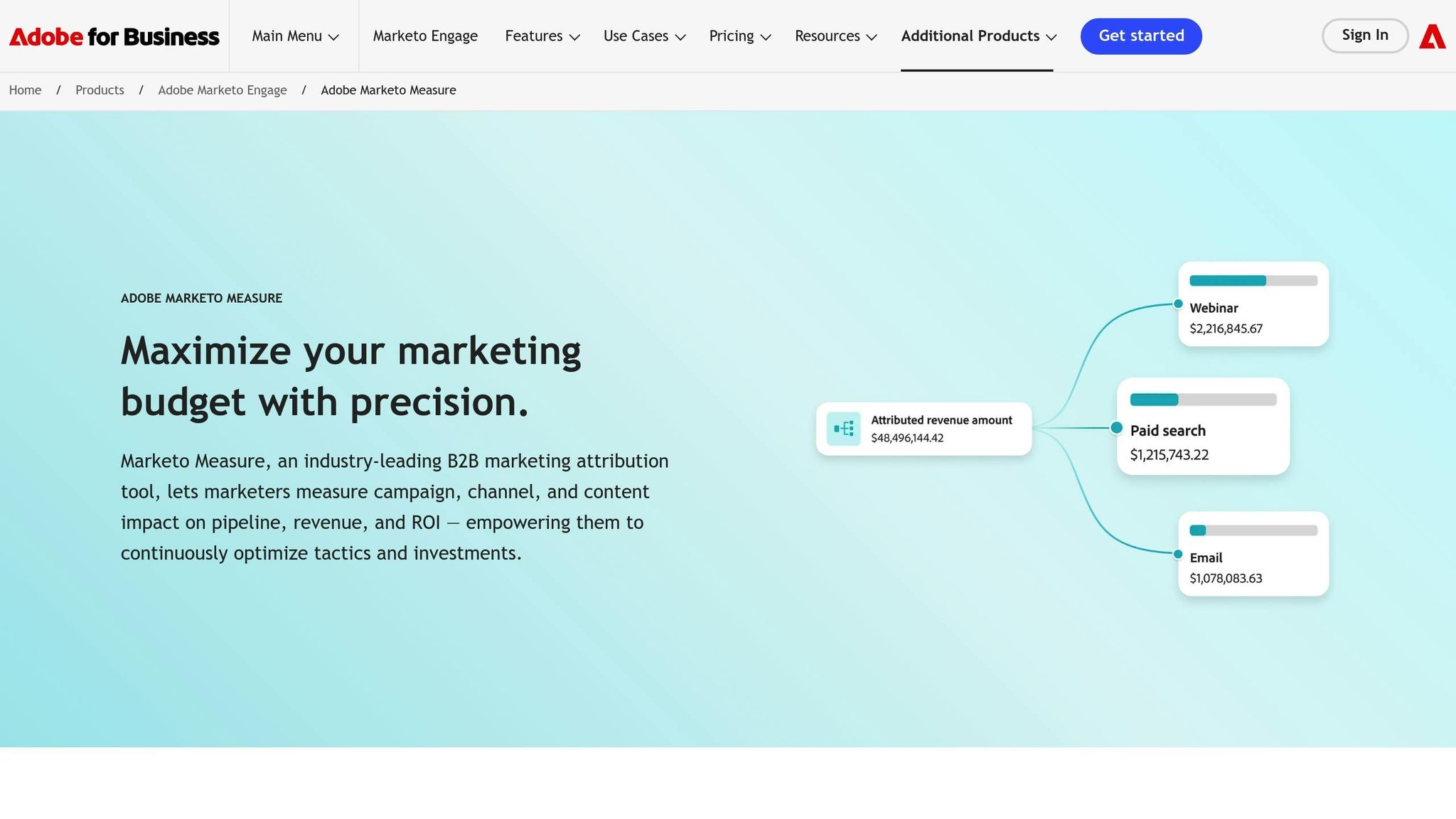
Adobe Marketo Measure, previously known as Bizible, is a powerful tool for tracking buyer interactions across both online and offline channels. It’s particularly valuable for e-commerce SEO because it captures the complexity of B2B sales cycles, which often involve over 100 touchpoints before closing a single deal. Using JavaScript tracking, it integrates seamlessly with your site or Google Tag Manager, enabling real-time monitoring of user behavior and sessions. This comprehensive tracking sets the stage for a variety of attribution models, which we’ll dive into below.
Attribution Model Types Supported
Attribution models are critical for evaluating and fine-tuning your SEO campaigns. Marketo Measure supports seven models, including:
- First Touch: Assigns 100% credit to the first interaction.
- Lead Creation: Credits the touchpoint that generated the lead.
- U-Shaped: Splits credit equally between the first touch and lead creation.
- W-Shaped: Distributes 30% of credit to first touch, lead creation, and opportunity creation stages.
- Full Path: Allocates 22.5% credit across four milestones - first touch, lead creation, opportunity creation, and closed won.
For more tailored analysis, custom models allow you to assign weights to up to six stages. Meanwhile, the Machine Learning model uses AI to determine attribution weights based on the stages that most influence deal closures.
For example, the U-Shaped model is ideal for focusing on acquisition, as it highlights the channels that brought visitors to your site and the content that converted them into leads. On the other hand, the W-Shaped model provides deeper insights into pipeline generation by adding the opportunity creation stage.
Integration Capabilities with E-commerce Platforms and SEO Tools
Marketo Measure excels at integrating data across various platforms, making it easier to connect marketing efforts with sales outcomes. It offers native integrations with major CRMs like Salesforce and Microsoft Dynamics, ad platforms such as Google Ads and LinkedIn, and form tools like HubSpot and Pardot. For SEO, the platform tracks organic search through its "Natural Search" channel and includes a Keyword ROI Dashboard to pinpoint which keywords drive revenue.
The Ultimate tier of Marketo Measure takes integration a step further by allowing businesses to ingest data from virtually any source, even multiple sources of the same type. This capability supports more complex attribution needs. For instance, Pricefx implemented Marketo Measure to gain a clearer understanding of buyer intent and engagement throughout the customer journey, as explained by Kelly Pronek, Vice President of Revenue Generation and Enablement:
"With Marketo Measure, we know how people get to us, how they engage, where they are in the buying cycle, and their buyer intent signals." – Kelly Pronek, Vice President of Revenue Generation and Enablement, Pricefx
Real-Time Tracking and Reporting Features
Marketo Measure provides real-time tracking of every buyer touchpoint, offering immediate insights into SEO’s impact across the sales funnel. The Web Traffic Dashboard highlights which search engines and referral paths are driving the most effective traffic, while CRM-native reporting breaks down attribution data by stages like First Touch, Lead Creation, and Closed Won.
For businesses looking to set up custom SEO-related milestones, enabling Field History tracking in your CRM ensures that Marketo Measure captures stage transitions accurately. Additionally, advanced users can leverage Data Warehouse access to integrate with BI tools like Tableau and Power BI for deeper analysis.
Pricing and Scalability for Businesses of Different Sizes
Marketo Measure offers tiered pricing to accommodate businesses of varying sizes and data needs. Smaller businesses can start with basic attribution features, while larger enterprises can opt for the Ultimate tier, which supports advanced data integration and migration from legacy systems. This scalable approach ensures that businesses can expand their use of the platform as their data requirements grow, making it a flexible solution for companies at any stage of growth.
4. Dreamdata
Dreamdata simplifies attribution by pulling data from your entire tech stack into a single, unified timeline. For e-commerce businesses navigating complex customer journeys with numerous stakeholders and touchpoints, the platform uses a proprietary script to track both known and anonymous users. It connects these interactions with data from tools like your CRM, ad platforms, and SEO tools and services such as Google Search Console. This approach creates a strong data foundation for Dreamdata's attribution models, revealing the real impact of your SEO efforts.
Attribution Model Types Supported
Dreamdata includes six default attribution models, blending traditional rule-based methods with advanced algorithmic approaches. Among the position-based models are First-touch, Last-touch, Linear, W-shaped, and U-shaped, each distributing credit based on touchpoint roles. For instance, the W-shaped model assigns 30% credit to the first interaction, 30% to the conversion point, 30% to the last touchpoint, and leaves 10% for the remaining interactions - perfect for untangling multi-decision-point e-commerce journeys.
The Data-Driven model takes things further by leveraging algorithms to analyze every customer journey simultaneously. As Mikkel Settnes from Dreamdata explains:
"Data-Driven Models replace specific business rules with a mathematical algorithm that uses data from all the journeys to dynamically determine what touchpoints influenced the outcomes".
This model uncovers patterns across your dataset, helping you identify hidden contributors to your SEO success.
For businesses with specific needs, custom models are available through Enterprise plans. These allow you to set detailed business rules, create attribution groups, and assign precise weights to sessions, channels, or events. You can even fine-tune models using attribution exclusions, such as removing "direct" traffic from attribution to better isolate SEO contributions.
Integration Capabilities with E-commerce Platforms and SEO Tools
Dreamdata’s strength lies in its seamless integrations with key platforms. It connects with CRMs like Salesforce, HubSpot, Zoho, and Pipedrive, as well as ad platforms like Google Ads, Meta, LinkedIn, and Bing. A dedicated Organic Search channel enables precise measurement of SEO’s role in driving pipeline stages like MQLs or closed deals. The platform also works with marketing automation tools like Marketo and Pardot, creating a full view of how organic search impacts later customer journey stages.
For advanced reporting, Dreamdata supports exporting revenue attribution data to Google BigQuery. This data can then be visualized in tools like Looker Studio, enabling custom reporting that ties SEO performance directly to ROI. By integrating organic search data with other channels, you get a detailed, ROI-focused view of your SEO efforts.
Real-Time Tracking and Reporting Features
Dreamdata allows you to track user interactions in real time. With dynamic report toggling, you can switch between attribution models directly within the report interface. This lets you see how credit distribution shifts between models like First-touch and Data-Driven without needing separate reports.
The platform automates cross-channel ROAS (Return on Ad Spend) reporting, linking marketing efforts directly to sales outcomes. Collaboration tools include shared reports and notifications sent via Slack or Microsoft Teams for timely updates. By tracking the entire customer journey - from the first organic search interaction to MQL stages and final conversions - Dreamdata helps pinpoint SEO’s contribution to your sales funnel.
Pricing and Scalability for Businesses of Different Sizes
Dreamdata is built for mid-market and enterprise B2B companies, typically those with 50 to 1,000 employees. It can handle almost any volume of monthly tracked users (MTU), with pricing based on MTU metrics. Enterprise plans unlock advanced features like custom attribution models and dedicated Customer Success Manager support. Accurate attribution is critical for scaling SEO efforts, and Dreamdata’s pricing reflects this focus.
With a 4.7/5 rating on G2, users frequently highlight the platform’s transparency and measurement capabilities. One reviewer called it "simply the best attribution platform we have used so far".
5. Cometly
Cometly provides platform-agnostic tracking for e-commerce businesses, allowing them to measure the impact of organic search on their sales. It integrates seamlessly with platforms like Shopify, WooCommerce, ClickFunnels, and custom storefronts. On top of that, it connects with tools like Klaviyo for email and Postscript for SMS marketing. This unified setup tracks "Google Organic" and other organic search interactions as distinct touchpoints in multi-touch customer journeys. The result? You can clearly see how SEO drives conversions. Trusted by over 3,000 companies, Cometly employs server-side event tracking to enrich data sent to ad platforms, offering better match rates and more accurate attribution than standard browser-based methods.
Attribution Model Types Supported
Cometly supports four core attribution models: First Touch, Last Touch, Linear, and U-Shaped. The U-Shaped model is particularly insightful, assigning 40% of the credit to the first and last touchpoints, while the remaining 20% is split across middle interactions. This approach highlights SEO's dual role in discovery and conversion. Additionally, the platform includes a Source-Specific Attribution feature, which isolates organic search performance. This lets you apply First or Last Touch logic exclusively to SEO touchpoints, giving you a clear view of how your SEO efforts are contributing to customer journeys.
With extended attribution windows of 30, 60, 90 days, or even Lifetime tracking, Cometly captures both immediate and long-term SEO impacts. This is especially helpful for high-ticket items that require more research before purchase. Its multi-touch models also uncover "assistive" SEO touchpoints - those interactions that might not lead directly to conversions but play a critical role in moving prospects through the funnel.
Integration Capabilities with E-commerce Platforms and SEO Tools
Cometly goes beyond tracking - it integrates with CRMs and offline events to align sales and marketing data, giving you a full picture of your pipeline. It tracks organic search alongside paid channels like Google Ads and Meta Ads, helping you understand how these channels work together. For example, Cometly can reveal how top-of-funnel social ads lead to branded organic searches, providing SEO teams with data to justify their efforts in brand awareness campaigns. The custom report builder allows you to filter data by source, campaign, product, or funnel stage, making it easy to see which SEO content or organic channels are delivering results - no data analyst required.
Real-Time Tracking and Reporting Features
Cometly provides real-time insights into purchase-driving sources, Average Order Value (AOV), and Lifetime Value (LTV). These live updates let you optimize your content and spending decisions on the fly. Its AI Chat feature automatically analyzes campaign data, highlighting top-performing channels and audiences so you can quickly determine if organic search is a key conversion driver. Multi-touch customer journey mapping shows every interaction, from initial ad clicks to organic search visits and final purchases, illustrating how SEO and paid media complement each other. The "Last Non-Direct Touch" model ensures that SEO and other marketing efforts are credited for conversions that might otherwise be attributed to a direct visit at the end. These features make tracking and reporting both dynamic and actionable.
Pricing and Scalability for Businesses of Different Sizes
Cometly doesn’t publicly disclose its pricing. Instead, businesses need to schedule a demo to receive custom pricing based on factors like business size, tracking volume, and integration requirements. This tailored approach suggests flexibility, accommodating everything from mid-sized e-commerce operations to large enterprises with complex, multi-channel customer journeys. Its ability to handle extended attribution windows and serve over 3,000 companies underscores its scalability.
6. ThoughtMetric
When it comes to e-commerce SEO, where organic search can heavily influence revenue, ThoughtMetric stands out with its tailored solutions. This platform provides platform-agnostic attribution, enabling e-commerce brands to clearly see how organic search drives revenue. It tracks performance across major search engines like Google, Bing, and Yahoo, while also keeping an eye on newer AI-driven search engines like ChatGPT. Trusted by over 1,200 e-commerce brands, ThoughtMetric simplifies analytics by offering a unified, revenue-focused view of marketing channels. Plus, its server-side tagging technology ensures accurate data collection, even overcoming challenges like iOS 14 updates and ad blockers. This makes it a powerful tool for improving SEO performance in the e-commerce space.
Attribution Model Types Supported
ThoughtMetric supports five key attribution models: Multi-Touch (its proprietary, data-driven model), First Touch, Last Touch, Position Based, and Linear Paid. The Multi-Touch model, which is the default, uses a combination of tracking pixels and post-purchase surveys to assign credit across all channels influencing a sale, including organic search. Additionally, its "SEO Clarity" tools help brands identify their top-performing pages and directly link SEO efforts to revenue. The platform also allows for configurable lookback windows that go beyond the typical 7-day period, acknowledging that the average purchase journey spans 8 days and that 64% of orders involve multiple touchpoints.
Integration Capabilities with E-commerce Platforms and SEO Tools
ThoughtMetric seamlessly connects with leading e-commerce platforms like Shopify, WooCommerce, BigCommerce, and Magento to sync sales and customer data. On the marketing side, it integrates with Google Ads, Meta Ads, TikTok Ads, Pinterest Ads, and Bing Ads. A standout feature is its customizable post-purchase surveys, such as the "How did you hear about us?" question, which captures attribution data that traditional tracking methods might miss. Users often praise this feature for delivering "one version of the truth" across all channels. These integrations feed into real-time reporting, ensuring that every channel's contribution is accurately measured.
Real-Time Tracking and Reporting Features
ThoughtMetric updates its data every 10 minutes, offering nearly instant insights into marketing performance. Its unified dashboard provides a comprehensive view, breaking down metrics at the campaign, ad set, and ad levels, with product-level attribution available for individual SKUs. For example, in September 2025, Ninja MTB used ThoughtMetric to identify underperforming marketing efforts, cutting $5,000 in wasted monthly ad spend. By reallocating that budget to better-performing channels, they improved their return on ad spend (ROAS) by 25% and increased their Marketing Efficiency Ratio (MER) by 53.8% within three months.
"The multi-touch attribution models are a game-changer. They show us the full customer journey in one clean dashboard." – Animals Matter
Pricing and Scalability for Businesses of Different Sizes
ThoughtMetric offers straightforward pricing, starting at $99 per month for up to 50,000 pageviews. All plans include access to features like multi-touch attribution, server-side tagging, and Conversion API integrations, without complex tiering. Customers can also save 18% with annual billing, and there's a 14-day free trial available with no credit card required. This pricing structure caters to businesses of all sizes. For instance, in April 2025, Cole Haan used ThoughtMetric’s attribution data to gain better visibility into channel-specific ROI, enabling them to secure larger marketing budgets.
7. AnyTrack
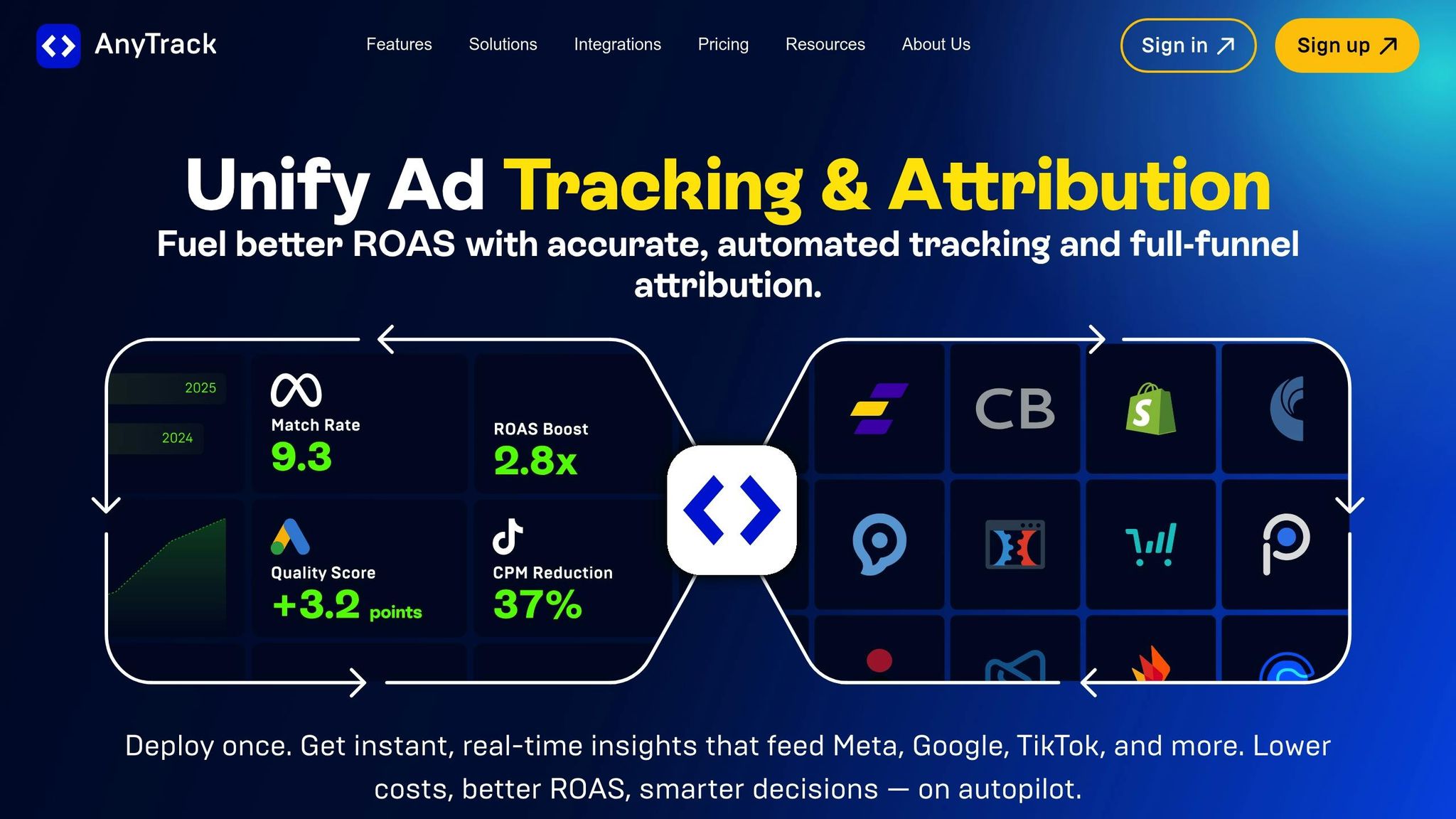
AnyTrack offers a cookieless, server-side tracking system tailored for e-commerce SEO teams dealing with browser restrictions and ad blockers. It automatically collects over 30 data points from your marketing and sales tools, tracking every customer interaction across platforms. Its Click ID system connects first-party data to specific marketing channels, ensuring precise tracking of organic search traffic. This is crucial, as incomplete tracking can result in businesses losing 20-30% of their return on ad spend.
Attribution Model Types Supported
AnyTrack supports multi-touch and post-view attribution models, allowing it to map and measure every touchpoint that drives conversions across ad networks. One of its standout features is the unlimited attribution window, which tracks customer journeys without time limits - especially valuable for e-commerce businesses with longer sales cycles. Additionally, it offers cross-device and cross-domain tracking, linking sessions across mobile, desktop, and tablet to provide a consistent view of user behavior.
Integration Capabilities with E-commerce Platforms and SEO Tools
The platform includes a no-code, plug-and-play pixel that automatically captures eight standard conversion events. For e-commerce, AnyTrack integrates seamlessly with Shopify and WooCommerce, tracking granular data like SKU, quantity, and shipping costs. On the SEO side, it works with Google Analytics 4 and Google Tag Manager, mapping the dataLayer for consistent audience building. The AutoTag system manages affiliate links automatically, while AutoTrack captures key website events like outbound clicks and form submissions. Its detailed landing page and campaign reports help pinpoint which pages drive conversions, offering actionable insights for improving SEO content.
"AnyTrack solved my biggest challenge - accurately tracking my entire funnel across Samcart and Meta Ads." – Chealsea Wierbonski, Product Leader at Google
These integrations provide a solid foundation for real-time, end-to-end tracking of your funnel.
Real-Time Tracking and Reporting Features
AnyTrack excels in delivering instant insights with its real-time tracking features. It processes conversion data instantly, offering tools like real-time CAPI sync, audience sync, and near real-time ROAS reporting. By combining client-side JavaScript tags with server-side webhooks and APIs, it bypasses ad blockers and browser restrictions, ensuring complete data collection. The platform also eliminates duplicate conversions using a transactionId parameter, keeping reports accurate. Philipp, an e-commerce marketer, described it as a "top-notch solution" that delivers reliable data without breaking the bank.
Pricing and Scalability for Businesses of Different Sizes
AnyTrack’s pricing starts at $100/month for the Starter plan, which includes 100,000 sessions, one website, full ad and CAPI integrations, and server-side tracking. The Personal plan, at $150/month, supports 500,000 sessions and three websites with GA4 integration. For larger needs, the Advance plan, priced at $300/month, handles 3 million sessions across 10 websites and offers unlimited CAPI integrations along with dedicated support. All plans come with a 14-day free trial and flexible billing, with no long-term contracts required. Additional sessions exceeding your plan are billed at the end of the cycle based on a rate card.
With its advanced tracking features and flexible pricing, AnyTrack is a powerful tool for refining SEO-driven conversion analysis.
8. Ruler Analytics
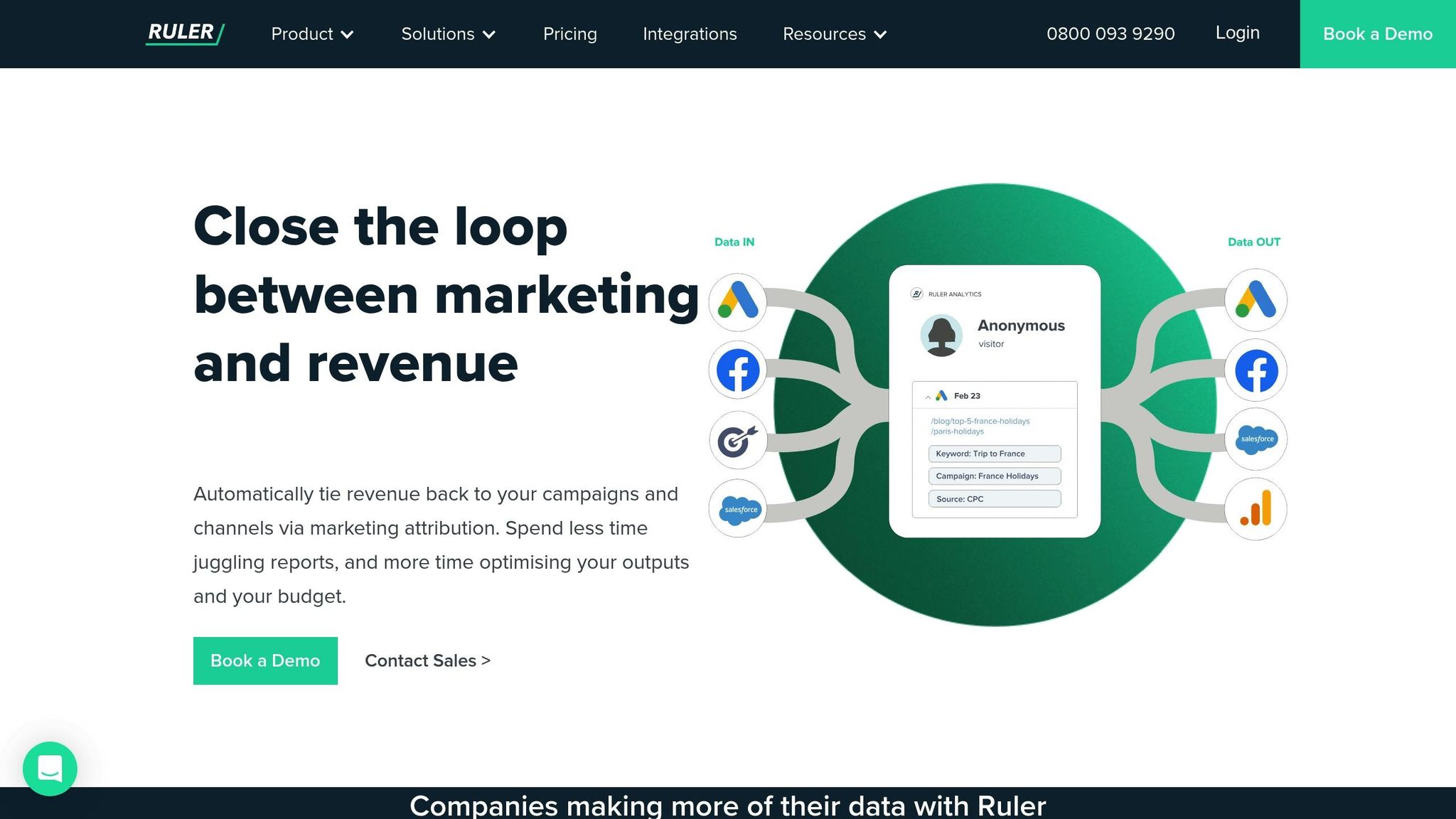
Ruler Analytics takes attribution tracking to the next level with its full-funnel, closed-loop approach. Unlike standard tools that focus on clicks or form submissions, Ruler follows the entire customer journey - from the first website visit to the final purchase - by connecting marketing activities directly to revenue. This makes it a powerful tool for e-commerce businesses looking to pinpoint which SEO strategies drive actual sales, not just traffic. By collecting UTM parameters, click data, and cookie IDs, Ruler links organic search sessions to offline conversions like phone calls and live chat interactions.
Attribution Model Types Supported
Ruler Analytics offers nine different attribution models, including First-touch, Last-click, Last non-direct click, Linear, Time decay, Position-based (U-shaped), W-shaped, Full Path, and Data-Driven Attribution (DDA). What sets it apart is its hybrid DDA/impression model, which combines click data with impression insights. Research highlights that for every ad click, there are 10 to 50 impressions that influence decision-making. For e-commerce SEO, the Position-based model stands out, assigning 40% credit to the initial touchpoint (organic discovery), 40% to the lead conversion point, and the remaining 20% to interactions in between.
Integration Capabilities with E-commerce Platforms and SEO Tools
Ruler Analytics integrates seamlessly with over 1,000 apps and leading CRMs like Salesforce, Pipedrive, and Microsoft Dynamics. It also connects directly with e-commerce platforms such as Magento, delivering actionable revenue insights. For example, Circleloop reported a 155% year-over-year increase in conversions after optimizing campaigns with Ruler. The platform enhances Google Analytics 4 by adding revenue and call data, helping businesses identify which keywords and landing pages are driving sales. Notably, Ruler bypasses GA4's 90-day lookback limitation with its unlimited lookback feature, which is crucial for companies with longer sales cycles - 52% of businesses report cycles lasting one to three months, and 19% exceed four months.
"Without Ruler, we would have less data to show a true return on investment, so it's hugely beneficial." – Ash Winder, SQ Digital
Real-Time Tracking and Reporting Features
Ruler Analytics also excels in real-time tracking and reporting. It monitors every click, call, and interaction through automatic integrations with forms, live chat, and call tracking tools. Real-time reports include key metrics like Return on Ad Spend (ROAS) and Cost Per Acquisition (CPA). Users can switch between attribution models within reports to see how different channels perform at various stages. For instance, comparing First-click and Linear models can reveal which channels initiate customer journeys versus those that close conversions. Victoria Foster from Hitsearch noted that after implementing Ruler's tracking, paid channels accounted for 91% of all calls. The Multi-Touch Comparison feature further enhances reporting by offering different perspectives on SEO performance, making it easier to justify spending on awareness-building content.
Pricing and Scalability for Businesses of Different Sizes
Ruler Analytics offers flexible pricing to suit businesses of all sizes. The Small Business plan starts at $199/month for up to 50,000 monthly visits. The Mid-Market plan is priced at $649/month, while the Enterprise plan costs $1,149/month for up to 200,000 visits. For businesses exceeding 200,000 visits, custom pricing is available. Annual plans may include a 10% discount. This tiered structure ensures that both growing e-commerce brands and large enterprises can leverage Ruler’s capabilities to measure SEO-driven revenue effectively.
9. CaliberMind
CaliberMind is a Customer Data Platform (CDP) specifically designed to tackle the challenges of e-commerce SEO attribution for complex B2B and e-commerce environments. By consolidating data from various sources like CRM systems, marketing automation platforms, ad networks, and website analytics, it creates a unified data lake. This allows businesses to map out the entire customer journey - from the first organic search to the final purchase. With over 170 connectors and integration capabilities with BI tools such as Looker, Tableau, and Power BI via Google BigQuery, teams can start uncovering actionable insights within just two weeks of connecting their data sources.
Attribution Model Types Supported
CaliberMind supports three main categories of attribution models: Single-Touch, Multi-Touch, and Machine Learning/Chain-Based models.
-
Single-Touch Models:
- First Touch: Gives 100% credit to the first interaction with the brand.
- Last Touch: Assigns full credit to the interaction just before opportunity creation.
- Middle Touch: Focuses on the "tipping point" asset in the journey.
-
Multi-Touch Models:
- Even-Weighted (Linear): Distributes credit evenly across all touchpoints.
- W-Shaped: Prioritizes the first interaction, last interaction, and the primary contact.
- Chain-Based (Markov Effect) Model: This machine-learning-driven model identifies the most common sequences in buyer journeys that lead to successful sales. Businesses are advised to implement this model after achieving 100 closed-won opportunities. Additionally, CaliberMind allows users to customize multi-touch models for specific needs, such as assigning more weight to high-value interactions like demo requests while excluding low-value actions like email opens.
Integration Capabilities with E-commerce Platforms and SEO Tools
CaliberMind integrates seamlessly with CRM systems like Salesforce, pushing engagement and attribution data into custom objects to provide sales teams with clear insights into buyer journeys. For example:
- NetApp: By using CaliberMind, NetApp's marketing team identified engagement spikes in 20% of their priority target accounts, which led to the creation of 733 new opportunities in a single quarter.
- Airship: Stephen Harper, Airship's Marketing Operations Analyst, consolidated their tech stack into a unified data lake. This enabled them to track most marketing touchpoints and reconcile siloed data.
In addition, CaliberMind organizes raw web data into "virtual campaigns", allowing businesses to monitor website visits and interactions even before a visitor is formally identified in the CRM. This setup provides a solid foundation for generating real-time insights.
Real-Time Tracking and Reporting Features
CaliberMind simplifies tracking and reporting with its intuitive dashboards:
- Summary and Explore Dashboards: These tools aggregate attribution data, allowing users to group insights by campaign, channel, or event type.
- ROI Heatmap: A visual tool that highlights ROI trends across platforms and time, distinguishing between finalized ("locked") and ongoing ("unlocked") attribution data.
For marketers dealing with large datasets, the AI tool Ask Cal provides quick summaries of buyer journeys, eliminating the need for manual spreadsheet analysis. Users can dive deep into metrics, exploring everything from overall attribution and pipeline performance to individual touchpoints like eBook downloads or specific search terms.
"CaliberMind is proving what I always knew: my campaigns are much more effective than my Salesforce dashboard for attribution would lead me to believe." – Nathan W., Senior Manager in Public Sector Marketing
Pricing and Scalability for Businesses of Different Sizes
CaliberMind caters to mid-market and enterprise-level businesses, particularly those with intricate, multi-touch customer journeys. To function effectively, it requires integration with CRM systems, marketing automation tools, and web tracking. While pricing details aren’t publicly available, the platform is best suited for organizations with larger marketing budgets and extended sales cycles. The default attribution lookback window is set to 365 days, though this can be adjusted to align with a company’s specific sales cycle. This flexibility ensures accurate attribution for businesses selling high-value products or those with longer consideration periods.
10. Top SEO Marketing Directory
The Top SEO Marketing Directory serves as a central hub for discovering e-commerce attribution and SEO tools. Instead of sifting through platforms one by one, you can quickly compare vetted solutions tailored to your specific needs. Tools are organized by their attribution models, integration capabilities, and pricing, making it easier to find the right fit for your business and budget. This directory works hand-in-hand with our detailed tool analyses to simplify your search for effective SEO and attribution solutions.
Attribution Model Types Supported
The directory includes tools that cater to a variety of attribution models, ensuring flexibility for different campaign strategies. Whether you’re working with single-touch models like First-click, Last-click, or Last non-direct interaction, or multi-touch models such as Linear, Time Decay, U-shaped, and W-shaped, there’s a solution for you. For more advanced needs, some platforms leverage machine learning for data-driven attribution, perfectly aligning with the intricate paths of multi-touch consumer journeys.
Integration Capabilities with E-commerce Platforms and SEO Tools
A standout feature of the directory is its focus on tools with strong integration capabilities. Many solutions seamlessly connect with popular e-commerce platforms like Shopify, WooCommerce, BigCommerce, and Magento. Additionally, they integrate with essential SEO tools such as Google Search Console and Semrush, consolidating critical performance data into a single dashboard. This integration is a key part of a technical SEO audit to ensure data accuracy. For businesses that rely on CRMs, email providers, or advertising platforms like Google Ads and Meta Pixel, these tools often include API support. This allows for tracking both online interactions - like clicks and form submissions - and offline touchpoints, such as phone calls or in-store visits. By bridging these data gaps, businesses gain a clearer view of their customer journeys.
Pricing and Scalability for Businesses of Different Sizes
The directory also categorizes tools by pricing, ensuring options for businesses of all sizes.
- Small businesses can explore platforms like ActiveCampaign (starting at $15/month), Matomo (offering a free self-hosted version or $19/month for cloud plans), and HubSpot Marketing Hub (free for up to two users).
- Mid-market businesses might consider tools such as ThoughtMetric (starting at $99/month) or Triple Whale, with plans beginning at $149/month.
- Enterprise-level solutions include robust platforms like Salesforce Data Cloud for Marketing ($1,250 to $2,750/month) and Adobe Analytics (starting around $2,000–$2,500/month depending on traffic volume).
This tiered approach ensures businesses can start with a solution that fits their current needs while having the flexibility to scale as they grow.
Conclusion
Selecting the right attribution modeling tool can transform your e-commerce SEO into a true revenue driver. These tools provide the clarity needed to make data-driven decisions that boost performance. As Boris Mustapic from Semrush puts it, "Marketing attribution is the process of determining which marketing actions help drive leads or sales".
The tools discussed here offer the visibility to identify which SEO keywords and acquisition channels are driving conversions. This insight allows you to secure buy-in from stakeholders and reallocate budgets to high-performing strategies. It's worth noting that 75% of marketers rely on attribution to measure their performance. Companies like IBM, for example, have reportedly increased marketing efficiency by as much as 30% by leveraging advanced attribution insights.
Tailoring attribution models to your business’s unique sales cycle is key. For instance, B2B companies with extended customer journeys may benefit from multi-touch or linear models. On the other hand, B2C businesses with shorter sales cycles might find U-shaped or last-touch models more effective. Additionally, it’s crucial to choose tools that integrate seamlessly with your existing tech stack - whether it’s your e-commerce platform, CRM, or advertising tools. Regularly reviewing your attribution reports will also help you fine-tune your strategy for better results.
For further guidance, the Top SEO Marketing Directory (https://marketingseodirectory.com) is a valuable resource. This directory simplifies the process of finding attribution and SEO tools tailored to your needs. Whether you're a small business starting at $15 per month or a large enterprise seeking custom solutions, the directory offers curated comparisons based on pricing, integration options, and attribution model support. It’s a one-stop resource to ensure you select tools that align with your current goals and scale with your future growth plans.
FAQs
Which attribution model should I use for my e-commerce SEO?
The best attribution model for e-commerce SEO hinges on factors like your specific goals, the length of your sales cycle, and how complex your customer journey is. Some of the most commonly used models include last-click, multi-touch, and data-driven approaches.
For those seeking deeper insights into customer behavior and the performance of campaigns, multi-touch and data-driven models are often the go-to choices. These methods provide a clearer picture of how various touchpoints contribute to conversions, making them especially useful for businesses with intricate customer journeys.
How can I track SEO conversions accurately with iOS 14 and ad blockers?
To keep tracking SEO conversions even with challenges like iOS 14 updates and ad blockers, switch to privacy-compliant attribution methods. Tools such as SKAdNetwork can provide aggregated insights, while server-side tracking and first-party data help fill in the blanks. You can also explore advanced attribution platforms that use AI and identity resolution to address data gaps. Don't forget to audit your current setup and use privacy-focused APIs, like Apple’s AdServices or Google’s tools for iOS campaigns, to ensure your conversion tracking stays accurate.
What integrations do I need for end-to-end SEO attribution?
To implement end-to-end SEO attribution for e-commerce, you’ll need to bring together a few essential tools: analytics platforms, ad channels, CRM systems, and offline conversion tracking.
For instance, Google Analytics offers a solid starting point for understanding your traffic and conversions. If you're looking for more advanced attribution models, platforms like HubSpot or Dreamdata can provide deeper insights.
Integrating advertising platforms such as Meta, Google, and TikTok with your CRM ensures you capture the full customer journey. This setup allows you to track every touchpoint, attribute results more accurately, and fine-tune your marketing spend for better results.