Managing online reviews is critical for businesses in 2026. With 95% of customers reading reviews before purchasing and 87% relying on Google Reviews for local businesses, your reputation can directly impact revenue. Positive reviews can boost revenue by 5–9%, while negative reviews may deter up to 60% of potential customers. Responding promptly to reviews is also crucial, as 53% of customers expect a reply within a week.
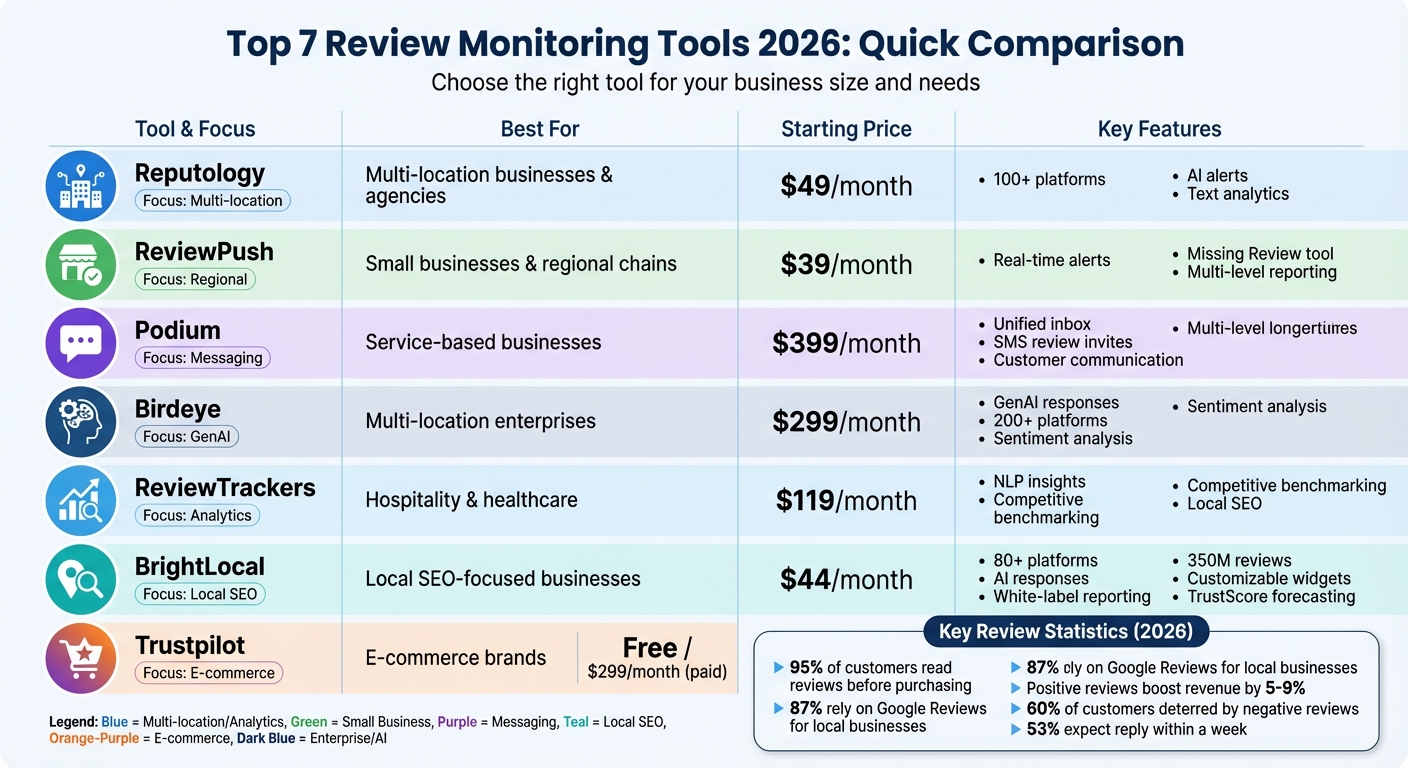
Here are the top 7 tools to streamline review monitoring and improve customer feedback management:
- Reputology: Great for multi-location businesses, offering insights from 100+ platforms with AI-driven alerts. Starts at $49/month.
- ReviewPush: Ideal for small businesses and regional chains, with real-time alerts and affordable plans starting at $39/month.
- Podium: Combines review monitoring with customer communication tools. Starts at $399/month.
- Birdeye: AI-powered tools for sentiment analysis and multi-location tracking. Starts at $299/month.
- ReviewTrackers: Advanced analytics and local SEO features for multi-location businesses. Starts at $119/month.
- BrightLocal: Affordable local SEO-focused tool with plans starting at $44/month.
- Trustpilot: Best for e-commerce, offering customizable widgets and public review hosting. Free plan available; paid plans start at $299/month.
Each tool offers unique features tailored to different business sizes and industries. Below is a quick comparison to help you decide which one fits your needs.
Quick Comparison
| Tool | Best For | Starting Price | Key Features |
|---|---|---|---|
| Reputology | Multi-location businesses | $49/month | Aggregates 100+ platforms, AI alerts |
| ReviewPush | Small/regional businesses | $39/month | Real-time alerts, multi-level reporting |
| Podium | Service-based businesses | $399/month | Unified inbox, SMS-based review invites |
| Birdeye | Multi-location enterprises | $299/month | Sentiment analysis, AI responses |
| ReviewTrackers | Hospitality/Healthcare | $119/month | NLP insights, local SEO tools |
| BrightLocal | Local SEO-focused | $44/month | Local SEO, review generation |
| Trustpilot | E-commerce brands | Free/$299+ | Public review hosting, widgets |
Managing reviews effectively can boost your visibility, improve customer trust, and drive revenue growth. Choose a tool that aligns with your business goals and budget.
Top 7 Review Monitoring Tools Comparison 2026: Features and Pricing
1. Reputology
Review Aggregation and Monitoring Capabilities
Reputology simplifies review management by pulling feedback from over 100 platforms - like Google, Facebook, Yelp, and TripAdvisor - into a single, unified dashboard. This setup is especially useful for multi-location businesses, such as restaurant chains or healthcare networks, allowing them to monitor branch performance and respond to reviews without the hassle of switching between tabs.
AI-Driven Features Like Sentiment Analysis and Real-Time Alerts
With its text analytics capabilities, Reputology helps identify recurring concerns - such as complaints about slow service or parking issues - so you can address them promptly. The system also sends automated alerts whenever new reviews are posted, ensuring you stay on top of customer feedback in real time.
Pricing and Affordability for Different Business Sizes
Reputology’s pricing structure is designed with multi-location businesses in mind. Plans start at $49 per month, making it a viable option for smaller chains. The Professional Plan, priced at $60 per seat per month (up to three seats), caters to slightly larger teams. Agencies managing multiple clients can opt for the Agency Plan at $40 per seat per month. These prices were last confirmed in January 2026, offering flexibility and scalability for various business needs.
Suitability for Specific Business Types
Reputology is a great fit for multi-location businesses like hotel chains, retail franchises, and healthcare networks. It excels at identifying trends and comparing performance across different regions. However, for single-location businesses, its extensive features may be more than necessary. Interestingly, while Reputology was acquired by ASG Technologies in February 2019, it continues to operate independently, maintaining its focus on review management for multi-location enterprises.
sbb-itb-5be333f
2. ReviewPush
Review Aggregation and Monitoring Capabilities
ReviewPush is an excellent choice for smaller businesses and regional chains looking for an effective way to manage online reviews. Unlike Reputology, which is designed for larger, multi-location enterprises, ReviewPush focuses on providing a powerful yet accessible solution. The platform brings together reviews from major sites like Google, Facebook, Foursquare, and TripAdvisor into a single, easy-to-navigate dashboard. Its multi-level reporting system allows corporate teams to track overall performance while giving location managers access to branch-specific insights. This setup strikes a balance between centralized oversight and localized management, making it a versatile tool for businesses with multiple locations.
One standout feature is the "Missing Review" tool, which ensures no important feedback slips through the cracks. Real-time email alerts notify you of new reviews as they come in, while missing profile alerts help identify incomplete business listings across various platforms.
Pricing and Affordability for Different Business Sizes
For businesses just starting with online reputation management, ReviewPush offers plans starting at just $39 per month. This makes it a budget-friendly option for small businesses that need essential monitoring tools without breaking the bank. The platform’s straightforward interface and competitive pricing make it a practical alternative to more expensive enterprise-level solutions. For larger businesses with multiple locations, pricing adjusts based on the number of locations being monitored, and the tool’s hierarchical reporting works well for complex organizational needs. The addition of AI-driven features further enhances its value by automating key aspects of review management.
AI-Driven Features and Real-Time Alerts
ReviewPush uses AI-powered sentiment analysis to categorize customer feedback, helping businesses quickly identify trends and address concerns. Another helpful feature is the platform’s ability to flag incomplete business listings, ensuring your online presence remains consistent across all platforms. These AI tools, combined with detailed performance reports, make it easier to stay on top of customer feedback and respond to negative reviews before they escalate into bigger issues.
Suitability for Specific Business Types
ReviewPush is particularly effective for businesses in industries like hospitality, retail, and food service - sectors where customer reviews can directly influence revenue. Its affordable pricing and simple interface are ideal for small and midsize businesses, while its advanced reporting capabilities appeal to larger, multi-location enterprises. However, if your business requires broader social listening features or more extensive customer communication tools, ReviewPush may not be the best fit, as its primary focus is on review monitoring and response.
3. Podium
Review Aggregation and Monitoring Capabilities
Podium stands out by combining reputation management with customer communication. It pulls reviews from over 24 platforms - like Google, Facebook, and DealerRater - into a single dashboard. What makes it even more practical is its unified inbox, which consolidates reviews and customer interactions from SMS, Facebook, Instagram, WhatsApp, and other channels in one place for easy access.
The platform simplifies the review process by automating invitations via text or email after a purchase. Customers can leave feedback in just two clicks, and businesses get real-time alerts whenever new reviews are posted. Currently, more than 100,000 businesses use Podium, with many seeing an average 15% boost in total review volume. For instance, Sherman's Furniture in Illinois used Podium to close the gap between its high customer satisfaction and low online review count. In just three months, they gained 726 new reviews, raising their Google rating from 4.0 to 4.8 - a 40% increase in overall reviews. This functionality is paired with a pricing model that caters to businesses of various sizes.
Pricing and Affordability for Different Business Sizes
Podium's pricing starts at $399 per month for the Core plan, which includes features like review management with AI responses, basic automations, and over 200 integrations. The Pro plan, priced at $599 per month, adds tools like an AI Reputation Specialist, AI phone call summaries, and advanced text marketing segmentation. For multi-location enterprises, the Signature plan offers custom pricing and includes advanced management tools and fraud alerts. Additional costs include a $5 per month 10DLC fee per location and optional add-ons ranging from $25 to $30 per user per month. While these prices are higher compared to basic review tools (typically $25–$110 per month), the platform’s added features aim to deliver more value.
Julie Davis, CEO of Pura Vida Body & Mind Spa, highlighted Podium's ROI potential by growing her business's Google reviews from 28 to 670 in just six months - a 24× increase - and generating $80,000 in revenue from a single two-day campaign.
AI-Driven Features and Real-Time Alerts
Podium integrates AI to streamline reputation management. Its Reputation Specialist drafts on-brand replies and uses sentiment analysis to identify trends, while real-time alerts ensure businesses never miss a new review. Higher-tier plans also include AI Auto Review Responses, which handle routine replies automatically. Over time, these responses can be tailored to match the business's tone and style. These advanced AI tools make Podium a strong choice for businesses that prioritize customer service and engagement.
Suitability for Specific Business Types
Podium is particularly suited for local service businesses and multi-location brands that need an all-in-one platform for communication and reputation management. Industries like auto repair, dental care, contracting, and similar services benefit from its SMS-focused approach and unified inbox. It’s especially effective for businesses generating $5 million or more in annual revenue, offering tools for messaging, payment processing, and review management in one system. This combination helps boost local SEO while improving customer interaction, utilizing top SEO tools and marketing resources to drive growth.
That said, smaller businesses focused solely on gathering reviews might find the starting price steep. The 12-month contract may also deter those looking for more flexibility if the platform doesn’t meet their expectations. Podium has earned a rating of 4.6/5 on G2 from 2,025 reviews and 4.3/5 on Capterra from 520 reviews. Users often praise its streamlined customer communication but note the high cost and the absence of Yelp integration as drawbacks.
4. Birdeye
Review Aggregation and Monitoring Capabilities
Birdeye brings together reviews from over 200 platforms - including Google, Facebook, and niche industry sites - into a single, easy-to-navigate dashboard. With BirdAI agents, the platform can detect new reviews, analyze sentiment, and quickly flag spam or critical feedback. It also tracks a Reputation Score across multiple locations, helping businesses identify trends in ratings, review volume, and response rates. The competitive benchmarking feature allows businesses to see how they stack up against local competitors. To increase review volume, automated workflows send review requests via SMS, email, and apps. Currently, more than 200,000 businesses rely on Birdeye to manage their online presence. On average, customers experience a 128% increase in review volume within the first 90 days, and 75% maintain an average star rating of 4 or higher across review platforms.
Pricing and Affordability for Different Business Sizes
Birdeye's pricing starts at $299 per month for the Starter plan, which includes features like Reviews AI, Listings AI, and Messaging AI. For $349 per month, the Growth plan adds Social AI, while the Dominate plan, at $449 per month, offers the full suite along with Chatbot AI. Pricing is per location, with volume discounts available for businesses managing multiple locations. Additional features, such as competitor tracking, AI insights, and surveys, can be added for $100 to $150 per month each. While the Starter plan is a good fit for smaller businesses, the higher-tier plans and optional add-ons may be a stretch for those with limited budgets.
AI-Driven Features and Real-Time Alerts
Birdeye's AI tools are designed to save time and improve efficiency. The platform's AI agents create personalized, on-brand responses in multiple languages without requiring manual input. Insights AI compiles sentiment data from reviews, surveys, and social media to highlight areas for improvement. Real-time alerts via desktop, mobile, email, or SMS ensure businesses can respond promptly to feedback. Predictive monitoring also helps flag spikes in negative reviews before they become larger issues. For example, Indiana Members Credit Union used Birdeye's AI features across 30+ branches, generating over 2,000 new reviews in a year. This effort raised their Google rating from 3.9 to 4.4 while achieving a 98% response rate within a 24-hour window.
"Being able to monitor and respond to reviews appropriately in a timely manner through Birdeye is a game changer. The recommended AI responses are definitely helpful when we've run out of ways to say thank you."
– Meghan Bingham, CVPM Senior Operations Manager, Valley Veterinary Care
Suitability for Specific Business Types
Birdeye is particularly well-suited for multi-location businesses in industries like healthcare, financial services, retail, automotive, real estate, and hospitality. For instance, Black Bear Diner, a restaurant chain with over 150 locations, used Birdeye's GenAI suite to handle a surge in reviews. This resulted in a 26% increase in customer reviews and improved response efficiency across all locations. The platform's integration with over 3,000 enterprise tools, including Salesforce and HubSpot, makes it an excellent choice for larger organizations seeking centralized reputation management. However, smaller businesses focused primarily on collecting reviews might find the starting price and add-on costs challenging, especially with the 12-month contracts that limit flexibility. Birdeye is highly rated for its user-friendly interface (4.5/5) and customer support (4.7/5). Additionally, 95% of users on G2 recommend the platform. Like other leading tools in 2026, Birdeye is built to help businesses efficiently monitor and manage reviews in real time.
5. ReviewTrackers
Review Aggregation and Monitoring Capabilities
ReviewTrackers pulls reviews from more than 100 third-party sites - including Google, Facebook, Yelp, and TripAdvisor - and captures 98% of new reviews within just 24 hours. Updates occur every 4–6 hours, ensuring businesses stay on top of their reputation game. This centralized system eliminates the hassle of logging into multiple platforms, making it a time-saver for businesses managing feedback across multiple locations using top SEO tools and services. The platform’s unified inbox allows teams to track, analyze, and respond to reviews efficiently.
What sets ReviewTrackers apart is its ability to turn review data into actionable insights. By analyzing customer feedback, businesses can identify trends, improve customer experiences, and make informed changes to their services or products. Since reviews play a crucial role in local SEO - ranking as the third most important factor for local pack results and among the top seven for local organic search - this functionality also boosts search visibility. It’s a comprehensive tool for businesses aiming to improve both their online reputation and operational strategies.
Pricing and Affordability for Different Business Sizes
ReviewTrackers offers flexible pricing plans to cater to different business needs:
- Essential Plan: Starting at $119 per location per month, this plan includes review monitoring, email alerts, and standard reporting.
- Professional Plan: At $189 per location per month, it adds features like API access, custom reporting, competitor tracking (up to 10 competitors per location), and SMS review invitations.
- Premium Plan: Designed for advanced needs, this plan offers white-label options, dedicated account management, and custom integrations. Pricing is customized and typically ranges between $300 and $500 per location.
- Data Only Plan: Tailored for organizations needing API access to integrate review data into their own platforms, this plan also comes with custom pricing.
While the Essential Plan may suit growing businesses, single-location small businesses might find it pricey unless their revenue heavily relies on online reputation. On the other hand, enterprises with multiple locations - especially those managing five or more - can maximize value through consolidated reporting and location comparison features.
AI-Driven Features and Real-Time Alerts
ReviewTrackers leverages natural language processing (NLP) to analyze review text, categorizing feedback as positive, negative, or neutral with an impressive 85% accuracy rate. Real-time alerts can be set for specific triggers, such as 1-star reviews or keywords like "unsanitary" or "rude." These alerts enable teams to address issues quickly, whether through email or Slack notifications. To streamline responses, the platform offers customizable templates that help maintain a consistent brand voice while speeding up reply times.
Will Swales, SEO Program Manager at evo, remarked: "Being quickly alerted to customer issues through ReviewTrackers, and routing the feedback to the person on our team best equipped to address the concern is a key part of our operations".
Suitability for Specific Business Types
ReviewTrackers is tailored for businesses with multiple locations, particularly franchises, offering tools to scale reputation management and enhance local SEO strategies. It’s especially effective for industries like hospitality, healthcare, retail, and wellness, where customer feedback directly impacts operations. Enterprises with five or more locations will find its features most beneficial.
Kirk Waidelich, VP of Marketing at Rural King, shared: "We use customer comments from reviews to pivot our store experience. ReviewTrackers helps us keep customers happy while we listen to the challenges they're facing".
The platform integrates smoothly with popular tools like Slack, Google Analytics, Salesforce, HubSpot, Hootsuite, and Zapier. Its mobile apps for iOS and Android make it easy for managers to respond to reviews on the go. Recognized as a "Leader in Reputation Management" by G2, ReviewTrackers earns praise for its ability to consolidate data from over 100 sources and for its responsive customer support team. However, some users have mentioned that the interface could use an update, and the absence of a free trial might deter potential customers.
6. BrightLocal
Review Aggregation and Monitoring Capabilities
BrightLocal simplifies reputation management by pulling reviews from over 80 platforms - like Google, Facebook, Yelp, TripAdvisor, Avvo, Healthgrades, and HomeAdvisor - into a single "Review Inbox". This saves time by eliminating the need to log into multiple accounts. Plus, daily automated reports ensure no new review goes unnoticed.
A standout feature is the ability to respond to Google and Facebook reviews directly from the dashboard, helping businesses reduce response times. For companies managing multiple locations, the "Review Leaderboard" compares performance across branches, making it easy to identify locations that need improvement. BrightLocal also offers tools to actively generate more reviews through email, SMS, and in-store campaigns, giving businesses a proactive way to build their online reputation.
"Features like reviews and ratings allow us to see data that we'd otherwise have to go to multiple websites to access. This is a huge time saver for us!" – Benjamin Collins, Laughing Samurai
Pricing and Affordability for Different Business Sizes
BrightLocal offers three pricing tiers: Track, Manage, and Grow. The Grow Plan, which includes full review management, costs $44 per month when billed annually or $59 per month on a monthly basis. The more basic Track and Manage plans, priced at $29 and $36 per month respectively, do not include review management features.
For businesses with multiple locations, the platform becomes even more cost-effective. For example, a single location on the Grow Plan costs $44 per month (with annual billing), but businesses managing 100 locations can benefit from discounts that reduce the per-location cost to around $6.74. Custom enterprise plans are also available for organizations managing between 100 and 1,000+ locations, providing tailored support and reporting options. Small businesses can explore BrightLocal with a 14-day free trial - no credit card required [39, 40].
AI-Driven Features and Real-Time Alerts
BrightLocal incorporates AI to make review management faster and more efficient. The platform’s AI tools draft quick responses to reviews, enabling businesses to engage with customers more promptly. Additionally, the "Review Insights" tool uses sentiment analysis and keyword tracking to identify recurring themes in customer feedback, such as "fast delivery" or "helpful staff" [15, 43].
To ensure businesses stay on top of their reviews, BrightLocal provides real-time and daily alerts. This is crucial, as 88% of consumers are more likely to choose a business that responds to reviews - both positive and negative. Users can customize alert frequency (daily, weekly, or as reviews come in) and take advantage of white-label reporting, which is especially useful for agencies looking to provide branded data to their clients.
"We helped generate $88,000 for a client with online reviews using Reputation Manager!" – Crystal Horton, GBP Product Expert & LSA Consultant
Suitability for Specific Business Types
BrightLocal’s features are particularly well-suited for businesses focused on improving local SEO and managing reviews efficiently. Small businesses can start with plans as low as $39 per month. Its emphasis on local SEO is valuable, considering that reviews account for about 17% of Google Local Pack ranking factors. The platform supports review tracking across the USA, UK, Canada, and Australia, making it a strong option for businesses in these regions.
For multi-location enterprises, BrightLocal offers significant advantages with its volume discounts and tools like the Review Leaderboard. Industries such as legal, healthcare, automotive, and home services benefit from the platform’s ability to monitor niche review sites relevant to their fields. Marketing agencies, on the other hand, gain value from features like white-label reporting and the "Agency Lead Generator" widget, which helps convert website visitors into clients. BrightLocal consistently earns high ratings - 4.6/5 on G2, 4.8/5 on Capterra, and 4.4/5 on Trustpilot - for its user-friendly dashboard and time-saving features.
"BrightLocal is one of the best internet marketing tools out there... It is fast, accurate, and produces excellent reports." – Colan Nielsen, VP of Local Search, Sterling Sky
7. Trustpilot
Review Aggregation and Monitoring Capabilities
Trustpilot hosts an impressive 350 million reviews from 1.3 million businesses globally, with approximately 190,000 new reviews added daily. Unlike platforms that gather feedback from multiple sources, Trustpilot focuses on building your brand's presence directly on its platform. With the Service Reviews Inbox, you can centralize all feedback into a single dashboard, making it easier to manage and respond to reviews without juggling multiple accounts.
The platform offers tools like review tagging and filtering to help you organize feedback by themes, making it easier to detect patterns in customer sentiment. To safeguard your brand, it flags suspicious reviews, protecting you from fake feedback. For those looking to leverage social proof, Trustpilot provides customizable widgets to embed reviews on your website. Notably, 73.6% of Trustpilot visitors report being more likely to buy from sites showcasing these reviews. This streamlined approach is similar to what other leading tools offer for review management.
Pricing and Affordability for Different Business Sizes
Trustpilot offers a Free plan that includes 50 automated review invitations per month and one basic website widget. If you're looking for more robust features, their paid plans are billed annually and priced per domain.
- Plus Plan: Starts at $299 per month, offering 200 invitations, eight widgets, and the removal of competitor ads from your profile.
- Premium Plan: Priced at $629 per month, this tier includes 500 invitations and TrustScore forecasting.
- Advanced Plan: At $1,099 per month, it provides 5,000 invitations along with full sentiment analysis.
- Enterprise Plan: Designed for large-scale operations, this plan offers unlimited invitations, full API access, AI-driven tools, and a dedicated success manager. Pricing is customized.
While the Free plan is great for startups, the $299 monthly entry-level cost might be a hurdle for very small businesses.
AI-Driven Features and Real-Time Alerts
Trustpilot integrates AI to streamline review management. It offers tools to craft empathetic, on-brand responses at scale and uses predictive analytics to forecast a 12-month TrustScore. This helps businesses anticipate rating trends and identify key service factors influencing their overall score. The Review Highlights feature automatically identifies and showcases your business's strengths based on customer feedback, making it perfect for marketing purposes.
For deeper insights, Trustpilot’s Data Solutions and Enhanced Insights provide sentiment analysis, helping businesses incorporate trust signals into their strategies.
"88% of consumers prefer businesses that reply to all of their reviews, compared to just 47% for those that don't respond."
One business reported a 37% increase in conversions by actively engaging with reviews.
Suitability for Specific Business Types
Trustpilot’s features make it especially well-suited for e-commerce businesses and consumer-facing brands aiming to build trust through transparent, public reviews. The Free plan is ideal for startups experimenting with review collection, while the Advanced and Enterprise tiers are tailored for high-traffic businesses handling thousands of reviews monthly.
Trustpilot holds a 3.8/5 rating on G2 based on 615 reviews and a 4.4/5 rating on its own platform, highlighting its strength as a specialized review platform rather than a tool for aggregating reviews across multiple sites.
Tool Comparison Table
The table below highlights the key strengths and limitations of seven review monitoring tools, summarizing their best use cases, standout features, and potential drawbacks.
| Tool | Best Use Cases | Main Features | Drawbacks |
|---|---|---|---|
| Reputology | Agencies and multi-location businesses | Aggregates reviews from 100+ platforms, text analytics, and automated alerts | Too complex for single-location businesses |
| ReviewPush | Small businesses and regional chains | Includes Missing Review tool, multi-level reporting, and real-time alerts | Lacks robust social listening capabilities |
| Podium | Service-based businesses leveraging communication | Unified inbox for reviews and social messages | High starting price ($399/month) and no Yelp integration |
| Birdeye | Organizations needing AI-driven, multi-language tools | GenAI-powered multi-language responses and alerts across 200+ platforms | Pricing may be steep for smaller businesses |
| ReviewTrackers | Hospitality and healthcare industries needing analytics | Sentiment analysis with NLP, competitive benchmarking, and location-based reporting | Limited social media integrations |
| BrightLocal | Local SEO-focused businesses and agencies | Review Inbox from 80+ platforms, AI-generated responses, white-label reporting | Basic plans lack review management features |
| Trustpilot | E-commerce and consumer-facing brands | 350 million reviews, customizable widgets, and TrustScore forecasting | Entry-level paid plans start at $299/month |
Each tool shines in specific scenarios. For instance, Podium simplifies customer communication with its unified inbox, while Birdeye offers GenAI-powered responses in multiple languages. ReviewTrackers provides advanced analytics with natural language processing, though its social media integration is limited. Meanwhile, Reputology is ideal for agencies and multi-location businesses, despite its lack of Yelp integration.
Choosing the right tool depends on your priorities. For a deeper dive into any of these options, refer to their detailed sections above.
Conclusion
Recent studies reveal that nearly all consumers rely on online reviews when deciding what to buy. The stats are clear: a single one-star improvement can increase revenue by 5–9%, while businesses with ratings above four stars see 32% more revenue compared to lower-rated competitors.
Based on the tools discussed earlier, the next step is to tailor your review management strategy to fit your business. If you're a small business with a limited budget, Reputology offers a practical starting point at just $49 per month. For multi-location businesses or agencies, centralized dashboards like those from Reputology or ReviewTrackers simplify managing reviews across multiple branches. Service-based companies that prioritize customer communication might find Podium's unified inbox worth the $399 monthly investment. Meanwhile, healthcare providers can benefit from tools specifically designed for platforms like Healthgrades and Zocdoc.
Ignoring reviews can come at a steep cost. A single negative review could deter 30 potential customers, and having three or more negative reviews in search results might result in losing up to 60% of potential customers. Since 87% of consumers rely solely on Google Reviews, focusing on Google-specific monitoring can yield the greatest benefits.
To improve your ratings, make it a habit to monitor, respond to, and actively request reviews. The impact of engagement is striking: 88% of consumers are more likely to choose a business that responds to reviews, compared to just 47% for businesses that don't. Use automation tools to send SMS or email review requests right after purchases. This keeps your reviews fresh and ensures your ratings stay competitive.
Investing in a review monitoring tool not only protects your reputation but also drives revenue. Refer to the comparison table above to find the best fit for your business size and industry. Consistent monitoring and timely responses can turn customer feedback into a powerful growth engine. Your reputation isn’t just about what customers say - it’s about how you respond. Start using the right tool today and turn reviews into actionable results.
FAQs
How can I select the best review monitoring tool for my business?
Choosing the right review monitoring tool hinges on factors like your business size, industry, and specific needs. If you're a small or medium-sized business (SMB), focus on tools that are both affordable and practical. Look for options that handle the basics, such as tracking reviews on platforms like Google and Yelp. These tools are simple to use, cost-effective, and perfect for SMBs that want reliable monitoring without unnecessary complications.
For larger companies or those operating in highly competitive industries - think healthcare, retail, or hospitality - it's worth exploring tools with advanced capabilities. Features like AI-powered sentiment analysis, compliance tracking, and multi-location management are particularly useful for businesses with a wider online footprint or more intricate reputation management challenges.
To make the best choice, weigh your budget against your industry needs and the features each tool offers. Aim for a solution that aligns with your goals while staying within your financial limits.
What features should you prioritize in a review monitoring tool in 2026?
When choosing a review monitoring tool in 2026, focus on features that make managing feedback easier and more effective. Key capabilities include broad platform coverage, real-time tracking, and sentiment analysis. The tool should cover major platforms like Google Reviews, Yelp, TripAdvisor, social media, and blogs, so no feedback slips through the cracks. Real-time alerts and automated workflows for routing reviews to the right teams can speed up responses and simplify management.
Sentiment analysis is essential for understanding how customers feel about your brand and identifying potential problems early. Tools that analyze trends over time and offer actionable insights can strengthen your reputation strategy. To make daily use simpler, choose tools with intuitive dashboards, customizable notifications, and seamless integrations with your marketing or customer service systems. These features will help you manage your brand’s reputation more effectively and stay ahead in the competitive digital space.
Why is it crucial to respond quickly to online reviews?
Responding to online reviews quickly is a key part of keeping your reputation strong and earning your customers' trust. When you reply promptly, it shows that you take feedback seriously and care about resolving concerns, which can go a long way in building loyalty.
On top of that, addressing reviews in a timely manner can help you tackle potential problems before they grow. It reflects professionalism and a dedication to customer satisfaction. This kind of proactive engagement not only impresses the reviewer but also leaves a positive mark on anyone else who comes across your responses.