Want to boost your global SEO? Language-specific keyword optimization tailors keywords to local languages, search habits, and cultural nuances, ensuring your content ranks higher and resonates with diverse audiences. Here’s what you need to know:
- Why it matters: 90% of internet users prefer browsing in their native language, and 75% never go beyond the first search results page. Optimized keywords can drive massive traffic and conversions.
- Key strategies: Use tools like Google Keyword Planner, SEMrush, and Ahrefs for regional keyword research using top SEO tools. Collaborate with native speakers to refine terms and account for slang, dialects, and search intent.
- Real results: Companies like Canva and Gisou have seen up to 1,365% increases in traffic by localizing their content instead of relying on direct translations.
- Technical tips: Implement hreflang tags, optimize meta tags, and localize URLs, alt text, and internal links through SEO marketing services to ensure seamless user experiences and improved search rankings.
- Track and refine: Use Google Search Console and analytics tools to monitor performance, adjust keywords, and stay competitive in each market.
Pro tip: Localization is more than translation - it’s about understanding how people search, speak, and engage in their region. Done right, it can transform your global reach.
Want the full details? Read on for a step-by-step guide to optimizing keywords for international audiences.
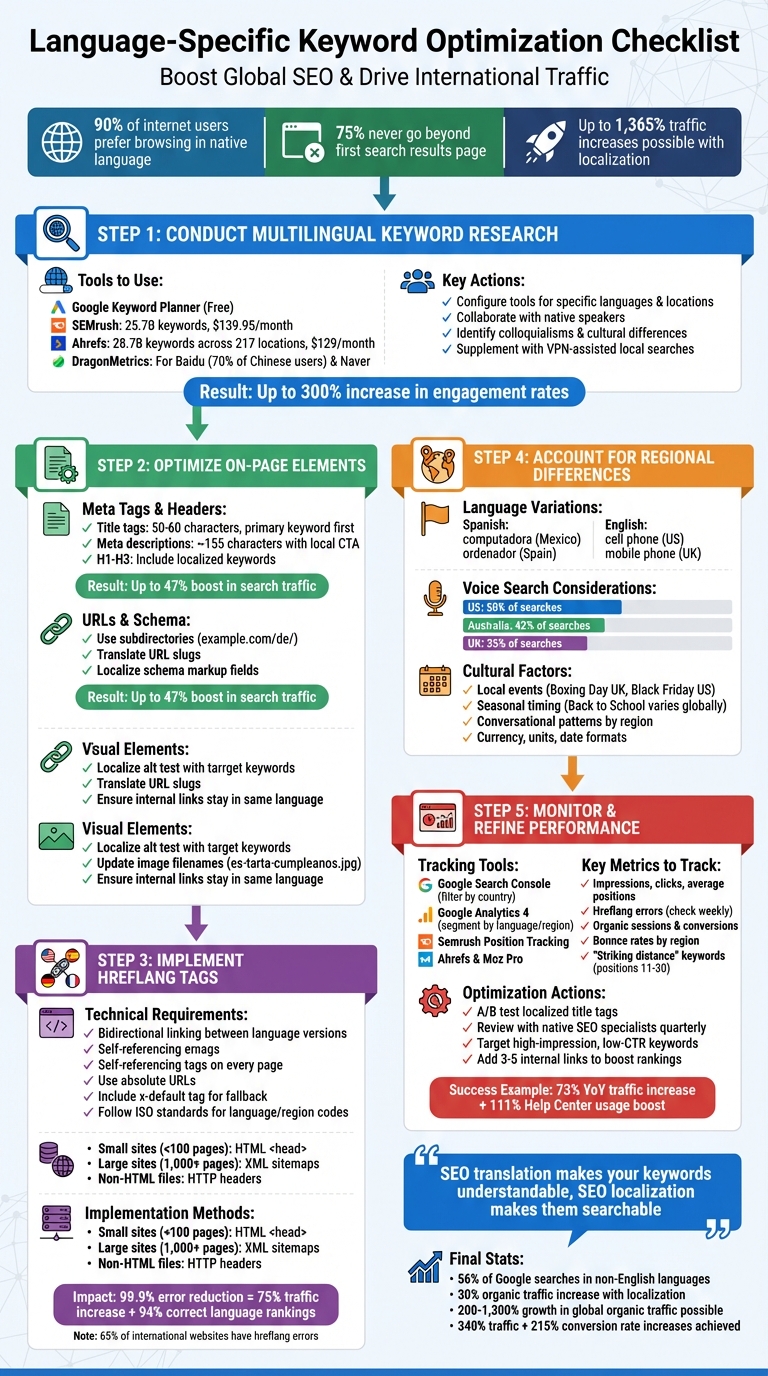
5-Step Language-Specific Keyword Optimization Checklist for Global SEO
Conducting Language-Specific Keyword Research
Choosing Tools for Multilingual Research
Picking the right tools is crucial for multilingual keyword research. Google Keyword Planner (free with a Google Ads account) offers direct access to regional search data, making it a great starting point. For more detailed insights, platforms like SEMrush (covering over 25.7 billion keywords, starting at $139.95/month) and Ahrefs (tracking about 28.7 billion keywords across 217 locations, starting at $129/month) are excellent options.
Make sure to configure these tools for specific languages and geographic locations instead of relying on global averages. In markets where Google isn’t the go-to search engine, specialized tools can be more effective. For example, DragonMetrics provides detailed data for regional search engines like Baidu in China and Naver in South Korea - an important consideration since 70% of Chinese users rely on Baidu.
"As multilingual marketers, we can't be experts in every language and market. But we can be experts at finding the right professionals who are." – Shaheen Samavati, CEO of VeraContent
To refine your keyword lists, collaborate with native speakers. They can help identify colloquialisms and subtle cultural differences. For instance, in 2024, Wise (formerly TransferWire) discovered that Vietnamese expats in Japan were searching for financial services in Vietnamese instead of Japanese. By creating content tailored to this audience in Vietnamese, they unlocked a previously overlooked segment, which became one of their top drivers of organic traffic.
Once you’ve built your keyword list, the next step is to evaluate search metrics.
Evaluating Search Volume and Competition
Keyword competition can vary significantly between languages. A highly competitive term in one language might have much less competition in another, presenting opportunities for quick wins. To get a clearer picture, supplement tool-generated metrics with VPN-assisted local searches. This allows you to review real search results, including features like "People Also Ask" and autocomplete suggestions.
Companies that invest in thorough international keyword research often see up to a 300% increase in engagement rates within their target markets.
After analyzing these metrics, fine-tune your approach to reflect local language intricacies.
Accounting for Regional and Cultural Differences
Even within the same language, regional variations can drastically alter your keyword strategy. For example, Spanish speakers in Mexico typically use "computadora", while those in Spain prefer "ordenador".
Cultural context also plays a major role in shaping search behavior. In some regions, users lean toward longer, more descriptive queries or questions. Voice search is another factor to consider, as it now accounts for 50% of all searches in the U.S., 42% in Australia, and 35% in the UK. Each region demonstrates unique conversational patterns.
Timing is equally important. Align your keywords with local events and seasonal trends. For example, target "Boxing Day" promotions in the UK, "Black Friday" in the U.S., or adjust for varying "Back to School" schedules around the world. Running PPC campaigns with localized keywords can help you test their effectiveness in real time.
sbb-itb-5be333f
Optimizing On-Page Elements with Localized Keywords
Adapting Meta Tags and Headers
When optimizing on-page elements, start with your meta tags. Place the primary localized keyword at the beginning of the title tag, keeping it within 50–60 characters. Remember, some languages require adjustments - German often needs more characters to convey the same message, while languages like Chinese, Japanese, and Korean (CJK) can fit more meaning into fewer characters.
Meta descriptions should also be tailored for each language. Aim for approximately 155 characters and include a culturally relevant call-to-action. This step alone can lead to notable results, with localized websites experiencing up to a 47% boost in search traffic.
Your headings (H1-H3) need careful attention too. Use one H1 per page, ensuring it includes the primary localized keyword. For H2 and H3 tags, incorporate secondary keywords. To refine these headers, search the term in the target country’s version of Google and verify the results align with your page’s intent, whether informational or transactional. This approach helps your content resonate with local search behaviors, enhancing visibility.
"SEO translation makes your keywords understandable, SEO localization makes them searchable" - Eva Legovic, Taia
Once meta tags and headers are in place, focus on refining URL structures and schema markup.
Adjusting URL Structures and Schema Markup
Your URL structure plays a key role in signaling language targeting to search engines. Subdirectories (e.g., example.com/de/) are a great option - they consolidate domain authority and simplify site management. Translate URL slugs into clear, readable phrases that align with the target language. For example, use /de/ueber-uns/ instead of /de/about/ for a German audience.
Here’s a real-world example: Between October 2025 and January 2026, a SaaS company with over 50,000 pages revamped its technical SEO with the help of the LinkGraph Team. By shifting to an XML sitemap-based hreflang approach and cleaning up inconsistent URL structures, they achieved impressive results. Within 90 days, hreflang errors in Google Search Console dropped from 34,000 to 12, correct language rankings jumped from 45% to 94%, and international organic traffic soared from 1.2 million to 2.1 million per month - a 75% increase.
For schema markup, translate fields like "name" and "description" into the target language. Don’t forget to include locale-specific attributes, such as priceCurrency, to ensure accurate pricing displays in rich results.
With URLs and schema in place, turn your attention to visual elements and internal linking.
Updating Alt Text and Internal Links
Optimizing images is another critical step for multilingual SEO. Localize alt text using target language keywords, but avoid direct translations. Instead, craft descriptions that resonate with local audiences. For example, for a U.S. audience, you might use "American family enjoying Thanksgiving dinner". Even image filenames should be localized - use es-tarta-cumpleanos.jpg instead of en-birthday-cake.jpg for a Spanish audience.
Internal links also need to stay consistent with the language version. A German blog post, for instance, should link to the German pricing page, not the English one. This prevents users from being directed to content in a different language, maintaining a seamless experience. Conduct an audit to ensure all internal links point to the appropriate translated pages.
The same rule applies to downloadable resources. If your page offers PDFs or guides, make sure the links point to localized versions. For example, a French page should link to a French PDF. This consistency strengthens your site’s language structure and improves both user experience and search engine clarity.
Implementing Hreflang Tags for Multilingual SEO
Understanding Hreflang Tags
After tackling on-page optimizations, implementing hreflang tags is a key step in ensuring search engines display the correct localized content to users.
Hreflang is an HTML attribute (rel="alternate" hreflang="x") that helps search engines understand which language or regional version of a page to serve based on a user's location and browser settings. For instance, it ensures a Spanish-speaking user in Mexico lands on the Spanish version of your site, while an English-speaking user in the UK sees the appropriate English page.
One major advantage of hreflang tags is avoiding duplicate content issues. By clarifying that pages in different languages are deliberate variations, search engines won't penalize your site for duplication. Studies reveal that over 65% of international websites have hreflang errors, but fixing these can reduce bounce rates from language mismatches by as much as 54%.
While Google and Yandex support hreflang, Bing relies on language meta tags and the lang attribute instead. It's important to note that Google treats hreflang as a strong signal but also factors in user IP addresses and search history when determining which page to display.
"Google uses hreflang as a strong hint for language/region targeting... Incorrect implementation can be ignored or cause unexpected behavior."
- Jon Fish, Director of Search, LinkGraph
Hreflang Implementation Best Practices
To get the most out of hreflang tags, follow these best practices:
- Bidirectional linking: Ensure that if your English page links to the French version, the French page links back to the English page. Without this, search engines may disregard your tags.
- Self-referencing tags: Every page should include a self-referencing hreflang tag pointing to its own URL.
- Absolute URLs: Use absolute URLs (e.g.,
https://example.com/fr/) rather than relative paths. - x-default tag: Include an x-default tag to direct users to a fallback page, like a global homepage or language selector, if their language or region doesn’t match any specified versions.
When working with canonical tags, ensure each localized page has a self-referencing canonical tag, and that hreflang annotations point to these canonical URLs. Stick to ISO standards for language codes (e.g., "en" for English) and region codes (e.g., "gb" for Great Britain, not "uk").
Choose the right implementation method based on your site’s size. For smaller sites (under 100 pages), adding hreflang tags directly in the HTML <head> is manageable. For larger sites (1,000+ pages), XML sitemaps offer better scalability and avoid slowing down page load times. HTTP headers are the only option for non-HTML files like PDFs.
A global SaaS company with 50,000+ pages in 12 languages faced significant challenges in January 2026, with only 45% of its rankings appearing locally due to 34,000 hreflang errors. After switching to an XML sitemap implementation and automating validation, the company reduced errors by 99.9% in just 90 days. This change boosted international organic traffic by 75% and improved local rankings from 45% to 94%.
Use tools like Google Search Console's International Targeting report to validate your hreflang implementation and catch errors early. For larger sites, third-party tools such as Screaming Frog, Sitebulb, and Aleyda Solis's Hreflang Checker can streamline audits.
"Hreflang tags are among the most complex specs we've ever seen from a search engine. Because doing it right is challenging and takes time."
- Joost de Valk, Founder, Yoast
Monitoring and Refining Language-Specific Keywords
Tracking Performance with Analytics Tools
Once your hreflang setup is in place, it's time to track how well your localized keywords are performing. Without effective monitoring, it’s impossible to know if your efforts are working - or where changes might be needed.
Start with Google Search Console (GSC). By filtering data by specific countries, you can analyze impressions, clicks, and average positions for each localized version of your site. For larger international websites, creating separate GSC properties for subdirectories like example.com/fr/ can provide cleaner, more actionable insights. The International Targeting report in GSC is another must-use tool. Check it weekly to catch hreflang errors like "No Return Tag" or "Unknown Language Code", which can hurt your regional rankings.
Pair GSC with Google Analytics 4 (GA4) to monitor user behavior, organic sessions, and conversions. Segment data by country, language, and device to identify issues like poor mobile experiences in specific regions. For more detailed keyword tracking, tools like Semrush Position Tracking, Ahrefs, and Moz Pro can help you monitor rankings across regions and devices. These platforms now also track visibility in AI search platforms, such as ChatGPT (SearchGPT) and Google AI Overviews, which are reshaping how users discover content. Set up automated alerts in these tools to quickly catch significant ranking drops.
The impact of ranking shifts can be dramatic. For instance, in September 2025, Pop Mart - a toy company - dropped from the top spot to second place for the keyword "labubu popmart." That one-position drop cost them an estimated 31,300 organic visits and roughly 381 potential purchases in a single day, based on a 1.22% conversion rate. Similarly, Barber Depot lost approximately $3,096 in daily revenue after dropping one position for "hair clippers for men", considering their 7.28% conversion rate and an average product price of $162.96.
These insights highlight why regular performance tracking is essential for refining your keyword strategy.
Adjusting Keywords Based on User Behavior
Analytics don’t just show rankings - they reveal how users interact with your content, helping you refine your strategy to better match local search intent. Raw ranking data is only part of the picture; understanding user behavior is key to aligning your keywords with what people in each region are actually searching for.
Focus on "striking distance" keywords - those ranking in positions 11–30. These terms often have the potential to reach page one with small adjustments, such as adding 3–5 internal links from high-authority pages within the same language version. In GA4, create custom dimensions to group markets into "Primary", "Growth", and "Test" categories, allowing you to prioritize regions that need the most attention.
Keep an eye on keywords with high impressions but low click-through rates (CTR). This often indicates that your title tags or meta descriptions aren’t engaging enough for the local audience, rather than a problem with the keyword itself. A/B test localized title tags by adding elements like numbers, brackets, or current-year markers to make them stand out. Similarly, high bounce rates or short session durations in specific regions may suggest that your content isn’t matching local search intent or is attracting the wrong audience.
A great example of the power of refining keywords comes from ActiveCampaign. By implementing SEO transcreation and localization for Spanish-speaking markets, they achieved a 73% year-over-year increase in traffic to their Spanish blog and a 111% boost in Spanish Help Center usage. This success came from regularly analyzing regional search queries in GSC to uncover untapped topics and local terms that competitors had overlooked.
To ensure long-term success, have native SEO specialists - not just translators - review your keyword performance regularly. They can identify when terms have become outdated or spot "false friends" (words that look similar but have different meanings) that could be undermining your results.
"Smart SEOs like rank tracking because it uncovers opportunities. When we see certain keywords performing well, it can indicate that it's a topic we should explore more."
- Moz
How to Find and Translate Keywords for Multilingual SEO in 4 steps
Conclusion
Mastering technical setup and performance tracking is just the start - success in global SEO hinges on language-specific keyword optimization. This approach demands ongoing effort but can deliver impressive results. For instance, moving beyond simple translations to true localization has been shown to increase organic traffic by up to 30%. One mid-sized U.S. e-commerce retailer saw even bigger gains: a 340% jump in organic traffic and a 215% boost in conversion rates through targeted multilingual research.
With 56% of Google searches conducted in non-English languages and common hreflang errors undermining visibility, precise localization is more important than ever. Brands that implement authentic multilingual strategies often report dramatic improvements - ranging from 200% to over 1,300% growth in global organic traffic.
"Brands won't win global visibility by translating content. They'll win it by earning relevance market by market." - Silvi Nuñez, Co-founder, Optimational
A B2B software provider working with COSEOM illustrates this point. They found that technical terms used by professionals in Japan, South Korea, and China differed dramatically from direct translations. By tailoring their keyword strategies to each market, they achieved a 200% increase in qualified leads and reduced acquisition costs by 45%.
Final Checklist for Multilingual SEO
- Market-Specific Keyword Research: Collaborate with native speakers to uncover local terminology, slang, and regional differences. For example, "cell phone" is typical in the U.S., while "mobile phone" is standard in the UK.
- Local SERP Analysis: Make sure your keywords match the search intent - whether informational, transactional, or navigational - of each target region.
- Technical Implementation: Use proper hreflang tags (including self-referential and x-default tags) and a scalable URL structure. Subdirectories (e.g., example.com/es/) often work best for consolidating domain authority while keeping language separation clear.
- On-Page Localization: Adapt metadata, headers, CTAs, image alt text, URL slugs, and multimedia content to reflect local keywords and cultural nuances. Adjust elements like currency symbols (e.g., $ for U.S. markets), measurement units (inches/pounds for U.S. audiences), and date formats (MM/DD/YYYY in the U.S.). Provide searchable transcriptions for video and audio content.
- Performance Tracking: Monitor regional performance using Google Search Console (filtered by country), Google Analytics 4 (segmented by language and region), and tools like Semrush or Ahrefs for keyword tracking. Conduct quarterly reviews to address ranking declines and adapt to market changes.
To help you execute these strategies, the Top SEO Marketing Directory (https://marketingseodirectory.com) offers a curated list of tools and services. From keyword research platforms to technical SEO and analytics solutions, these resources are tailored for multilingual optimization success.
FAQs
How do I choose the right keywords for each country?
When optimizing for local markets, don’t just translate keywords - dig deeper. Focus on understanding local search behaviors, preferences, and regional nuances. This means researching trends, idiomatic expressions, and terminology that resonate with the target audience.
Use tools to uncover regional search habits and collaborate with native speakers to fine-tune your keywords. Their insights can help you spot slang or phrases that might not translate directly but are essential for connecting with local users.
Beyond keywords, adjust your content, metadata, and on-page elements to reflect region-specific terms and search intent. For example, ensure formats like dates, currency, and measurement units align with local conventions. This attention to detail not only improves relevance but also builds trust with your audience.
When should I use hreflang vs separate URLs?
When offering multiple language or regional versions of your website, using hreflang tags is a smart move. These tags signal search engines about the intended audience for each version, preventing issues like duplicate content and ensuring users are directed to the most relevant version of your site.
Alternatively, you can opt for separate URLs, such as country-specific domains (e.g., example.com for the U.S. or example.co.uk for the U.K.). This approach can provide stronger geographic targeting and a more tailored local presence. The decision between these options should align with your SEO strategy, resources, and the specific audience you're trying to reach.
What should I track to know localization is working?
To determine whether localization efforts are hitting the mark, keep an eye on key performance indicators like organic search traffic from specific target markets, rankings for localized keywords, and user engagement stats such as bounce rate and conversion rates.
On the technical side, make sure everything is in place by reviewing elements like hreflang tags, URL structures, and geo-targeting signals. These components are essential for ensuring your localization strategy not only works smoothly but also enhances visibility in local search results.