Key Takeaways:
- Higher Rankings: Matching user intent and updating content boosts visibility.
- Increased Traffic: Organic search drives 53% of website traffic; optimized pages attract more visitors.
- Better Conversions: Structured content improves engagement, leading to higher lead generation.
- Cost Efficiency: Organic leads cost significantly less than paid ones ($31 vs. $181 per lead).
- Long-Term Returns: Updated content delivers value for over 18 months, unlike paid ads.
- AI-Ready Content: Structuring content for AI boosts visibility in AI Overviews (15% of US searches).
- Keyword Expansion: Covering primary and related keywords captures users across the buyer’s journey.
- Improved Engagement: Enhanced readability and faster load times reduce bounce rates.
- Backlink Growth: High-quality content attracts more backlinks, increasing domain authority.
- Data-Driven Updates: Re-optimizing existing content yields faster and higher ROI than creating new material.
Quick Comparison:
| Benefit | Impact | ROI Contribution |
|---|---|---|
| Higher Rankings | Aligns with search intent, improves visibility | Reduces paid ad dependency, increases conversions |
| Increased Traffic | Optimized content attracts organic visitors | More qualified leads, lower acquisition costs |
| Better Conversions | Engages users with structured, scannable content | Higher lead-to-customer conversion rates |
| Cost Efficiency | Organic leads are cheaper than PPC leads | Saves money, improves profitability |
| Long-Term Returns | Content delivers results for 18+ months | Sustains traffic and leads without ongoing investment |
| AI-Ready Content | Structured for AI algorithms and Overviews | Enhances visibility in AI-driven search results |
| Keyword Expansion | Covers broad and niche search terms | Attracts users at all stages of the buyer’s journey |
| Improved Engagement | Better readability and UX metrics | Reduces bounce rates, increases dwell time |
| Backlink Growth | High-quality content earns more links | Boosts domain authority, improves rankings |
| Data-Driven Updates | Focuses on re-optimizing underperforming pages | Faster ROI, maximizes existing content potential |
Content optimization is a cost-effective, long-term strategy that transforms your website into a lead-generation machine. By focusing on user intent, AI readiness, and strategic updates, you can achieve measurable growth in traffic, leads, and revenue.
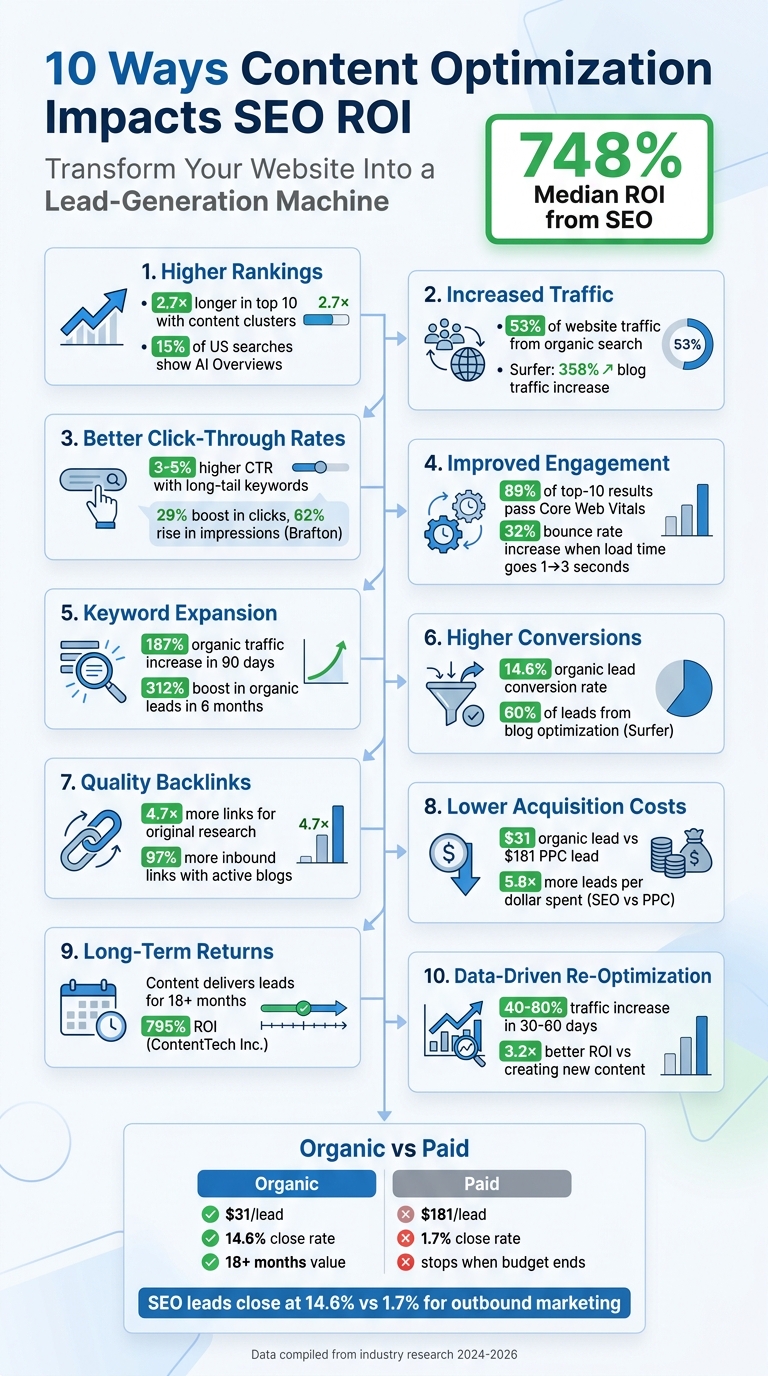
SEO Content Optimization ROI: 10 Key Benefits and Impact Metrics
1. Improves Search Engine Rankings
Impact on Rankings and Visibility
Optimizing your content can help improve your search engine rankings by aligning with what Google values most. At the heart of this is search intent matching - when your content directly addresses what users are seeking, whether it's informational, transactional, navigational, or commercial, Google rewards it with better visibility. This isn't about cramming in keywords; it's about understanding what users want and delivering answers quickly and effectively.
Another key factor is content freshness. Google sees recently updated content as more reliable, which is why 90% of AI bot activity focuses on content published or updated within the last three years. Websites that use clusters of 15 or more interlinked articles to establish authority on a topic tend to stay in the top 10 rankings 2.7× longer. This strategy signals to search engines that your site offers a thorough and valuable resource.
Technical optimization also plays a big role. Fine-tuning title tags, meta descriptions, and alt text using top SEO tools helps search engines better understand your content. Structuring your articles for AI extraction - such as including clear definitions, direct answers within the first screenful, and question-focused subheaders - boosts your chances of appearing in AI Overviews, which now appear in 15% of US searches. For YMYL (Your Money, Your Life) content, having detailed author bios can make a big difference, as these pages rank 1.8× higher than those without author attribution. Together, these efforts not only improve rankings but also reduce acquisition costs while enhancing conversions.
Contribution to ROI Through Conversions and Cost Savings
Higher rankings don't just mean more visibility - they also mean lower costs. When your site ranks organically on the first page, you avoid the high costs associated with pay-per-click advertising. For example, ContentTech Inc. reported that optimized content reduced their cost per lead by over 60% and delivered a 795% ROI.
"If you do those four things consistently, optimizing content for SEO starts behaving like an acquisition system again, not a slot machine."
- Jake Moffett, Senior SEO Strategist, RevenueZen
The stakes are high. Google's March 2024 core update cut visibility for low-quality content by 45%, proving that optimization can make or break your online presence. With 89% of top-10 results meeting all three Core Web Vitals thresholds as of May 2024, it's clear that technical performance, user experience, and content quality must work together to secure rankings that drive real, measurable results.
sbb-itb-5be333f
2. Drives Organic Traffic Growth
Effect on Traffic and Engagement Metrics
Optimized content does more than just improve rankings - it brings in more organic traffic. Did you know that organic search is responsible for 53% of all website traffic? Yet, many websites fail to tap into this potential simply because they skip basic optimization steps.
One key to success is aligning content with user search intent. For example, using question-based headers not only helps search engines understand your content but also keeps readers hooked. A great example of this is Surfer, which saw its blog traffic skyrocket by 358% after consistently optimizing its content. Even more impressive? That organic traffic contributed to 60% of its total leads and 27% of its paying customers.
This kind of traffic growth doesn’t just improve engagement - it lays the groundwork for reducing customer acquisition costs, as we’ll explore next.
Contribution to ROI Through Conversions and Cost Savings
When your traffic grows, your customer acquisition costs shrink. For instance, ContentTech Inc. managed to cut their cost per organic lead by 63%, dropping from $340 to $127, simply by optimizing their content. That’s the beauty of SEO: it keeps delivering results long after the initial investment, unlike paid ads that stop working the moment you stop funding them.
"SEO content ROI compounds. Month 1 content still generates leads in month 18. Your LinkedIn ad from January? Dead by February." - Cited.so
This long-term impact is why deeply optimized, thought leadership content can deliver a staggering 748% ROI, compared to just 16% for shallow, surface-level strategies.
3. Boosts Click-Through Rates
Impact on Rankings and Visibility
Click-through rate (CTR) plays a major role in improving both rankings and visibility. One of the most influential elements here is your title tag, which affects both relevance and CTR. During the Google antitrust trial, it was revealed that CTR serves as a direct ranking signal. Essentially, when more users click your result, Google interprets it as highly relevant, pushing it higher in search rankings.
"Search engine results pages (SERPs) are SERP headlines, and your title tags are the headline. An optimized title is the difference between a curious click and a missed sales opportunity." - WebFX
Using long-tail keywords - phrases with four or more words - can further enhance CTR. These keywords align more closely with user intent, resulting in CTRs that are 3% to 5% higher than generic searches. Considering that 75% of users don’t scroll past the first page of results, even slight improvements in CTR can make a noticeable difference in visibility and engagement.
Effect on Traffic and Engagement Metrics
A strong headline is critical because 80% of readers ignore weak or unappealing titles. Even if your content ranks on page one, a poorly crafted title can significantly reduce traffic. Similarly, your meta description acts like ad copy, providing searchers with a quick snapshot of why your page is worth clicking over others.
Take Brafton’s experience as an example. Between January and October 2021, they re-optimized 41 blog posts by updating content and refreshing publication dates. Led by Director of Marketing Lauren Fox, this effort resulted in 85.37% of the articles earning more clicks across all keywords. The re-optimized blogs saw a 29% boost in total clicks and a 62.35% rise in organic search impressions.
By improving CTR, you not only increase traffic but also reduce customer acquisition costs, creating a win-win situation for your business.
Contribution to ROI Through Conversions and Cost Savings
Optimized title tags don’t just improve rankings - they can directly drive conversions. A metal manufacturer, for instance, revamped its title tags to better align with search intent, using phrases like “Free Guide” and “Fast Results.” The outcome? A 100% increase in organic traffic, which translated into a surge in quote requests for their services. This highlights the value of treating organic listings with the same care as paid ads - without the ongoing expense of ad campaigns.
4. Improves User Engagement Metrics
Impact on Rankings and Visibility
User engagement metrics like time on page, scroll depth, and bounce rate play a critical role in showing how well your content aligns with user intent. If visitors quickly leave your page and return to search results, it signals to Google that your content didn’t meet their needs.
Here’s something to consider: 89% of top-10 search results in May 2024 passed all three Core Web Vitals thresholds, a jump from 71% in 2023. With Google’s algorithms placing more weight on user experience, slow-loading pages or clunky layouts can hurt your rankings - even if your content is top-notch. For example, increasing load time from just 1 to 3 seconds can raise bounce rates by 32%.
Effect on Traffic and Engagement Metrics
A well-structured page doesn’t just look good - it keeps visitors engaged. Clear headings (H1, H2, H3 tags) and concise, active language make it easier for readers to digest information quickly. In fact, 43% of marketers and SEOs are now focusing on readability to boost both rankings and conversions.
Content tailored for engagement - offering clear definitions, direct answers, and scannable sections - also stands out in AI Overviews, which now feature in about 15% of US searches. These engagement signals not only improve rankings but also reduce acquisition costs, making them a key part of an effective SEO strategy.
Contribution to ROI Through Conversions and Cost Savings
Higher user engagement doesn’t just bring more traffic; it directly supports better conversions and lower costs. By improving engagement metrics, businesses can see meaningful, long-term returns.
"You don't want to get traffic, you want to get sales." - Tom Niezgoda, CMO, Surfer
Take this example: A Surfer user applied Content Audit recommendations to update older content. The result? Daily traffic soared from 50 clicks to 500 clicks. These kinds of gains build over time, offering an advantage that paid ads simply can’t replicate.
5. Increases Keyword Coverage
Impact on Rankings and Visibility
Expanding your keyword coverage can have a powerful effect on your content's performance. By weaving in primary, secondary, and LSI (Latent Semantic Indexing) keywords, you signal to search engines that your content covers a topic in depth. This approach sets detailed guides apart from surface-level content and helps your pages rank for a wider range of related search queries.
Search algorithms like BERT and MUM are designed to understand the connections between words and concepts using natural language processing. When your content incorporates a mix of keywords, it strengthens its topical relevance and authority. This strategy not only boosts your rankings but also ensures your content resonates with users at different stages of their journey.
Effect on Traffic and Engagement Metrics
Broad keyword coverage ensures your content is visible to users across the buyer journey - from initial awareness to the final purchase decision. By aligning keywords with different search intents (informational, commercial, transactional), you can attract a diverse audience. Structuring your content into well-organized clusters further allows you to capture keywords from every stage of this journey.
Take ContentTech Inc., for example. This B2B SaaS company invested $97,000 in an SEO-focused content strategy between 2023 and 2024. They published 156 new articles and updated 89 existing ones to improve keyword coverage and organize content into clusters. The results? A 47% increase in organic traffic and a 120% jump in organic leads within a year.
Another success story comes from a client of VJ SEO Marketing. Their website had 340 blog posts but generated just 4,200 monthly sessions due to thin content and a weak keyword plan. By consolidating these into 95 high-quality, keyword-optimized pages, they saw a 187% increase in organic traffic in just 90 days and a 312% boost in organic leads over six months. These improvements in visibility and engagement directly contributed to stronger ROI.
Contribution to ROI Through Conversions and Cost Savings
Focusing on long-tail keywords - like "CRM for small manufacturing businesses" - can deliver impressive results. These keywords often have lower competition, making it easier to rank and attract highly targeted traffic. For instance, optimizing for such a keyword reduced its difficulty ranking from 94/100 to 38/100, resulting in 36 SQLs (Sales Qualified Leads) per month with a 4.2% conversion rate.
The financial benefits are just as striking. ContentTech Inc. managed to cut its cost per organic lead from $340 to $127 - a 63% reduction - while increasing annual revenue from organic search from $224,000 to $868,000. Unlike paid advertising, which stops driving traffic once the budget runs out, well-optimized content with broad keyword coverage continues to perform for over 18 months. This creates a compounding effect, delivering an impressive 795% ROI.
"Comprehensive topic coverage beats keyword stuffing; natural language beats forced optimization." - Vijay Bhabhor, Founder, VJ SEO Marketing
6. Improves Conversion Rates
Effect on Traffic and Engagement Metrics
Optimized content doesn’t just attract traffic - it helps turn visitors into engaged readers who stick around. By using a clear structure with H2/H3 headings, short paragraphs, and bullet points, you make your content easy to skim and digest. This approach is crucial because readers often decide within seconds whether to stay on a page. A skimmable format reduces bounce rates by delivering the information they need quickly. In fact, 43% of marketers focus on improving readability to enhance both SEO performance and conversion rates. These small but impactful changes in engagement metrics set the stage for higher conversions.
Contribution to ROI Through Conversions and Cost Savings
The relationship between optimized content and ROI becomes even more apparent when you look at conversion rates. Organic leads, for instance, convert at an average rate of 14.6%. That’s a significant edge over paid leads, especially considering the cost difference: organic leads average $31 each, while PPC leads cost a hefty $181. This means SEO efforts generate 5.8x more leads per dollar spent.
One of the biggest advantages of optimized content is its longevity. Unlike paid ads that stop delivering results as soon as you turn off the budget, well-crafted content continues to drive leads long after it’s published. Trust-building principles like E-E-A-T (Experience, Expertise, Authoritativeness, Trustworthiness) play a big role in converting readers into customers. Adding social proof - such as testimonials, case studies, or client logos near calls-to-action - can help reduce hesitation. Showing your product’s value through workflows or screenshots that solve real-world problems makes it easier for readers to see how your solution fits their needs.
This strategy has proven results. For example, Surfer saw impressive outcomes in 2024, where blog optimization efforts contributed to 60% of their leads and 27% of their paying customers. These numbers highlight how impactful content optimization can be in driving conversions and boosting ROI.
7. Generates Quality Backlinks
Impact on Rankings and Visibility
Backlinks are a powerful way to signal trust and authority to search engines. When your content is designed to be a link-worthy asset - think original research, detailed guides, or interactive tools - it naturally attracts citations from high-authority websites. This, in turn, boosts your domain authority and improves your rankings on search engine results pages.
The stats back this up. Original research content earns 4.7 times more links than standard blog posts, and articles exceeding 3,000 words attract 3.5 times more links than shorter ones. However, 94% of online content gets zero external links. On the flip side, content created to attract links earns 10 times more links than typical pieces. Plus, companies with active blogs generate 97% more inbound links compared to those without.
A great example comes from Semrush in 2024. They published a post titled "Can AI Content Rank on Google?" that featured original data and testing. This piece garnered over 200 backlinks and became a go-to reference for AI tools and industry publications.
"Original research carries built-in authority. Whether it's owned data or survey-based, if the insights are timely and relevant, they give journalists, bloggers, and industry sites a strong reason to link back." - Quentin Aisbett, SEO Strategist at Searcht
By building authority through quality backlinks, you’re also setting the stage for better traffic quality and return on investment, as outlined below.
Effect on Traffic and Engagement Metrics
Backlinks don’t just improve rankings - they also bring in referral traffic from credible sites. This traffic often comes with better engagement metrics, like longer dwell times and lower bounce rates.
For instance, original research can boost engagement by 77.2%. Interactive content, another great link-building tool, doubles engagement time compared to static formats. Businesses that implement a structured content strategy, including link-building efforts, report an average 63% increase in traffic within 90 days.
Contribution to ROI Through Conversions and Cost Savings
The benefits of quality backlinks extend beyond traffic - they also cut costs and improve conversions. By building domain authority, you can rank organically for competitive keywords, reducing the need for costly paid ads. On average, the cost per lead for organic SEO is $31, compared to $181 for PPC, making SEO about 5.8 times more cost-effective.
Conversions from organic traffic also outshine other channels. Organic search traffic typically converts at 2.75%, but traffic from AI search citations converts at a much higher rate of 7.48%. Additionally, SEO leads have a close rate of 14.6%, far exceeding the 1.7% close rate for outbound marketing. Businesses that prioritize SEO and authority building report returns as high as 700%.
What’s more, quality content doesn’t just deliver short-term results. It continues to earn backlinks and drive traffic for over two years. By Year 2, link acquisition still reaches 40-60% of Year 1 levels. This compounding effect ensures that the authority gained from backlinks keeps generating leads with minimal ongoing effort.
8. Lowers Customer Acquisition Costs
Impact on Rankings and Visibility
Optimized content is like a gift that keeps on giving - it continues to drive leads long after it's published, without requiring constant ad spend. Paid ads, on the other hand, stop working the moment your budget runs dry. By focusing on high-intent keywords and organic search, you can shift from paying for every click to building a system where your returns grow over time. This approach significantly reduces customer acquisition costs.
Refreshing old content can provide a major traffic boost - up to 40–80% within just 30–60 days. Instead of creating new assets from scratch, updating existing content maximizes the value of your earlier efforts. These improvements in visibility naturally attract more qualified traffic, which leads to better outcomes across the board.
Effect on Traffic and Engagement Metrics
When your content matches what users are actively searching for, it draws in visitors who are closer to making a purchase. This alignment with search intent often results in lower bounce rates and improved engagement metrics, such as longer dwell times and more in-depth scrolling. Businesses that use a structured approach to content optimization report an average 63% boost in traffic within 90 days. Even better, this traffic tends to convert at higher rates because it’s more qualified.
Case studies repeatedly show that well-optimized content not only increases organic traffic but also slashes customer acquisition costs, making it a win-win for businesses.
Contribution to ROI Through Conversions and Cost Savings
Optimized content doesn’t just bring in more visitors - it directly impacts your bottom line by reducing costs and driving conversions. For example, in-depth, well-crafted content can generate a 748% ROI, compared to just 16% from shallow, surface-level pieces. By addressing every stage of the buyer journey - from awareness with helpful guides to decision-making with comparison pages and pricing details - you can significantly improve conversion rates.
"SEO content ROI compounds. Month 1 content still generates leads in month 18. Your LinkedIn ad from January? Dead by February." - Cited.so
Typically, businesses see content optimization break even between months 7 and 9, as organic leads begin to replace the need for paid traffic. From that point on, every lead generated organically translates into pure cost savings, turning content into a revenue-driving powerhouse.
9. Supports Long-Term Compounding Returns
Impact on Rankings and Visibility
Optimized content doesn't just perform well in the short term - it builds authority that lasts. By regularly refreshing content, you can combat "content decay", the gradual decline in rankings as competitors publish newer material. A great example of this is Hydroworx, which saw a 261% year-over-year increase in SEO leads in July 2025. They achieved this by strategically pruning and updating their blog posts to keep them relevant and competitive. This kind of ongoing effort ensures that your rankings remain stable and harder for competitors to overtake, while your authority steadily grows.
Effect on Traffic and Engagement Metrics
The growth from content optimization often follows a clear progression. Here's how it typically unfolds:
- Months 1–3: Traffic gains of 5–12% as search engines begin indexing and trusting your content.
- Months 4–6: Traffic increases climb to 18–30% as your rankings start appearing in positions 8–15.
- Months 7–9: Rankings move into positions 3–8, resulting in 35–55% traffic boosts.
- Months 10–12: Gains reach 45–75% as the content matures, and featured snippets start driving additional visibility.
Take ContentTech Inc., a B2B SaaS company with 85 employees, as an example. In 2024, they invested $97,000 in an SEO content strategy that included 156 new articles and 89 updates to existing content. Within a year, their organic traffic increased by 47% (from 18,500 to 27,195 visitors), and organic leads grew by 120%. Even more impressive, content published in the first month was still delivering leads 18 months later, proving the long-term value of compounding returns.
Contribution to ROI Through Conversions and Cost Savings
The long-term benefits of this approach are hard to ignore. ContentTech Inc.'s investment reduced their cost per organic lead by 63% and delivered a 795% ROI, generating $868,000 in organic revenue. Unlike paid ads, which stop producing results as soon as you stop spending, optimized content keeps working for you - drawing in qualified traffic and leads for 18 months or more after publication. This transforms your content into a lasting asset that continues to deliver value over time.
10. Enables Data-Driven Re-Optimization
Impact on Rankings and Visibility
Data-driven re-optimization transforms analytics into actionable steps for boosting rankings. Instead of guessing which content needs improvement, tools like Google Search Console provide clear metrics - such as impressions, click-through rates, and average position. For example, focusing on pages ranked between positions 7 and 20 can be a game-changer. These pages already have authority and backlinks, so even small updates can lead to noticeable traffic increases within 30 to 60 days.
This approach also tackles the issue of content decay. Over time, posts can lose relevance due to shifting search intent or newer competitor content. Monitoring quarterly performance metrics helps identify which pages need updates. To align with AI Overviews, ensure direct answers appear in the first 40–60 words of your content. This method ensures every update is purposeful and impactful.
Effect on Traffic and Engagement Metrics
Refreshing content often delivers traffic boosts faster than starting from scratch. While new content might take three to six months to gain traction, optimized content can achieve a 40–80% traffic increase within just 30 to 60 days. A compelling example comes from February 2026, when VJ SEO Marketing shared a case study of a B2B SaaS client. By consolidating 340 blog posts into 95 high-quality pages, the client saw a 187% jump in organic traffic within 90 days and a 312% increase in organic leads over six months.
On average, content refreshes yield up to 3.2 times better ROI compared to creating new material. Many websites report a 63% traffic increase within 90 days of implementing these strategies. Even a single updated article can drive organic traffic up by as much as 70.43%. These results highlight not just traffic gains but also the financial advantages of re-optimization.
Contribution to ROI Through Conversions and Cost Savings
Re-optimization doesn’t just boost traffic - it also drives conversions and reduces costs. By focusing on pages with strong commercial intent and established authority, you can generate higher returns without the expense of creating new content. For instance, a mid-market retailer that revamped its top 120 blog posts saw a 48% increase in organic revenue from those pages within six months.
This strategy works by leveraging existing assets like backlinks and page authority. Using a scoring system that evaluates opportunity (search volume and intent) versus effort (time and resources), you can prioritize updates with the highest potential impact. This approach not only sustains long-term value but also helps lower acquisition costs over time.
SEO ROI | How SEO Can Drive Long-Term Results
Using Top SEO Marketing Directory
When it comes to improving your SEO ROI, having the right tools and agencies on your side is essential. That’s where Top SEO Marketing Directory comes in. This platform simplifies your search by offering a carefully curated list of tools and agencies tailored to your specific needs. Whether you’re managing large-scale enterprise campaigns, diving into semantic SEO, or working with a smaller budget, this directory helps you find solutions that align perfectly with your goals.
The directory includes NLP-driven content optimization platforms like Surfer SEO, Clearscope, MarketMuse, Frase, and NeuronWriter, with pricing options ranging from $15/month to $189/month. These tools analyze over 200 ranking factors to decode search intent and semantic relationships. Features like real-time content scoring, SERP reverse-engineering, and AI-powered brief generation and AI-powered writing assistants give your team the insights they need to stay competitive in today’s AI-driven search landscape.
In addition to software, the directory connects you with agencies that deliver proven results. For instance, VJ SEO Marketing, a featured agency, implemented an 11-step optimization process for a B2B SaaS client, leading to a 187% increase in organic traffic within just 90 days through content consolidation. This kind of structured approach ensures you’re not just getting promises but measurable outcomes.
Another standout feature of the directory is its focus on integration. It highlights tools that seamlessly connect with your existing workflows, whether you’re using Google Docs, WordPress, or other CMS platforms. This ensures you don’t waste time or resources on software that doesn’t fit into your team’s daily processes. With the right tools and partners, you can protect your ROI and achieve long-term success with your content optimization efforts.
Conclusion
Content optimization isn't just about increasing traffic - it's about creating a long-term asset that drives revenue and delivers lasting value. Adam Kelly, Head of Solutions at NP Digital Australia, captures this perfectly:
"Optimizing for raw traffic volume is a legacy mindset that hides real commercial performance. The new mandate is to build an acquisition engine that influences buyers and protects your profit and loss."
When you focus on improving rankings, attracting the right audience, increasing engagement, and lowering acquisition costs all at once, you're setting the stage for sustainable growth - without getting distracted by vanity metrics.
The numbers back this up. SEO delivers a median return of $7.48 for every $1 spent, equating to a 748% ROI. Top performers see even higher returns, reaching 10x–15x their investment. SEO leads also boast a much higher close rate (14.6%) compared to outbound marketing's 1.7%. And with AI-driven search citations converting at 7.48% - more than double the 2.75% conversion rate from traditional organic search - it's clear that optimizing for both human readers and AI systems is no longer optional.
Consistency is the cornerstone of success. Unlike paid ads, which stop generating results the moment the budget runs out, optimized content continues to deliver. Articles published today can still drive leads 18 months down the line. Plus, with nearly 90% of AI bot activity prioritizing content updated within the last three years, regular updates and re-optimization ensure your content stays effective.
So, how do you get started? Use the strategies outlined in this article - like creating content clusters and leveraging structured data - to build a strong foundation. Tools and agencies listed on the Top SEO Marketing Directory can connect you with the resources you need to implement these tactics effectively, tailored to your specific goals and budget.
The SEO landscape is evolving. It's no longer just about "getting found" - it's about "getting cited." Businesses that adapt their strategies now will not only capture high-intent users but also reduce acquisition costs and establish authority that lasts for years.
FAQs
How do I choose which pages to re-optimize first?
To get the most return on your efforts, zero in on pages that already show promise - those with existing traffic and rankings that could benefit from a refresh or optimization. Start by conducting a thorough content audit. Look for pages that are currently ranking on the second or third page of search results or ones experiencing a dip in traffic.
Prioritize pages that matter most to your audience and align with your core keywords. Make sure these pages meet search intent and follow the latest SEO best practices to maximize their potential.
How often should I update content to prevent ranking decay?
Refreshing your content every 90 days is a smart way to prevent ranking decay. Regular updates not only maintain your search rankings but can also boost them. In fact, content updated on this cycle often sees 3–4 times more organic traffic over a two-year period.
The key? Focus on structured updates. This means refining your content to stay relevant and useful for your audience. By doing so, you're not just keeping up with search engine algorithms - you’re also ensuring your readers find value in what you offer.
How do I optimize content for AI Overviews without hurting SEO?
To make your content stand out for AI-generated overviews and still perform well in search engines, you need a thoughtful structure. Here's what to focus on:
- Use Clear Headings and Concise Sections: Organize your content with distinct headings and brief paragraphs. This makes it easier for AI systems to parse and understand your content.
- Include Verifiable Facts and Relevant Entities: Back up your points with accurate data and mention relevant topics or names. This builds trust and credibility with both AI and human readers.
- Provide Direct, Well-Structured Answers: Summarize key points in a straightforward manner. AI tools prioritize content that delivers clear, actionable answers to user queries.
By following these steps, your content can be recognized as reliable and authoritative, all while keeping SEO performance intact.