Country-specific SEO isn't just about translating content - it’s about creating strategies tailored to local search habits, language, and preferences. This article dives into five real-world examples of businesses that improved their SEO by focusing on one country at a time. Key takeaways include:
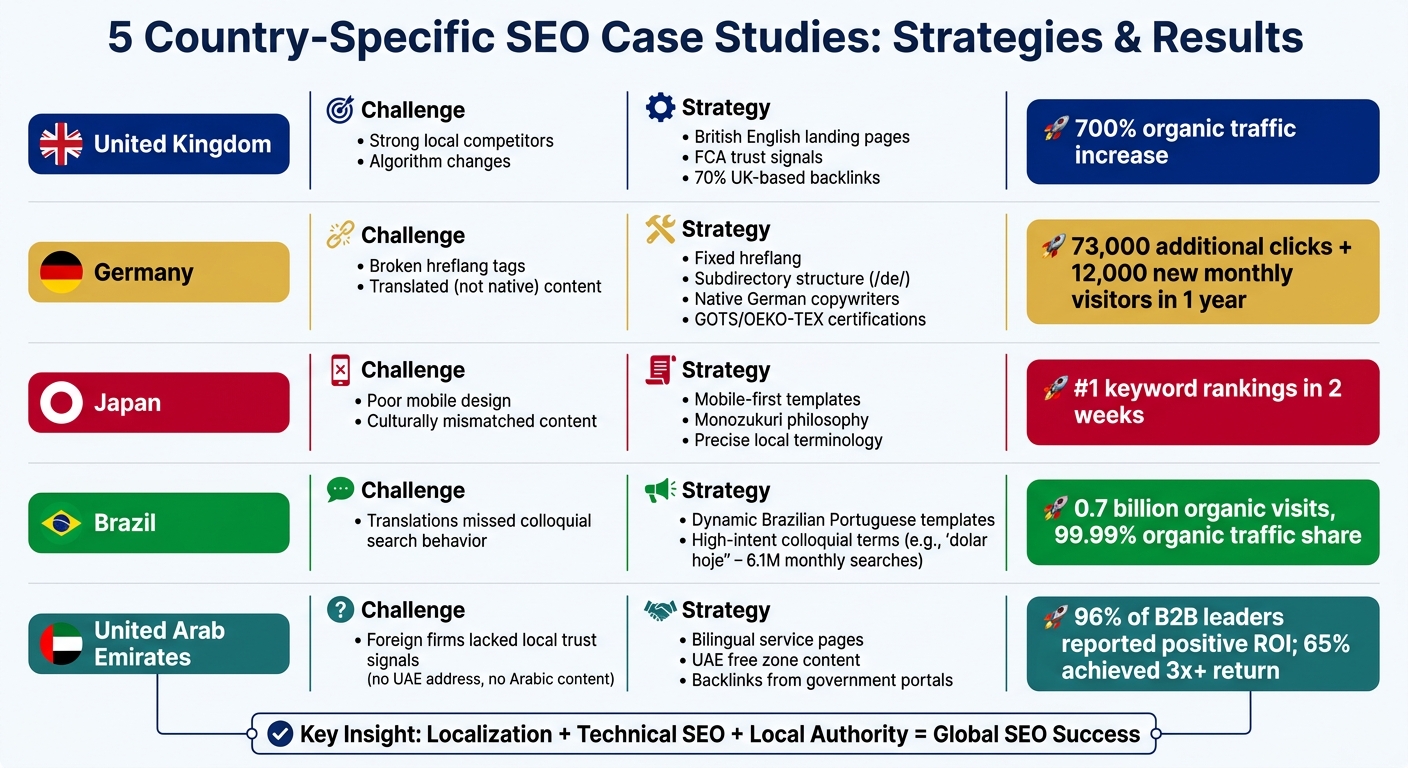
- United Kingdom: Using British English and local trust signals led to a 700% organic traffic increase.
- Germany: Fixing hreflang tags and writing native content brought 73,000 extra clicks in a year.
- Japan: Mobile-first design and culturally relevant content helped a shampoo brand rank #1 in two weeks.
- Brazil: Optimizing for colloquial Portuguese terms drove 0.7 billion organic visits.
- United Arab Emirates: Bilingual pages and local backlinks boosted ROI for professional services firms.
The lesson? Success comes from combining technical fixes, local language expertise, and regionally specific trust-building efforts. Whether it’s keyword research or backlinks, every market demands its own SEO approach. For tools and expert help, check out the Top SEO Marketing Directory.
5 Country-Specific SEO Case Studies: Strategies & Results
International SEO Full Course: Rank Globally with Multilingual & Multiregional Strategies
sbb-itb-5be333f
How These Case Studies Were Selected
To ensure quality and relevance, only SEO success stories meeting three strict criteria were included: a focus on one primary country, documented and measurable outcomes, and a clearly outlined strategy that others can replicate.
Each case study zeroes in on a single market, which is crucial for understanding the specific tactics that worked. Why? Because isolating one market removes the noise and highlights what truly made an impact. When multiple markets are combined, the insights can become muddled. Lawrence Hitches, an AI SEO Consultant, explains it best:
"International eCommerce SEO is not localization-as-translation. Every market has its own search language, its own category structure, its own competitive landscape, and its own link authority requirements."
For measurable results, the focus was on hard data - organic traffic growth, keyword rankings, or conversion increases. These metrics were verified through Google Search Console (GSC) and supplemented with SEO marketing tools like Google Business Profile (GBP) for call tracking and Core Web Vitals assessments. Year-over-year (YoY) comparisons for identical periods were used to eliminate seasonal variations, ensuring the results were consistent and reliable.
Lastly, every case needed a clear and actionable strategy. Whether it involved fixing hreflang issues, creating content in the native language, or restructuring site architecture for a specific region, the strategy had to be well-defined. Vague or overly general approaches didn’t make the cut. These criteria ensure the case studies offer practical, localized SEO insights.
For consistency, all monetary values are presented in USD, dates follow the mm/dd/yyyy format, and US spelling conventions are used throughout (e.g., "localization" instead of "localisation"). This meticulous selection process ensures the upcoming case studies are both insightful and applicable.
5 Country-Specific SEO Case Studies
These case studies showcase how adapting SEO strategies to specific markets delivers better results than using a one-size-fits-all global approach. Each example highlights unique challenges and solutions tailored to the local audience.
United Kingdom: Local Keywords and Content Targeting
The UK poses a tough SEO landscape due to strong local competitors and frequent Google algorithm changes. Success here required a laser focus on both language and trust signals.
One strategy involved creating UK-specific landing pages using British English (e.g., "colour" instead of "color" or "trousers" instead of "pants"). These pages also incorporated local trust elements, such as references to the Financial Conduct Authority (FCA), which helped boost credibility with users and Google's algorithms. Additionally, the backlink strategy prioritized UK-based domains, with 70% of new links coming from local sources. This approach led to a massive 700% growth in organic traffic for businesses that embraced it.
"Translation changes the words. Localisation changes the currency, the date format, the trust signals, the legal compliance layer, the search engine targeting, and the buyer psychology." - Shaiful Mozumder, AI SEO Journal
This case proves how important it is to adapt both language and trust signals for local audiences.
Germany: Technical SEO and Native Copywriting
Germany's SEO challenges were more technical. Many international websites targeting German users had poorly implemented hreflang tags, causing the wrong pages to rank in search results. This led to high bounce rates and wasted crawl budgets. Another issue was that content was often translated rather than written natively, which fell short of German B2B buyers’ high standards for thorough research.
The solution had two parts. First, hreflang tags were fixed, and subdirectories (e.g., example.com/de/) replaced separate country-specific domains. This consolidated domain authority while allowing precise geotargeting through Google Search Console. Second, native German copywriters rewrote key pages, incorporating references to certifications like GOTS and OEKO-TEX, which are crucial for German buyers. A machinery manufacturer that adopted this strategy saw 73,000 additional clicks and 12,000 new monthly visitors from markets like the US, India, and the UK within a year. These results underline the importance of combining technical accuracy with locally relevant content.
Japan: Mobile Design and Local Content Norms
In Japan, SEO success required tackling two main issues: mobile usability and culturally mismatched content. With one of the highest rates of mobile-first browsing globally, slow-loading pages and poor mobile design were major barriers. Additionally, generic product descriptions and stock images failed to connect with Japanese users.
The solution started with mobile-first page templates optimized for speed. Visuals were redesigned to align with Japanese aesthetics, and content was rewritten to reflect the monozukuri philosophy, which emphasizes craftsmanship and production excellence. For example, using precise terms like "Hōsei kōjō" (sewing factory) instead of generic phrases like "apparel manufacturer" significantly improved search relevance. This approach delivered quick results: a Japanese shampoo brand expanding into Taiwan achieved #1 rankings for target keywords in just two weeks. It’s a clear example of how tailoring design and content to local expectations can yield rapid gains.
Brazil: Portuguese Localization and Local Search Behavior
In Brazil, search behavior is heavily influenced by colloquial language. Direct translations from English or European Portuguese often missed the mark, as they didn’t match how Brazilians phrase their queries.
Wise (formerly TransferWise) tackled this by creating dynamic page templates in Brazilian Portuguese, targeting every currency pair with high-intent colloquial search terms like "dolar hoje" (which has 6.1 million monthly searches). The results were staggering: the site achieved 0.7 billion organic visits, with 99.99% of traffic coming from organic search. This case demonstrates how localized content can outperform translated content by 40–60% in click-through rates, especially at scale.
United Arab Emirates: Building Authority in Professional Services
The UAE’s professional services sector - covering legal, financial, and consulting industries - is highly competitive and trust-driven. Foreign firms often struggled because their websites lacked key local elements, such as an office address in the UAE, Arabic-language content, or links to regional professional bodies.
To address this, companies created bilingual service pages, localized content around regulatory topics like UAE free zone structures, and built partnerships with local authorities. Backlinks from UAE government portals, industry associations, and regional news outlets boosted both rankings and lead generation for high-value queries. The data backs this approach: 96% of B2B leaders reported a positive ROI from localization, with 65% achieving at least a 3× return.
Key Lessons from These Case Studies
The main takeaway from these case studies is that effective localization goes beyond translation - it requires adapting keyword research to reflect the nuances of the local language and culture. Whether it's using colloquial expressions in Brazil, incorporating precise manufacturing terms in Japan, or aligning with trust signals that resonate in the UK, success hinges on understanding the market's unique characteristics. Each market demands tailored keyword research rather than a one-size-fits-all translation.
Technical optimization is just as important as localized content. Utilizing a website audit and SEO analysis tool can help identify these critical issues early. Germany's example highlights how issues like broken hreflang tags and poorly structured URLs can derail a campaign before it even begins. Addressing these technical elements - such as implementing proper hreflang tags, setting up server-side redirects, and organizing URL structures - should always be the first step, not an afterthought.
Building local authority takes time, but it pays off. The UAE case demonstrated that backlinks from regional government portals and industry-specific associations carry significantly more value than generic global links. Across all five markets, the most effective campaigns focused on sourcing 70–80% of backlinks locally. Here's an overview of the typical timeframes and priorities for a successful localization strategy:
| Phase | Typical Timeframe | Key Focus |
|---|---|---|
| Technical Cleanup | Months 1–3 | Hreflang, redirects, URL structure |
| Content & Transcreation | Months 2–6 | Localized keyword mapping, native copy |
| Authority Building | Months 3–9 | Local backlinks, citations, regional PR |
| Significant ROI | 6–12 Months | Revenue growth, lead generation |
One common misstep businesses make is treating a new market as a simple extension of their existing strategy. For example, Bondi Sands initially used the same approach in both the UK and US but overlooked key differences in search behavior. UK users searched for "gradual tan", while US users preferred "sunless tanner". Another frequent mistake is creating "thin" content for regional pages while maintaining robust content on the main site, which can slow down ranking improvements. Additionally, relying on IP-based redirects can block search engine bots from accessing regional pages. A language selector is a safer and more effective alternative.
These strategies not only deliver results tailored to specific markets but also lay the groundwork for using the Top SEO Marketing Directory to enhance localized SEO efforts even further. Each lesson underscores the importance of combining technical precision, cultural understanding, and market-specific tactics for long-term success.
Using Top SEO Marketing Directory for Country-Specific SEO
When businesses aim to expand globally, they often face the challenge of finding expert partners who understand the nuances of country-specific SEO. Generalist agencies, especially those focused on the U.S., may lack the expertise needed for search engines like Baidu in China or Naver in South Korea. This is where the Top SEO Marketing Directory comes in. By curating agencies and tools with a track record of regional success, the directory helps businesses quickly find the right resources to tackle local SEO challenges.
The directory highlights agencies that specialize in specific geographic regions. For instance, Sotavento Medios caters to Southeast Asia and Oceania, Hashmeta focuses on markets like Singapore, Malaysia, and China, while Amine.ma serves Morocco and France. These agencies go beyond simple content translation - they understand local search behaviors, trust signals, and technical needs like configuring hreflang tags. Case studies show that working with such localized expertise can make or break a campaign.
In addition to agencies, the directory includes keyword research tools with global reach. For example, SEMrush, which starts at about $120 per month, offers keyword analysis for over 90 countries and rank tracking in more than 70 markets. This tool is invaluable for identifying regional differences in search terms - like "trainers" in the U.K. versus "sneakers" in the U.S., or "Handy" in Germany versus "cell phone" in the U.S. It also helps businesses connect with technical SEO specialists who can handle complex configurations like CDNs, hreflang audits, and multi-language URL structures. As highlighted in Germany's case, mishandling these elements can derail even the best campaigns. For businesses scaling to 40+ countries, working with experts to implement subfolder structures (e.g., example.com/de/) can help consolidate domain authority and improve results.
For those looking to maximize their investment, the directory offers a Premium plan at $49 per month. This plan provides access to advanced agency listings and comparisons of the best SEO tools, offering a cost-effective way to find the right partners without the trial-and-error approach. By leveraging these resources, businesses can better position themselves for SEO success tailored to their target markets.
Conclusion
The five case studies in this article highlight one key takeaway: what thrives in one country can fail in another. Each market demands its own tailored approach - whether it’s establishing local authority in the United Arab Emirates or tackling technical SEO challenges in Germany. This reinforces the idea that every market has its own "search language", structure, and authority benchmarks.
The data backs this up. Businesses that invest in localized strategies - like native copywriting, accurate hreflang setup, and trust signals customized for each region - have achieved impressive results. For instance, companies have reported a 189% increase in organic traffic across Germany, France, and Spain, and a 350% rise in international organic sessions within just 12 months.
For global growth, begin with a thorough technical audit, create keyword maps tailored to each language, and focus on building region-specific links. Tools like the Top SEO Marketing Directory can connect you with agencies and experts who specialize in specific regions - whether you’re looking for an SEO specialist in Southeast Asia or a native German copywriter. Their Premium plan, priced at $49/month, offers access to advanced listings to support your efforts. Achieving success in global SEO means crafting strategies that resonate with each individual market.
FAQs
How do I choose the best URL structure for each country?
When deciding on the best URL structure, it's important to think about your long-term objectives and the technical framework of your site. Subdirectories (like example.com/en-us/ or example.com/en-gb/) are often the preferred choice because they centralize domain authority and are relatively simple to manage.
If you're planning a major, long-term presence in specific countries, ccTLDs (such as example.de or example.fr) can be a smart choice. They signal clear geographic targeting and can help build trust with local audiences.
On the other hand, subdomains (like fr.example.com) can be a practical option when you need to accommodate separate hosting requirements or provide regional teams with greater independence.
What’s the best way to use hreflang without hurting rankings?
To make hreflang work properly, ensure every page in a group has reciprocal hreflang tags, including self-referencing ones. Stick to valid language-region codes like en-US or en-GB, and use them consistently. Don't forget to add an x-default tag as a fallback option. Avoid combining methods, such as using both HTML and XML sitemaps for hreflang. Regularly check your setup using tools like Google Search Console to spot errors or missing reciprocal links.
How many local backlinks are needed to compete in a new country?
There isn’t a magic number of local backlinks that guarantees success when entering a new country's market. Search engines place more emphasis on trust within the local ecosystem rather than the sheer number of links you have.
Your strategy should focus on securing links from sources like local news outlets, regional directories, and country-specific blogs. These types of links help establish your credibility and relevance in the local context.
To gauge the level of authority required, take a close look at the top 5–10 competitors in your target search results. By analyzing their backlink profiles, you can get a clearer picture of what it takes to rank effectively in that market.