If you want better rankings, written reviews usually do more than star ratings. Reviews add crawlable text, help product pages show up for more long-tail searches, and keep pages updated over time. Star ratings matter too, but mostly for how your result looks in Google and whether people click it.
Here’s the short version:
- Written reviews help with rankings because they add indexable text.
- Star ratings help with CTR because they can trigger rich snippets.
- Schema markup needs to be set up right, with both
AggregateRatingandReviewunderProduct. - Review text should be in the HTML so search engines can read it.
- Rich snippets can lift clicks by 20% to 30%, and some reports put that lift even higher.
- The best setup is usually both together: reviews for relevance, ratings for SERP visibility.
If I had to boil it down to one line, it would be this: reviews help Google understand the page; ratings help searchers notice it.
Quick Comparison
| Factor | Written Reviews | Star Ratings |
|---|---|---|
| Main SEO role | Help rankings | Help clicks |
| Adds crawlable text | Yes | No |
| Helps long-tail queries | Yes | No |
| Affects SERP appearance | Sometimes | Yes |
| Needs schema for impact | Not always | Yes |
| Best use case | Thin product pages | Crowded search results |
So if your product page lacks text, I’d fix reviews first. If it ranks but gets ignored, I’d focus on ratings and markup.
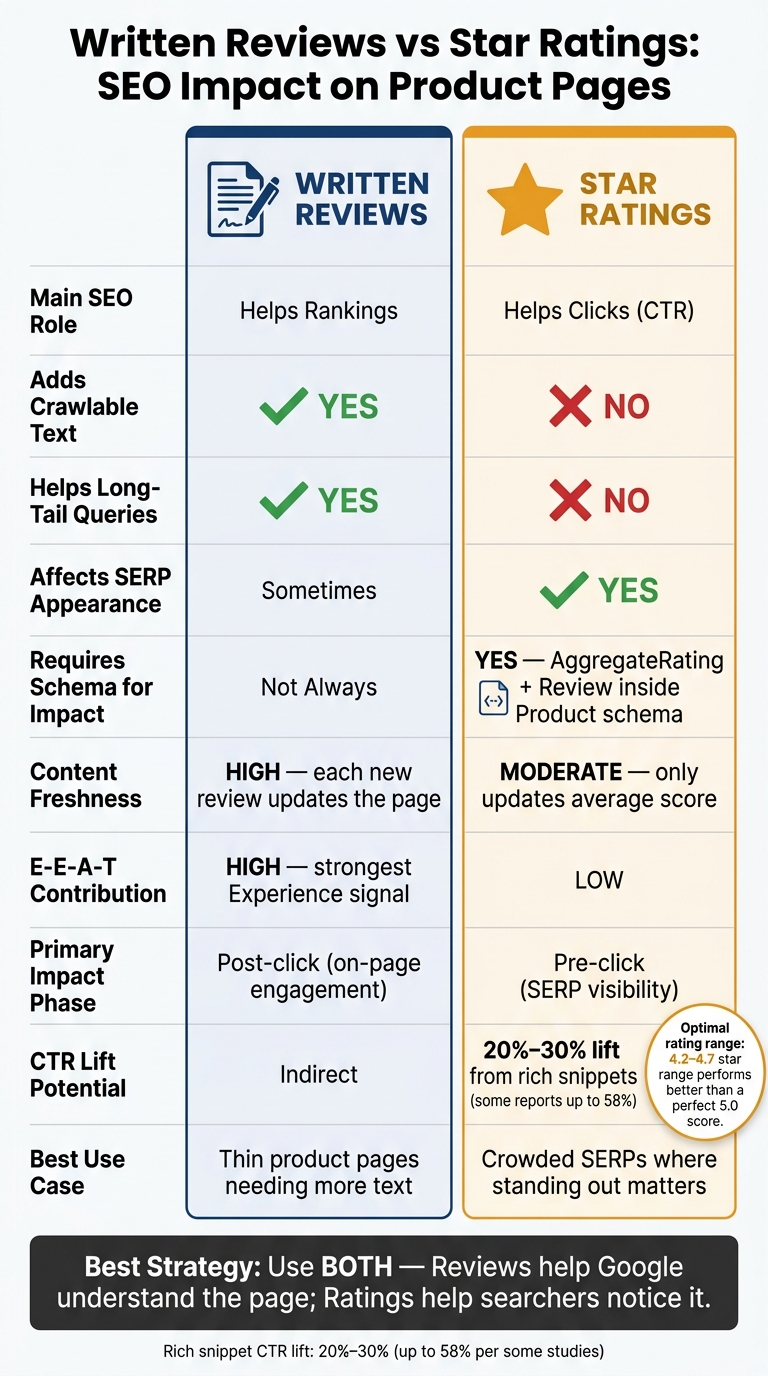
Written Reviews vs Star Ratings: SEO Impact at a Glance
⭐ How Customer Reviews SKYROCKET Your SEO Rankings! 🚀
sbb-itb-5be333f
Written Reviews as Indexable Content on Product Pages
Written reviews give product pages crawlable text that goes far beyond the product name. That opens up more chances to rank for the kinds of searches people type every day. And there’s an important split here: review text helps determine what a page can rank for, while ratings mostly shape how that page looks in search.
How Review Text Expands Keyword and Long-Tail Search Coverage
Customers don’t write like brand teams do. They use plain, natural language. One person might mention a “wide toe box.” Another might say a jacket feels “tight around the shoulders.” Someone training for a race could write that a shoe is “good for marathon training on concrete.” Those kinds of phrases can help product pages appear for conversational, long-tail, and problem-based searches that the main product copy often never covers.
In simple terms, reviews broaden keyword coverage without forcing anyone to go back and rewrite the product description by hand, often outperforming manual efforts with top SEO marketing tools.
There’s also a technical point that can’t be skipped: reviews should appear directly in the HTML. Server-side rendering is the safest route. If reviews sit inside JavaScript widgets or iFrames, or only load after a click or scroll, search engines may not index that text.
How New Review Submissions Add Page Content Over Time
A product description written years ago can sit there untouched. Reviews, on the other hand, keep adding new text to the page over time.
That means each new review can add original wording, new product details, and different use cases without manual edits. It’s a steady stream of page updates driven by customers themselves.
The pace of those reviews matters too. A steady flow over time often does more than one short spike of activity.
Here’s the side-by-side view:
| Feature | Written Reviews | Star Ratings (Only) |
|---|---|---|
| Indexable Text | High - adds unique, crawlable content to the page | Low - primarily numerical data in schema |
| Keyword Relevance | High - introduces natural language and synonyms | None - no contribution to keyword density |
| Long-Tail Coverage | High - captures specific use cases and attributes | None - no text to match complex queries |
| Content Freshness | High - each new review updates the page | Moderate - only updates the average score |
Written reviews do most of the ranking heavy lifting. Ratings mainly influence search appearance. Next, star ratings and schema markup shape search appearance rather than page text.
Star Ratings and Schema Markup in Search Results
Written reviews add text. Star ratings change how the result looks.
How aggregateRating Markup Supports Rich Snippets
When you set up structured data the right way, Google can show star ratings in search results. That usually means the average score and total review count appear right below the page title. And that extra visual detail can help. Rich snippets like these can improve click-through rates by 20%–30%.
So star ratings work more like a presentation signal than a content signal.
For product pages, the setup Google wants is pretty clear: place both AggregateRating and individual Review entities inside the main Product schema. After a 2023 policy update, AggregateRating by itself is no longer enough if you want Google to show stars in search results. You also need valid Review markup alongside AggregateRating.
One more thing matters here: the schema has to match what people see on the page. If the rating in the markup doesn't line up with the displayed rating, the page can lose rich result eligibility.
Why Schema Improves Visibility Without Replacing Content Quality
Schema markup is not a direct ranking factor. Its effect is indirect. It can make a page that already ranks look more prominent in search results, which can help it earn more clicks.
Use JSON-LD for implementation.
| Feature | Written Reviews | Star Ratings (Only) |
|---|---|---|
| Indexable Text | High - adds unique, crawlable content to the page | Low - mainly numerical data in schema |
| Keyword Relevance | High - introduces natural language and synonyms | None - no contribution to keyword density |
| Long-Tail Coverage | High - captures specific use cases and attributes | None - no text to match complex queries |
| Content Freshness | High - each new review updates the page | Moderate - only updates the average score |
Once ratings improve visibility, the next step is figuring out whether that extra visibility turns into clicks.
How Reviews and Ratings Shape User Behavior Signals
If ratings win the click, reviews help keep it. Both matter, but they do different jobs at different points in the visit.
Why Star Ratings Can Improve Click-Through Rate From Search
Star ratings do their work before someone lands on your page. When a product result shows a score and review count in the SERP, it pops more than a plain blue-link result. That small visual cue can reduce hesitation. And when two results sit in the same spot, a rated listing will often get the click over one with no rating at all.
Put simply, star ratings can lift clicks because they make product listings stand out in the SERP.
Why Detailed Reviews Often Improve Engagement After the Click
After the click, written reviews do the heavy lifting.
Once a shopper lands on the page, detailed reviews help answer the questions product copy often skips, like fit, quality, and durability. That keeps people on the page longer. It can also cut bounce rate because shoppers get answers right there instead of heading back to search results.
Reviews also help with Google's E-E-A-T evaluation. They act as one of the strongest "Experience" and "Trustworthiness" signals a product page can carry.
In practice, these two signals influence different stages of the visit.
| Signal | Star Ratings | Written Reviews |
|---|---|---|
| Primary impact phase | Pre-click (SERP) | Post-click (on-page) |
| SEO metric affected | Click-through rate | Dwell time, bounce rate |
| User function | Quick reassurance | Validation and research |
| E-E-A-T contribution | Low | High - strongest "Experience" signal |
Using Reviews and Ratings Together for Better Product Page Rankings
Reviews and ratings help in different ways. So the best move depends on what your product page is missing.
If the page needs more crawlable text, put the focus on written reviews. If the page already says enough but struggles to win clicks, star ratings can do more for you in the search results. Think of it this way: reviews help Google understand the page, while ratings help searchers notice it.
When Reviews Should Be the Priority
If your product page is thin - built mostly around a manufacturer description, a few bullet points, and not much else - reviews add the missing text. That matters most when you're trying to show up for specific use-case searches.
Why? Because customers often use words that product teams don't. A few detailed reviews that mention fit, material, comfort, durability, or performance can help your page match long-tail queries that a standard product description may never touch.
There’s also a simple way to get better review copy: ask better questions. Instead of a vague prompt like "Tell us what you think", ask something specific, such as "How does the fit compare to your usual size?" That tends to lead to more useful, searchable text.
If the page already has enough crawlable copy, ratings are often the faster way to improve visibility.
When Ratings Deliver the Biggest Lift
In crowded product categories, star ratings can be the fastest way to improve CTR. When people scan a search results page, those stars stand out fast. They act like a visual shortcut: this product has been tried by other buyers, and people had something to say about it.
Research shows that rich snippets can improve click-through rates by 15% to 35%, and some data puts the lift as high as 58%.
A perfect 5.0 score may sound ideal, but it can also look a little too polished. In many cases, a rating in the 4.2–4.7 range, along with a few visible negative reviews, feels more believable and performs better than a flawless score.
Key Takeaways for Product Page SEO
- Written reviews help rankings through indexable content and freshness. Put them first on thin pages, pages with long-tail gaps, and pages that need stronger E-E-A-T signals.
- Star ratings help visibility through rich snippets and CTR. Put them first in crowded SERPs when your average score is strong.
- Using both together tends to produce the best long-term result for product page SEO.
FAQs
Do reviews help rankings more than ratings?
Yes. Written reviews usually offer more SEO value than star ratings on their own.
Ratings and schema markup can help with rich snippets and may improve click-through rates. But review text gives search engines something they can actually index: keyword-rich language about product fit, use cases, and user experience.
That extra detail matters. Written reviews can help pages show up for long-tail searches and signal freshness when new feedback keeps coming in. Star-only ratings, by contrast, don't give much descriptive context, so they're less useful for building topical relevance.
Can Google read reviews in JavaScript widgets?
Not reliably.
If reviews show up only inside JavaScript widgets, Google may not render or index them.
If you want reviews to help with SEO and rich snippets, the review text should be available as indexable HTML. Best case, it appears in the page’s initial HTML.
You can check this in:
- View Source
- the URL Inspection tool in Google Search Console
What schema should a product page use?
Use Product schema as the main object. Then place AggregateRating inside it so search engines can read the average rating and total review count.
If the page includes individual reviews, add those as Review objects inside the Product schema too. The key here is simple: your structured data should line up with the page. That means price, availability, and review text should match what people can see on the page.