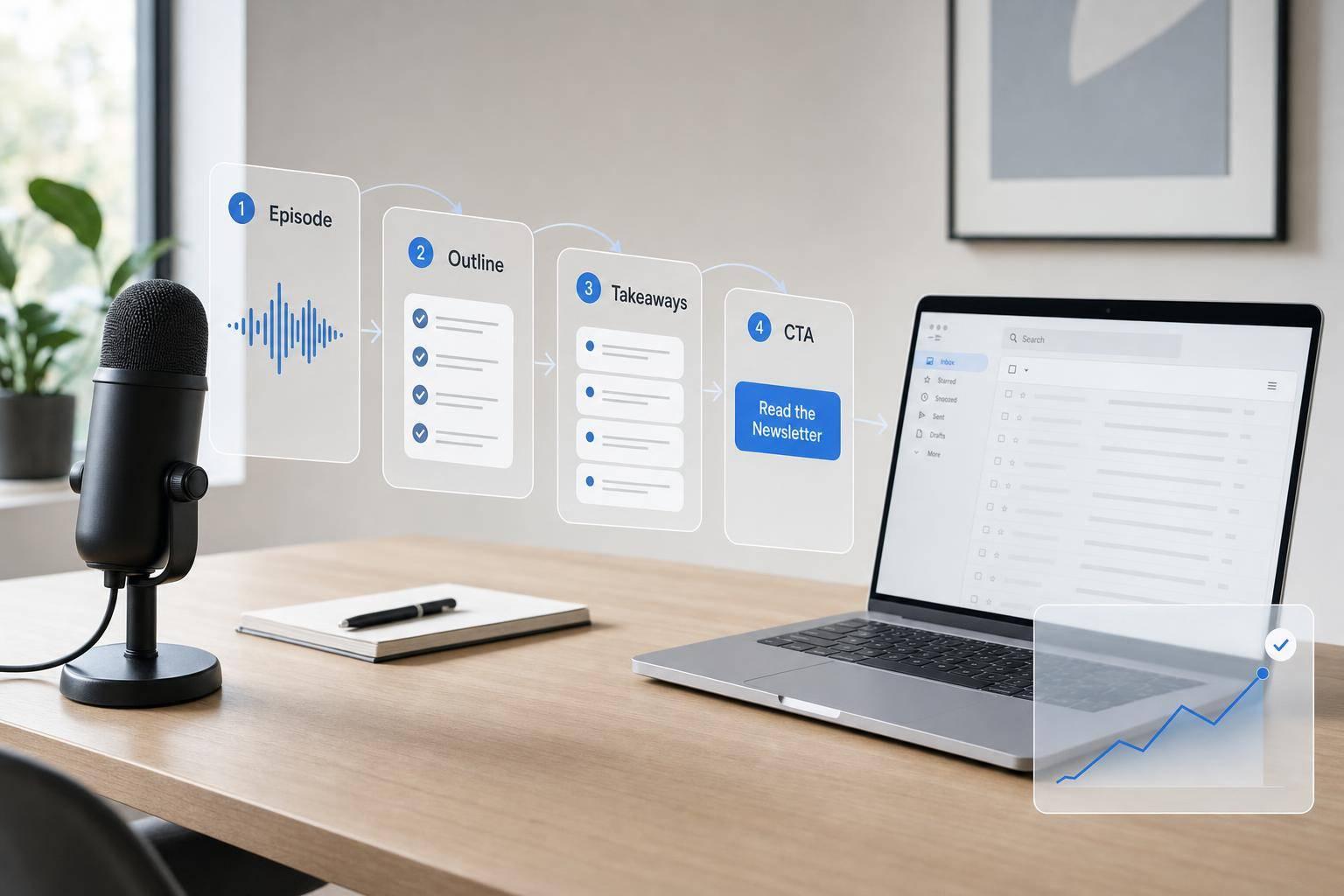
Most pages get no Google traffic. If I want an SEO content program to ship pages that drive traffic, leads, and revenue, I need a simple planning system - not more ideas.
Here’s the short version:
- I set 3 planning layers: quarterly, monthly, and weekly
- I use the same inputs each time: keyword scores, near-page-one queries, capacity, tech checks, and launch needs
- I assign one owner and one deadline to every page
- I split work between new pages and older page updates
- I track both leading signals like publishing pace and indexing, and lagging results like traffic and conversions
A few numbers make the case. About 91% of pages get zero organic traffic from Google. Pages with at least one internal link see about a 93% indexing rate, versus 47% for orphan pages. And teams that document SEO plans in a template are 3.2x more likely to hit organic traffic goals.
If I had to boil the article down to one point, it would be this: <u>SEO content planning works when the team follows one calendar, one scoring system, and one workflow from idea to publish.</u>
What I’d take from the article:
- Quarterly planning sets topic direction and cluster structure
- Monthly planning re-checks priorities based on rankings, impressions, CTR, and business needs
- Weekly planning keeps briefs, reviews, and publishing from stalling
- Meetings should focus on decisions, not status recaps
- Reporting should show what needs action now - not just what happened last month
This is less about brainstorming and more about running a publishing system that turns SEO research into shipped pages.
Set the Right Cadence, Agenda, and Meeting Inputs
Choose a Cadence Based on Team Size and Publishing Volume
Set your meeting rhythm based on two things: how much you're publishing and how many approvals a piece needs. Too many meetings drag the team down. Too few, and blockers sit there until they turn into missed deadlines.
| Cadence | Team Context | Pros | Cons | Ideal Use Case |
|---|---|---|---|---|
| Weekly | Lean / high-volume teams | Catches blockers early; keeps velocity high | Can become status updates without discipline | Production check-ins and unblocking stalls |
| Bi-weekly | Mid-market / growth teams | Balanced rhythm for technical and GSC review | Technical issues can wait longer than ideal | Impression trend reviews and crawl health checks |
| Monthly | Mid-market / enterprise teams | Best for KPI review and reprioritization | Too slow for day-to-day operational decisions | Keyword scorecard updates and resource shifts |
The simple rule: pick the shortest cadence that still keeps briefs, approvals, and publishing on track.
And don't wait for the next scheduled meeting when something big changes. Treat these as triggers for an off-cycle review: a Google core update, a new competitor entering a primary keyword cluster, or a traffic drop of 30% or more within seven days.
After cadence, structure matters just as much. A meeting only works when everyone knows what it's for.
Use a Fixed Agenda: Performance, Pipeline, Calendar, Blockers
Use the same 60-90 minute agenda every time: performance, pipeline, calendar, blockers.
| Agenda Block | Time | Focus |
|---|---|---|
| Performance Review | 15-20 min | Organic clicks, conversions, GSC impressions, and CTR by cluster |
| Pipeline & Scoring | 15-20 min | Keyword cluster gaps, topic scoring, and competitor moves |
| Calendar Decisions | 20-30 min | Assign topics to owners with firm deadlines based on actual capacity |
| Blockers & Workflow | 10-20 min | Technical issues, legal delays, dev dependencies, and SME availability |
"If a metric does not change decisions, cut it. Every executive-facing chart should trigger an action or a strategic adjustment." - Digital Applied
That quote gets to the point. If a chart won't change what the team does next, it doesn't belong in the room.
In the performance block, lean more on leading indicators like impressions and CTR. Rankings and traffic still matter, but they're slower signals. If impressions are climbing and CTR is weak, you've got something to work on now - not a month from now.
Bring the Same Inputs to Every Meeting
Bring the same inputs to every meeting, and keep them limited to what can change priority, ownership, or timing. The pre-read should include:
- An updated keyword scoring matrix weighted by intent, difficulty, value, and effort using top SEO tools
- Queries near page one with high impressions and low CTR from GSC
- Content velocity, based on available writer hours divided by average hours per piece
- Core Web Vitals and indexation checks
- A list of upcoming product launches or campaigns that need content support
This keeps the meeting grounded in decisions, not opinions. When everyone walks in with the same inputs, topic picks move faster, owners get assigned with less back-and-forth, and the publishing calendar gets a lot less messy.
sbb-itb-5be333f
Define Roles and Make Topic Decisions with Clear Rules
Assign Clear Responsibilities Across SEO, Content, Analytics, Product, and Web
Once the data is on the table, the meeting needs to turn that input into clear owners and clear topic calls.
Good meetings end with decisions. Bad ones end with more debate. The fix is simple: give each function one lane. One person owns strategy, one owns content execution, one owns data, one owns product input, and one owns technical limits.
- SEO lead: sets strategy, ranks clusters, and removes blockers.
- Content lead: turns data into briefs, cluster maps, and calendar slots.
- Analytics/SEO analyst: tracks GSC trends and flags high-impression, low-CTR pages.
- Product/SMEs: check accuracy, positioning, and roadmap fit.
- Web/technical SEO: owns crawlability, indexation, architecture, and publishing limits.
| Role | Meeting Responsibility |
|---|---|
| SEO Lead | Final prioritization of topic clusters and keyword targets |
| Content Lead | Selection of content formats and assignment of owners |
| Analytics/Ops | Identification of high-impression, low-CTR opportunities |
| Product/SME | Evaluation of business relevance and positioning |
| Web/CMS | triage of technical SEO tickets and site architecture decisions |
Every topic that leaves the meeting should have one named owner and one firm deadline. As Russel Gabiola puts it, "Vague assignments like 'team to handle' guarantee nothing gets done."
Once ownership is set, the next move is deciding which topics earn the next calendar slots.
Turn Keyword Research into Topic Clusters and Calendar Slots
Planning meetings need clusters, not raw keyword lists. A giant keyword dump doesn't help much on its own. What helps is using search and performance signals to decide whether a cluster needs a new pillar page, supporting content, or a refresh.
The split between new content and refreshes matters more than many teams think. Putting 20% to 30% of your content budget into refreshing older pages that are slipping in rank is often more cost-efficient than building from scratch. For new content, map each topic to intent stage - informational, commercial, or transactional - so the calendar matches the business's current content mix.
Use the score to sort clusters into refreshes, new pages, or holds.
Score Topics by Intent, Difficulty, Value, and Effort
Scoring cuts down opinion-driven prioritization. Use one scoring model to rank topics by business value, intent, difficulty, traffic potential, and effort. Put the most weight on business value - about 30% - because if a topic doesn't tie back to revenue or pipeline, it shouldn't move to the front of the line just because search volume looks good.
Use that score to approve, defer, or reject topics. Then place approved items into the calendar.
Once topics are approved, the next step is moving them through brief, draft, review, and publish.
Watch Me Build a 6-Month SEO Content Calendar (Step by Step)
Run Clean Handoffs, Reporting, and Cross-Team Communication
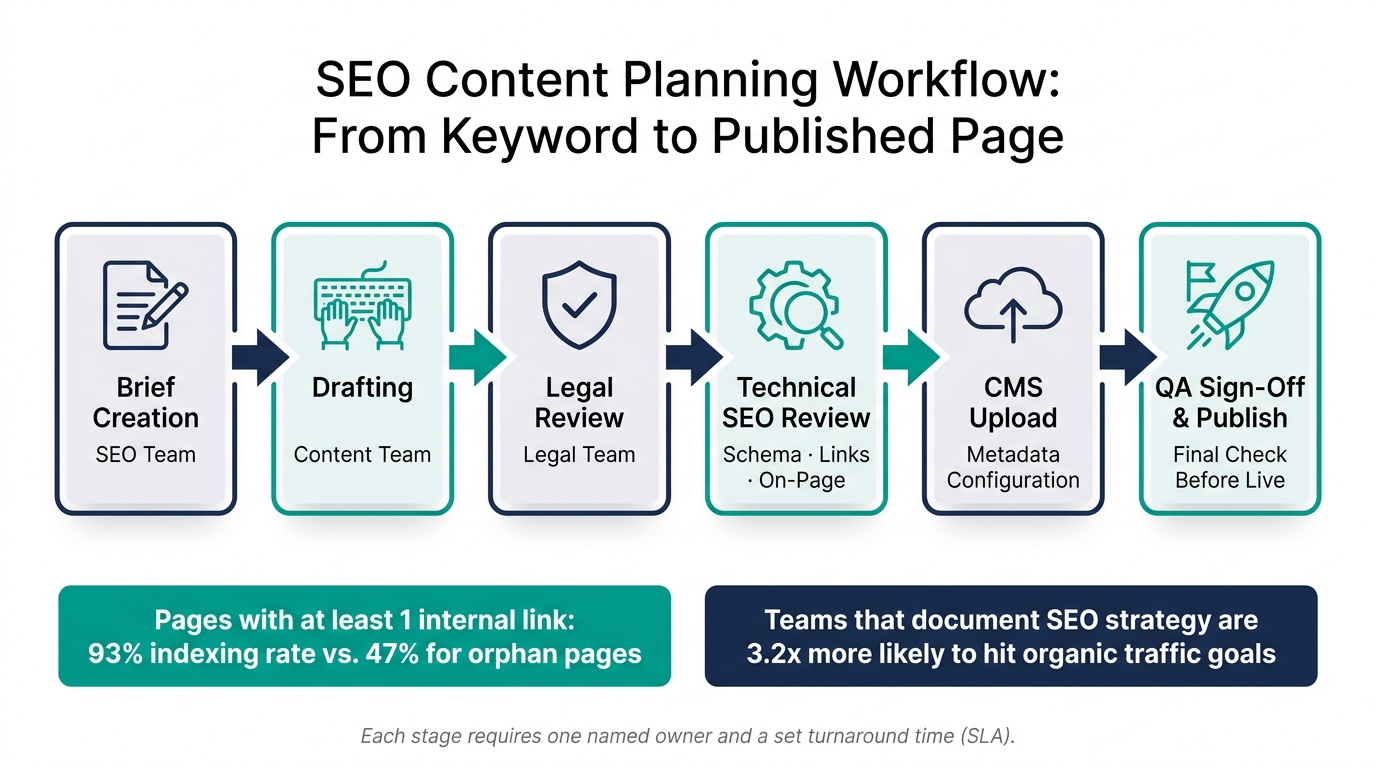
SEO Content Planning Workflow: From Keyword to Published Page
Build a Workflow from Approved Topic to Published Page
After a topic gets approved, the work changes fast. Now it's not about picking priorities - it's about getting the page live. Without a clear handoff path, approved topics sit in inboxes, drift between teams, or show up missing key details.
Move each approved topic through six stages, in order: brief creation (SEO team), drafting (content team), legal review, technical SEO review (schema, links, and on-page checks), CMS upload with metadata configuration, and QA sign-off before publish. Give each stage a named owner and a set turnaround time. SLAs for drafting, editing, and review help keep output steady and make blockers easier to spot.
Add internal links in the brief, then check indexing, schema, and Core Web Vitals after publish. Pages with at least one internal link have a 93% indexing rate, compared with 47% for orphan pages.
Use one shared board with one row per page and one column per stage. If something gets stuck, everyone can see it right away.
Report on Rankings, Traffic, Conversions, and Content Velocity
Once pages are moving, track whether the workflow is driving results and where it may be slowing down. Split leading indicators from lagging indicators in your reporting.
Leading indicators include content velocity, internal link density, index coverage, and Core Web Vitals pass rates. Lagging indicators include organic sessions by cluster, average position, assisted conversions, and organic-sourced pipeline. Both matter. They just belong in different reporting rhythms.
| Cadence | Focus | Key Metrics |
|---|---|---|
| Weekly | Operational signals | Publishing velocity, internal links added, crawl errors, index coverage |
| Monthly | Performance review | Organic sessions by cluster, conversions, SERP feature ownership |
| Quarterly | Strategy calibration | Pipeline influence, revenue attribution, OKR scorecard, refresh plan health |
Also track backlog health - are approvals piling up faster than publishing?
Put those updates on the same board so the team can share progress without adding another meeting.
Use Shared Systems for Async Updates and Vendor Selection
Use the board for the work that happens between meetings. Every decision should show up there as an owner, due date, and status.
Document each meeting decision in one place: which topics were approved, who owns them, and when they’re due. If a topic is deferred or rejected, log the reason. Teams that document their SEO strategy in a structured template are 3.2x more likely to report hitting organic traffic goals.
Conclusion: The Operating Model for Consistent SEO Content Planning
Once the workflow is in place, the gap between random publishing and steady growth comes down to operating discipline. SEO content planning works when it runs like an operating model: one cadence, one scoring logic, one owner per task, one workflow.
This model works because each part feeds the next. Quarterly, monthly, and weekly planning only work when they all point to the same backlog and calendar. Cadence, inputs, ownership, scoring, and handoffs need to support one goal: ship the right pages on time. When that happens, planning meetings stop feeling like repeat status calls and start working like a system.
It also helps to track leading indicators - like content velocity and technical issues - separately from lagging indicators, such as organic conversions. That keeps the team focused on execution health and business impact at the same time. Teams that document SEO strategy in a structured template are 3.2x more likely to hit organic traffic goals, which is why the plan needs to be written down and followed with consistency.
FAQs
How do I balance new pages vs. content refreshes?
Set aside 20% to 30% of your monthly content resources for refreshes. Put most of that effort into pages ranking in positions 5-30. These are your striking distance pages, and they often move up faster than brand-new content.
Use your content audit to decide what each page needs:
- Keep and optimize pages that already show promise
- Consolidate thin pages that overlap or don’t say much
- Remove or redirect content that’s no longer relevant
- Create new content only when you find clear keyword gaps
It also helps to zero in on pages with high impressions but low CTR. Those pages are already showing up in search. They just aren’t getting enough clicks, which usually means the title tag, meta description, or search intent match needs work.
What should I do if SEO content keeps missing deadlines?
If SEO content keeps missing deadlines, audit your workflow and look for the bottlenecks.
A slow approval process is often the main problem. Keep the approver list to two people max and set a firm 48-hour turnaround. Each item on your calendar should also have a clear owner and a hard deadline. If no one owns it, it tends to sit there.
When technical issues slow things down, line up SEO planning with engineering sprint cycles and run requests through a formal ticketing system. That way, work gets tracked instead of living in Slack threads or someone’s memory. Clear, repeatable content briefs help too. They cut down on guesswork and reduce extra revision rounds.
Which metrics matter most in SEO content planning?
Focus on metrics that tie search performance to business results: organic-attributed revenue, leads, and conversion rates.
It helps to track both leading and lagging indicators.
Leading indicators show whether your SEO work is moving in the right direction before business results show up. These include impressions, ranking movement, content production velocity, and technical health.
Lagging indicators show the business impact after that work has had time to play out. These include organic traffic, top-keyword rankings, conversions, and revenue or pipeline influenced by search.
Skip vanity metrics that look good in a report but don’t show actual business value.