Hybrid content models are reshaping how businesses create content by blending in-house teams with external freelancers, agencies, and AI tools. This approach maximizes efficiency, cuts costs, and improves content performance.
Key takeaways:
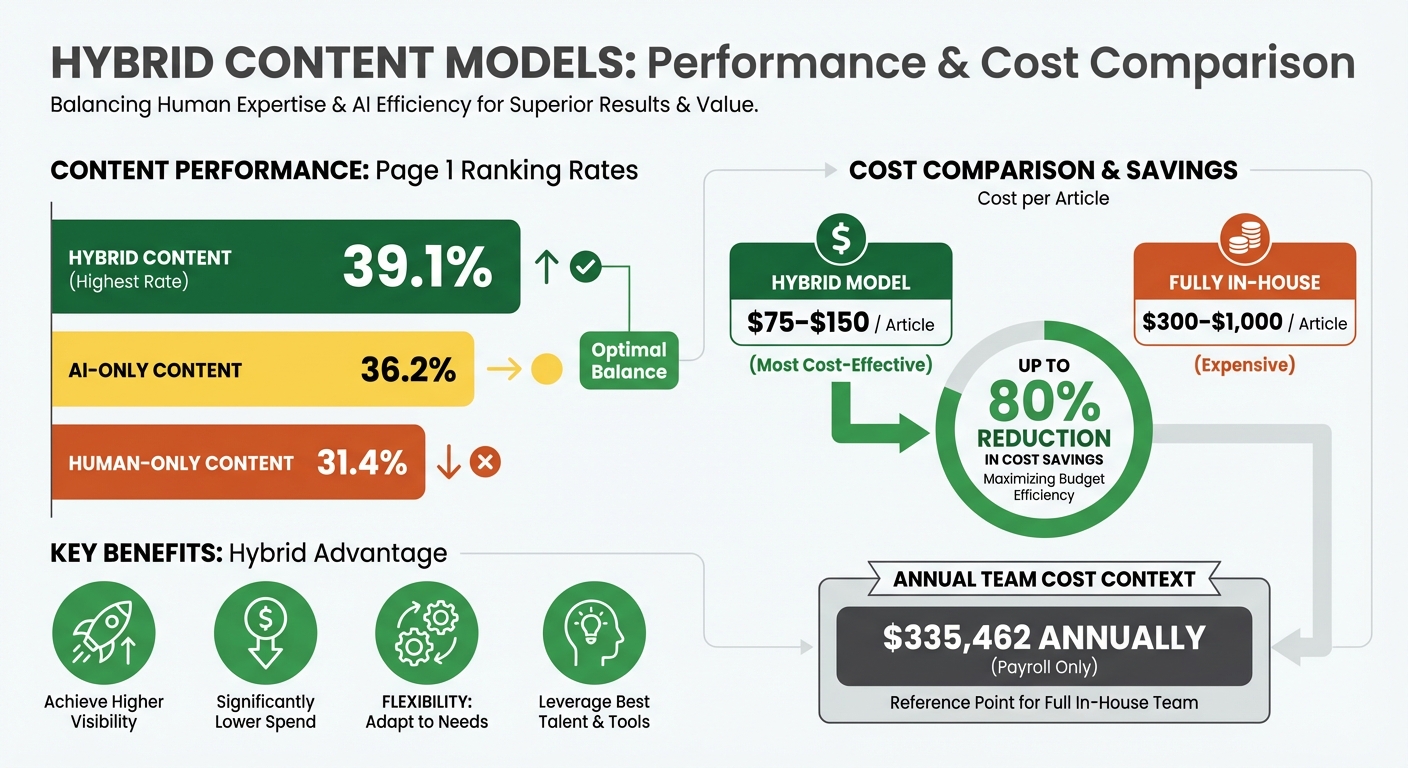
- Better results: Hybrid content achieves a 39.1% page 1 ranking rate, outperforming AI-only (36.2%) and human-only (31.4%) content.
- Cost savings: Businesses can reduce content costs by up to 80%, with hybrid articles costing $75–$150 each compared to $300–$1,000 for fully in-house pieces.
- Flexibility and expertise: In-house teams handle strategy and brand voice, while external partners provide niche skills and scalability.
Hybrid models are ideal for companies aiming to produce high-quality content efficiently without the expense of maintaining a full in-house team. This guide explores how to build and manage a hybrid content team for optimal results.
Hybrid Content Model Performance and Cost Comparison
What Are Hybrid Content Models
Definition and Core Principles
A hybrid content model combines the efforts of in-house teams, freelancers, and content marketing agencies to create content. Instead of relying entirely on internal resources or outsourcing everything, this approach takes advantage of the unique strengths that each group brings to the table.
The model is built on three key principles:
-
Ownership and strategy stay in-house. Your internal team ensures the content aligns with your brand voice, product knowledge, and overall business goals. Joei Chan, Director of Content at 360Learning, highlights this point:
"There are things that you cannot outsource, like making sure that every single piece of content, it's not just great, but also mapped with the strategy".
- Scalability and flexibility come from external partners. By working with freelancers and agencies, you can easily adjust the volume of content production based on your needs - without the cost of hiring permanent staff.
- Specialization allows you to tap into specific expertise. Agencies can handle cornerstone content or tackle complex editorial challenges, while freelancers bring niche skills and fresh perspectives.
This balanced approach ensures that your content strategy remains both adaptable and effective. Let’s dive into why businesses are turning to hybrid models to tackle content production challenges.
Why Businesses Use Hybrid Models
Hybrid models are a practical solution for companies looking to scale their content efforts without the financial burden of building a large, full-time team.
One major advantage is access to specialized skills. For example, demand for cybersecurity expertise grew by 75% in 2024. Instead of hiring full-time experts for every niche, businesses can work with freelancers or agencies that already have the knowledge they need.
The financial benefits are also clear. In 2025, a healthcare SaaS company adopted a hybrid model to produce 142 articles targeting telehealth and dermatology keywords. Their strategy included 85 AI-only articles, 42 hybrid pillar articles, and 15 human-led thought leadership pieces. The total cost? $18,400. Within six months, 64 articles ranked on page 1 (a 45% success rate), driving 28,000 monthly organic visits.
Rob Wade, Content Marketing Director at CallRail, sums up the collaborative advantage:
"We're the stewards and the curators of the content, but we're not dictators…good ideas come from everywhere".
This model empowers businesses to maintain control over their strategy while benefiting from a variety of perspectives and specialized expertise that would be harder to achieve with just an internal team.
sbb-itb-5be333f
Benefits of Hybrid Content Models
Cost Efficiency and Scalability
Hybrid content models offer a budget-friendly way to produce content while remaining flexible enough to scale. Consider this: maintaining a full in-house content team can cost around $335,462 annually in payroll alone. And that doesn’t even include benefits, software, or office space. On the other hand, hybrid models operate on a per-piece basis, costing $75–$150 per article, compared to the $300–$1,000 price tag for content created exclusively by in-house teams.
This pay-as-you-go approach allows businesses to adjust their spending based on demand. In fact, 50% of organizations reported they were able to optimize costs across resources, and 45% increased production capacity without needing additional capital investments. It’s a win-win: lower costs and the ability to scale when needed.
Access to Specialized Skills
Finding someone who’s equally talented at crafting creative content and managing technical SEO is no small feat. Logan Mayville, a marketing consultant at Optimist, sums it up well:
"A content marketing manager that has both sides - content and SEO - is a bit of a unicorn. Don't count on finding one anytime soon!"
Hybrid models solve this challenge by blending in-house brand experts with external specialists. For example, your internal team can focus on maintaining the brand’s voice, while tasks like technical SEO audits or keyword research can be outsourced to top SEO tools and services. Writing remains the most outsourced activity among marketing teams, with 47.06% of companies hiring freelance writers to meet their content needs. This setup ensures you get the best of both worlds: strategic consistency and access to niche expertise.
Better Collaboration and Control
One of the standout advantages of hybrid models is their ability to balance collaboration and control. Your in-house team plays a crucial role in preserving the brand’s voice and leveraging their deep product knowledge, ensuring that every piece of content aligns with your business objectives. Meanwhile, external contributors bring in fresh ideas and specialized skills, handling high-volume tasks without compromising quality.
This partnership creates a structure where strategic oversight remains firmly in place, even as production scales. The result? A seamless workflow that supports both creativity and efficiency, keeping your brand consistent and your content pipeline flowing.
When to Use In-House vs. Outsourced Content
When to Use In-House Teams
In-house teams shine when content demands a deep understanding of your product or brand. If your audience consists of seasoned professionals or the material is highly technical, keeping it internal ensures accuracy and relevance. Marketing consultant Logan Mayville sums it up well:
"If your content will be used by experienced professionals on deeply technical content, you probably won't want to have a third party responsible for accuracy."
These teams are also better suited for projects that require close collaboration with other departments. Think case studies, white papers, webinars, or sales materials - anything that benefits from direct access to internal knowledge. Plus, when quick turnarounds are critical, like with rapid-response content, an in-house team can adapt instantly.
When to Outsource Content
Outsourcing works best when you need to scale efficiently without the overhead of new hires. For instance, if your goal is to publish 6–10 or more posts each month to establish authority across your marketing funnel, external partners can handle the workload seamlessly. Jimmy Daly, founder of Superpath, captures this trend:
"The most common thing I hear on sales calls lately is, 'we want SEO content, but actually good.'"
Agencies like WebFX are particularly effective for managing the entire content production process - from drafting and design to publishing. This is especially useful for standardized blog posts aimed at boosting organic traffic and conversions. For smaller marketing teams (just 2–3 people), outsourcing can provide access to a full range of expertise without adding permanent staff. Many agencies can deliver high-quality strategies and publish several pieces - often 4–6 articles - within just a couple of months.
Finding the Right Balance
The choice between in-house and outsourced content boils down to three key factors: your internal resources, your timeline for achieving goals, and your company’s stage of growth. Larger companies with ample budgets (often Series C funding or beyond) might lean toward fully in-house teams. Meanwhile, startups with limited resources may find outsourcing more practical. If your product is highly complex and difficult for outsiders to grasp, relying on in-house talent - or training your technical team to handle content - might be the better option.
For many, a hybrid model offers the best of both worlds. However, this approach requires a dedicated manager to oversee freelancers or agencies. Without proper management, you risk spending more time on administrative tasks than on strategy - a pitfall often referred to as the "Project Management Trap." Before committing to a hybrid setup, ensure that your team leader has the capacity to manage these responsibilities effectively.
Building and Managing a Hybrid Content Team
Defining Roles and Responsibilities
A successful hybrid content team starts with clearly defined roles. Think of it as a three-tiered structure: strategists set the vision, managers oversee the editorial calendar, and the production team handles content creation. Without this clarity, workflows can easily become chaotic.
The RACI model - Responsible, Accountable, Consulted, and Informed - can help streamline processes and avoid bottlenecks. As Trae Halkitis, Co-Founder of Penmo, points out:
"The solution is a RACI model (Responsible, Accountable, Consulted, Informed) for every piece of content. Clearly define who must approve (Accountable) versus who simply needs to be notified (Informed)."
Content managers, ideally in-house, should act as the central point of accountability. They manage strategy, the editorial calendar, and relationships with external partners. For specialized tasks like graphic design, technical SEO, or expert writing, outsourcing is often the smarter choice. Considering that 59% of B2B content teams have five or fewer full-time employees, hiring full-time specialists for every role isn’t practical. Instead, build a reliable "freelancer bench" - a network of vetted contractors you can tap into as needed.
To keep everyone on the same page, create Standard Operating Procedures (SOPs). These should include detailed briefs with objectives, target audience insights, SEO keywords, and key messaging. Rob Wade, Content Marketing Director at CallRail, emphasizes the importance of thorough briefings:
"Proper briefings are essential. You've got to put yourself in the shoes of your agency and your writers, and ask 'Do I have the information I need to write it?'"
Once roles are established, the next step is finding outsourcing partners who can integrate smoothly into your workflow.
Selecting the Right Outsourcing Partners
With internal roles clarified, picking the right external collaborators becomes crucial. This isn’t just about finding service providers - it’s about identifying partners who align with your long-term goals and can function as an extension of your team. Jimmy Daly, founder of Optimist, captures this shift in expectations:
"The most common thing I hear on sales calls lately is, 'we want SEO content, but actually good.'"
When evaluating potential partners, focus on their expertise and industry experience. For example, agencies with regulatory knowledge are invaluable for industries like fintech or healthcare, while SaaS companies might prioritize those experienced in product-led content strategies. Resources like the Top SEO Marketing Directory can help you find trusted agencies and specialists.
Operational capacity is another key factor, especially if your content needs fluctuate. Outsourcing can reduce operational costs by 10% to 40%. Offshore teams, particularly in regions like Eastern Europe, can handle technical tasks at 40–60% lower costs than U.S.-based teams. Before committing to a partner, test the waters with a small project to assess their quality, communication, and turnaround time. Set clear KPIs and SMART goals, and ensure they’re willing to sign NDAs with specific Intellectual Property (IP) protections. Platforms like Clutch, DesignRush, and GoodFirms offer verified reviews and case studies to guide your decision.
Using Tools for Team Collaboration
Technology is the glue that holds a hybrid content team together. A solid tech stack ensures seamless collaboration between in-house staff and external partners. For communication, tools like Slack or Microsoft Teams enable real-time messaging, while Zoom facilitates virtual face-to-face interactions. Project management platforms such as Trello, Jira, or Notion centralize task tracking and documentation.
Content production benefits significantly from specialized tools at every stage. For example:
- Ahrefs and Google Search Console for SEO and keyword research
- Google Docs and Clearscope for content creation and optimization
- Figma or Adobe Creative Cloud for managing design assets
- Google Analytics for tracking performance
On average, a robust tech stack costs between $200 and $500 per month.
Standardizing workflows within these tools boosts efficiency. As Joei Chan, Director of Content at 360Learning, notes:
"As long as they [agencies] understand the ecosystem, they can write more or less on autopilot, with minimum guidance."
Regularly reviewing data and metrics ensures your team stays aligned with business goals. For context, publishing 6–10 posts per month typically requires 80–100 hours of work. Allocate an additional 20% of time for management tasks. Agencies can also take on intermediary responsibilities, like interviewing subject matter experts. Alycia Mitchell, Head of Content Marketing at GoDaddy, highlights this advantage:
"If you can take some of the pressure off your own operations and not have to do middleman stuff, if an agency is willing to do that, that's awesome."
Common Challenges and Solutions
Maintaining Brand Consistency
To keep your brand consistent across all content, start by creating detailed brand guidelines. These should cover your voice, values, mission, and key messaging. Include a style guide with clear rules for grammar, punctuation, formatting, and visual elements like colors and fonts. It’s also helpful to develop persona profiles that describe your ideal customers’ demographics and challenges. This helps external partners understand your audience better. Sharing examples of content that aligns with your brand can provide a solid reference point. Before committing to a long-term partnership, consider running a paid sample project to ensure they can capture your brand voice and respond to feedback effectively.
Establishing a multi-step review process can help catch inconsistencies before publication. Equip your reviewers with checklists to verify that each piece meets your standards. When providing feedback, be as specific as possible. For example, instead of saying, “This feels too formal,” you could suggest, “Use contractions to make this sound more conversational.” Shari Berg, Copywriter and Content Strategist, highlights the importance of clarity in feedback:
"The clearer you are about what needs adjusting, the fewer additional revisions (which makes everyone happier)."
These steps lay the groundwork for addressing other challenges, such as communication and workflow issues.
Fixing Communication and Workflow Problems
Centralized coordination is key to ensuring outsourced content aligns with your business goals. Appoint an in-house lead to oversee strategy, performance tracking, and overall organization. Joei Chan, Director of Content at 360Learning, puts it well:
"Managing the strategy and tracking performance and just making sure everything doesn't break is a full-time job."
A standardized briefing process is essential. Each assignment should clearly define objectives, target audience, key messages, and tone. This avoids confusion and ensures everyone is on the same page. Clearly outline the steps for approvals, edits, and revisions to prevent bottlenecks in the workflow. Building long-term partnerships with freelancers or agencies can also streamline the process, as they’ll become familiar with your brand over time. Collaboration tools can help reinforce these processes and make communication smoother.
When planning projects, account for the time required for effective management. For instance, project management typically adds about 20% to your total monthly hours. A standard content program producing 6–10 posts per month often requires 80–100 hours of work. Initial setup might take 40–60 hours (or 4–6 weeks), while ongoing strategy maintenance and reporting can add 9–13 hours per week.
Once workflows are running smoothly, the next step is balancing costs while maintaining quality.
Balancing Costs and Quality
Finding the right balance between cost and quality starts with choosing the best pricing model for your needs. For straightforward SEO blog posts, "per word" or "per piece" pricing works well to keep costs predictable. For strategy-heavy or revision-intensive projects, hourly or retainer models are better options.
| Pricing Model | Typical Cost Range | Best For |
|---|---|---|
| Per Word | $0.10 – $1.00+ | Simple blog posts, SEO content |
| Per Piece | $150 – $1,500+ | Standardized content |
| Hourly | $30 – $150+ | Consulting, strategy, revisions |
| Monthly Retainer | $2,000 – $20,000+ | Consistent strategy and production |
| Project-Based | $1,500 – $25,000+ | Website launches, large campaigns |
To ensure quality, focus on writing skill, SEO compatibility, keyword optimization, and alignment with your business objectives. As Jimmy Daly puts it:
"The most common thing I hear on sales calls lately is, 'we want SEO content, but actually good.'"
Evaluate potential partners based on their experience in your industry and their SEO expertise. Always request relevant samples before committing to long-term contracts. By providing clear brand guidelines, detailed buyer personas, and a structured approval process, you can reduce costly revisions and ensure high-quality content from the start.
Track performance metrics like organic traffic, keyword rankings, and conversion rates to measure success. Sharing this data with external partners allows them to refine their strategies and focus on what works. Be cautious of providers who start writing without understanding your strategy or those who promise guaranteed top rankings. For vetted agencies with proven SEO expertise, resources like the Top SEO Marketing Directory can be a helpful starting point.
Mastering Hybrid Team Management: Essential Strategies for Software Companies
Conclusion
Hybrid content models bring together in-house leadership and external expertise to produce more content, faster, and at a lower cost. These models boast a 39.1% page 1 ranking rate, surpassing AI-only content (36.2%) and human-only content (31.4%), all while cutting costs by up to 80% compared to a fully human-driven approach.
The key to success lies in smart allocation. Use AI for high-volume, straightforward pieces, hybrid models for cornerstone content that benefits from human oversight, and fully human-created content for thought leadership and nuanced topics. This tiered approach not only helps scale production but also ensures consistency - something both readers and search engines value. With this strategy in place, managing content creation becomes more efficient and aligned with brand goals.
However, running a hybrid model requires careful planning and coordination. Clear brand guidelines, standardized briefing templates, and effective collaboration tools are essential to keep workflows smooth. When done right, the results can be transformative. For instance, a healthcare SaaS company adopted a hybrid model to create 142 articles for $18,400. This effort led to a 45% page 1 ranking rate and 28,000 monthly organic visits within six months - proof that strategic execution delivers tangible results.
Choosing the right partners is equally important. As highlighted throughout this guide, finding reliable outsourcing partners is critical to the success of a hybrid model. Resources like the Top SEO Marketing Directory can help you connect with vetted agencies and specialists who have the expertise to meet your needs. Look for partners who take the time to understand your goals and audience, and always request industry-specific samples before committing to any long-term collaboration.
Anthony Scott from Blueprint Media sums it up perfectly:
"The hybrid model isn't a transitional step - it's the destination".
Whether you're building a content strategy from scratch or refining an existing one, a well-executed hybrid approach offers the adaptability, expertise, and efficiency needed to stay competitive in today’s digital landscape.
FAQs
How do I decide what to keep in-house vs outsource?
Deciding whether to handle tasks internally or outsource them depends on your goals, budget, and the expertise available. In-house teams are great for retaining control over your strategy, ensuring consistent branding, and building internal SEO expertise. On the other hand, outsourcing is a smart choice when you need access to specialized skills, want to scale quickly, or aim to manage costs more effectively. A hybrid approach, blending both methods, can strike a balance - offering scalability while keeping strategic control aligned with your business objectives.
What’s the fastest way to keep outsourced content on-brand?
The fastest way to ensure outsourced content stays true to your brand is by having your internal team manage the project while delegating specific tasks. This setup keeps your brand standards intact through direct oversight. To stay on the same page, create clear brand guidelines and keep open lines of communication with your outsourced partners. This method ensures consistent messaging and allows for quick tweaks when necessary.
How should I measure success in a hybrid content model?
To gauge success, focus on tracking key performance indicators (KPIs) such as search rankings, user engagement, and content quality. Metrics like improved SERP positions, longer time spent on pages, and increased user interactions indicate stronger visibility and audience engagement. It's also essential to evaluate your content for accuracy, originality, and consistency with your brand's voice. These elements collectively show how effectively the hybrid model supports organic growth, builds authority, and contributes to your business goals.