If you translate English keywords and stop there, you will miss demand. In some cases, literal translation can cut organic click-through rate by up to 55%.
I’d sum up the article like this: international keyword research works best when I treat each country-language pair as its own market, score markets before doing keyword work, validate terms with local input, study local SERPs, cluster by intent, map each cluster to one local URL, and track performance by locale instead of global rollups.
If you want the short version, here it is:
- I score markets by revenue upside, search demand, and effort
- I build seed keywords from product pages, CRM notes, sales calls, and Search Console
- I check whether translated terms match local wording and local intent
- I review country-level competitors and SERPs, not just my home market
- I group keywords into intent-based clusters
- I assign each cluster to one localized page
- I report by country and language so weak markets do not get hidden
A few points stand out:
- A market is not just a language - it is a country + language
- Spain Spanish and Mexico Spanish should not be treated as the same search market
- Search behavior changes by market, even when the language looks similar
- For enterprise SEO, the goal is not more keyword lists - it is pipeline and revenue tied to each locale
One example says a lot. In Germany, people often search “Beamer” instead of “Projektor.” The translation is correct. The search term people use is different. That gap is where traffic and leads get lost.
So if I were reducing the full article to one line, it would be this: international keyword research is market research first, keyword work second.
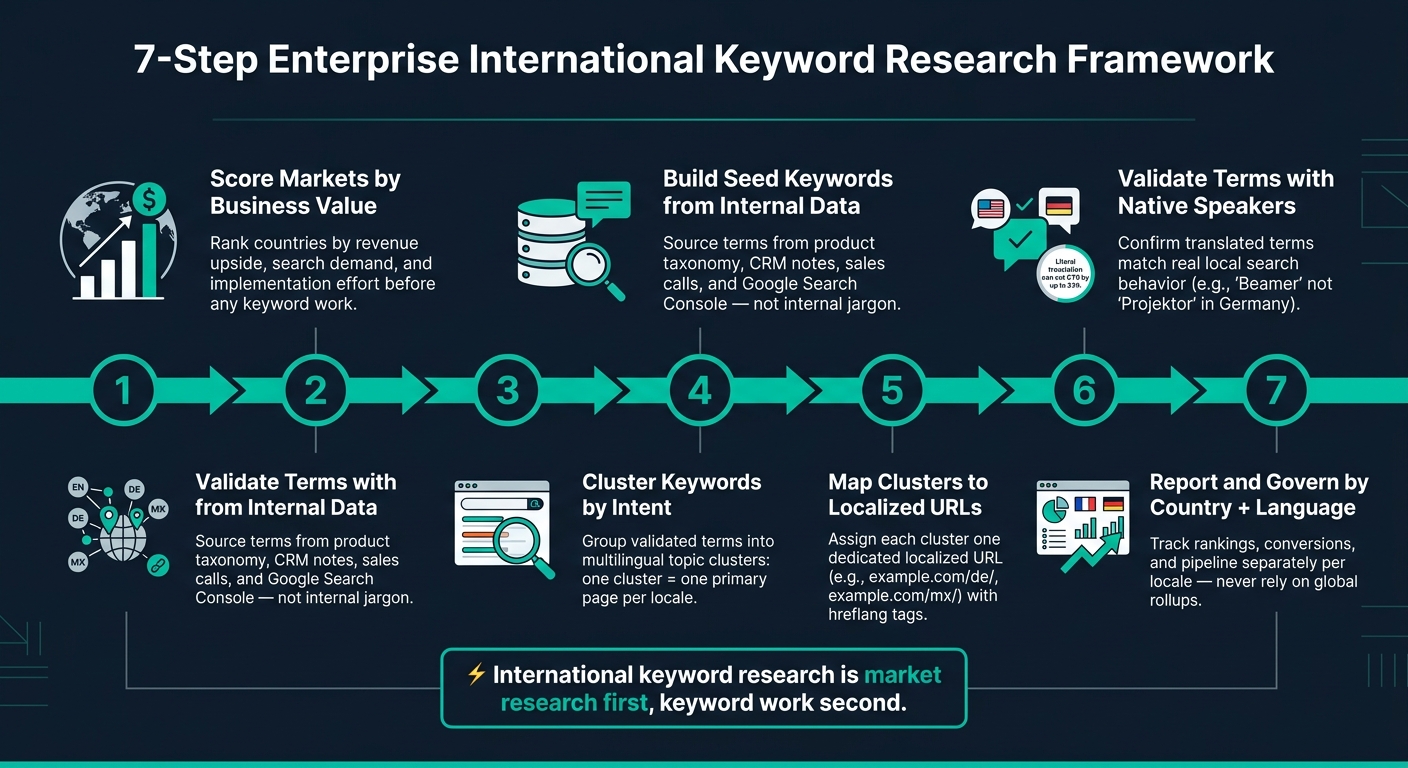
7-Step Enterprise International Keyword Research Framework
Steps 1-2: Score markets and build seed keyword lists
Step 1: Score countries and languages by business value and SEO potential
Rank markets before you start keyword research. That keeps you from spending time on countries that look busy in a spreadsheet but don't line up with revenue or execution reality.
Use a weighted scoring model to sort markets by three factors:
- Business value: current revenue, pipeline potential, and sales fit
- Market demand: local search volume and seasonality, not global totals
- Implementation effort: keyword difficulty, competitive intensity, and how hard localization will be
CPC can help here as a rough proxy for competition and commercial intent.
Example:
| Market | Revenue Opportunity (USD) | Search Demand (Score 1–10) | Competitive Intensity (KD) | Implementation Effort | Priority Score |
|---|---|---|---|---|---|
| Germany (DE) | $1,250,000 | 8 | 65 (High) | Medium | 7.5 |
| Brazil (BR) | $850,000 | 9 | 40 (Low) | High | 8.2 |
| France (FR) | $600,000 | 6 | 55 (Med) | Low | 6.0 |
This is where trade-offs get clear fast. Brazil scores well because demand is high and keyword difficulty is lower, but localization is still a real lift. Germany offers more revenue upside, yet organic competition is harder. France is easier to execute, but the upside is smaller. A scoring model makes those trade-offs visible before you commit people, budget, and time.
Economic context matters too. Price-sensitive markets like Brazil and India often lean toward informational and comparison queries. Premium markets like Switzerland and Norway tend to lean more transactional.
Use the highest-ranked markets to build seed lists for the next step.
Step 2: Build enterprise seed keywords from product, sales, and CRM data
Once you've ranked your priority markets, build a seed list based on how buyers in those markets actually talk - not how your team labels the product internally.
Use buyer language from CRM notes, sales calls, and query data. Skip internal product jargon where possible.
Your best starting point is usually internal data. Product taxonomy, solution pages, and CRM opportunity themes show the terms your business already uses and the problems buyers have already named. Sales calls and win-loss notes take that a step further. They often reveal the exact phrases buyers use when they're close to a decision.
If you already have indexed pages in a market, Google Search Console is one of the best sources of local demand data because it shows real queries from real users.
| Source | Role | Limitation |
|---|---|---|
| Product Taxonomy | Aligns with core offerings and solutions | May use internal jargon buyers don't search for |
| CRM & Sales Data | Captures high-intent buyer language and pain points | Often unstructured; requires manual review |
| Search Console | Shows real queries from indexed markets | Limited to markets where the site already ranks |
| Local SERP Analysis | Reveals what Google rewards in a specific market | Time-consuming across multiple regions |
One quick gut check helps here: if a term sounds polished in a product meeting but never shows up in Search Console, sales notes, or local SERPs, it's probably not a strong seed keyword.
Use country-specific search settings or a VPN to verify which terms and content types actually rank in-market before native-language validation in Step 3.
Use the validated seed list as the input for Step 3.
sbb-itb-5be333f
Steps 3-5: Validate local terms, review competitors, and cluster keywords
Step 3: Review local terms with native-language validation
Now check whether your seed terms line up with how people actually search in each market. This step matters because a direct translation can be correct on paper and still miss the way buyers talk.
In Germany, the common search term for a projector is "Beamer," not "Projektor." Research from July 2025 on the film digitization market found a similar pattern: UK users searched by outcome, as in "digitises old cine films," while German users searched by technical process, as in "super 8 digitalisieren." The direct translation, "digitise super 8," had fewer than 50 searches per month.
| English Phrase | Direct Translation | Validated Localized Term | Market | Recommendation |
|---|---|---|---|---|
| Projector | Projektor | Beamer | Germany | Use "Beamer" for search volume |
| Car Insurance | Seguro de coche | Seguro de auto | Mexico | Use "auto" for regional dialect |
Native speakers - whether in-house sales staff, local consultants, or market specialists - should sign off on final term lists. They can spot wording that is technically correct but sounds off in the market. They can also catch intent mismatches that keyword tools often miss.
Google Autocomplete and "People Also Ask" in the target locale also work well as quick reality checks for how people phrase searches in the wild.
Step 4: Check competitors and SERPs by country and language
Your competitors at home usually are not the same companies competing with you in Germany, Brazil, or South Korea. Once you look at local SERPs, you often find a different group of sites ranking for the same product-level terms.
Pay close attention to the content formats that dominate. If the top 10 results for a high-intent term in France are all long-form guides, a product page will probably struggle no matter how well you optimize it. That's the kind of thing you only see when you review the SERP market by market.
Run a keyword gap analysis against 2-4 local competitors in each market to find non-brand terms they rank for and you do not. Focus on positions 4-15. Those rankings often show where competitors are visible but not locked in, which makes entry more realistic.
| Tool | Market Coverage | Language Depth | Enterprise Fit |
|---|---|---|---|
| Semrush | 140+ country databases | 25.7B+ keywords | Best for country-level research |
| Ahrefs | 217 locations | 10 search engines indexed | Best for competitor keyword and backlink gaps |
| Sistrix | Strong European focus | Deep DACH market data | Needed for Europe-specific competitor analysis |
| Baidu Index / Naver | China / South Korea | Native language only | Required where Google is not dominant |
Use those competitor gaps to decide which terms should share one page in Step 5.
Step 5: Cluster keywords into multilingual topic groups
After validation and competitor review, group terms by shared intent. The goal is simple: one cluster per locale and one primary page per cluster. That keeps pages from competing with each other and gives each page one clear job.
"International SEO keyword research is not a translation exercise. It is a market research exercise that happens to involve search terms." - DevOptiv
At scale, teams usually rely on two clustering methods:
| Method | Scalability | Accuracy | Speed | Oversight Needed |
|---|---|---|---|---|
| Manual (Native) Clustering | Low | High for cultural nuance | Slow | High - native SEO expertise required |
| SERP-Overlap Clustering | High | High for search engine logic | Fast | Medium - tool output needs validation |
In practice, the safest approach is to combine both. Use SERP-overlap clustering to process large keyword sets, then have native reviewers check high-value commercial and brand terms where intent needs to be exact. After that, sort clusters by page type - service, pricing, comparison, or problem-solving.
Steps 6-7: Map keywords to pages and report by locale
Step 6: Map keyword clusters to localized pages
Once your clusters are checked, the next move is URL assignment. Give each checked cluster one localized URL. Don’t use the same page across countries or languages.
Before you assign URLs, sort clusters by page type - service, pricing, comparison, industry, or educational pages. That setup keeps the site clean and helps search engines understand who each page is meant to serve.
| Country | Language Code | URL | Primary Keyword | Secondary Keywords | Page Owner |
|---|---|---|---|---|---|
| Germany | de-DE | example.com/de/preise |
SEO Preise | SEO Kosten, SEO Pakete | DE Marketing Mgr |
| Mexico | es-MX | example.com/mx/precios |
Precios de SEO | Costo de SEO, Planes SEO | LATAM Content Lead |
| Japan | ja-JP | example.com/jp/pricing |
SEO 料金 | SEO 価格, SEO 費用 | JP Growth Lead |
Don’t reuse one pricing page across Germany and Mexico. Search intent, currency, and local context are different.
For most enterprise teams, subdirectories like example.com/de/ are the right structural choice because they help concentrate domain authority across markets. Add self-referencing canonicals and bidirectional hreflang across all language variants. Audit both every quarter.
This page map then becomes the foundation for locale-level reporting.
Step 7: Build reporting and governance by country and language
After pages are mapped, governance is what keeps each locale on track over time. Rolled-up SEO metrics can hide zero-volume markets by locale. In plain English, a strong global average can mask markets where you have little - or no - real visibility.
Use separate Google Search Console properties for each country domain or subdirectory to report performance by locale. Track rankings, conversions, and pipeline by country and language. Review results quarterly to account for seasonality and regional holidays.
| Country | Language | Cluster | Ranking Trend | Conversions | Pipeline Contribution (USD) |
|---|---|---|---|---|---|
| Brazil | Portuguese | Cloud CRM | +5 | 142 | $45,000 |
| France | French | Logiciel RH | -2 | 89 | $28,500 |
| UK | English | HR Software | +1 | 215 | $72,000 |
Keyword Research Across Languages: Localizing for International SEO
Conclusion: The 7-step framework for scalable international keyword research
After Step 7, the process becomes repeatable. International keyword research at the enterprise level is not a one-time project. It is an operating process you can run again and again. Each step feeds the next, turning market research into localized pages and measurable demand.
Clustering and mapping are what turn research into scalable page architecture. When you group keywords by intent and assign each cluster to a dedicated localized URL, your site stays clean. It also helps stop pages from competing with each other across markets. That structure makes expansion easier to repeat.
Governance decides whether the work stays accurate and measurable. The last step is governance: track each country-language pair separately so performance stays visible at the locale level, instead of getting buried in global rollups that can hide weak or missing visibility in individual markets.
The teams that win treat this as a quarterly process. When each market is scored, validated, clustered, mapped, and reported separately, international SEO becomes a demand channel - not a translation exercise.
FAQs
How do I prioritize which markets to target first?
Prioritize markets using three criteria:
- Business opportunity
- Competitive landscape
- Cultural alignment
Look at market size, revenue potential, and your chance to build early authority. It’s usually better to go deep in one or two high-potential markets than to stretch your team across too many countries at once.
Before you lock in your list, make sure you can actually support those countries on the operational side too. That includes things like staffing, logistics, customer support, payments, and local compliance.
Why isn’t direct keyword translation enough for international SEO?
Direct keyword translation isn't enough. Search behavior reflects local intent, local habits, and how mature a market is - not just the language people speak.
People in different regions often use different terms for the same product. And a word-for-word translation may have little search volume or miss what people are actually looking for.
Search intent can shift from country to country. So can competition, regulations, and seasonality.
How often should enterprise teams update international keyword research?
International keyword research isn’t a one-and-done task. Search trends shift, seasons change, and people in different markets look for the same thing in different ways. That’s why enterprise teams should run a quarterly review cycle to track those changes, including regional holidays and seasonality across each market.
Regular performance audits help keep search performance on track as your international footprint grows. They also help teams spot changes in intent, react to algorithm updates, and keep content aligned with local search patterns and audience expectations.