Payment terms in SEO agreements are often overlooked but are critical for maintaining smooth client relationships and ensuring timely compensation. Without clear guidelines, you risk delayed payments, disputes, and cash flow issues. Here's a quick breakdown of what to include in your SEO contracts:
- Payment Schedules: Define when invoices are due. Options include Net 15, Net 30, or milestone-based payments (e.g., 50% upfront, 25% mid-project, 25% on completion).
- Upfront Deposits: Secure a non-refundable deposit (commonly 50%) before starting any work.
- Late Fees: Charge 1.5%-2% per month on overdue balances and include a work suspension clause for non-payment.
- Accepted Payment Methods: Specify options like ACH transfers, credit cards (note processing fees), or wire transfers, and clarify who covers transaction costs.
- Extra Costs: Outline additional charges for out-of-scope work or third-party tools, with client pre-approval required.
- Contract Terms: Include a 6-12 month minimum commitment, notice periods for termination, and early termination fees.
- Dispute Resolution: Require written notice for billing disputes, ensure undisputed amounts are paid on time, and include arbitration or suspension clauses if disputes persist.
Clear payment terms protect your business and foster transparency. They minimize misunderstandings and ensure you get paid for your hard work.
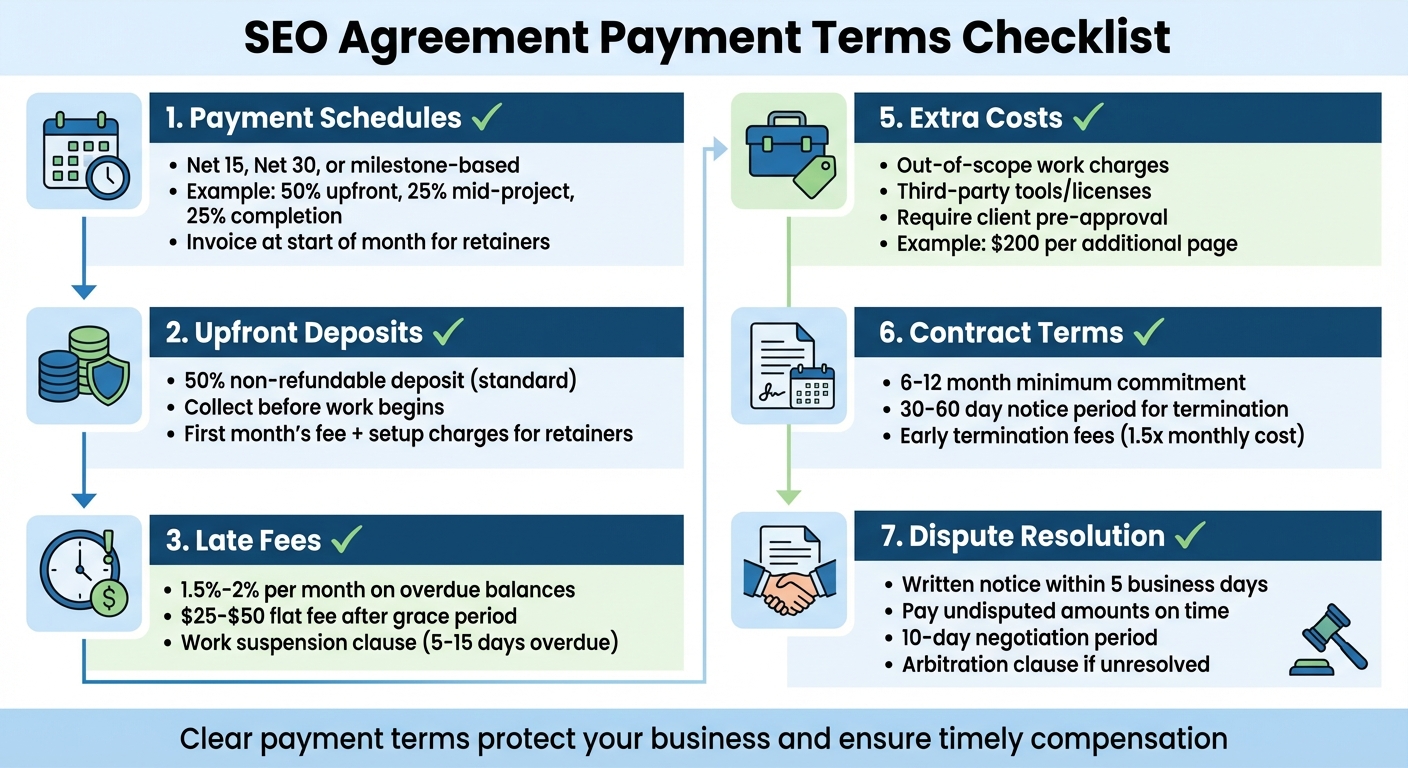
Essential Payment Terms Checklist for SEO Agreements
Don't Get Screwed: My 2026 Bulletproof Freelance Contract Walkthrough
sbb-itb-5be333f
Payment Structure and Schedule
When setting up your SEO agreement, it’s important to outline the payment structure clearly. Using terms like Net 30 (payment due within 30 calendar days) can help avoid misunderstandings. For smaller agencies or new clients, Net 15 or even "due upon receipt" might be better options to ensure quicker payments. Always specify calendar days instead of business days to remove any confusion about deadlines.
Payment Frequency and Due Dates
For retainer-based SEO services, it’s a good idea to invoice at the start of each month rather than waiting until the work is completed. This approach helps maintain steady cash flow. Automating invoices can also save time and ensure consistency, often by using top SEO tools and marketing resources. For project-based work, tie payments to clear milestones. A common breakdown is:
- 50% upfront at the start of the project
- 25% at the midpoint, such as after delivering a technical audit
- 25% upon final delivery
Be sure to define what triggers an invoice - whether it’s the invoice date, submission of deliverables, or client approval. This avoids potential disputes over milestone payments.
Another key step is requiring deposits before beginning work.
Upfront or Advance Payments
Collecting a non-refundable deposit upfront is a smart way to secure commitment from clients. For project-based SEO, it’s common to request 50% of the total project fee upfront. For retainers, you should collect the first month’s fee along with any setup charges before starting.
"A non-refundable deposit of 50% of the total project fee is due prior to commencement of any work. Work will not begin until the deposit has cleared".
This practice not only weeds out clients who aren’t serious but also ensures your resources are protected. Additionally, include a clause stating that all deliverables and intellectual property remain with the agency until full payment is received.
Once deposits are handled, it’s important to address overdue payments.
Late Payment Penalties
To protect your cash flow, set clear penalties for late payments. A standard approach is to charge 1.5% to 2% per month on overdue balances, with an additional flat fee of $25–$50 after a grace period. You can also include a work suspension clause, allowing you to pause services if payments are overdue by a set number of days (typically 5 to 15). For instance, Direction Inc. uses this clause:
"Failure to render payment by the due date grants [the Company] the right to suspend all work until the outstanding balance is paid in full".
If you want to encourage faster payments, consider offering an early payment discount. For example, a "2/10 Net 30" term gives clients a 2% discount if they pay within 10 days. This can significantly improve cash flow while benefiting clients with an annualized return of about 36.5%.
Accepted Payment Methods and Processes
When it comes to payment, clarity is key. Listing all accepted payment methods upfront can help avoid misunderstandings later. Each method comes with its own advantages and drawbacks. For example:
- ACH transfers are highly cost-effective for B2B transactions, with fees typically under $1 and processing times of 1–3 business days.
- Credit cards are convenient but come with a 3% processing fee.
- Wire transfers work well for large or international transactions, though they often involve additional bank fees.
"ACH payments are often the best option for B2B - they typically carry much smaller fees than credit cards (often under $1 per transaction) and complete within one to three business days".
It’s also important to state clearly in your agreement who will cover transaction fees. For instance, if you accept credit cards, specify whether you’ll absorb the 3% fee or pass it on to the client. If a client consistently misses wire transfer deadlines, you might require a backup credit card on file after three late payments. These details set the foundation for your approved payment methods, outlined below.
Approved Payment Methods
Your list of approved payment methods should include ACH transfers, wire transfers, credit cards, checks, and any preferred digital payment platforms. If you work with international clients, specify that payments must be made in USD and clarify who will handle currency exchange rate differences. For wire transfers, it’s a good idea to send invoices at least two weeks before the due date to account for potential bank delays. Additionally, make sure to outline who is responsible for fees associated with each payment method.
Invoice Delivery and Format
A clear and structured invoicing process ensures both parties understand their obligations. Specify how invoices will be delivered - whether via email, a client portal, or automated tools like Monday.com or Close CRM. Each invoice should include:
- A unique invoice number
- A specific due date (e.g., "Payment due by May 6, 2026", instead of vague terms like "Net 30")
- An itemized list of services provided
- The exact amount due
For convenience, include the total amount and due date directly in the email body so clients can quickly spot the key details. Adding a clickable payment link can also streamline the process and encourage faster payments.
Additional Fees, Expenses, and Adjustments
When working on an SEO project, the monthly retainer isn't the only cost to consider. There may be one-time setup fees for onboarding and technical configurations, charges for detailed SEO audits, or expenses for third-party tools and licenses. To avoid misunderstandings, it's critical to list any extra charges for services like additional content creation that go beyond the initial agreement. Establishing clear payment schedules and addressing these potential costs upfront ensures a smoother process and protects both parties.
To reinforce clarity, agreements often include provisions like this:
"Any and all incidental costs beyond the agreed deliverables will be reimbursed to Provider with prior client approval." - PandaDoc SEO Agreement Template
Some contracts also account for cancellation or early termination fees, which may apply if a client ends the agreement before the typical term of 6 to 12 months - an ideal timeframe for SEO to deliver measurable results. Additionally, it's essential to clarify tool ownership in the contract. Specify who will handle payments and licenses for any third-party software used during the engagement.
Additional Charges Beyond the Retainer
Extra costs can arise when services exceed what's covered by the standard retainer. For example, if your base package includes five optimized pages per month, additional pages might be billed separately - some contracts set a rate of $200.00 per page. Small-business retainers often start at around $1,500 per month, while enterprise-level services can range between $5,000 and $10,000+ per month. To prevent unexpected charges, always secure written client approval before incurring extra costs and keep a record of all approvals.
Pricing Adjustments for Scope Changes
Scope changes - like adding extra landing pages, managing site migrations, or handling additional revisions - should be clearly addressed in your contract. Include an "Additional Services" clause to outline how out-of-scope work will be billed, often at an hourly rate. To avoid scope creep, specify the number of revisions included in the base price and charge separately for any extra rounds. If a client makes changes that disrupt your SEO efforts, you can charge your standard hourly rate for remediation.
As the SolvLegal Team explains, "Any additional work beyond the stated scope will require a written amendment signed by both parties". This type of clause not only prevents disputes but also ensures that both sides are on the same page before any extra work begins.
Minimum Contract Terms and Early Termination
SEO agreements often come with a 6- to 12-month commitment, giving search engines enough time to properly crawl, index, and assign authority to your site. For newer domains or websites with technical issues, this timeframe often extends to 9–12 months. Like payment schedules, clear contract terms are essential for setting expectations and protecting both parties. Here's a breakdown of key points regarding contract durations and early termination fees.
Minimum Contract Length
Most top SEO marketing agencies follow a standard practice of a 6-month mandatory retainer that transitions into a month-to-month agreement.
"For most agencies, a 6-month mandatory retainer that rolls into a month-to-month agreement is the gold standard".
For larger e-commerce platforms or businesses in highly competitive markets - whether national or international - a longer commitment, often 12 months or more, is typically required.
Contracts should also include a 30- or 60-day notice period for termination, ensuring clarity on how to end or transition the agreement. Be sure to review any auto-renewal clauses to avoid unintentionally committing to another long-term period without prior notice.
"A 12-month contract should specify the notice period required if you wish to terminate or transition to a rolling retainer afterwards (typically 30 or 60 days)".
Early Termination Fees
To safeguard their revenue, agencies usually impose an early termination fee (ETF) if a client cancels before the contract ends. These fees can take several forms, such as:
- A flat fee equal to one or two months of the retainer
- Full payment of the remaining contract value
- A specific multiplier of the monthly campaign cost
For instance, Direction Inc. applies a cancellation fee of 1.5 times one month's campaign cost for terminations within the first 12 months.
Some contracts allow for immediate termination in cases of a material breach, such as non-payment or failure to grant website access. Typically, the breaching party is given 10 to 30 business days to resolve the issue before the agreement is terminated. Once full payment is made, clients retain ownership of all content and assets created during the contract. Additionally, many agencies require 60 days’ written notice to waive cancellation fees.
Reporting and Payment Ties
When you set up a clear payment structure, linking invoices to performance reports can help protect your cash flow. By tying your payment schedule to monthly performance reports, you introduce a built-in layer of accountability. For ongoing SEO campaigns, monthly reporting is considered the norm in the industry. This approach ensures that both reporting and payment processes remain aligned.
Reports Required Before Payment
Make it a contractual requirement that each invoice is accompanied by a detailed monthly performance report outlining agreed-upon KPIs.
"Provider agrees to provide Client with monthly reports detailing activities performed for the previous 30-day period along with the results of SEO efforts." - PandaDoc
A well-crafted monthly report should include the following:
- An executive summary for a quick overview.
- Organic traffic trends, sourced from tools like Google Search Console and Google Analytics 4.
- Updates on keyword ranking progress.
- Data on top-performing pages.
- Insights into technical SEO health metrics.
For a deeper dive, advanced reports might also cover backlink profiles, competitor comparisons, content performance, and conversion tracking. However, the focus should remain on business-driven metrics like organic sessions and conversion rates, avoiding less meaningful data such as Domain Authority.
Payment Release Tied to Performance Verification
Take this a step further by linking payment approval to a review of the report’s accuracy and milestone achievements. Allow a 3–5 business day window for this review. To maintain balance, include a clause in the agreement that suspends work if payment is delayed by more than five days. This system ensures mutual accountability: the agency must deliver clear and accurate reports, while you commit to processing payments promptly once the deliverables are verified. Additionally, schedule a monthly review call to discuss the report findings and plan future efforts.
Dispute Resolution for Payment Issues
Even with well-defined payment terms, billing disagreements can arise. The trick is to have a structured plan in place to address disputes quickly, so they don’t disrupt your SEO campaign.
Billing Dispute Resolution Process
Your agreement should require clients to submit a written dispute notice within 5 business days of receiving an invoice. This avoids vague excuses like "accounting is reviewing it", which can drag out the process for weeks. The notice should clearly outline the objections, specifying any missing deliverables, unmet scope items, or billing errors.
It’s also important to require payment of all undisputed portions by the original due date. Alex Berman explains it well:
"Disputing a $500 line item doesn't let the client hold the entire $5,000 invoice hostage. Only the disputed portion is held - the rest is still due".
This approach ensures that minor disagreements don’t freeze your cash flow entirely.
Once a dispute is filed, both parties should enter a 10-day good-faith negotiation period. If the issue isn’t resolved within 30 days, binding arbitration begins in your jurisdiction. If the dispute remains unresolved after negotiations, a suspension clause can help protect your business.
Service Suspension for Unresolved Disputes
Your agreement should also include clear language granting you the right to pause work when payments are delayed. A typical clause might state:
"Failure to render payment by the due date grants [Your Company] the right to suspend all work until the outstanding balance is paid in full. Suspended work time will not impact project timelines".
Most agencies enforce suspension 15 days past the due date. For severe delinquency (28+ days), you might reserve the right to remove deliverables hosted on agency-controlled platforms, such as guest posts or third-party citations. This creates a sense of urgency to resolve the issue.
Additionally, include a "prevailing party" clause, which allows the winning party in any dispute to recover reasonable attorney fees and costs. This discourages frivolous disputes and motivates both sides to resolve issues promptly.
Conclusion
Establishing clear payment terms is critical for a successful SEO partnership. Without them, you could find yourself delivering services without any legal protection if a client fails to pay.
Issues like overdue invoices and large outstanding balances highlight why well-defined payment clauses are a must. These clauses - covering everything from payment timelines to late fees - help protect your cash flow and ensure you’re compensated fairly for your work.
FAQs
What should I pick: Net 15, Net 30, or milestones?
When deciding between Net 15, Net 30, or milestones, it all comes down to your cash flow requirements and the nature of the project. With Net 15, payment is due within 15 days, while Net 30 extends that to 30 days - both work well for smaller or recurring projects. On the other hand, milestones split payments across project phases, making them a better fit for larger, more complex projects. If you need more security and oversight, go for milestones. For quicker, straightforward tasks, Net terms keep things simple.
How big should an upfront deposit be for SEO work?
When it comes to SEO work, it's common for professionals to request an upfront deposit of around 50%. However, this amount can differ depending on the scope of the project and the agreement between both parties. In some cases, especially for ongoing monthly services, full payment might be required upfront. To ensure everything is clear, always review and confirm the payment terms outlined in your contract. This helps prevent any potential misunderstandings down the line.
How can I handle scope creep without disputes?
To keep scope creep from becoming an issue, it’s critical to clearly define the scope of work in your agreement. Be specific about what services are included - and just as importantly, what services are not included.
Make sure to include clauses that explain how changes or additional work will be handled. For example, require that any modifications be documented in writing and approved before moving forward. This creates a clear process for managing adjustments.
Regular communication is also essential. Keeping an open line of dialogue and thoroughly documenting any changes ensures everyone stays on the same page. This approach helps align expectations and provides a structured way to address updates to deliverables, costs, or timelines.