If I want traffic in Japan, I can’t treat Yahoo! Japan like an afterthought. In 2026, it still drives about 10% to 20% of search use in Japan, and it matters most for users who compare brands, read portal content, and spend more time researching before they buy.
Here’s the short version: Yahoo! Japan SEO starts with Google SEO, but it does not end there. Because Yahoo! Japan uses Google’s search tech, I still need a strong technical SEO audit, indexing, and page quality. But to get clicks and sales in Japan, I also need to match Japanese search terms, script choice, page format, mobile use, and trust signals.
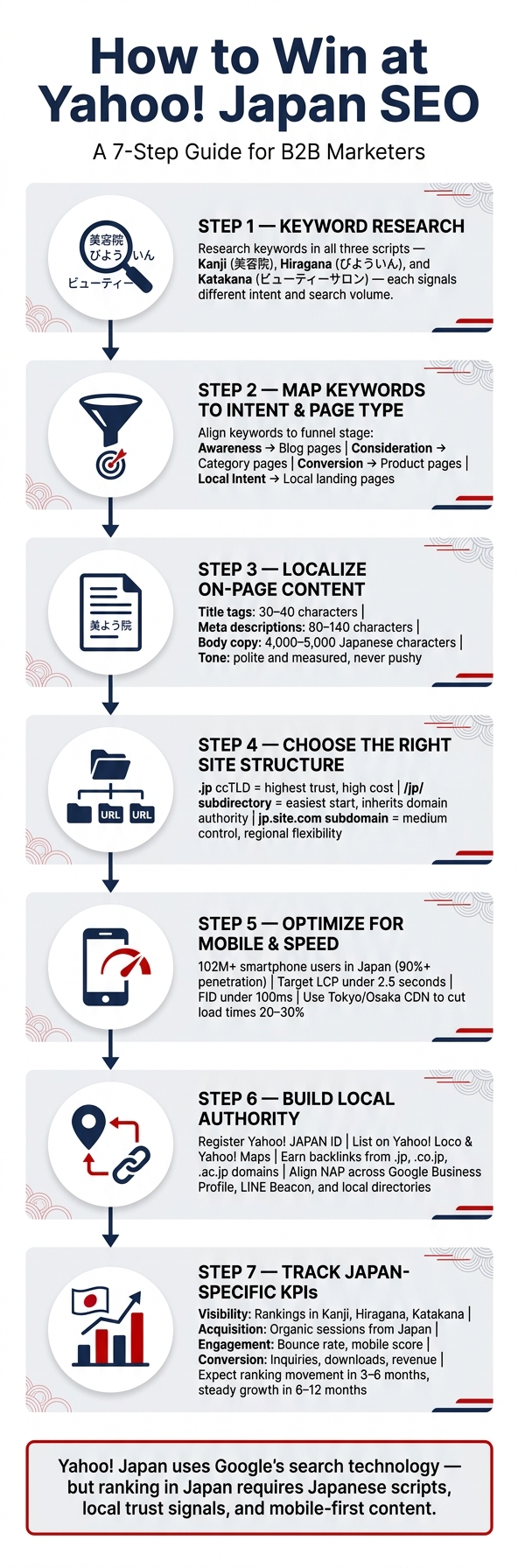
If I were entering Japan today, I’d focus on these steps first:
- Research keywords in Kanji, Hiragana, and Katakana
- Match each term to intent and page type
- Write Japanese copy that sounds natural, not translated
- Use a clean Japan site setup, often
/jp/for a first launch - Make mobile speed a priority for Japan’s 100+ million smartphone users
- Build local signals through Japanese links, company details, and Yahoo! properties
- Track Japan-only KPIs for rankings, traffic, engagement, and leads
A few points stand out right away:
- Yahoo! Japan is still tied to a portal model, so users may click News, Shopping, Chiebukuro, Auctions, Maps, or Loco
- Title tags in Japanese often work best at about 30–40 characters
- Meta descriptions often fit best at about 80–140 characters
- Many top Japanese pages run longer, often around 4,000–5,000 Japanese characters
- Mobile performance still matters, with LCP under 2.5 seconds as a solid target
Yahoo! Japan SEO: Step-by-Step Strategy for Ranking in Japan
3 tips for digital marketing in Japan | Need-to-know
sbb-itb-5be333f
Quick Comparison
| Area | What I should do |
|---|---|
| Search engine base | Use Google SEO as the base |
| Keyword work | Check script choice, phrasing, and intent |
| Content | Localize for tone, trust, and readability |
| Site setup | Start with /jp/ unless I need a separate Japan site |
| Local visibility | Use Yahoo! Loco, Maps, and business listings |
| Measurement | Segment Japan traffic, rankings, and conversions |
The main idea is simple: if I want to rank and win clicks in Japan, I need more than translated U.S. pages. I need Japanese-language pages that fit how people in Japan search, compare, and decide.
Understand the Search Environment and Build the Right Keyword Strategy
How Yahoo! Japan Search Results Relate to Google and Local SERP Features
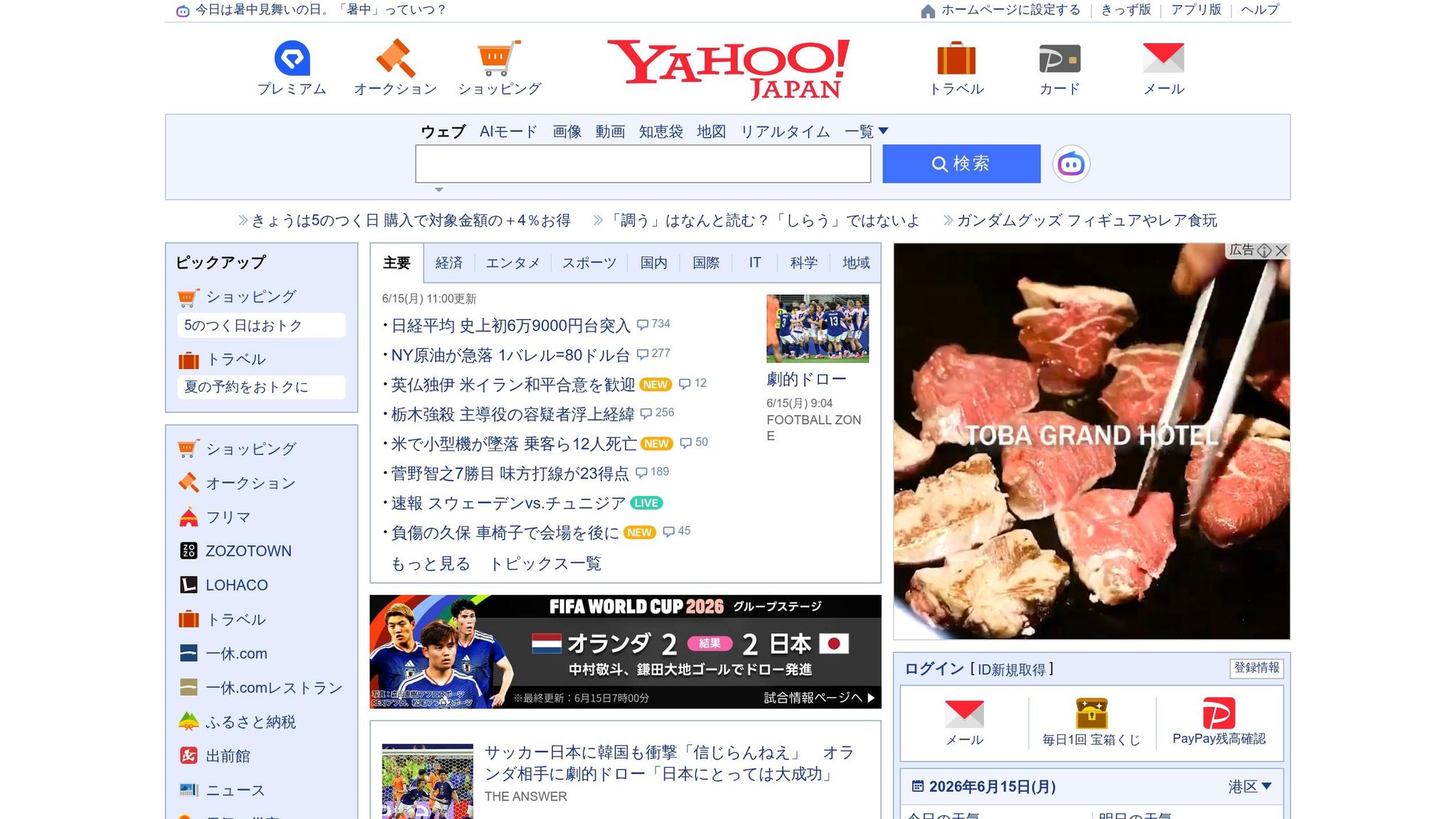
Yahoo! Japan uses a portal-style SERP, with news, shopping, and auction modules mixed into the results. In practice, that means Yahoo-owned properties often show up first: Yahoo! Chiebukuro (Q&A), Yahoo! Shopping, Yahoo! News, and Yahoo! Auctions. It also pulls in real-time social posts from X (formerly Twitter), Facebook, and Instagram right inside the results.
That setup changes two things: which pages can rank and which content formats get the click.
Broad searches often bring up category pages. More specific searches tend to show product listings. That split matters when you're deciding what kind of page to create and how to target a term. Once that's clear, script choice and local phrasing become the next focus.
Research Japanese Keywords by Script, Intent, and Local Phrasing
Japanese keywords can appear in Kanji, Hiragana, or Katakana, and each script can signal a different intent and attract different search volume. A simple example is "beauty salon":
- 美容院 (Kanji) feels formal and professional
- びよういん (Hiragana) feels casual and broad
- ビューティーサロン (Katakana) suggests a modern, foreign-influenced brand
Pick the wrong script, and you can miss search demand that already exists. You also make the page feel less relevant than it should.
Direct translation from English usually falls flat. Even a basic "how to" search can show up in different ways: どうやって sounds casual, 方法 sounds formal, and やり方 feels more colloquial. In search, those differences matter.
"The Japanese search market has unique characteristics, and simply applying Western SEO methods often yields limited results." - Toshiki Matsumura, CEO of MEDIA REACH
A smart move is to check Yahoo! Chiebukuro and see how people ask questions in Japanese. Then compare those phrases against Japanese competitor rankings. That's where the pattern starts to show. You learn not just what people search, but how they say it. From there, you can match each keyword to the page type and SERP feature it should go after.
Map Keywords to Business Goals and Page Types
Map each keyword to the SERP feature it tends to trigger. Then line that up with the page format that fits the search intent.
| Funnel Stage | Keyword Type | Yahoo! SERP Feature | Page Type |
|---|---|---|---|
| Awareness | Broad informational queries | Yahoo! News, Chiebukuro | Blog or informational pages |
| Consideration | Generic category terms | Yahoo! Shopping categories | Category or service pages |
| Conversion | Descriptive product terms | Yahoo! Shopping listings | Product or landing pages |
| Local Intent | Location + service terms | Yahoo! Maps | Local landing pages |
For informational content, Chiebukuro-style questions are a good fit, and the page should match the depth users expect. For product and service pages, descriptive Katakana brand terms or specific Kanji/Hiragana mixes often work better than broad labels. For local landing pages, you need a Yahoo! Japan ID and a Yahoo! Loco listing to show up in local search features.
With the keyword map in place, the next move is localizing the page itself.
Localize On-Page Content for Japanese Users
Once keyword intent is mapped, the page itself needs to feel like it was written for Japan, not translated after the fact.
Write Titles, Meta Descriptions, and Headings for Japanese Search Behavior
Titles and meta descriptions in Japanese need to match how people in Japan search. A direct translation usually isn't enough. Use your keyword map to shape title wording, tone, and page structure around search intent.
Keep title tags between 30–40 characters and meta descriptions between 80–140 characters. In Japan, brand names often appear at the end of the title tag to support recognition and click-through rates. Headings should also stay easy to scan on mobile, where Japanese text needs more line space.
Tone matters just as much as length. Japanese users tend to respond better to softer, more polite headings than to bold, forceful ones. Lead with the answer first, then back it up.
"In Japan, people tend to dislike strong, assertive expressions and prefer expressions that leave room for error." - Tokyo SEO Maker
Machine translation often misses nuance, honorifics, and search intent. The result can feel stiff or unnatural, which may signal low commitment to Japanese users.
Adapt Body Copy, Formatting, and Brand Voice for Japan
Japanese pages often need more depth than U.S. pages. Top-ranking Japanese pages usually contain 4,000–5,000 characters, while many English-language pages do fine under 2,000 words. That extra length isn't filler. It reflects what the page needs to do.
Japanese users tend to research carefully, and they often treat language quality as a sign of reliability.
Brand voice needs a shift too. Copy that feels energetic or punchy in the U.S. can sound pushy in Japan. Polite, measured phrasing works better. For example, "We believe that..." may land better than blunt, declarative copy. And because Japanese text does not use spaces between words, subheadings and bullet points matter even more for breaking up long sections and making mobile reading easier.
Build Content That Matches Japanese Market Expectations
Japanese pages should answer core questions early, then build trust with company details, case studies, and author information.
On trust-heavy searches, users often want to know who you are before they do anything else. That means adding:
- Detailed company profiles with the CEO name, founding year, and physical address
- Japan-specific case studies
- Clear author or editor information
- For e-commerce pages, legal disclosures and privacy policy pages
These are strong trust signals in Japan.
Content structure should follow the Japanese decision path: Explain → Reassure → Validate → Convert. In practice, that means a service page should start with a plain explanation of the service, move into proof and supporting details, and only then ask the user to take the next step.
Local imagery and denser page layouts also tend to feel more native to Japanese users. Detailed pages can reduce friction and build trust before contact.
After the page is localized, technical setup and local authority determine whether Yahoo! Japan can trust it.
Set Up Technical SEO and Local Authority for Japan
After localization, the next hurdle is getting the Japanese version crawled, indexed, and trusted. At that point, rankings come down to site structure, speed, and trust signals.
Choose the Right Domain, URL Structure, and Mobile Setup
Your domain choice sends an instant signal to both users and search engines. A .jp ccTLD sends the strongest local trust signal, but it often requires a local nexus or business presence in Japan. For many U.S. companies, a /jp/ subdirectory is the easiest place to start because it lets you use existing domain authority and keep everything under one CMS.
No matter which setup you pick, stick to one clean URL per language, add hreflang, set canonicals, and publish a Japanese sitemap. Japanese URLs should be short, clear, and properly encoded.
Japan has more than 102 million smartphone users, which is over 90% penetration as of 2025. That means mobile can't be an afterthought. Design for mobile first, use 16–18 px body text, keep touch targets at least 40 px apart, and use native Japanese font stacks like "Noto Sans JP" or "Yu Gothic". For Core Web Vitals, aim for an LCP under 2.5 seconds and FID under 100 ms.
A Tokyo- or Osaka-based CDN node can cut load times by 20% to 30% compared with overseas servers. If your Japanese pages rely on JavaScript, check Search Console index coverage so you can confirm Japanese-specific content is rendering and getting indexed the right way. Use TLS 1.3 with a trusted CA or Let's Encrypt so users don't run into "Not Secure" warnings.
Once the site is fast and mobile-ready, the next lever is local authority.
Build Trust with Japanese Backlinks, Mentions, and Business Signals
Link building in Japan isn't a copy-and-paste version of what works in the U.S. Skip link exchanges. Go after links through digital PR, original research, and industry partnerships. Put your focus on links from .jp and .co.jp domains, plus university (.ac.jp) or local government pages.
Backlinks are only part of the picture. Yahoo! JAPAN visibility also gets support from business signals across its own properties. Register for a Yahoo! JAPAN ID so you can add your business to Yahoo! Loco and Yahoo! Maps. Then keep your business details aligned across Yahoo! Loco, Yahoo! Maps, Google Business Profile, LINE Beacon, and local directories.
Compare Japan Site Structure Options Before Scaling
Before you lock in a setup, match it to your team size, budget, and timeline. Each option comes with trade-offs.
| Setup Option | Control & Authority | Localization Depth | Implementation Cost | Best Fit |
|---|---|---|---|---|
| .jp ccTLD | Highest; strongest local trust signal | High; fully localized site | High (usually requires local nexus/presence) | Enterprise / long-term commitment |
| Subdirectory (/jp/) | Medium; inherits main domain authority | Medium; shares global assets | Low; easiest to set up on an existing site | Small businesses / startups |
| Subdomain (jp.site.com) | Medium; treated as a separate entity | High; can use different server/CMS | Medium; requires DNS setup | Large brands with regional teams |
Use the simplest setup that fits your launch stage, then scale after you have performance data. For most U.S. businesses, /jp/ is the simplest starting point.
Measure Performance, Use the Right Resources, and Plan Next Steps
Track Rankings, Traffic, and Conversions for the Japan Market
After launch, the job changes. At that point, you need proof. That means measuring how Japanese users find your pages, read them, and decide whether to take action.
The main thing to watch is Japan-specific behavior, not broad global averages.
Start with four core KPI groups:
| KPI Category | What to Track | How to Segment |
|---|---|---|
| Visibility | Japanese keyword rankings in Kanji, Hiragana, and Katakana; indexed pages | By search engine (Google, Yahoo! Japan, and Bing) |
| Acquisition | Organic sessions from Japan; new vs. returning users | By source (Yahoo! News, Yahoo! Chiebukuro, and Yahoo! Loco) |
| Engagement | Bounce rate, time on page, mobile-friendliness score | By device (mobile vs. desktop) |
| Conversion | Inquiries, case study downloads, revenue contribution | By page type (product pages vs. trust and company info pages) |
Pay close attention to engagement on trust pages, such as About Us, company profile, and case studies. These pages often act as an early sign of conversion activity because Japanese users tend to do a lot of research before they contact a company.
You should expect ranking movement within 3–6 months, with steadier growth showing up between 6–12 months. It also helps to watch Yahoo! Loco for local intent and Yahoo! Chiebukuro for long-tail traffic.
"Japanese search behavior is fundamentally different from American search behavior. Japanese users tend to research carefully before contacting a company." - Tokyo SEO Maker
Find SEO Tools and Services for Execution
Use tools that can read Japanese keywords, local SERPs, and Japan-based search trends.
Most standard SEO platforms can support a Japan-focused campaign. But there’s a catch: you need to use them with Japanese keywords, local SERP features, and domestic websites in mind. Tools like Ahrefs and Data For SEO can show Japanese competitor data when you set the target country to Japan.
For trend changes as they happen, Yahoo! Real-time Search and Yahoo! Trend Rankings can help you spot spikes in demand that global tools may not catch.
If your team needs outside help - for Japanese keyword research, technical audits, link building through platforms like PR TIMES or ValuePress, or content localization - Top SEO Marketing Directory is a curated resource for finding SEO tools and services for keyword research, technical SEO, link building, and content optimization.
Conclusion: Core Steps to Win at Yahoo! Japan SEO
Yahoo! Japan SEO works best when you treat Japan as its own market, with its own language patterns, search intent, and trust signals.
That means understanding Yahoo! Japan’s place in the search market, doing keyword research across all three Japanese scripts, localizing content so it sounds natural instead of translated, setting up the right URL structure and mobile performance, building authority through Japanese backlinks and local business signals, and measuring results with Japan-specific KPIs.
"The Japanese search market has unique characteristics, and simply applying Western SEO methods often yields limited results." - Toshiki Matsumura, CEO, MEDIA REACH, Inc.
Track Japan-specific KPIs, keep localizing based on what the data shows, and scale only after you see traction in the numbers.
FAQs
How is Yahoo! Japan SEO different from Google SEO?
Yahoo! Japan SEO is a bit different, mostly because the Japanese search market works differently and so do its users.
Yes, Yahoo! Japan runs on Google’s search technology. But that doesn’t mean the same approach always works the same way.
Yahoo! Japan is especially popular with people over 40. It also matters a lot in B2C categories like travel, food, and e-commerce. That audience mix can shape what people click, how they search, and which pages get attention.
There’s also the Yahoo! Japan ecosystem to think about. Products like Yahoo! News, Shopping, and Yahoo! Chiebukuro can influence visibility and engagement in ways that go beyond standard Google search results.
So the technical base may be similar, but the way you optimize should match Yahoo! Japan’s audience and its platform-specific features.
Should I use a .jp domain or a /jp/ subdirectory?
A /jp/ subdirectory can work well if it’s clearly signaled to search engines.
That said, a .jp domain may send stronger geographic signals and carry more authority in Japan.
How long does it take to see Yahoo! Japan SEO results?
Yahoo! Japan SEO usually starts to show ranking movement in 3 to 6 months.
More stable growth and measurable results often show up within 6 to 12 months. The longer-term gains tend to become clearer after 12 months.