Your search rivals are often not your sales rivals. In B2B SEO, publishers, directories, review sites, and niche blogs can outrank vendor pages for the terms buyers search first.
If I had to boil this article down, it says this:
- I should build my competitor list from the SERP, not from Salesforce
- I should compare competitors by page type, topic clusters, keyword gaps, and update pace
- I should use Semrush or Ahrefs for gap work, Similarweb for traffic patterns, SpyFu for ranking history, Clearscope for page coverage, and a directory of SEO tools for rival discovery
- I should turn all of that into a 30/60/90-day content plan
Mastering the art of B2B SaaS competitor research
sbb-itb-5be333f
Quick comparison
| Tool | Best use | Main limit |
|---|---|---|
| Top SEO Marketing Directory | Finding search rivals outside my sales list | No keyword or traffic data |
| Semrush | Keyword overlap, gap analysis, page-type review | Traffic estimates are directional |
| Ahrefs | Deep page and keyword gap review | Best with a small set of direct rivals |
| Similarweb | Folder-level traffic and channel mix | Weak for exact keyword gaps |
| SpyFu | Ranking history and cluster staying power | Lighter than full SEO suites |
| Clearscope | Page briefs and topic coverage checks | Not built for discovery or traffic data |
Here’s the plain takeaway: if a rival owns a cluster with 30+ keywords and I rank for fewer than 5, that’s not a one-page issue. It’s a coverage issue. And if directories or comparison pages keep winning, I may need a different page format, not just different keywords.
The rest of the piece shows how to find those gaps and turn them into pages I can publish and update on a fixed schedule.
1. Top SEO Marketing Directory
Top SEO Marketing Directory is a curated directory of SEO tools, software, and agencies. It helps you spot the search rivals showing up in organic results - not by traffic numbers or ranking charts, but by showing who keeps appearing in the SERP. Start here to find the publishers, review sites, and nearby tools that shape what buyers see.
Competitor Discovery
A directory like this brings indirect rivals into view. That includes publishers, comparison sites, review platforms, and adjacent SaaS tools that pull in buyers during the research and comparison stages. That matters because your search competition usually goes well beyond companies that sell the same thing you do.
Once you have that competitor set, shift to platform data to check traffic, keywords, and ranking patterns.
Content Planning Support
Top SEO Marketing Directory works best as a starting point for category-level competitor discovery. By looking at how tools and agencies are grouped, B2B teams can spot the content formats and topic clusters most likely to perform for specific intent.
Here’s the practical takeaway: if directory pages outrank product pages, the problem is often page type and topic fit - not just keywords. So think of the directory as a discovery layer, not a measurement layer.
It does not provide traffic, keyword gap, or ranking data. Use the directory to build your competitor set, then use SEO tools to measure overlap and ranking gaps.
2. Semrush
Semrush is best for overlap, gap, and page-type analysis. It helps with competitor discovery, keyword gap work, and content planning signals.
Competitor Discovery
A practical place to start in Semrush is SERP overlap analysis. Add a core set of 50 to 200 keywords tied to your product categories, specs, and use cases. Semrush then shows the domains that appear most often across those searches.
That overlap list gives you a clean way to find search competitors. From there, you can move into page-level traffic review and see who's winning where.
Traffic & Rankings
Once you have a competitor set, Semrush's Traffic Analytics and Top Pages reports show which parts of a competitor's site bring in the most organic traffic. You can spot, fast, whether traffic is stacked in /blog/, /products/, or a /resources/ folder.
That matters because it shows how they acquire traffic. If most visits go to product pages, that's one signal. If guides and blog posts do the heavy lifting, that's another. Either way, you get a plain read on which page type to prioritize.
Semrush can also point out on-page issues like missing H1s, duplicate title tags, or no Product schema on high-ranking pages. Once you know which page types are pulling their weight, map those pages back to keyword gaps.
Keyword Gap Depth
The Keyword Gap tool is especially useful for B2B content planning. The Missing filter shows keywords where competitors rank and your site has no presence. The Weak filter shows terms where you do rank, but competitors sit much higher.
The smart move is to group those gaps by product category instead of treating each keyword on its own. For example, if a competitor ranks for 30+ terms under "SCADA software" and you rank for fewer than five, that's not just a missed term here and there. It's a structural content gap.
Content Planning Support
Semrush adds intent signals - informational vs. transactional - next to volume data. That helps B2B teams line up content with where buyers are in the buying process.
It also includes an AI Overview tracking module, which lets you watch which competitor pages get cited in generative search results. That can look very different from old-school blue-link rankings. You can use this to see whether original-research pages, product pages, or guides get the strongest visibility.
The Content Audit tool adds another useful signal: when competitor pages were last updated. That helps you spot refresh cadence and find high-ranking pages that may have gone stale. Then you can use the gap list to choose formats, set update priorities, and assign refresh cadence.
Treat Semrush traffic estimates as directional, not exact. Accuracy can vary by vertical. Next, compare Semrush's overlap and gap signals with tools that help check traffic and ranking depth.
3. Ahrefs
Ahrefs is strongest when you want to map a competitor’s page setup and see how deep their rankings go. It gives you a clearer look at how rival sites build pages and pull in organic search demand.
Competitor Discovery
The Competing Domains report shows which sites overlap with you on the most keywords. Use it to rank rivals by shared keyword count, not Domain Rating.
Traffic & Rankings
Ahrefs’ Top Pages report sorts a competitor’s URLs by estimated organic traffic. That makes it easy to spot which page types and folders drive the most search visibility, often identified using top SEO tools and services.
You can also look for pages ranking in positions 3-8 that haven’t been updated in more than two years. Those are often fragile rankings - pages that still perform well, but can be pushed aside by newer content.
Keyword Gap Depth
The Content Gap tool compares your domain against up to three competitors. It shows keywords where they rank in the top 10 while you rank outside the top 50, or don’t rank at all.
A good filter here is simple: focus on terms where at least two competitors rank in the top 10. That usually means the keyword matters for the category. Use those gaps to decide which clusters need net-new pages and which ones just need a refresh.
Next, compare these page-level signals with broader traffic estimates.
4. Similarweb
Semrush and Ahrefs go deep on keywords. Similarweb does something different. It shows which competitors and content hubs are pulling in the audience.
Competitor Discovery
Similarweb finds competitors through audience overlap. In plain English, it shows which other domains your target audience visits too. That matters because your search rivals are not always the companies that sell the same thing you do.
Industry directories like G2 or Thomasnet, publishers, and niche consultancies can all compete for the same SERP space.
Traffic & Channel Mix
Similarweb breaks traffic down by folder, so you can see whether /blog/, /glossary/, or /resources/ brings in the most visits. That view can quickly point you to the page type worth auditing. If a glossary or resource hub is doing most of the work, that's a strong clue.
It also shows the full channel mix - direct, organic, paid, referral, and social. If a site leans hard on paid search, that can point to weak organic coverage.
Keyword Gap Depth
Similarweb does not support granular keyword gap analysis. Use it to shortlist competitors and content hubs first, then move to Semrush or Ahrefs for exact missing terms.
Use Similarweb to narrow the competitor set before moving into keyword-level analysis.
5. SpyFu
SpyFu is built for one thing in particular: search history. It shows the keywords competitors rank for and how those rankings change over time.
Competitor Discovery
Start with a core set of 50 to 200 category keywords. Then sort domains by how often they show up. That gives you a cleaner view of your actual search competitors - not just the companies you already know, but also publishers and adjacent vendors that keep appearing in the same SERPs.
Keyword Gap Depth
SpyFu is useful when you want to look past one-off missing keywords and find clusters that competitors have held over time. If a cluster keeps showing up under one or two domains, that usually points to a structural gap in your own coverage.
Here’s the simple read:
- If a competitor has held a cluster for months, treat it as a priority gap
- If rankings move around a lot, treat it as a refresh or support-content candidate
Content Planning Support
SpyFu can also help you map those cluster findings into an action plan. You can see which topic clusters need coverage, then decide whether the right move is a net-new page, a refresh, or a supporting subpage.
From there, use those cluster priorities to shape the page structure and set the right level of coverage in the next B2B SEO tool.
6. Clearscope

After SpyFu surfaces durable keyword clusters, use Clearscope to check whether each target page covers the topic in full. It comes later in the workflow - after keyword discovery. Its job is to score how well a page covers the topics that search results reward, not to handle competitor discovery, traffic estimates, or ranking visibility.
Topic Coverage
Once broader SEO tools tell you which keywords to go after, Clearscope helps you judge how well top-ranking pages cover those topics. It gives you term relevance data and a content score based on how completely a page addresses the subtopics that current search results reward. This tends to matter most for decision-stage service and industry pages.
Content Planning Support
Clearscope works best when you're drafting new pages or updating existing high-value pages that have stalled in rankings. For a refresh, enter the target keyword, review the top-ranking pages, and spot the terms and subtopics your current page is missing. Then use that gap list as the content brief.
Use the content score as the page-completion target. Clearscope focuses on on-page relevance, not broader SEO metrics like backlinks or technical SEO health, and it sits in a premium pricing tier.
How These Platforms Compare Across Core B2B SEO Signals
B2B SEO Tools Compared: Competitor Analysis Stack Guide
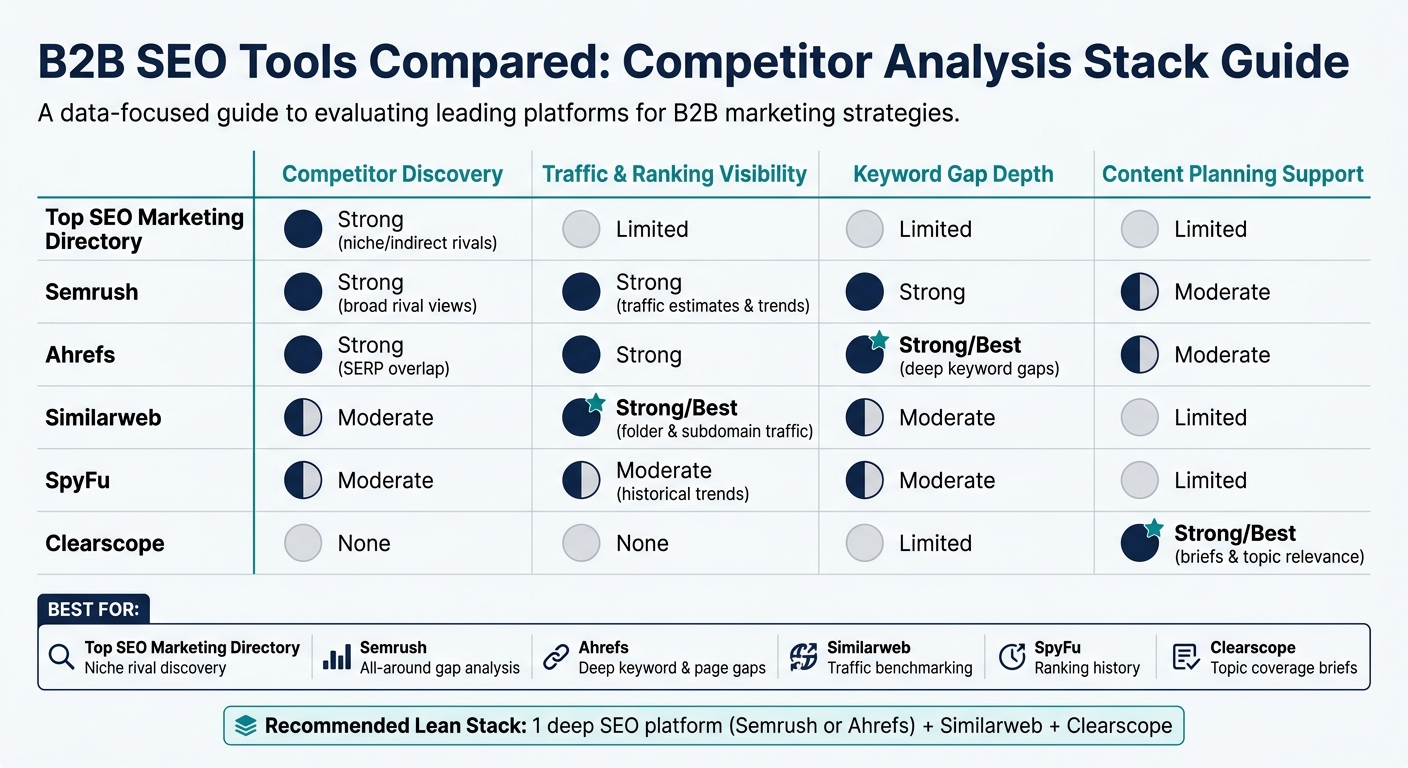
No single platform covers every B2B SEO signal. That’s the point of this comparison: each tool helps answer a different planning question. Use the table below to see where each platform is strong, where it’s light, and how it fits into your workflow.
| Platform | Competitor Discovery | Traffic & Ranking Visibility | Keyword Gap Depth | Content Planning Support |
|---|---|---|---|---|
| Top SEO Marketing Directory | Strong for niche publishers and indirect rivals | Limited | Limited | Limited |
| Semrush | Strong for broad rival views | Strong for traffic estimates and visibility trends | Strong | Moderate |
| Ahrefs | Strong for SERP overlap across core keyword sets | Strong | Best for deep keyword gaps | Moderate |
| Similarweb | Moderate | Best for folder- and subdomain-level traffic analysis | Moderate | Limited |
| SpyFu | Moderate | Moderate for historical ranking trends | Moderate | Limited |
| Clearscope | None | None | Limited | Strongest for briefs and topic relevance |
Competitor Discovery and Search Overlap
B2B teams often mix up sales competitors with search competitors. Those are not always the same.
Ahrefs and Semrush are the main tools for finding search competitors through keyword overlap. They show who ranks for the same terms, even if those companies aren’t competing with you in a sales call. Top SEO Marketing Directory adds another layer by helping surface niche publishers and indirect rivals that might not show up in a standard software-versus-software view.
Traffic Estimates and Ranking Visibility
Similarweb is best when you want to see where traffic is concentrated at the folder or subdomain level. That matters when you're trying to spot patterns like /blog/, /resources/, or a separate product subdomain pulling most of the visits.
Semrush is stronger for broad visibility tracking across domains and keyword sets. In plain English, Similarweb helps you see where traffic goes, while Semrush helps you track how visible a site is in search. Traffic concentration points to the page types worth building. Gap depth shows which clusters deserve more coverage.
Keyword Gap Depth and Topic Coverage
Ahrefs leads on gap depth, especially when you need a close look at missing terms and cluster-level openings. Semrush is useful for multi-competitor comparison, which helps when you want to stack your site against several rivals at once. Clearscope plays a different role - it helps validate topic coverage once you’ve picked the page or cluster to work on.
Put together, these tools help answer two different but related questions:
- Which clusters need net-new pages
- Which pages need a refresh
Content Planning Support and Refresh Signals
For refresh decisions, the sequence is pretty direct: GSC decay data → Ahrefs or Semrush to confirm the ranking decline → Clearscope to spot what the page is missing.
That flow keeps teams from guessing. First, you see the drop in GSC. Then you confirm it in Ahrefs or Semrush. After that, Clearscope helps map the missing subtopics or weak coverage areas on the page.
SpyFu adds historical context by showing which topics competitors have pushed over time. That can help when a ranking drop isn’t just about page quality, but about a competitor steadily putting more effort into a topic set.
Use these signals to turn competitor findings into page-level priorities.
How to Turn Competitor Findings Into a B2B SEO Content Plan
Build a Competitor Page Inventory
Start by separating search competitors from sales competitors. They are not always the same. In the SERPs, your main rivals may be directories, review sites, and niche blogs - even if your sales team is up against a different set of vendors. In plain terms, you might lose deals to one group and lose search traffic to another.
After you know who your actual search rivals are, map their top pages by URL pattern. This is one of the fastest ways to see what they're trying to win. Directories like /alternatives/, /vs/, /templates/, and /integrations/ point to different acquisition plays. A competitor with a large /vs/ library is going after bottom-of-funnel comparison searches. If you don't have that page type at all, that's not just a keyword gap - it's a page-type gap.
Tag each page by format and funnel stage, then use the inventory to spot what you're missing. From there, group those gaps by cluster and search intent.
Group Keyword Gaps by Intent and Topic Cluster
Group keyword gaps by cluster and buyer stage first. Check search volume after that.
| Buyer Stage | Typical Keywords | Recommended Page Type |
|---|---|---|
| Awareness | "signs you need [service]" | Blog, guide, educational hub |
| Consideration | "[service] vs [alternative]" | Comparison page, pricing guide |
| Decision | "[service] for [industry]" | Service page, case study, industry page |
Use Missing gaps for net-new pages and Weak gaps for updates. Also flag any cluster where a competitor ranks for 30 or more keywords and you rank for fewer than five. That's a category-level gap, and it usually needs a direct response.
Next, score each cluster by business value and difficulty.
Score Opportunities by Value and Difficulty
A gap list by itself doesn't give you a plan. You need a way to sort what matters now from what can wait. Score each opportunity based on business value, ranking difficulty, relevance, and freshness. Freshness here means how recently the competing page was updated.
The best near-term targets usually have high business value and low ranking difficulty. Once you've scored the gaps, use the top group to decide which page format fits the SERP.
Choose the Right Page Format
Topic matters. Format matters just as much. If the SERP is full of comparison tables, a long narrative page probably won't do the job. Match the page format to what Google is already rewarding for that query.
Content with comparison tables is cited 2.5x more often by AI search engines like Perplexity than content without them. That's especially relevant for comparison and pricing pages. On the flip side, if a competitor is using a heavy block of text to explain a messy process, a clean checklist or diagram may fit the query better.
That format choice should shape the order of work in your roadmap.
Set an Update Schedule
Use a 30/60/90-day roadmap. This keeps the plan tied to action instead of turning into a giant backlog.
-
Days 1-30: Quick Wins
Refresh high-intent pages that are already close to Page 1 - especially service pages, comparison pages, and pages ranking in positions 11-20 that need better intent match or newer data. -
Days 30-60: Strategic Builds
Create the decision-stage and consideration-stage pages you found in your cluster review. -
Days 60-90: Support and promotion
Add supporting content and put effort into promotion.
Document each target publish date and refresh date in MM/DD/YYYY format inside your content inventory. Review commercial pages every 90-120 days, and move faster when a competitor updates a target cluster.
Pros and Cons of Each Resource for B2B SEO Content Planning
Use this quick read after the comparison table to choose the smallest stack that covers discovery, gap analysis, traffic benchmarking, and content briefs. The idea is simple: each tool solves a different planning problem, so pick the one that gives you the signal you need most.
Semrush and Ahrefs cover the most B2B SEO planning signals. They're the best all-around picks for overlap checks, gap analysis, and rival-page research. Similarweb is the go-to option for market-level traffic benchmarking. Clearscope fits best after keyword research, when you need to turn gap findings into a brief. SpyFu is a lighter pick for keyword history and paid/organic overlap. Top SEO Marketing Directory helps with vendor discovery, not keyword research or traffic analysis.
Here’s the clearest strength and limitation for each one:
| Resource | Main Strength | Main Limitation |
|---|---|---|
| Semrush | Broad keyword-gap analysis; competitor visibility tracking | High cost; heavy data volume |
| Ahrefs | Backlink profiles; content-gap analysis; page-level rival research | High cost; credit limits |
| Similarweb | Folder-level traffic estimates; channel mix benchmarking | Weak for page-level optimization |
| Clearscope | Topic coverage scores; drafting and refreshing high-priority pages | Narrow scope; expensive per brief |
| SpyFu | Competitor keyword history; paid/organic overlap tracking | Less complete than full SEO suites |
| Top SEO Marketing Directory | Curated tool and agency discovery | Not a research or traffic tool |
For most teams, the best setup is the smallest one that covers both overlap analysis and page planning: one deep SEO platform - Semrush or Ahrefs - plus Similarweb for traffic benchmarking and Clearscope for the pages that matter most.
Conclusion
Taken together, these tools help teams move from discovery to prioritization to execution. Semrush and Ahrefs cover keyword gaps and rival-page research. Similarweb gives teams a way to benchmark traffic patterns. Clearscope turns those findings into content briefs. SpyFu supports steady competitor tracking. Top SEO Marketing Directory helps teams find SEO tools and agencies.
For lean teams, a simple setup can work well: GSC, GA4, and one paid platform. Editorial teams should add Clearscope after gap discovery. Larger teams can bring in Similarweb to compare market-level traffic patterns. The stack matters less than how you use it. What counts is turning overlap, traffic, and gap signals into page decisions.
The goal isn't traffic for its own sake. It's building compounding topical depth across the pages that matter most.
Prioritize by business value, buyer stage, and page format. Then refresh on a fixed cadence so competitor analysis becomes an ongoing SEO program.
FAQs
How do I tell sales rivals from search rivals?
Separate who sells to your buyers from which domains rank in the SERP for the keywords those buyers use.
Start with 5-10 core, buying-intent keywords. Then look at which domains show up again and again in positions 1-10.
Those are your search rivals - even if they’re publishers, directories, or software brands.
Your sales rivals may be a different group.
Then look at the top-ranking pages themselves. In SEO, your real rival is often the page type that does the best job of matching the query.
When is a gap a new page vs. a refresh?
A gap calls for a new page when competitors rank for a topic cluster you don't cover at all.
It calls for a refresh when you already have a page, but that page underperforms because it misses search intent, depth, structure, or freshness.
In practice:
- Net-new page = total gap
- Refresh = partial gap on an existing URL
How often should B2B content be updated?
For B2B SEO content, check ranking movement for priority keywords every month. Then step back once a quarter and run a deeper competitor content audit, along with a keyword and backlink gap check. If you're in a fast-moving or highly competitive market, do that deeper review monthly instead.
Your top commercial pages should get attention every quarter. And if a page starts to slip in rankings - or a competitor changes something in a way that matters - update that page sooner.
After each update, watch ranking movement month by month. That makes it easier to decide which pages need the next refresh.