When it comes to backlinks, quality matters more than quantity. A single link from a high-authority site can improve your rankings significantly more than multiple links from low-quality sites. Guest blogging on high-DA websites not only boosts SEO but also builds credibility and drives targeted traffic to your site. Here’s how to identify and secure these opportunities:
- Focus on quality: Combine strong authority metrics (DA/DR), niche relevance, and editorial standards.
- Search smarter: Use advanced Google search operators like
"guest post by" + [your niche]to find active sites. - Evaluate prospects: Check metrics (DA 40+, 10,000+ monthly visitors), traffic trends, and content quality.
- Avoid red flags: Steer clear of link farms, penalized sites, or those with irrelevant outbound links.
- Stay organized: Create a tiered prospect list and prioritize outreach to the most relevant and authoritative sites.
How To Find Guest Blogging Opportunities For Backlinks
sbb-itb-5be333f
What Makes a High-DA Guest Blogging Opportunity?
High Domain Authority (DA) alone doesn’t guarantee SEO success. The best guest blogging opportunities combine three key factors: strong authority metrics, niche relevance, and genuine editorial standards. If any one of these is missing, even a placement on a "prestigious" site might not deliver meaningful SEO results.
Understanding Domain Authority (DA)
Domain Authority (DA) and its counterpart Domain Rating (DR) are metrics that measure the overall strength of a website’s backlink profile. Think of them as a quick way to filter out low-quality sites using SEO marketing tools before you dive into outreach. A good target range for DA/DR is between 30 and 70 - high enough to pass link equity but not so high that outreach becomes overly difficult.
Here’s why this matters: a backlink from a DA 60 site can carry the same SEO weight as 10–50 backlinks from a DA 20 site. However, DA alone doesn’t guarantee referral traffic, faster indexing, or audience alignment.
Balancing Authority and Relevance
Once you’ve filtered sites by DA/DR, the next step is to focus on relevance. Topical alignment acts as a multiplier for a site’s authority.
"Relevance is the multiplier on whatever DR the link source has." - Backlynk, 2026
For example, a DA 30 blog that’s directly related to your industry could provide 70% more ranking value than a DA 70 general business blog with no connection to your niche. Beyond rankings, relevance ensures your content reaches an audience that is genuinely interested in your message, driving real referral traffic - not just backlinks.
In 2026, guest blogging on niche-relevant sites also builds semantic associations that help AI tools like ChatGPT and Perplexity recognize your brand as an authority in your field. This combination of rankings, referral traffic, and brand recognition makes relevance a critical factor in guest blogging success.
Quality Over Quantity
Here’s a striking fact: only 4.6% of guest blogging opportunities meet high-quality standards - defined as having a DR of 71+ and at least 50,000 monthly organic visitors. This highlights why a selective, quality-focused approach consistently outperforms casting a wide net.
"The best guest-post target is not the highest-authority site in the spreadsheet. It is the site most likely to move a measurable business outcome." - Crawl.page Editorial
High-quality sites stand out because they have robust editorial standards, including named editors, clear contributor guidelines, recent bylines, and engaging content. For example, HubSpot’s targeted guest posting strategy on authoritative, niche-relevant sites led to a 118% increase in organic blog traffic and $3.7 million in pipeline revenue. These results weren’t about sheer volume - they came from carefully chosen, high-quality placements.
In guest blogging, a handful of well-placed posts on the right sites will always outperform dozens of low-impact placements. This kind of selective strategy is a cornerstone of long-term SEO success.
How To Build a List of High-DA Guest Blogging Prospects
When building your list, focus on high-DA sites that are relevant to your niche. Use targeted search techniques and curated directories to identify the best opportunities.
Using Google Search Operators
Skip the overused [keyword] + "write for us" searches. Instead, look for sites actively publishing guest content by using smarter queries like "guest post by" + [your niche] or "this post was written by" + [topic]. These help you find websites that are currently accepting external contributions. You can also try intitle:"write for us" or inurl:"guest-post-guidelines" to locate contributor pages that might not show up through basic searches.
| Operator Type | Example Query |
|---|---|
| Standard Footprints | digital marketing "write for us" |
| Submission Pages | SEO "submit an article" |
| Advanced Title/URL | content marketing intitle:"write for us" |
| Published Guest Posts | "guest post by" + SEO |
| Hidden Guidelines | inurl:contributor-guidelines SEO |
Use the "Last 90 days" filter in your searches to ensure the sites you find are still active. Pair these techniques with trusted directories for even better results.
Using Curated Directories
Curated directories can save you hours of research by offering pre-vetted lists of sites that accept guest posts. These directories often include key metrics like Domain Authority (DA), Domain Rating (DR), and monthly organic traffic, making it easier to evaluate potential opportunities.
For instance, the Top SEO Marketing Directory features authoritative sites in niches like link building, content optimization, and technical SEO audits. Since the directory is organized by category, you can quickly find publishers that align with your specific focus instead of sifting through unrelated options.
Before pitching, double-check the metrics provided in any directory using tools like Ahrefs or Semrush to ensure accuracy.
Organizing Your Prospect List
Once you've gathered potential sites through searches and directories, organize your findings in a spreadsheet. Include columns to track essential details like the URL, DA/DR, monthly traffic, niche, contact information, and the status of your pitch.
"A small, well-researched list you can defend will always outperform an overwhelming spreadsheet you can't." - Madison Houlding, Content Manager, Hetneo
To stay efficient, tier your prospects. Place the top 10% (highly authoritative and relevant sites) in Tier 1 for highly personalized outreach. Tier 2 should include the next 30% for moderately tailored efforts, while Tier 3 covers the remaining 60% for lighter follow-ups. This approach ensures your time and energy are focused where they’ll make the biggest impact.
How To Evaluate and Prioritize Guest Blogging Opportunities
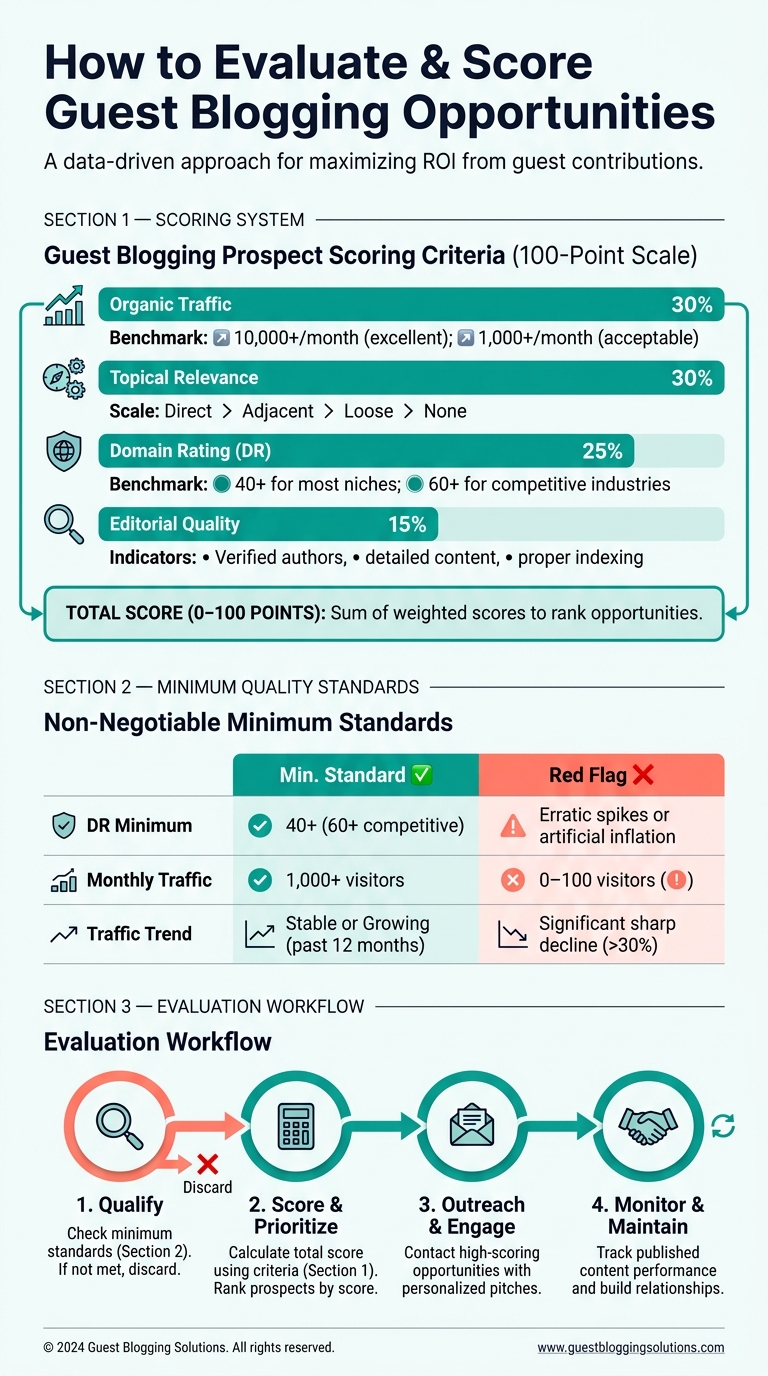
How to Evaluate Guest Blogging Opportunities: Scoring Criteria & Red Flags
Once your prospect list is organized into tiers, the next step is to figure out which sites are worth your time. Careful evaluation helps you separate opportunities that can deliver results from those that might waste your efforts. A high Domain Authority (DA) score alone doesn’t always mean a site is worth pitching. These initial checks lay the groundwork for a deeper content review.
Checking Domain Metrics
Start by examining the numbers. SEO tools and services like Ahrefs or Semrush can help you evaluate three key metrics: Domain Rating (DR), organic traffic trends, and outbound link health. For most niches, a DR of 40+ is a good starting point, while competitive industries may require 60+. When it comes to traffic, 10,000+ monthly organic visitors is a strong benchmark, though niche-specific sites with 1,000+ visitors can still be valuable.
Pay attention to trends, not just static scores. For instance, a site with a DR of 55 that’s been steadily growing over the past year is likely more reliable than one with a DR of 65 that shows a sudden spike - such spikes can indicate underlying problems. To ensure the site is healthy, perform a "site:domain.com" search on Google. If recent articles (especially within the past two weeks) aren’t indexed, the site might have deeper issues that no DA score can compensate for.
"A website with a DR of 60 can be considered untrustworthy by Google, given its recent toxic link profile." - Venchito Tampon, Founder of Link Building Services IO
Assessing Content Relevance and Quality
Once you’ve confirmed the metrics, shift your focus to the content itself. Numbers only tell part of the story. Use what’s called the "Neighbor Test": check if your guest post would naturally fit alongside two existing articles in the same category. If it feels out of place, even a high DR won’t make the site a good match.
Content quality is just as important as relevance. Look for signs of editorial integrity - verified author bios, consistent publishing schedules, and in-depth articles (usually 1,500+ words). On the other hand, sites with anonymous posts or content that’s overly focused on commercial links may prioritize link sales over quality.
"If a site looks great in a metrics tool but weak when a human reads it, trust the human review." - Ana Clara, Rankchase
It’s also essential to consider the site’s audience. For example, if your target audience is based in the United States, confirm that a significant portion of the site’s traffic comes from the U.S.
Creating a Scoring System
After reviewing both the metrics and the content, assign each prospect a score to help rank them. A simple spreadsheet can do the trick. Use weighted scores across four main criteria:
| Criteria | Weight | What to Measure |
|---|---|---|
| Domain Rating (DR) | 25% | 40+ for most niches; 60+ for competitive industries |
| Organic Traffic | 30% | 10,000+/month is excellent; 1,000+ is acceptable |
| Topical Relevance | 30% | Direct > Adjacent > Loose > None |
| Editorial Quality | 15% | Verified authors, detailed content, proper indexing |
Traffic and topical relevance should carry the most weight. A link from a niche site with DR 35 that’s highly relevant to your topic can often outperform one from a DR 70 generalist site. This is because search engines increasingly prioritize topical authority over sheer link volume in 2026. By combining both quantitative and qualitative factors, this scoring system ensures you’re aligned with your guest blogging goals. Rank sites on a 100-point scale and focus your outreach on the top scorers.
Red Flags To Watch for in Guest Blogging Sites
When evaluating guest blogging opportunities, it’s important to stay alert for signs of low-quality or penalized sites. Even with a strong scoring system, some problematic sites might slip through unless you know what to watch for. Spotting these warning signs early can save you time and protect your SEO efforts from harm.
Identifying Spam Signals
One of the clearest indicators of a low-quality site is incoherent niche coverage - domains that publish content on completely unrelated topics like finance, gambling, skincare, and pet care all at once. These are often "guest post farms", created solely to sell links. Another major red flag is a heavily skewed outbound link profile. For example, a site with 200 referring domains but links out to over 3,000 different sites likely operates as a link farm.
Anchor text patterns can also reveal trouble. If recent posts feature excessive exact-match commercial anchors - phrases like "best payday loans" or "buy crypto fast" - it’s a strong signal the site belongs to a bad neighborhood already distrusted by search engines. Similarly, sites that accept submissions without any editorial review should raise concerns, as reputable publications usually provide feedback and maintain strict quality controls.
Finally, always review a site's traffic trends. A sudden drop in traffic is often a sign of a penalty, which could harm your SEO if you associate with the site.
Avoiding Penalized Websites
A dramatic drop in traffic is often a telltale sign of a site being penalized. Even a high DR score can hide deeper issues. One of the most reliable indicators of a penalty is a "cliff-edge" traffic drop - such as when a site’s organic traffic plummets from 50,000 to 2,000 monthly visitors in a single month. This kind of drop usually points to a Google core update penalty.
It’s also important to know that Google’s algorithm now often neutralizes manipulative links without issuing manual penalties. This means you might not see a warning in Google Search Console - your rankings will simply lose their boost without explanation. To catch these cases, compare traffic drops to known Google update dates. For example, the March 2026 Core Update caused sharp declines for sites with irrelevant authority, while the August 2025 Spam Update targeted mass-produced AI-generated content.
A site with a high DR but low organic traffic is another red flag. For instance, in May 2024, Google enforced its Site Reputation Abuse policy against major publishers like Forbes Advisor and CNN Underscored. This resulted in deindexing specific content sections that exploited host site authority without adding value for readers. This marked a turning point in how Google evaluates third-party guest content, even on high-authority platforms.
Setting Minimum Quality Standards
To maintain a strong guest blogging strategy, establish minimum quality standards for every site you consider. These filters should be non-negotiable and serve as your baseline for assessing potential outreach targets:
| Metric | Min. Standard | Red Flag |
|---|---|---|
| DR Minimum | 40+ (60+ for competitive niches) | Erratic spikes or artificial inflation |
| Monthly Traffic | 1,000+ visitors | 0–100 visitors; "zombie" site |
| Traffic Trend | Stable or growing | Cliff-edge drop in a single month |
| Author Bios | Real names with LinkedIn presence | Anonymous or unverifiable personas |
| Outbound Links | Selective and contextually relevant | Links to casinos, CBD, or crypto |
Roughly 19% of sites available for guest posting attract fewer than 100 monthly visitors, meaning they’ve already been devalued by search engines. A site without a real audience offers no SEO value, no matter how impressive its DA score might seem. Use Google’s site:example.com operator to confirm that the site’s pages are indexed. If a high-traffic site has very few indexed pages, it’s best to move on. Consistently applying these quality filters is just as important as targeting high-DA sites, ensuring your guest blogging efforts remain effective over time.
Conclusion: Building Long-Term Success with High-DA Guest Blogging
High-DA guest blogging thrives on consistent effort and careful planning. Success comes from combining targeted outreach, thorough filtering, structured scoring, and vigilant spam checks to ensure your placements are both effective and sustainable.
Considering that 47% of SEO professionals rely on guest posting as their go-to link-building strategy, maintaining a well-researched and regularly updated prospect list can give you a clear competitive advantage.
"In 2026, search engines no longer just reward link volume – they truly reward topical authority and audience trust gained from backlinks." - Venchito Tampon, Founder of Link Building Services IO
This approach underscores the importance of a steady, thoughtful strategy. Aiming for 2–5 high-quality guest posts per month helps build a diverse and natural link profile while avoiding spam-related penalties. By consistently delivering engaging, on-time content, you can turn one-off opportunities into ongoing contributor roles, reducing the need for constant outreach.
To streamline your efforts, align your strategy with trusted quality benchmarks. The Top SEO Marketing Directory is a great resource to explore. It provides a curated list of reliable SEO tools, link-building services, and agencies, helping you find high-authority platforms without the hassle of starting from scratch.
FAQs
What’s the fastest way to confirm a high-DA site isn’t penalized?
The fastest way to check if a high-DA site has been penalized is by analyzing its organic traffic trends using tools like Ahrefs or Semrush. A healthy site typically displays consistent traffic with thousands of monthly visitors. On the other hand, if the traffic is stagnant, nearly nonexistent, or has dropped significantly, it could indicate the site has been penalized or even de-indexed. For reliable outreach opportunities, consider trusted platforms like the Top SEO Marketing Directory.
How can I tell if a guest blogging site has real editorial standards?
Look for indicators of human involvement, such as original, well-researched content, consistent formatting, clear bylines, and detailed author bios. A solid About page, transparent contact information, and clearly stated editorial guidelines also suggest credibility. Signs of engagement, like active comment sections or social media interaction, can further confirm authenticity.
On the flip side, steer clear of websites with repetitive content, vague communication, or inconsistent traffic patterns. These can be red flags for low-quality or automated content.
What should I include in my outreach pitch to high-DA sites?
Your outreach email should feel personal, get to the point quickly, and demonstrate that you've taken the time to understand the site you're pitching to. Start with a clear subject line that grabs attention. Mention a recent article from their site that you genuinely enjoyed - this shows you’re familiar with their content. Then, pitch one strong idea by including a tentative title and a few bullet points outlining the key points or structure of the piece.
To strengthen your pitch, include 1–2 samples of your previous work that align with the site's style or audience. Wrap things up with a straightforward call to action, like asking if they’d be open to your idea or if they have any feedback. Make sure your pitch matches the site’s editorial guidelines in terms of tone, word count, and linking practices. This attention to detail can make all the difference.